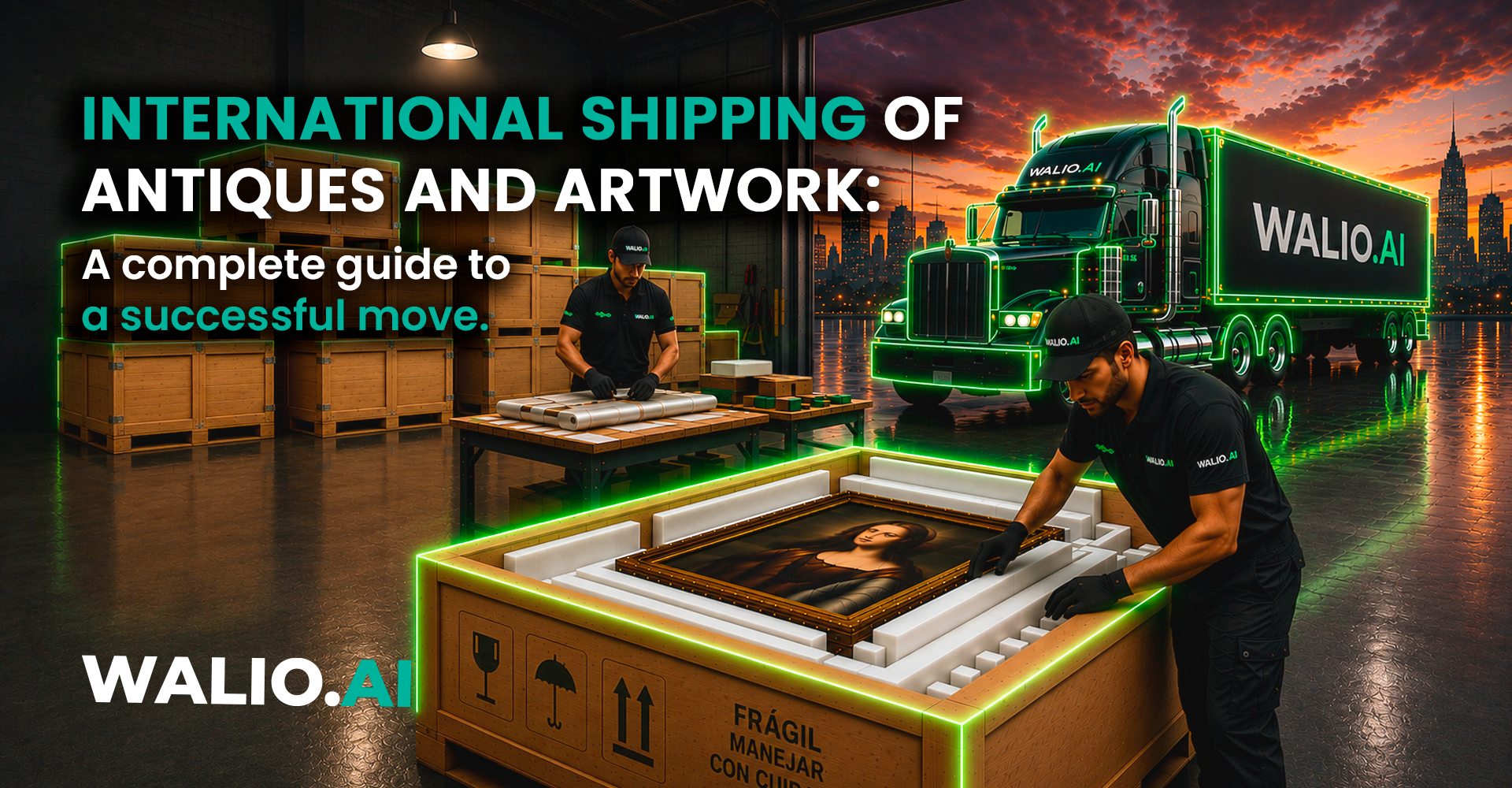
- Specialized, museum-quality packaging is mandatory to protect artworks during international transit.
- Documentation includes certificates of authenticity, professional appraisals, and CITES declarations where applicable.
- Air freight is preferred for high-value pieces (>$10,000), while sea freight works for larger volumes with less urgency.
- Customs regulations vary by country: Colombia requires DIAN, Mexico needs VUCEM, Brazil demands SISCOMEX.
Quick Answer: International shipping of antiques and artworks from the US to South America requires specialized, acid-free packaging, authenticity documentation, and specific customs coordination for cultural goods valued over $2,500 USD.
Shipping artworks and antiques from the United States to Latin America represents one of the most specialized logistical challenges in international freight. Unlike standard commercial cargo, these unique pieces demand specific protocols, ranging from museum-quality packaging to navigating complex cultural regulations in each destination country.
Collectors, galleries, and auction houses operating in the US-South America corridor face unique challenges: differing cultural heritage regulations, specialized documentation requirements, and the critical need to maintain controlled environmental conditions throughout the entire logistics journey.
This guide details the exact procedures, real costs, and specific regulations for each transport mode, from express air freight to consolidated sea freight. Based on thousands of shipments processed through major ports like Miami, Los Angeles, and Houston, we provide best practices to ensure your artworks arrive intact at destinations such as Bogotá, São Paulo, Buenos Aires, and Mexico City.
What Documentation Do You Need for International Art Shipments?
For international artworks, you need a certificate of authenticity, a professional appraisal, a detailed commercial invoice, and potential CITES permits if the piece contains organic materials. Additional documents vary by the South American destination country.
Documentation for international artworks goes beyond standard commercial freight requirements. Customs authorities in the United States and South America have implemented specific controls to prevent the trafficking of cultural heritage and ensure the legitimacy of each piece.
Certificate of authenticity signed by a recognized expert, accredited auction house, or museum institution.
Up-to-date professional appraisal (maximum 12 months old) performed by a certified appraiser for customs purposes.
High-resolution photographs showing the artwork from multiple angles, including signature details and condition.
Sworn declaration from the owner detailing origin, legal provenance, and ownership history.
CITES permits when the artwork contains ivory, tortoiseshell, exotic woods, or materials from protected species.
For shipments valued over $2,500 USD, most South American countries require additional cultural heritage documentation. Colombia requires prior approval from the Ministry of Culture for certain categories, while Mexico needs INAH opinions for pieces with potential archaeological value.
Attention: CITES Regulations
Artworks containing ivory (even antique), tortoiseshell, woods like Brazilian mahogany, or exotic leathers require mandatory CITES permits. The process takes 15-30 business days and must be initiated before packaging. Without these permits, customs authorities can permanently confiscate the artwork.
The specialized commercial invoice must include a detailed technical description: exact dimensions, technique used, materials, historical period, and current condition. This information determines the HS classification and applicable taxes at the destination.
How to Safely Pack Antiques for International Transport?
Professional packaging for antiques uses museum-quality materials: polyethylene foam, acid-free tissue paper, plywood crates, and multi-layer cushioning systems. Each piece requires individual packing with protection against moisture and vibrations.
Specialized packaging makes the difference between an artwork arriving intact and a total loss. Museum-quality materials not only protect during transport but also prevent chemical deterioration that can occur with standard commercial packaging materials.
Plywood crates at least 1/2 inch (12mm) thick with internal reinforcements and metal corner protectors.
100% acid-free materials: tissue paper, neutralized corrugated cardboard, cross-linked polyethylene foams.
Multi-layer cushioning system with silica gel to maintain relative humidity between 45-55%.
Bilingual labeling 'FRAGILE - ARTWORK / FRÁGIL - OBRA DE ARTE' with clear orientation arrows.
Complete photographic documentation of the packaging process for insurance claims.
For paintings and two-dimensional works, the system includes custom-cut foam spacers, rigid honeycomb backings, and face protection with barrier film. Three-dimensional works require custom foam molds that distribute weight evenly.
Pro Tip: Climate Control
Include temperature/humidity data loggers in each crate. These devices record conditions throughout the journey, providing crucial evidence for insurance claims and allowing adjustments for future shipments.
The cost of professional packaging varies by complexity: $300-500 for standard artworks, $800-1,200 for large-format pieces, and up to $2,000 for extremely fragile antiques requiring customized support structures.
Prohibited Materials in Art Packaging
Certain common materials in standard freight are harmful to artworks and can cause permanent damage:
Newspaper (acidic) - causes permanent yellow stains.
Standard bubble wrap - generates condensation and adhesion.
Untreated wood - releases tannic acids that attack pigments.
Conventional adhesive tapes - leave impossible-to-remove residues.
Polyurethane foams - degrade and release corrosive gases.
Air Freight vs. Sea Freight: Which is Better for Art?
Air freight is ideal for valuable artworks (>$10,000) with 3-7 day transit and temperature control, while sea freight works for large volumes with 15-25 day transit and 60% lower costs, but greater exposure to environmental conditions.
The choice between air freight and sea freight for artworks depends on critical factors: the value of the piece, urgency, environmental sensitivity, and available budget. Each mode offers specific advantages according to international transport standards.
Air Freight - Premium
- Transit: 3-7 days door-to-door
- Climate control in pressurized holds
- Minimal, specialized handling
- Ideal for artworks >$10,000 USD
- Real-time GPS tracking
Sea Freight - Economical
- Transit: 15-25 days depending on route
- 60% more economical than air freight
- No size/weight restrictions
- Better for large volumes
- Climate-controlled containers available
For extremely sensitive works (watercolors, pastels, ancient parchments), air freight offers decisive advantages: less exposure time to environmental variations, climate-controlled holds, and handling by specialized personnel on major airlines like FedEx and DHL.
 Miami
(MIA)
Miami
(MIA)
 Bogotá
(BOG)
Miami
(USMIR)
Cartagena
(COCTA)
Bogotá
(BOG)
Miami
(USMIR)
Cartagena
(COCTA)
Sea freight LCL works excellently for galleries consolidating multiple artworks in regular shipments. Reefer (refrigerated) containers maintain a constant temperature of 18-22°C (64-72°F) and controlled humidity, ideal conditions for most artistic techniques.
Compare All Your Shipping Options
Air freight, sea freight, courier express - get quotes for all modes in seconds.
Get a Free Quote →How Much Does it Cost to Ship Antiques from the US to South America?
Costs vary by mode: air freight $8-15 per kg with a $500 minimum, sea freight $2,500-4,500 for a 20ft container. Additional services like specialized packaging add $300-800, and insurance is 0.3-0.8% of the declared value.
The real costs of specialized freight for artworks include multiple components that do not appear in standard commercial cargo quotes. Price transparency is critical for accurately budgeting cultural import projects.
Average rate for specialized air freight of artworks, including careful handling and climate-controlled holds on US-South America routes.
Detailed Cost Breakdown by Mode
Specialized Air Freight:
Basic freight: $8-15 USD per kilogram (minimum $500)
Fuel Surcharge: 15-25% additional depending on fluctuations
Security Fee: $35-50 per shipment for specialized screening
Premium handling: $150-300 for art handling
Documentation: $75-125 for customs processing
Consolidated Sea Freight (LCL):
Ocean freight: $150-250 USD per cubic meter
THC (Terminal Handling Charges): $125-200 per shipment
BAF (Bunker Adjustment Factor): 10-15% of basic freight
Bill of Lading (B/L): $45-65 per document
Specialized consolidation: $100-180 additional
Los Angeles
(USLAX)
 Veracruz
(MXVER)
Miami
(USMIR)
Veracruz
(MXVER)
Miami
(USMIR)
 Santos
(BRSTS)
Santos
(BRSTS)
Additional Specialized Services:
Museum-quality packaging: $300-800 depending on complexity
Fine Arts insurance: 0.3-0.8% of declared value
White glove delivery: $200-500 at destination
Climate-controlled storage: $8-15 per day/m³
Professional installation: $150-400 per artwork
Factors Impacting Final Cost
Prices fluctuate significantly based on specific art market variables. Artworks with unusual dimensions, special temperature requirements, or remote destinations can increase base costs by 40-80%.
Dimensions: Artworks >8.2 feet (2.5m) require mandatory charter or sea freight.
Weight: Sculptures >660 lbs (300kg) need special handling equipment.
Fragility: Ceramics, glass require 100% customized packaging.
Value: Artworks >$50,000 trigger additional security protocols.
Urgency: Express service can triple standard rates.
Instant Quote With No Surprises
Transparent pricing with all costs included - no more quotes arriving days later.
See Real Prices →What Customs Regulations Apply in Each South American Country?
Each country has specific regulations: Colombia requires DIAN registration and potential Ministry of Culture approval, Mexico needs a VUCEM declaration, and Brazil demands a SISCOMEX license. Values over $2,000 generally require a customs broker.
Customs regulations for artworks in South America have evolved significantly in recent years. Each country implements specific controls to protect its cultural heritage and regulate the import of artistic goods according to current international regulations.
Colombia - Specialized DIAN Process
Colombia operates one of the most structured systems for cultural imports. DIAN requires pre-validation for artworks over $2,000 USD and coordination with the Ministry of Culture for certain categories.
DIAN Registration - Advance declaration with specific HS classification (97.01-97.06).
Ministerial Evaluation - Artworks >$5,000 require approval from the Ministry of Culture.
Customs Broker - Mandatory for values >$2,000, must specialize in cultural goods.
Physical Inspection - 85% of artworks undergo detailed inspection at the port.
Attention: Colombia Timelines
The Colombian customs process takes 7-12 business days for artworks. Initiate DIAN documentation 15 days before shipment to avoid port delays and storage costs ($45 USD daily).
Mexico - Digitalized VUCEM System
Mexico has completely modernized its process through the VUCEM Single Window. Artworks require pre-classification and potential intervention from INAH for pieces with potential archaeological value.
VUCEM declaration with specialized A1 customs entry.
Non-archaeological heritage certification (INAH) for pre-1900 antiques.
Authorized customs broker specializing in art and culture mandatory for >$1,500 USD.
16% VAT applicable - no exemptions for artistic imports.
Documentary review: 3-5 days, physical inspection: 24-48 additional hours.
Brazil - SISCOMEX Complexity
Brazil maintains the most rigorous process for cultural goods in South America. The SISCOMEX system integrates multiple institutions and requires prior licenses for most artistic categories.
Import License (LI) processed in SISCOMEX 30-45 days in advance.
IPHAN Classification for works of potential national cultural interest.
Mandatory Certificate of Origin - consular process in the US.
Import Tax: 20% + state ICMS + PIS/COFINS.
Specialized customs dispatcher - official list available from RFB.
 Argentina
AFIP
Argentina
AFIP
Peru and Chile - Simplified Processes
Peru and Chile offer the most agile processes for artistic imports, with digitalized systems and less institutional intervention for contemporary artworks.
Peru (SUNAT): Digital declaration, 3-5 day process, optional broker <$3,000.
Chile (Aduana): SIDi system, 2-4 days, VAT exemption for original art.
Both countries: Selective inspection (30% probability vs. 85% in Colombia).
Standard documentation sufficient - no ministerial pre-approvals required.
Yes, artworks require specialized 'Fine Arts' insurance that covers damage, theft, and loss during transit. Standard cargo insurance does not adequately cover the true value of antiques and artworks.
The customs process takes between 3-10 business days depending on the country. Colombia and Mexico process faster (3-5 days), while Brazil and Argentina may require 7-10 days due to additional cultural heritage verifications.
Yes, oil paintings can be shipped by air freight with specialized packaging and temperature control. A non-hazardous materials declaration and packaging that prevents contact with other chemicals during the flight are required.
With adequate Fine Arts insurance, damages are covered at the declared value. You must document the damage immediately, notify the insurer within 48 hours, and retain all packaging materials for investigation.
No, the United States generally does not require special permits to export private antiques. However, you must verify that they are not stolen cultural heritage and comply with CITES regulations if they contain protected organic materials.
The successful shipment of artworks from the United States to South America requires meticulous planning, specialized documentation, and careful selection of logistics partners with proven experience in cultural freight. The difference between a successful shipment and a costly loss lies in the details: from the quality of packaging materials to the precision in HS classification.
Collectors and galleries working in this corridor have learned that price and timeline transparency are critical for budgeting art projects. Quotes that arrive days after the initial request, with hidden costs appearing at the destination, are incompatible with the modern dynamics of the art market.
Ready to ship your next artwork with the confidence it deserves? At ship.walio.ai, get instant quotes for air freight, sea freight, and specialized courier services – compare real prices in seconds, without phone calls or endless waiting. Join the galleries already trusting modern technology for their most valuable shipments.