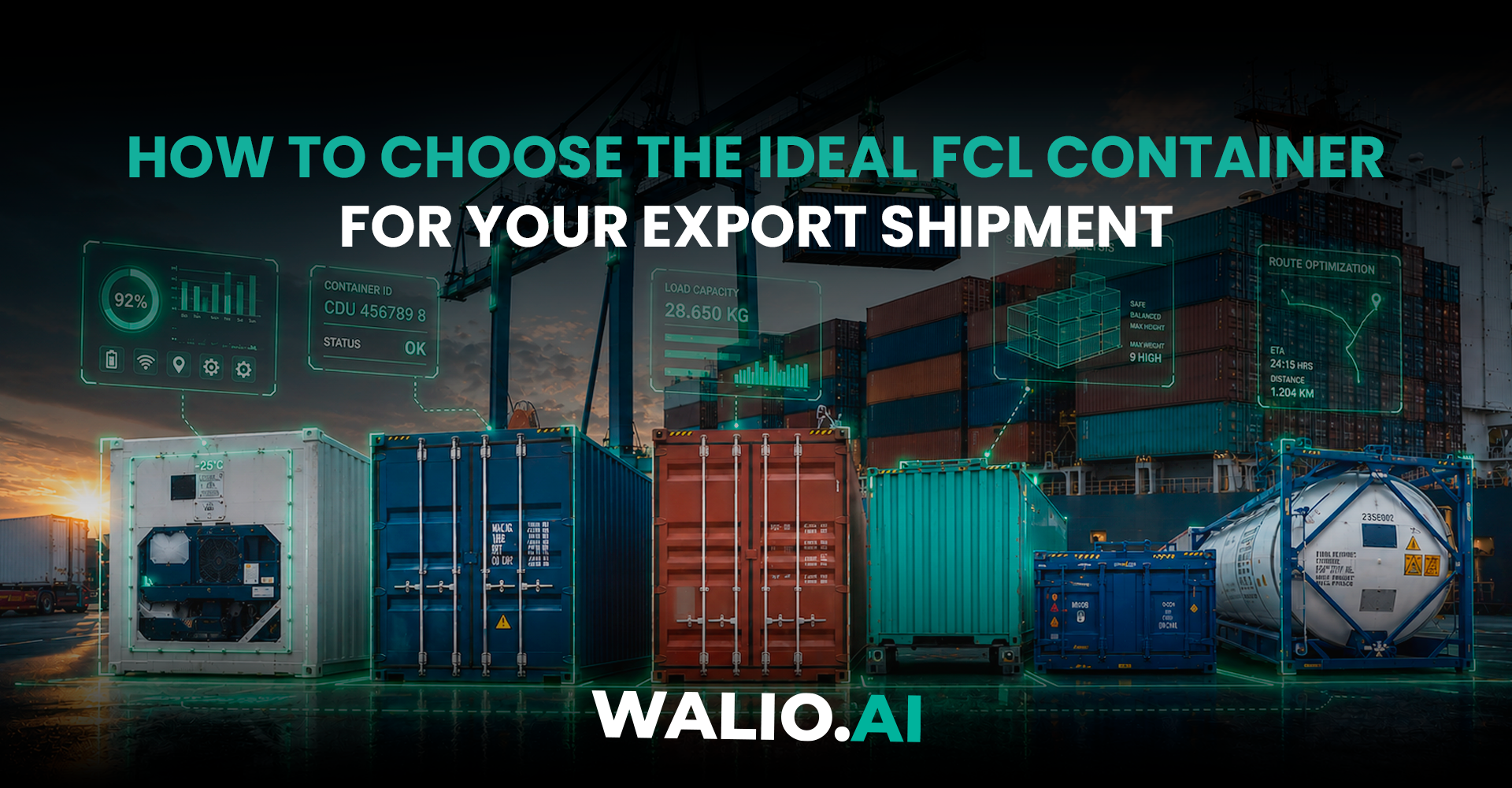
- FCL containers available in 20' (33m³), 40' (67m³), and 40'HC (76m³) with weight limits of 26-28 metric tons
- Choose container size based on cargo density: bulky goods require 40'HC, while heavy loads optimize with 20' containers
- FCL costs from Latin America: $2,800-$6,000 depending on route, plus local and customs charges
- Critical documentation includes B/L, commercial invoice, and ISF for USA with specific filing deadlines
Quick Answer: FCL containers are available in standard 20', 40', and 40'HC sizes, offering volumetric capacities ranging from 33 cubic meters up to 76 cubic meters, with weight limits typically between 28-30 metric tons depending on the chosen container type and specific carrier.
Selecting the correct FCL container is crucial for optimizing costs and efficiency in exports from Latin America. Ocean carriers like Maersk Ocean Transport offer standard containers that vary significantly in volumetric capacity and weight limits.
Exporters often underestimate the importance of choosing the right container size, which can lead to 15-25% cost overruns or inefficient use of cargo space. This practical guide will help you make informed decisions based on your specific merchandise characteristics.
What are the Standard Types and Dimensions of FCL Containers?
Quick Answer: Standard FCL containers include 20' (33 m³), 40' (67 m³), and 40'HC (76 m³), each with specific weight limits and internal dimensions that dictate which goods can be transported most efficiently.
The global ocean freight market primarily utilizes three main types of FCL containers, each designed for different cargo needs based on volume and weight.
20' Container (Twenty-foot Equivalent Unit)
- Internal Dimensions: 5.90m x 2.35m x 2.39m
- Volumetric Capacity: 33.2 cubic meters
- Maximum Cargo Weight: 28,230 kg (28.2 metric tons)
- Tare Weight: Approximately 2,300 kg
- Door Dimensions: 2.34m width x 2.28m height
40' Container (Forty-foot Equivalent Unit)
- Internal Dimensions: 12.03m x 2.35m x 2.39m
- Volumetric Capacity: 67.7 cubic meters
- Maximum Cargo Weight: 26,700 kg (26.7 metric tons)
- Tare Weight: Approximately 3,800 kg
- Door Dimensions: 2.34m width x 2.28m height
40' High Cube Container (40'HC)
The 40-foot High Cube container is the most popular option for exports from Latin America, especially for manufactured goods and consumer products.
Internal Dimensions: 12.03m x 2.35m x 2.70m
Volumetric Capacity: 76.4 cubic meters
Maximum Cargo Weight: 26,700 kg (26.7 metric tons)
Additional Height: 30.5 cm (1 foot) extra versus standard container
Door Dimensions: 2.34m width x 2.58m height
Logistics Expert Tip
For textiles, furniture, or appliances from Colombia and Mexico, the 40'HC optimizes space utilization. Its additional height allows for stacking up to 15% more merchandise compared to a standard 40' container.
How to Choose the Right FCL Container for Your Cargo?
Quick Answer: Choosing the right FCL container depends on your cargo's limiting factor: whether it's weight per volume (kg/m³), product type, or destination route. The goal is to optimize costs by selecting the size that best balances capacity and price.
The primary criterion for selecting the container type is determining whether your cargo is limited by weight or by volume. This decision directly impacts the cost efficiency of your export operation.
Calculating Cargo Density (Limiting Factor)
The density of your merchandise determines which container best optimizes your investment in ocean freight.
Calculate density: Total Weight (kg) ÷ Total Volume (m³) = kg/m³
Compare with limits: 20' = 850 kg/m³ | 40' = 394 kg/m³ | 40'HC = 349 kg/m³
Choose container: Where your density is closest to the limit without exceeding it.
Heavy Loads (>500 kg/m³)
- Ideal Products: Coffee, sugar, minerals, metals
- Recommended Container: 20' to optimize weight vs. cost
- Advantage: Lower cost per metric ton transported
- Consideration: Verify destination weight limits
Bulky Loads (<300 kg/m³)
- Ideal Products: Textiles, furniture, plastics, paper
- Recommended Container: 40'HC to maximize volume
- Advantage: Better utilization of cubic space
- Consideration: Evaluate destination handling
Special Considerations by Destination Route
Destination port and inland infrastructure restrictions affect container selection, especially on routes from Latin America to emerging markets.
Destination Weight Restrictions
In several Latin American countries, the maximum permissible road weight is 28-30 total metric tons, including the truck. Always verify local regulations before loading 40' containers to maximum weight.
How Much Does It Cost to Ship FCL Containers from Latin America?
Quick Answer: FCL costs from Latin America typically range from $1,800-$6,000 depending on the route, container size, and season. Routes to the United States start from $2,800 (20'), and to Europe from $3,500, plus local and customs charges.
FCL container prices fluctuate based on multiple market factors. The rates presented here reflect current market conditions according to data from FreightWaves Logistics.
Key Routes from Latin America
 Cartagena
(COCTA)
Cartagena
(COCTA)
 Miami
(USMIR)
Miami
(USMIR)
 Veracruz
(MXVER)
Veracruz
(MXVER)
 Valencia
(ESVLC)
Valencia
(ESVLC)
FCL prices experience significant seasonal fluctuations, with peaks during October-December due to holiday demand and lows in February-March.
Breakdown of Additional Costs
Basic ocean freight typically accounts for only 60-70% of the total cost. Additional expenses include port charges, documentation, and customs services.
THC (Terminal Handling Charge): $150-$300 per container
Documentation and B/L: $75-$150 per shipment
ISF Filing (USA): $50-$100 per container
Certificates of Origin: $25-$75 depending on destination country
Cargo Insurance: 0.1-0.3% of CIF value
What Customs Regulations Apply to FCL Containers?
Quick Answer: FCL shipments require specific documentation, including a Bill of Lading, commercial invoice, packing list, and compliance with regulations like ISF in the USA or DUA in Europe, all with critical filing deadlines.
Compliance with international customs regulations is essential to avoid costly delays and penalties. Authorities like CBP Export Guidelines have increased controls over the last decade.
Mandatory Documentation for FCL
Bill of Lading (B/L): Title of ownership and receipt of goods
Commercial Invoice: Declared value and detailed description
Packing List: Specific contents per package/box
Certificate of Origin: For applying trade agreements
Phytosanitary Certificates: Agricultural and food products
ISF (Importer Security Filing) for the United States
The CBP 10+2 program requires specific information before the vessel departs from the origin port. Non-compliance results in penalties of $5,000-$10,000 per container.
Filing Deadline: 24 hours before vessel departure from origin port
Required Information: 10 importer elements + 2 carrier elements
Responsibility: Importer of Record or their authorized customs broker
Updates: Changes must be reported immediately
Critical HS Code Classification
An incorrect HS Code classification can lead to 100% container inspections, 5-10 day delays, and penalties for undervaluation. Use specific 10-digit classifications for the USA.
Specific Regulations by Country of Origin
Each Latin American country has specific customs procedures that exporters must comply with before FCL shipment.
Colombia (DIAN)
- DEX (Export Declaration): Mandatory 24h prior
- Exporter RUT: Updated tax registration
- INVIMA Authorization: Food and cosmetic products
- ICA Approval: Agricultural products
Mexico (SAT)
- Export Pedimento: Through customs broker
- CFDI for Export: Digital tax receipt
- Annex 22: For products with special regulations
- SENASICA Phytosanitary Certificate: Agricultural products
How to Get Quotes and Book FCL Containers Online?
Quick Answer: Online FCL quotes allow instant comparison of prices from multiple carriers, with tools like ship.walio.ai displaying all-inclusive costs and real-time availability for immediate booking.
The digitalization of ocean freight has transformed the FCL quoting process. Modern platforms eliminate the traditional 24-48 hour wait for freight forwarder prices.
Required Information for Accurate Quotes
Origin and Destination: Specific cities, not just countries
Type of Merchandise: General description and HS Code if available
Weight and Volume: Exact or realistic estimated data
Merchandise Value: For calculating insurance and customs duties
Estimated Date: To consider space availability
Advantages of Instant Digital Quoting
Platforms like ship.walio.ai offer complete transparency in pricing and conditions, eliminating surprises in the import process.
Traditional Quoting
- Request by email or phone
- Wait 24-48 hours for response
- Partial prices without local charges
- Case-by-case negotiation
- Manual documentation and calls
Digital Quoting
- Instant results in seconds
- Side-by-side comparison of options
- Transparent all-inclusive pricing
- Online booking with one click
- Complete digital tracking
FCL vs LCL Cost Optimization
Use online calculators to automatically compare FCL vs LCL based on your specific volume. The typical break-even point is between 15-20 cubic meters, but it varies by route and season.
Compare FCL Rates in Real-Time
Get instant quotes for 20', 40', and 40'HC containers from any Latin American port.
Calculate Shipping Cost →Booking Process and Confirmation
Once the optimal FCL option is selected, the booking process should include immediate space confirmation and booking numbers to coordinate with suppliers.
Select Rate: Compare time vs. cost options
Confirm Details: Verify origin, destination, and container type
Provide Information: Exporter and importer details
Receive Booking: Booking number and cut-off dates
Coordinate Delivery: Schedule empty container pickup
The 40' High Cube container has an additional 30 cm (1 foot) of height (2.9m vs 2.59m), offering 76.4 m³ of capacity versus 67.7 m³ for the standard 40' container. This allows for transporting bulkier merchandise while maintaining the same 26-28 metric ton weight limit.
A 20' FCL container can carry up to 28 metric tons of maximum gross weight, including the empty container's tare weight. The net useful load is approximately 25-26 metric tons, depending on the specific container's weight.
For exports from Latin America, the 40'HC container is ideal for low-weight, high-volume products like textiles or processed foods. For heavy commodities such as coffee or minerals, the 20' container optimizes costs by maximizing the use of the weight limit.
You need FCL when your cargo occupies more than 15-20 cubic meters or exceeds 10 metric tons. If you have less volume, LCL is more economical. Use online calculators like ship.walio.ai to compare exact FCL vs LCL costs for your specific route.
The cost of an FCL container from Colombia to the United States ranges between $2,800-$4,200 for a 20' and $3,500-$5,800 for a 40', depending on the origin and destination port. Prices include basic ocean freight but exclude local and customs charges.
Optimizing FCL container selection requires considering multiple variables: merchandise type, destination route, regulatory restrictions, and cost objectives. Businesses that master these concepts achieve 15-25% savings in their export operations.
Implementing digital quoting tools like ship.walio.ai eliminates uncertainty in pricing and transit times. With access to transparent rates from multiple carriers, exporters can make informed decisions in real-time.
Ready to optimize your FCL shipments from Latin America? Get instant quotes comparing 20', 40', and 40'HC containers at ship.walio.ai. No phone calls, no waiting – just transparent pricing and immediate booking to grow your export business.