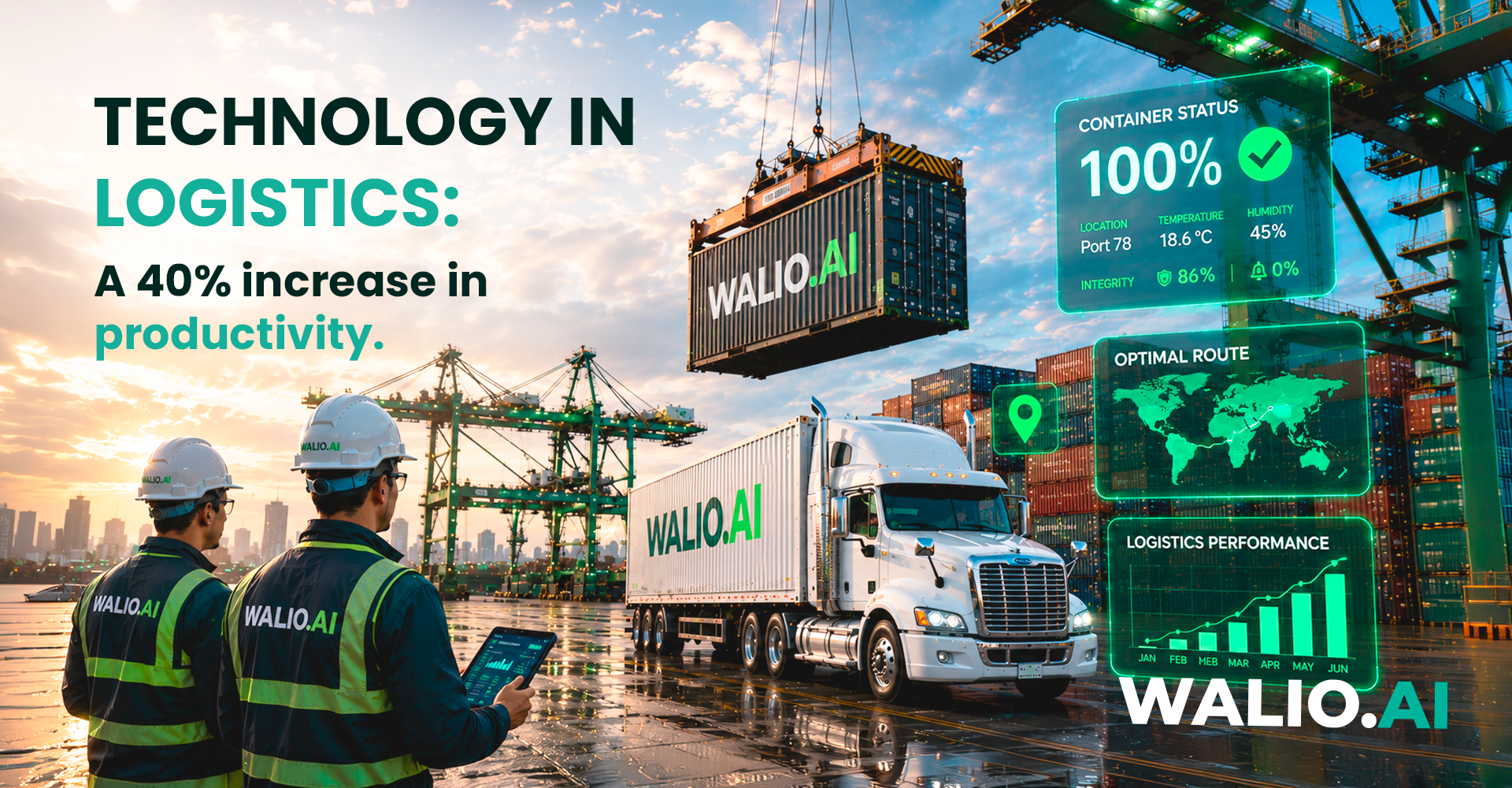
- AI and automation can boost logistics productivity by up to 40% through route optimization and demand forecasting
- Automated WMS/TMS systems cut operational costs by 15-25% and eliminate manual errors
- Digital quoting platforms like ship.walio.ai save 40% of procurement time with transparent pricing
- Real-time visibility with IoT reduces losses by 90% and improves customer satisfaction
Quick Verdict: Logistics technology can boost productivity by up to 40% through process automation, AI-driven route optimization, real-time cargo visibility, and reduced operational costs. Digital tools eliminate manual errors and speed up quoting.
The logistics industry has seen an accelerated digital transformation in recent years. Companies adopting advanced technology report significant increases in productivity and reduced operational costs. In 2026, the gap between digital and traditional businesses is more apparent than ever.
Data from FreightWaves Market Data shows that companies with integrated tech solutions outperform traditional competitors by considerable margins. Automation, artificial intelligence, and digital platforms are not luxuries—they are competitive necessities.
This article analyzes specific technologies that drive the biggest impact on logistics productivity, with concrete ROI examples and successful implementation cases in Latin American businesses.
How Does Artificial Intelligence Revolutionize Logistics Planning?
Quick Verdict: AI in logistics enables demand forecasting with 95% accuracy, automates route optimization, and cuts operational costs by up to 20%. Algorithms analyze historical patterns and real-time conditions for better decision-making.
Artificial intelligence has completely transformed modern logistics planning. Machine learning algorithms process millions of data points to generate accurate predictions and optimize operations in real-time.
Companies implementing AI report dramatic improvements in operational efficiency. Intelligent systems analyze demand patterns, weather conditions, traffic, and carrier availability to make optimal decisions automatically.
AI algorithms can predict demand with up to 95% accuracy, compared to 60-70% for traditional methods.
Machine Learning Algorithms for Demand Forecasting
AI systems analyze historical sales data, seasonal trends, and external factors to generate precise forecasts. This technology allows businesses to maintain optimal inventory levels without overstocking or stockouts.
Seasonal pattern analysis: Automatic identification of demand peaks and valleys
Integration of external data like weather, events, and economic trends
30% reduction in dead stock and inventory shortages
Automatic optimization of reorder points and quantities
Route Optimization with Geospatial AI
Optimization algorithms consider multiple variables simultaneously: distance, traffic, fuel costs, vehicle restrictions, and delivery windows. The result is maximum efficiency for each planned route.
Pro Tip
Implement AI gradually: start with demand forecasting for high-turnover products before expanding to your entire operation. ROI is evident in 3-6 months.
Colombian companies that implemented AI route optimization report a 15% reduction in fuel costs and a 25% improvement in delivery punctuality. The technology considers local conditions like protests, car-free days, and municipal restrictions.
Which Automation Systems Reduce Operational Costs the Most?
Quick Verdict: Automated WMS and Transportation Management Systems (TMS) offer the highest ROI, cutting operational costs by 15-25%. Automating customs documents can save a mid-sized company up to $50,000 annually.
Logistics automation systems generate immediate and sustainable savings. Technology investments are quickly recouped through reduced manual errors and optimized critical processes.
According to industry studies, companies with automated systems process 60% more orders with the same staff. Eliminating repetitive tasks frees up human resources for higher-value strategic activities.
WMS (Warehouse Management)
- Automatic optimization of picking locations
- Intelligent slotting management by rotation
- 40% reduction in preparation time
- Real-time inventory control
TMS (Transportation Management)
- Automatic selection of the most economical carrier
- Load optimization and consolidation
- 20% reduction in transportation costs
- Integrated tracking with customers
WMS vs. TMS: Which to Prioritize?
The decision depends on your specific business model. Companies with complex warehouse operations gain higher ROI with WMS, while multi-modal operations benefit more from integrated TMS.
Evaluate your current operation: Identify the main bottleneck (warehouse vs. transportation)
Calculate implementation costs: WMS from $2,000/month, TMS from $1,500/month
Project expected ROI: Typically 12-18 months to recover investment
Customs Process Automation
Automated customs documentation eliminates costly errors and speeds up clearance. Systems automatically generate commercial invoices, packing lists, and customs declarations with 99% accuracy.
Critical Compliance
Errors in customs documentation can lead to fines of $5,000-$25,000. Automation reduces this risk to virtually zero, according to ICC Incoterms 2020.
How to Get Instant Quotes and Optimize Freight Costs?
Quick Verdict: Digital quoting platforms allow you to compare FCL, LCL, and air freight prices in seconds, not days. Tools like ship.walio.ai offer full cost transparency with no hidden fees, saving 40% of procurement time.
Traditional freight procurement consumes valuable time. Businesses lose days waiting for email quotes while business opportunities vanish. Digital platforms have completely revolutionized this process.
Real-time freight calculators integrate rates from multiple carriers, fuel surcharge updates, and space availability. The result is instant, informed decisions to maximize profitability.
 Miami
(USMIR)
Miami
(USMIR)
 Cartagena
(COCTA)
Cartagena
(COCTA)
Digital Calculator vs. Traditional Methods
The efficiency difference is dramatic. While traditional brokers require 24-72 hours to generate quotes, digital platforms offer answers in 5 seconds with comparable accuracy.
Traditional Method
- Email multiple brokers (2-3 day response)
- Phone calls for negotiation
- Hidden fees discovered later
- No visibility of alternatives
Digital Platform
- Instant quote in 5 seconds
- Side-by-side comparison of options
- Full cost transparency
- Direct booking without intermediaries
Eliminating Hidden Fees
Surprises in final billing destroy budgets and trust. Transparent platforms show all charges upfront: fuel surcharge, security fee, documentation charges, and handling fees.
Procurement Tip
Always request a detailed cost breakdown. "All-inclusive" rates can hide 15-25% surcharges compared to transparent, itemized quotes.
Compare Transparent Rates
No surprises, no hidden fees. Real prices from the first click.
See Real Prices →How Does Real-Time Visibility Improve Inventory Control?
Quick Verdict: Real-time tracking via IoT and GPS allows 24/7 cargo monitoring, reduces losses by up to 90%, and optimizes inventory levels. Automatic alerts prevent disruptions and improve end-customer satisfaction.
Full supply chain visibility eliminates the logistics "black box." IoT sensors and GPS provide continuous data on location, temperature, humidity, and cargo conditions throughout the international transit.
According to the World Shipping Council, companies with real-time tracking report 90% fewer cargo losses and 35% higher customer satisfaction due to proactive communication.
IoT sensors transmit data every 15 minutes throughout the journey, allowing immediate intervention for issues.
Implementing IoT Sensors in Cargo
Modern IoT devices monitor multiple parameters simultaneously. For pharmaceuticals or food, temperature control is critical to maintaining an intact cold chain.
Temperature monitoring: Automatic alerts if allowed ranges are exceeded
Impact detection and unauthorized handling
Geofencing for notifications upon entering/exiting specific zones
Long-lasting battery (30+ days for ocean transits)
Centralized Control Dashboard
Dispersed information does not generate value. Integrated dashboards consolidate data from multiple sources into a unified view, enabling rapid, data-driven decision-making.
Real-time KPIs
- Average transit time per route
- On-time delivery percentage
- Cost per mile/container
- Customer satisfaction index
Automatic Alerts
- Delays exceeding 2 hours
- Unauthorized route deviations
- Temperature issues in sensitive products
- Early arrival at destination
Critical Integration
Isolated tracking systems create data silos. Ensure your platform integrates with ERP, WMS, and customer communication systems for maximum value.
What Emerging Technologies Will Transform Logistics in 2026?
Quick Verdict: Blockchain for total traceability, drones for last-mile delivery, autonomous vehicles for ground transport, and digital twins for logistics simulation are the technologies set to revolutionize the industry in 2026, promising 50% greater efficiency.
The logistics technology landscape is evolving rapidly. Emerging technologies promise radical transformations in efficiency, costs, and operational capabilities over the next 2-3 years.
Companies that adopt these technologies early gain significant competitive advantages. The key is identifying which technologies will generate the greatest impact for your specific business model.
Pilot studies show that combining blockchain, AI, and IoT can increase logistics efficiency by up to 50% by 2027.
Blockchain in Supply Chain: Immutable Traceability
Blockchain creates immutable records of every transaction in the supply chain. For pharmaceuticals, food, and luxury goods, complete traceability from origin to end-consumer is increasingly regulated and demanded.
Complete traceability: Immutable record from manufacturing to delivery
Smart contracts for payment automation and compliance
95% reduction in counterfeit or adulterated products
Automatic audits for regulatory compliance
Preparing for Early Adoption
Successful implementation requires careful evaluation of current infrastructure and team training. Leading companies start with pilot projects before a full rollout.
Evaluate current infrastructure: Identify technology gaps and integration requirements
Train key teams: Invest in training before implementing new technologies
Start with pilots: Test on specific routes/products before scaling
Establish partnerships: Collaborate with experienced technology providers
Implementation Strategy
Don't adopt all technologies simultaneously. Prioritize based on operational impact: automation first, AI second, blockchain/IoT once the foundation is solid.
Technology That Works Today
Experience instant AI-powered quotes — no waiting, no hassle.
Try the Technology →Yes, logistics technology can boost productivity by 25-40% according to industry studies. Companies implementing digital solutions report a 60% reduction in document processing time and 30% fewer operational errors.
The most effective technologies include AI for demand forecasting, IoT for real-time tracking, blockchain for traceability, and TMS systems for transportation management. These integrated tools can cut logistics costs by up to 15%.
Automation reduces costs by eliminating manual errors (20% savings), optimizing routes (15% fuel reduction), and accelerating processes (30% less administrative time). Typical ROI is achieved in 12-18 months.
Not necessarily. Cloud-based solutions have low initial investment (from $500/month) and offer fast ROI. Many businesses recoup their investment in 6-12 months through operational savings and increased efficiency.
Real-time visibility enables proactive decision-making, reduces delays by up to 25%, improves customer communication, and optimizes inventory. Companies report 90% higher customer satisfaction with transparent tracking.
Logistics technology is not the future—it's the present. Companies adopting digital solutions today build sustainable competitive advantages for years to come.
The difference between successful businesses and those struggling to survive lies in the speed of technology adoption. Every day of delay represents lost opportunities and unnecessary costs that directly impact profitability.
Ready to transform your logistics operation? At ship.walio.ai, you can immediately experience the power of technology: instant FCL, LCL, air, and courier quotes with full price transparency. No calls, no waiting, no surprises—just immediate results that boost your productivity from the first use.