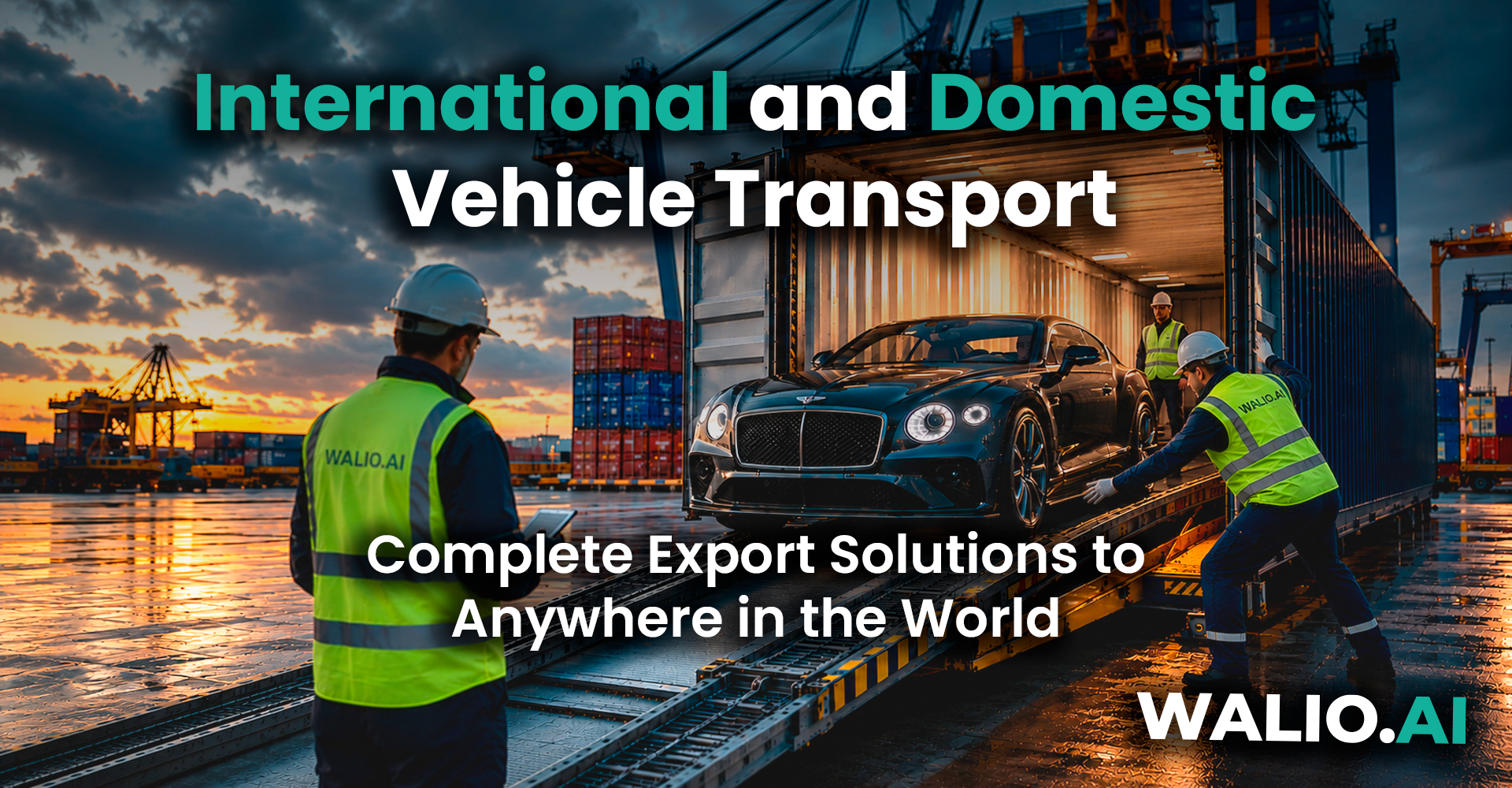
- Vehicles require specific documentation: title, commercial invoice, and export certificate
- Available modes: RoRo (Roll-on/Roll-off), container, and air freight for luxury vehicles
- Costs range from $1,200 USD for standard cars to $8,000 USD for heavy machinery
- Delivery times: 2-6 weeks by ocean, 7-14 days by air depending on destination
Quick Answer: International vehicle shipping requires specific documentation, specialized insurance, and certified operators. Costs range from $1,200 USD for small cars to $8,000 USD for heavy machinery, with transit times of 2-6 weeks depending on destination and mode.
International vehicle shipping has become a critical need for car dealers, collectors, and businesses moving automobiles, motorcycles, and heavy machinery to global destinations. Whether you need to export a classic car to Europe, send construction equipment to Latin America, or relocate a commercial fleet, understanding the available shipping modes and customs processes is essential for a successful operation.
The specialized vehicle freight forwarding industry handles over 4.2 million units annually, according to FIATA Freight Forwarding data, with sustained 8% annual growth. However, each shipping mode presents unique challenges in terms of documentation, costs, and delivery times that must be carefully evaluated.
In this article, we explore the three main modes of international vehicle shipping, specific documentation requirements, updated cost structures for 2026, and strategies to optimize both time and budget in your global export operations.
What Shipping Modes Are Available for International Vehicle Transport?
Quick Answer: There are three main modes: RoRo (Roll-on/Roll-off) for standard cars, container shipping for modified or luxury vehicles, and air freight for urgent deliveries. Each mode has different costs and transit times depending on the destination.
Selecting the correct mode depends on the vehicle's value, delivery urgency, and final destination. Each option offers specific advantages in terms of cost, security, and transit time.
RoRo Shipping (Roll-on/Roll-off)
Ideal for standard cars and motorcycles. Vehicles are driven directly onto the vessel and secured on specialized decks. It's the most economical option, with costs ranging from $1,200 to $2,500 USD depending on the destination.
- Fast loading/unloading process (2-4 hours)
- Lower insurance cost per unit
- Availability on major global routes
- Ideal for commercial fleets
Enclosed Container Shipping
Maximum protection for luxury, modified, or classic vehicles. The car is secured inside a 20ft or 40ft container, offering protection against weather elements and handling. Costs range from $2,800-$4,500 USD.
- Complete protection against weather and handling
- Additional security with customs seal
- Option to ship additional spare parts
- GPS tracking throughout the journey
Air Freight for Premium Vehicles
Reserved for high-end vehicles, prototypes, or urgent deliveries. Costs range from $8,000-$15,000 USD depending on the vehicle's weight and dimensions. Transit time is reduced to 7-14 days depending on the destination and cargo flight availability.
Pro Tip
For vehicles valued over $75,000 USD, enclosed container shipping offers the best cost-benefit ratio versus air freight, especially on routes to Europe and Asia-Pacific.
Continental Land Freight
For movements within the American continent, specialized land freight offers flexibility and competitive costs. From the United States to Mexico, Central America, and even Colombia, transit times range from 5-12 business days with costs from $800-$2,200 USD per unit.
What Documentation and Customs Procedures Does Your Vehicle Need?
Quick Answer: Vehicle export requires a lien-free certificate of title, commercial invoice, export form 7525-V, and certificate of origin. Additionally, some countries require extra inspections and emissions certificates based on local regulations.
Customs documentation for vehicles is more complex than general cargo due to specific safety, emissions, and vehicle identification regulations. An error in documentation can result in weeks of delays or costly rejections.
Mandatory Export Documents
Original certificate of title, free of liens or outstanding financing
Commercial invoice with declared value and complete technical specifications of the vehicle
CBP Form 7525-V for used vehicles (required by US Customs and Border Protection)
Manufacturer's certificate of origin to leverage trade agreements (USMCA, etc.)
Bill of Sale if the exporter is not the original owner
Notarized Power of Attorney if acting as the owner's representative
Additional Documents by Destination Country
Each market has specific requirements that must be verified before shipment. According to CBP Export Guidelines, 23% of vehicle delays are due to incomplete destination country documentation.
EPA Emissions Certificate - Required for Europe and Australia
Phytosanitary inspection - Mandatory for agricultural or construction vehicles
Certificate of conformity - Necessary to meet local technical standards
Declaration of modifications - For vehicles with post-manufacturing alterations
Certificate of destruction - For vehicles intended for dismantling or parts
Critical Warning
Vehicles over 25 years old may be exempt from certain emissions and safety regulations. However, they must comply with special "classic vehicle" documentation, which varies by destination country.
How Much Does It Cost to Export Vehicles and How to Calculate the Total Price?
Quick Answer: The total cost includes ocean freight ($1,200-$4,500 USD), international insurance (2-4% of value), customs procedures ($300-$800 USD), and variable destination charges by country. Use specialized calculators for accurate real-time quotes.
Vehicle cost calculation includes multiple components that vary by destination, shipping mode, and vehicle value. Prices have seen a 15% increase in 2026 due to new environmental regulations and elevated fuel costs.
Cost Structure by Mode
 Houston
(USHOU)
Houston
(USHOU)
 Hamburg
(DEHAM)
Miami
(USMIR)
Hamburg
(DEHAM)
Miami
(USMIR)
 Cartagena
(COCTA)
Cartagena
(COCTA)
Mandatory Additional Costs
International vehicle insurance covers ocean freight, loading/unloading, and temporary storage. For a car valued at $35,000 USD, insurance costs range from $700-$1,400 USD.
Origin export charges: $300-$500 USD (documentation, CBP inspections, port handling)
Mandatory international insurance: 2-4% of the declared vehicle value
Destination import charges: Variable by country ($500-$2,000 USD average)
Port storage: $25-$45 USD per day after free time
Compliance modifications: $200-$1,500 USD depending on local regulations
Specialized Calculator for Comparison
Walio offers an instant vehicle-specialized calculator at ship.walio.ai that allows you to compare all modes (RoRo, container, air) with real-time updated prices. The tool includes estimated additional costs by destination country and calculates the total landed cost.
Cost Optimization
For fleets of 3+ vehicles, consider 40ft High Cube containers, which can accommodate up to 4 compact sedans, reducing the cost per unit by up to 35% versus individual shipments.
How to Prepare and Insure Your Vehicle for International Shipping?
Quick Answer: Preparation includes thorough interior and exterior cleaning, reducing fuel to less than 1/4 tank, disconnecting alarms, and removing personal items. Insurance should cover ocean transport and specific risks like salt corrosion.
Proper vehicle preparation is crucial to avoid customs delays, damage during transit, and insurance issues. A poorly prepared vehicle can be rejected at origin or incur significant additional costs.
Mandatory Preparation Checklist
Thorough cleaning: Interior, exterior, and engine compartment must be free of dirt, seeds, and organic residues to pass customs inspection
Reduce fuel: Maximum 1/4 tank to comply with IMDG (International Maritime Dangerous Goods) maritime safety regulations
Deactivate security systems: Alarms, GPS tracking, and anti-theft devices must be disconnected to prevent activation during handling
Remove personal items: Any non-permanent objects must be removed - only factory tools, spare tire, and jack are permitted
Document current condition: Detailed photographs from all angles and any pre-existing damage for insurance claims
Specialized Vehicle Insurance
Insurance for international vehicle shipping must cover specific risks not included in standard auto policies. According to Maersk Logistics Explained, 12% of vehicle claims are related to salt corrosion during ocean transit.
All-Risk Coverage: Protection during loading, ocean transport, and unloading
Salt corrosion: Essential for long ocean transits (Europe, Asia-Pacific)
Handling damage: Covers scratches and dents during loading/unloading
Total theft: Protection in ports and during temporary storage
Constructive total loss: If the repair cost exceeds 75% of the vehicle's value
Important Restrictions
Vehicles with over 200,000 miles or significant structural modifications may require additional pre-shipment inspection and specialized insurance with 40-60% higher premiums.
Compare Insurance Options
Get specialized vehicle insurance quotes from multiple carriers.
View Options →What Are the Most Common Destinations and Delivery Times by Region?
Quick Answer: Key destinations include Europe (20-25 days), Asia-Pacific (25-35 days), and Latin America (10-18 days) via ocean freight. Air transport reduces times to 7-14 days but significantly increases costs depending on the route.
Vehicle transit times vary considerably by destination region, shipping mode, and vessel service frequency. The industry has seen an 18% improvement in punctuality during 2026 thanks to new direct services and port optimization.
Latin America - Primary Market
Miami
(USMIR)
 Veracruz
(MXVER)
Veracruz
(MXVER)
Latin American destinations offer the shortest transit times from the United States, with weekly services from Miami, Houston, and Long Beach. Key destination ports include Veracruz (Mexico), Cartagena (Colombia), Callao (Peru), and Santos (Brazil).
Mexico: 10-12 days by ocean from Gulf Coast ports
Colombia: 8-10 days from Miami, three times a week service
Brazil: 14-18 days from Houston, requires a specialized local agent
Chile/Argentina: 16-20 days via Panama Canal from West Coast
Europe - Premium Market
Europe represents the most demanding market in terms of documentation and regulatory compliance. Direct services from the US East Coast operate weekly to major European ports.
New York
(USNYC)
Hamburg
(DEHAM)
United Kingdom: 18-22 days from New York, requires DVLA certification post-Brexit
Germany: 20-25 days, main hub for European redistribution
Spain: 16-20 days from Miami, ideal for vehicles with final destination Latin America
Netherlands: 19-24 days, Port of Rotterdam as main entry point
Asia-Pacific - Growing Market
The Asia-Pacific region presents the longest transits but also the highest value opportunities, especially for classic American vehicles and collectibles. Services primarily operate from West Coast ports.
Japan: 25-30 days from Long Beach, premium market for muscle cars
Australia: 28-35 days, very strict biosecurity regulations
South Korea: 22-28 days, growing demand for American electric vehicles
Singapore: 30-35 days, redistribution hub for Southeast Asia
Express Air Freight
For urgent deliveries or extremely high-value vehicles, specialized air freight significantly reduces transit times. However, it is limited to airports with heavy cargo facilities.
Air transport for vehicles operates from major airports like Miami (MIA), Los Angeles (LAX), and New York JFK to destinations with specialized cargo facilities such as Frankfurt, Tokyo, and São Paulo.
No, only vehicles with a lien-free title can be exported. You must fully pay off the financing and obtain the original title before starting the export process.
RoRo shipping is more economical, costing $1,200-$2,500 USD versus $2,800-$4,500 USD for a container. However, container shipping offers greater protection for luxury or modified vehicles.
Ocean freight to Europe takes 20-25 days from East Coast ports. You should add an additional 5-7 days for customs procedures and vehicle preparation before shipment.
Yes, many countries require modifications such as headlight changes, additional mirrors, or speedometer conversion. These modifications can be performed at origin or destination depending on local regulations.
You need international cargo insurance that covers the full value of the vehicle during ocean transport, loading/unloading, and storage. The typical cost is 2-4% of the declared vehicle value.
International vehicle shipping requires careful planning, accurate documentation, and selecting the correct mode based on your specific needs. Whether you're exporting a family car to relatives in Latin America, a classic vehicle to a European collector, or heavy machinery for commercial operations, understanding the costs, times, and documentary requirements is fundamental for a successful operation.
With technological advancements in the logistics and shipping industry, getting accurate quotes and comparing options has never been easier. The ship.walio.ai platform allows you to generate instant quotes for the three main modes (RoRo, container, and air), compare prices from multiple carriers, and book your shipment directly online without phone calls or prolonged waits.
Ready to export your vehicle professionally and securely? Get your instant quote at ship.walio.ai and discover why thousands of exporters trust Walio for their international vehicle shipping operations.