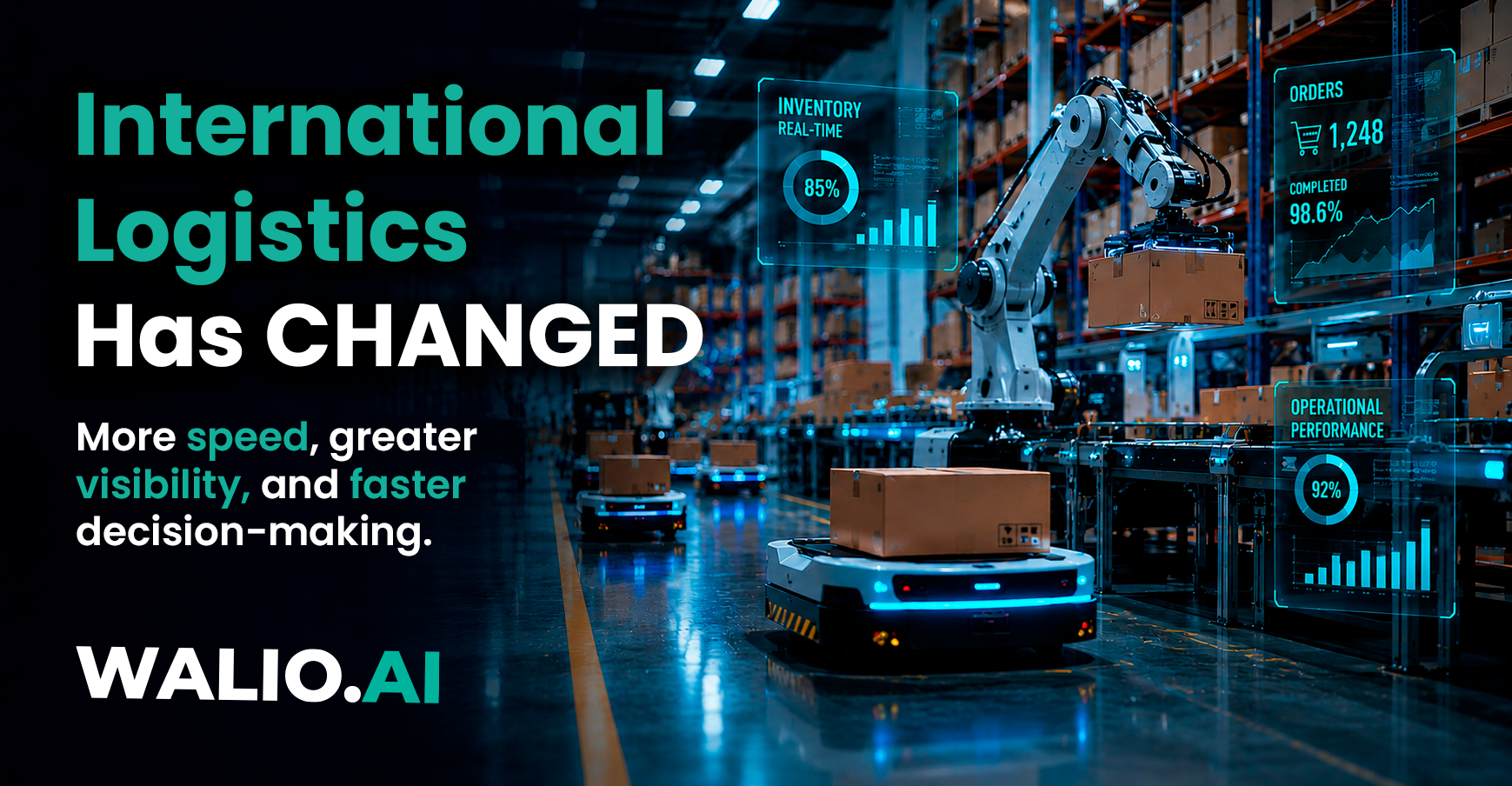
- Logistics automation can reduce operational costs by up to 30% according to 2026 studies
- Expect improved customs management accuracy and an 80% reduction in documentation errors
- Quoting times will shrink from days to seconds with automated calculators
- Real-time cargo visibility will completely transform the customer experience
Quick Verdict: Logistics automation aims to reduce operational costs by 15-30%, accelerate delivery times, minimize human errors in customs, and optimize warehouse management through AI and advanced technologies.
The logistics industry is undergoing an unprecedented digital transformation. Companies handling ocean freight, air freight, land freight, and courier services face increasing pressure to reduce costs, accelerate deliveries, and maintain total cargo visibility.
Automation is not just a technological trend – it's a competitive necessity. According to IATA Air Cargo analysis, companies implementing comprehensive automation report significant operational improvements and sustainable competitive advantages.
In markets like the Miami-Latin America corridor, where Walio operates, automation is completely redefining how businesses manage their international supply chains.
Key Objectives of Logistics Automation
Quick Verdict: Key objectives include reducing operational costs by 15-30%, accelerating customs processes, improving cargo tracking accuracy, and optimizing ocean, air, and land freight routes.
Logistics automation pursues specific and measurable objectives that transform the entire operation of freight forwarders and international transport companies.
Dramatic Reduction in Operational Costs
Successful logistics automation implementations report savings of 15-30% in total operational costs. This reduction comes from multiple sources:
Elimination of manual processes in customs documentation
Automatic route optimization for ocean freight and land freight
Reduction of costly errors in cargo manifests
Less reliance on operational staff for routine tasks
Average operational cost savings reported by companies implementing full automation in their logistics processes.
Accelerating Customs Clearance Processes
Automated systems completely transform customs management. Artificial intelligence can automatically classify HS Codes, validate documents before cargo arrival, and detect inconsistencies that traditionally required human intervention.
At ports like Cartagena or PortMiami, clearance times are significantly reduced when systems that integrate directly with MUISCA, VUCEM, and CBP are implemented.
Intelligent Optimization of Transportation Routes
Automation algorithms analyze millions of variables in real-time to optimize ocean freight, air freight, and land freight routes simultaneously:
Capacity analysis - Evaluates availability on vessels, aircraft, and trucks
Demand prediction - Anticipates congestion at ports and airports
Cost optimization - Selects the most efficient combination of modes
Experience Automation Now
Get automated quotes in seconds for FCL, LCL, Air, and Courier.
Get a Free Quote →Impact on Customs and Cargo Processes
Quick Verdict: Customs automation reduces clearance times by 50-70%, automates tariff classifications, detects document errors pre-shipment, and enhances compliance with international regulations.
Customs management represents one of the biggest challenges in international logistics. Automated systems are completely revolutionizing how companies handle compliance and customs documentation.
Automated HS Code Classification
Artificial intelligence can analyze product descriptions and automatically assign HS/TARIC codes with 95-98% accuracy. This eliminates human errors that traditionally led to customs delays and penalties.
For complex or new-to-market products, systems maintain specialized human oversight, ensuring full compliance with international regulations.
Pre-Shipment Document Validation
Automated systems validate customs documents before cargo arrival, detecting inconsistencies in:
Commercial invoices with declared values
Certificates of origin and phytosanitary documents
Cargo manifests and Bills of Lading (B/L)
Country-specific import forms
Critical Compliance
Errors in tariff classification can lead to penalties of 20-40% of the merchandise value. Automation reduces this risk to near zero through pre-validation and specialized algorithms.
Intelligent Detection of Restricted Goods
Automated systems cross-reference international databases to automatically detect restricted, prohibited, or specially licensed goods. This includes verification against OFAC sanctions lists and country-specific regulations.
Direct Integration with Customs Systems
Automation allows direct API integration with government systems such as:
MUISCA (Colombia) - For automated import declarations
VUCEM (Mexico) - Single window for foreign trade
CBP ACE (United States) - For ISF and automated manifests
DIAN (Colombia) - For electronic invoicing and RUT
Improvements in Warehousing and Inventory Management
Quick Verdict: Automated warehouses promise 99.9% inventory accuracy, a 60% reduction in picking times, AI-driven space optimization, and full integration with transportation systems.
Automated warehousing represents one of the most visible transformations in the logistics chain. Smart warehouses operate with near-perfect precision and 24/7 capabilities.
WMS Systems with Artificial Intelligence
Modern Warehouse Management Systems use AI to automatically optimize merchandise locations, predict demand patterns, and coordinate picking and packing operations efficiently.
Traditional Warehousing
- Manual product placement
- Operator-experience-based picking
- Inventory errors of 5-10%
- Limited to business hours
Automated Warehousing
- Automatic optimization of locations
- AI-calculated picking routes
- 99.9% accuracy in inventories
- Continuous operation 24/7/365
Advanced Robotics for Picking and Packing
New-generation robots can handle products of various sizes and shapes, operating without fatigue and maintaining consistent processing speeds.
According to ISO Warehouse Standards, robotic systems achieve levels of precision and speed impossible for manual operations.
Real-time IoT Monitoring
Internet of Things sensors continuously monitor critical warehouse conditions:
Temperature and humidity for sensitive cargo
Exact location of each SKU via RFID
Security levels and zone-controlled access
Maintenance prediction for critical equipment
Complete Integration
The best automated warehousing systems integrate directly with ocean freight, air freight, and land freight, providing complete visibility from the warehouse to final door-to-door delivery.
Transforming Freight Quoting and Booking
Quick Verdict: Automated quotes will reduce response times from 24-48 hours to seconds, offering real-time pricing for FCL, LCL, courier, and door-to-door services with full transparency.
The traditional international logistics quoting process has historically been slow and inefficient. Automation is completely changing the customer experience in this critical aspect.
Instant Shipping Calculators
Platforms like ship.walio.ai allow users to get quotes in seconds for multiple transportation modes simultaneously. Users can compare FCL, LCL, air freight, and courier service options without waiting.
 Miami(USMIR)
 Cartagena(COCTA)Los Angeles(LAX)
 Mexico City(MEX)
Dynamic Real-time Pricing
Automated systems calculate prices based on multiple constantly changing variables:
Current demand - Booking levels on specific routes
Available capacity - Actual space on vessels and aircraft
Market conditions - Fuel rates and port congestion
Commercial season - Demand peaks on specific dates
Automated Booking Without Human Intervention
For standard shipments, systems allow for completely automated booking. The customer selects the preferred option, confirms cargo details, and receives instant confirmation with an assigned tracking number.
Services like those from International Courier Services already offer this functionality for courier shipments, and it is rapidly expanding to FCL and LCL.
Try Automated Quoting
Compare FCL, LCL, Air, and Courier in real-time - no waiting, no calls.
Get a Quote Now →Real-time Door-to-Door Tracking
Automation provides complete visibility from pickup to final delivery. Customers receive automatic updates at each milestone:
Pickup confirmed at origin
Arrival at consolidation terminal
Vessel/aircraft departure with actual ETD
Ocean or air transit with updated ETA
Arrival at destination port/airport
Automated customs release or holds
Final door-to-door delivery completed
Expected Economic and Operational Benefits
Quick Verdict: Total logistics cost savings of 20-40% are projected, alongside an 85% improvement in delivery accuracy, a 90% reduction in quoting time, and a 300% increase in processing capacity.
The benefits of logistics automation go beyond operational efficiency. Companies implementing automated systems report complete transformations in their competitiveness and growth capacity.
Proven ROI in Implementations
The return on investment in logistics automation is consistently positive when implemented correctly:
Typical return on investment in logistics automation during the first 2-3 years of implementation.
Companies recoup their initial investment in 18-24 months through operational cost savings, error reduction, and increased processing capacity without proportionally increasing staff.
Scalability Without Staff Limits
One of the most significant benefits is the ability to handle 10x greater volumes without proportionally increasing operational staff. Automated systems scale horizontally:
Processing 1,000+ daily quotes automatically
Simultaneous handling of multiple modes (ocean freight, air freight, land freight)
Managing customs documentation for hundreds of shipments
Integration with multiple carriers without added complexity
Competitive Advantage vs. Traditional Freight Forwarders
Automated businesses consistently outperform traditional competitors in key metrics:
Traditional Freight Forwarders
- Quotes in 24-48 hours
- Document errors 5-10%
- Limited cargo visibility
- Headcount-limited capacity
Automated Businesses
- Quotes in seconds
- Document errors <1%
- Complete real-time visibility
- Unlimited technological scalability
Complete B2B Integration
Automation allows full API integration with business client systems. Large corporations can directly integrate their ERPs with automated logistics systems, eliminating manual intervention in the entire shipping process.
According to Air Cargo News reports, this integration can reduce administrative processing costs by up to 60% for high volumes.
Automate Your Logistics Now
Join businesses already saving 20-40% on logistics costs with automation.
Get Started Now →Logistics automation implementation takes between 6-18 months, depending on the scope. Basic systems like automated quoters can be operational in 2-3 months, while full warehousing and customs automation requires 12-18 months.
Automation transforms rather than eliminates jobs. It reduces routine operational positions but creates new roles in data analysis, system management, and specialized customer service. The logistics sector typically maintains or increases total employment.
Current AI achieves 95-98% accuracy in tariff code classification for standard products. For complex or new merchandise, specialized human oversight is maintained to ensure full customs compliance.
Yes, the typical ROI for logistics automation is 200-400% over 2-3 years. Savings in operational costs, error reduction, and increased processing capacity generally recoup the investment within 18-24 months.
Automation adapts to each transportation mode. Ocean freight benefits most from documentation and tracking, air freight from speed-to-market, and land freight from route optimization. Each mode has specific algorithms to maximize efficiency.
Logistics automation is not the future - it is the present. Businesses embracing these technologies today are building lasting competitive advantages while their traditional competitors struggle with outdated manual processes.
Are you ready to automate your logistics operations? At Walio, we've developed the most advanced platform for instant quotes and automated management of FCL, LCL, air freight, and courier services. Experience the difference of getting quotes in seconds instead of days.
Visit ship.walio.ai now and discover how thousands of businesses are already saving time and money with real logistics automation. No calls, no waiting, no manual processes - just immediate results and total transparency.