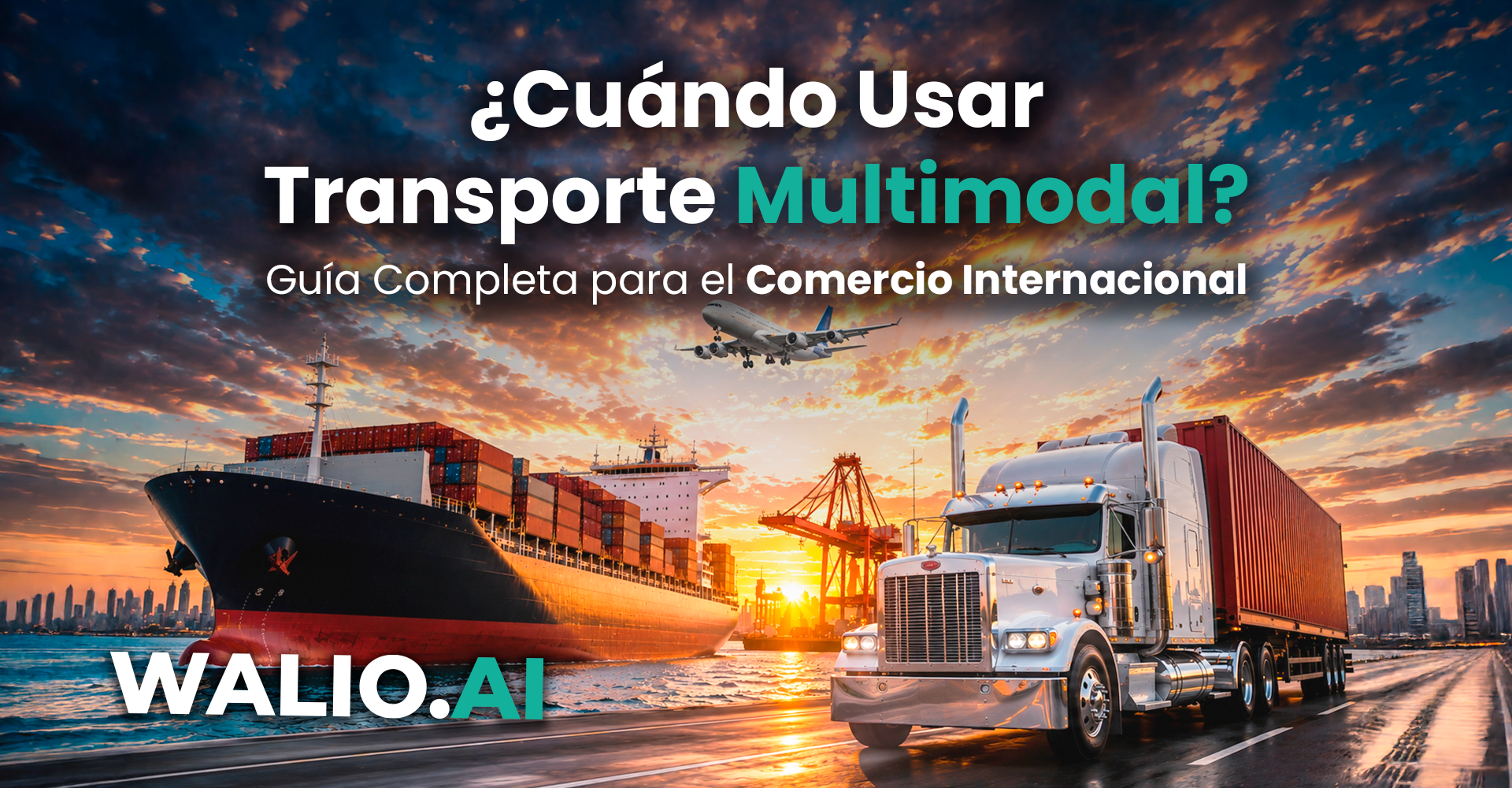
- Multimodal transport combines different modes (ocean, land, air) in a single operation
- It's more cost-effective than pure air freight but faster than ocean-only shipping
- Ideal for medium-sized cargo and routes with multiple destinations
- Reduces costs by up to 30% compared to unimodal transport on long routes
Quick Answer: Multimodal transport is ideal when you need to combine speed, cost, and flexibility to move commercial cargo between different regions. It's especially effective for long routes with multiple destinations and when transit time is not critical.
In modern international trade, choosing the right type of transport can make the difference between the success and failure of your operation. Multimodal transport has become a strategic solution for businesses looking to optimize their logistics operations without compromising efficiency.
This transport modality isn't new, but its intelligent application in global trade has revolutionized how businesses handle their commercial cargo. The key is understanding when and how to apply it correctly.
For companies operating routes between the United States and Latin America, multimodal transport offers significant competitive advantages. According to the FIATA Multimodal Transport, these types of operations can reduce operational costs by up to 35% on specific routes.
What is the Multimodal Transport and When to Use It?
Quick Answer: Multimodal transport combines at least two different modes of transport under a single contract. It is ideal when you need to balance cost, time, and flexibility to move commercial cargo between distant regions.
Multimodal transport is defined as the movement of goods using two or more different transport types, coordinated under a single transport document and sole responsibility. This differentiates it from intermodal transport, where each segment has separate contracts and responsibilities.
The main difference lies in responsibility. In multimodal transport, the Multimodal Transport Operator (MTO) assumes full responsibility from the origin point to the final destination. This means less paperwork, less coordination for you, and a single point of contact for claims.
Pro Tip
Use multimodal transport when your commercial cargo weighs more than 220 lbs (100 kg) but less than 44,000 lbs (20 tons), and when you can afford 2-5 additional transit days to save 20-35% on costs.
The most common situations where multimodal transport outperforms unimodal options include:
Inland destinations: When your cargo needs to reach cities without an international airport or seaport
Medium volumes: Between 35-530 cubic feet (1-15 cubic meters), where LCL is too expensive and FCL is excessive
Tight budgets: When time is not critical but cost is
Multiple destinations: Distribution from an entry point to several cities
The regulatory framework for multimodal operations is supported by international conventions like the United Nations Convention on International Multimodal Transport of Goods, which establishes clear responsibilities for operators.
Which Transport Types Are Most Effective to Combine?
Quick Answer: The most effective combinations are ocean-land for volume and cost, air-land for urgency, and ocean-air-land for complex international routes with multiple destinations across different continents.
Choosing the right combination of transport types determines the success of your multimodal operation. Each combination has specific advantages depending on the cargo type, urgency, and route.
Ocean-Land Combination: The Most Popular
This is the most widely used combination in international trade, especially for USA-Latin America routes. The typical process includes ocean freight from the origin port to an intermediate port, followed by land transport to the final destination.
 Miami
(USMIR)
Miami
(USMIR)
 Bogota
via Cartagena
Bogota
via Cartagena
Advantages: Competitive cost, capacity to handle large volumes, flexibility in cargo types.
Typical Transit Time: 12-18 days USA-Colombia, 15-25 days USA-Brazil
Air-Land Combination: Speed with Cost Control
Perfect for cargo that needs speed but where the cost of door-to-door air freight would be prohibitive. The process includes a flight to a hub airport near the destination, followed by land distribution.
Pure Air Freight
Transit Time: 2-4 days
Cost: $8-15/kg (approx. $3.60-$6.80/lb)
Limitations: Very expensive, limited to airports
Air-Land
Transit Time: 4-7 days
Cost: $5-9/kg (approx. $2.25-$4.00/lb)
Advantages: 30-40% more economical, wider coverage
Triple Combination: Maximum Flexibility
For complex intercontinental routes, the ocean-air-land combination offers maximum cost and time optimization. It's common for shipments from Asia to inland cities in Latin America.
Well-planned multimodal operations can save up to 35% compared to direct air freight, while maintaining competitive transit times.
How to Evaluate if Your Commercial Cargo Needs Multimodal Transport?
Quick Answer: Evaluate your cargo's weight, volume, urgency, final destination, and budget. If it weighs over 220 lbs (100 kg), isn't urgent, and the destination is far from major ports/airports, multimodal transport can reduce costs by 20-40%.
Correctly evaluating your commercial cargo is fundamental to making the right transport decision. Not all cargo is an ideal candidate for multimodal transport.
Decision Matrix: Weight and Volume
Your cargo's weight and volume determine which transport options are economically viable:
0-66 lbs (0-30 kg): Courier/Express always most efficient
66-220 lbs (30-100 kg): Direct air freight generally better option
220-2,200 lbs (100-1,000 kg): Ideal zone for air-land multimodal
2,200-22,000 lbs (1,000-10,000 kg): Ocean-land multimodal very competitive
+22,000 lbs (+10,000 kg): Direct FCL usually most efficient
Urgency vs. Budget Evaluation
The relationship between urgency and budget is inverse in cargo transport. Multimodal transport shines when you have time flexibility but budget constraints.
Important Consideration
If you need your cargo in less than 7 calendar days, multimodal transport is likely not the right option. Consider direct air freight or courier express.
Destination Analysis and Accessibility
Your final destination's location is crucial. Multimodal transport is especially advantageous when:
The destination is more than 125 miles (200 km) from the main port or airport
You need distribution to multiple cities from a single entry point
Local transport infrastructure favors certain modes
There are access restrictions for certain vehicle types
How Much Does Multimodal Transport Cost vs. Other Options?
Quick Answer: Multimodal transport typically costs 15-30% less than pure air freight and takes 2-5 days longer than direct ocean shipping. For USA-Colombia routes, expect $2,500-$4,200 for a 20ft multimodal container vs. $8,000+ for air freight.
Cost analysis in multimodal transport must consider not only the base price but also transit times, flexibility, and hidden costs. The economic advantage varies significantly depending on the route and cargo type.
Cost Comparison by Route
Multimodal transport costs vary depending on the combination of modes and the specific route. Here are real examples for popular routes:
Miami
(USMIR)
Cartagena
(COCTA)
Miami
(USMIR)
Bogota
via CTG
Miami
(MIA)
Bogota
(BOG)
Factors Affecting the Price
Multimodal transport prices fluctuate based on several factors you should consider when planning your shipments:
Peak/Off-peak season: December-January can increase costs by 20-35%
Cargo type: Dangerous or fragile goods add 15-25% to the base cost
Service urgency: Multimodal express services cost 40-50% more
Consolidation availability: Multimodal LCL depends on consolidation frequency
Hidden Costs to Consider
Multimodal transport can include additional costs that are not evident in the initial quote. It's important to request "all-inclusive" quotes for accurate comparison:
Transfer costs - Between transport modes at changeover points
Intermediate storage - If there are delays in coordination between modes
Additional documentation - May require specific paperwork per mode
Specialized insurance - Coverage for multimodal operations
How to Optimize Documentation and Procedures in Multimodal Transport?
Quick Answer: Multimodal transport requires a Multimodal Transport Document (MTD) that covers the entire chain. It simplifies customs procedures but requires precise coordination between different modes to avoid delays and extra costs.
Documentation in multimodal transport is both an advantage and a challenge. While you reduce the number of separate documents, you need to ensure all information is accurate from the start.
Multimodal Transport Document (MTD)
The MTD is the heart of any successful multimodal operation. According to CBP Import Guidelines, this document must include specific information for each segment of the journey.
The MTD replaces multiple documents you would normally need:
Bill of Lading (B/L) for ocean segment
Air Waybill (AWB) for air segment
Road Waybill for land segment
Transfer documents between modes
Specialized Customs Procedures
Customs procedures in multimodal transport require special attention at modal transfer points. Each change of mode can represent a customs inspection point.
Attention: Critical Points
Modal transfer points are where 80% of delays in multimodal transport occur. Ensure your operator has clear procedures for each changeover point.
Specialized Insurance for Multimodal Operations
Insurance in multimodal transport must cover all transport modes and specific transfer risks. Not all cargo insurance adequately covers multimodal operations.
All-risk coverage during modal transfers
Protection against delays at changeover points
Coverage for damage during additional handling
Multimodal Transport Operator liability
Tracking and Full Visibility
Cargo visibility in multimodal transport is more complex but also more valuable. You need an operator that offers integrated tracking across all transport modes.
The best multimodal platforms, like the one Walio offers at ship.walio.ai, provide:
Real-time tracking throughout the entire journey
Automatic alerts at each modal transfer
Updated estimated times of arrival
24/7 accessible digital documentation
Companies using multimodal operators with full tracking report 92% satisfaction vs. 67% with traditional operators.
Success in multimodal transport depends on choosing an operator who understands the complexities of coordinating multiple transport modes. Modern technology makes it possible for you to gain full visibility and total control over your cargo, no matter how many mode changes your shipment requires.
Ready to optimize your international trade operations? At ship.walio.ai, you can get instant quotes for all transport options, including customized multimodal solutions for your cargo type. Compare prices, transit times, and services in seconds, without phone calls or waiting.
Yes, multimodal transport is typically 15-30% more economical than pure air freight. However, it takes an additional 2-5 days in transit time. It is ideal when cost is more important than extreme speed.
Multimodal transport from the USA to Colombia takes between 8-15 days, depending on the route and combination. Ocean-land from Miami takes 8-12 days, while air-land from other US cities can take 10-15 days, including consolidation.
You need a Multimodal Transport Document (MTD), commercial invoice, packing list, certificate of origin, and cargo insurance. The MTD replaces multiple documents and covers the entire transport chain from origin to final destination.
Do not use multimodal transport when you have extremely urgent cargo (less than 3 days), perishable goods with a short shelf life, or when the origin and destination are directly connected by a single efficient mode, such as frequent direct flights.
Yes, modern operators offer full tracking throughout the entire multimodal process. Walio provides real-time visibility from the origin point to final delivery, regardless of how many transport modes are used.