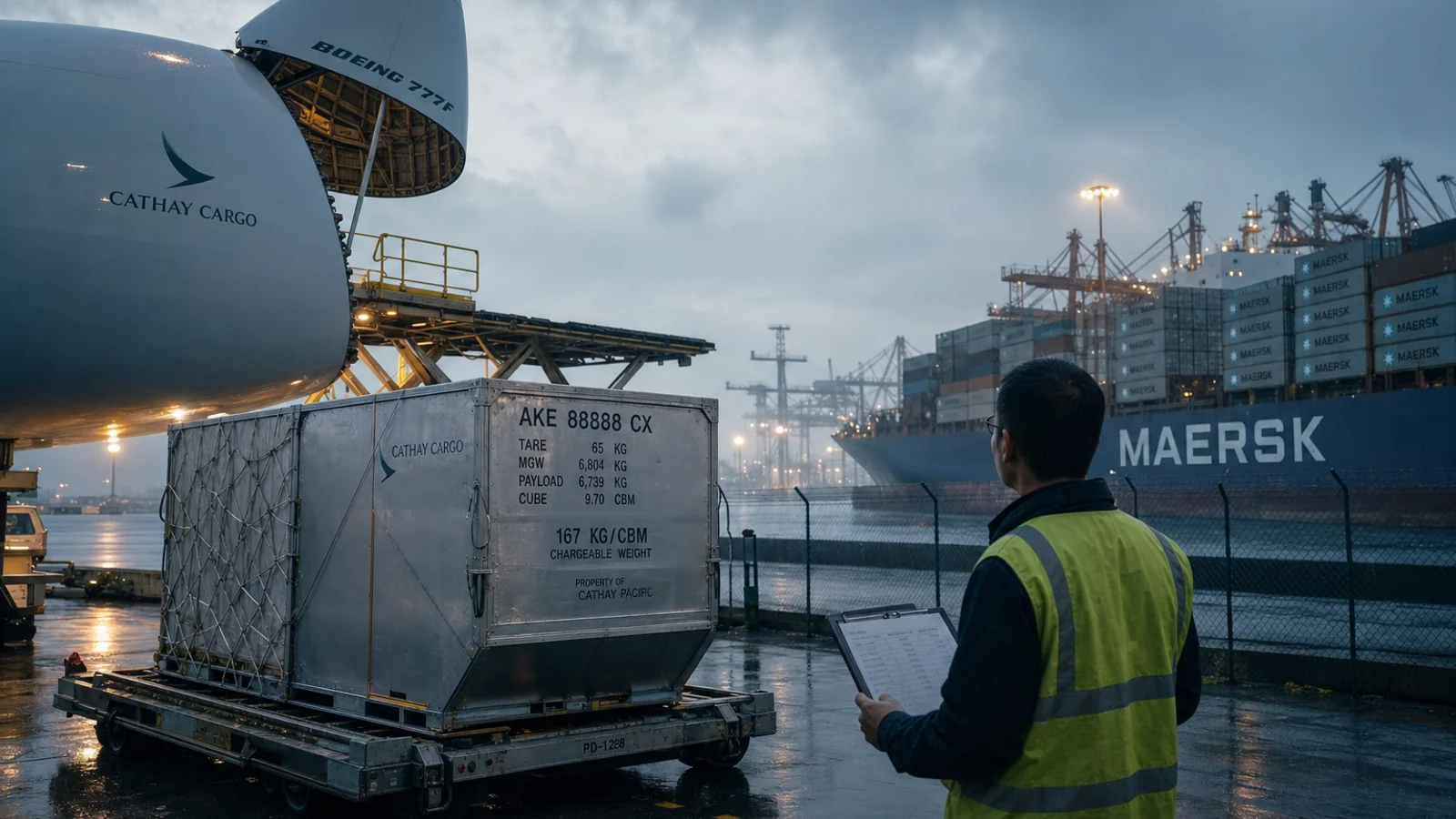
Quick answer Air freight moves cargo in 2 to 8 days and is billed per chargeable kilo; ocean freight takes 18 to 45 days and is billed per container or per cubic meter. Air wins when your cargo is dense, high-value or urgent. Ocean wins on almost everything above 2 CBM.
- Air freight charges the greater of actual weight or volume ÷ 6000; ocean LCL charges the greater of tonnes or CBM (the 1:1000 W/M rule).
- The practical break-even is cargo density: above roughly 167 kg per CBM, air pricing stops punishing you — below it, air bills you for air.
- Ocean emits about 10–40 g CO2e per tonne-km; air emits roughly 500–1,000 g — a 50x to 100x gap that now shows up in ESG reports.
- Carrier liability differs by law: the Montreal Convention caps air at 22 SDR per kg, Hague-Visby caps ocean at 2 SDR per kg or 666.67 SDR per package.
Spanish-speaking importers search this decision as flete aéreo vs flete marítimo, and the honest answer is that it comes down to three numbers you already have. This guide gives you the formulas, the lane transit times and the break-even math, then prices both modes for your exact shipment.
See your price in seconds
Real carrier rates, no signup, no follow-up calls.
Air Freight vs Ocean Freight: Which Should You Choose?
Quick answer Choose air freight when transit time, cargo value or density justifies the rate per kilo. Choose ocean freight when volume exceeds roughly 2 CBM and your delivery date allows 18 to 45 days. The deciding variables are density in kg per CBM, cargo value per kilo, and your inventory carrying cost.
Three variables settle the mode, and none of them is a gut feeling. Density tells you how the carrier will bill you. Value per kilo tells you how much the freight premium matters against the goods. The cost of waiting tells you what 30 extra days of tied-up capital actually costs.
The pricing logic differs completely between modes. Air freight is quoted per chargeable kilo, ocean FCL is quoted per container, and ocean LCL is quoted per cubic meter or tonne, whichever is greater. Comparing a per-kilo rate to a per-container rate without converting both to landed cost is how importers overpay.
| Factor | Air freight | Ocean freight |
|---|---|---|
| Billing unit (weight) | Per chargeable kilo | FCL per container; LCL per revenue ton |
| Billing unit (volume) | Volume cm³ ÷ 6000 | Per CBM (LCL) or flat per box (FCL) |
| Door-to-door transit | 2–8 days | 18–45 days |
| Schedule reliability | High, capacity-sensitive | ~50–65% on-time in recent years |
| Minimum viable volume | From 1 kg | LCL from ~1 CBM; FCL from ~10–15 CBM |
| Chargeable weight rule | 1:6000 (IATA volumetric) | 1:1000 W/M (1 tonne = 1 CBM) |
| CO2e per tonne-km | ~500–1,000 g | ~10–40 g |
| Cargo restrictions | Strict: IATA DGR, lithium, aerosols | Broad: IMDG with declaration |
| Typical insurance premium | Low % of CIF value | Slightly higher; LCL above FCL |
| Carrier liability cap | 22 SDR per kg (Montreal Convention) | 2 SDR per kg or 666.67 SDR per package (Hague-Visby) |
| Main surcharges | FSC, SSC, screening, terminal handling | BAF, CAF, THC/DTHC, PSS, drayage, CFS |
| Transport document | Air Waybill (AWB) | Bill of Lading (B/L) or Sea Waybill |
The document difference matters more than most importers realize. An AWB is a receipt, not a document of title — it cannot be endorsed or traded. An original ocean B/L is a document of title, which is why letters of credit and bank-financed deals run on ocean paper. Walio prices air, LCL and FCL side by side so the comparison is a number on screen, not a theory.
What Is Air Freight and How Is It Priced?
Quick answer Air freight is cargo moved in the belly hold of a passenger aircraft or on a dedicated freighter, billed per chargeable kilo. Carriers take the greater of gross weight or volumetric weight, calculated as length × width × height in centimeters divided by 6000. Rates move weekly with capacity and fuel.
The 1:6000 divisor is an IATA standard, and it decides whether air pricing is fair to your cargo. A pallet measuring 120 × 80 × 100 cm occupies 960,000 cm³. Divide by 6000 and you get 160 kilos of volumetric weight, even if the scale reads 90. You pay 160.
Rates split by service type. General cargo rates apply to standard freight on a consolidator's master AWB, which is slower to book but cheaper per kilo. Direct airline bookings and express products cost more and move faster. A consolidator groups many shippers into one master AWB and issues each shipper a house AWB.
- Fuel surcharge (FSC) and security surcharge (SSC), both billed per kilo
- Terminal handling at the origin airport and again at destination
- Screening fees per kilo, higher for cargo from unknown shippers
- Customs clearance and last-mile delivery on door-to-door service
Airport cut-off is not wheels-up. Cargo typically must be tendered 4 to 6 hours before departure, and screening queues at peak hours push that earlier. Missing cut-off on a daily flight costs you a full day; on a three-times-weekly lane it costs two or three.
Know what your quote covers. Airport-to-airport pricing stops at the destination terminal, leaving clearance, terminal fees and trucking on your side. Door-to-door includes pickup, screening, the flight, customs and final delivery. The two numbers are not comparable, and that gap is where most "cheap" air quotes hide.
What Is Ocean Freight, and What's the Difference Between FCL and LCL?
Quick answer Ocean freight moves cargo by vessel, either as FCL (a container you fill alone) or LCL (your cargo consolidated with other shippers' cargo). FCL is priced per container — 20', 40', 40HC or 45'. LCL is priced per cubic meter or per tonne, whichever is greater, under the W/M rule.
The FCL versus LCL break-even usually lands between 10 and 15 CBM. Below that, you pay only for the space you use plus consolidation handling. Above it, a 40' container costs less per cubic meter than consolidated LCL space, and you skip the CFS warehouse entirely.
| Container / service | Usable capacity | Typical payload | Best for |
|---|---|---|---|
| LCL (consolidated) | 1–13 CBM | Per revenue ton | Small and mid-size shipments |
| 20' standard | ~28–30 CBM | ~21–22 tonnes | Dense cargo, one sedan plus boxes |
| 40' standard | ~58–60 CBM | ~26 tonnes | Mixed volume cargo |
| 40' high cube | ~68–70 CBM | ~26 tonnes | Light, bulky goods |
| 45' high cube | ~78–80 CBM | ~27 tonnes | Maximum volume per box |
LCL adds a container freight station (CFS) step at both ends. Origin consolidation waits for the container to fill, and destination deconsolidation unpacks it. Budget 3 to 7 extra days on each side for CFS handling — that is the real cost of LCL, more than the rate itself.
Plan backward from cut-off, not from the sailing date. Documentation cut-off, VGM (verified gross mass) submission and gate-in all fall 2 to 4 days before vessel ETD. Carriers like Maersk, MSC, CMA CGM and Hapag-Lloyd publish these deadlines per sailing, and a missed VGM rolls your box to the next vessel.
How Do You Calculate Chargeable Weight for Air and W/M for Ocean?
Quick answer Chargeable weight is the figure the carrier bills, not what your scale says. Air freight divides volume in cubic centimeters by 6000. Ocean LCL compares tonnes to cubic meters at a 1:1000 ratio. In both cases the carrier charges the higher of the two numbers, every time.
Air freight worked example
Take six cartons measuring 60 × 40 × 40 cm each. Volume per carton is 96,000 cm³, so the shipment totals 576,000 cm³, or 0.576 CBM. Divide 576,000 by 6000 and you get 96 kilos volumetric. The cartons weigh 55 kilos on the scale. You pay for 96 kilos, not 55.
Ocean LCL worked example
Now take 2.4 CBM weighing 1.1 tonnes. The W/M rule compares 2.4 cubic meters against 1.1 tonnes at a 1:1000 ratio. The volume figure is larger, so the shipment bills as 2.4 revenue tons. Flip it — 1 CBM weighing 1.8 tonnes bills as 1.8 revenue tons.
Courier uses a harsher divisor
Express and courier services apply a 1:5000 divisor, not air cargo's 1:6000. The same 120 × 80 × 100 cm pallet bills as 192 kilos by courier and 160 kilos by air cargo. Never price a courier shipment using an air cargo formula — the gap runs 20%.
Density decides everything. At exactly 167 kg per CBM, volumetric weight equals actual weight and the two formulas agree. Below that density, air bills you for empty space. Above it, air pricing stops punishing you and the per-kilo rate starts looking rational against ocean.
Measure the shipping configuration, not the product. Pallet height, overhang beyond the pallet footprint and protective repacking all raise chargeable weight. A supplier who stacks 10 cm too high on a 120 × 100 cm pallet adds 20 chargeable kilos per pallet before anything moves.
See your price in seconds
Real carrier rates, no signup, no follow-up calls.
When Does Air Freight Actually Become Cheaper Than Ocean?
Quick answer Air becomes competitive on a landed-cost basis when cargo density exceeds roughly 167 kg per CBM and value per kilo is high enough that 30 extra days of tied-up capital costs more than the air premium. Below 2 CBM, LCL minimums and CFS fees often erase ocean's advantage entirely.
At 167 kg per CBM, volumetric weight and actual weight match exactly under the IATA 1:6000 rule. Below that density, every air kilo you pay for is partly empty space.
Build the comparison as total landed cost, not rate against rate. Air cost equals chargeable kilos times the per-kilo rate, plus FSC, SSC, screening, clearance and last mile. Ocean cost equals revenue tons times the LCL rate, plus CFS, destination charges, drayage, clearance and any minimum charge. Minimums are where small ocean shipments lose their advantage.
Then add the cost of waiting. A $100,000 shipment sitting on the water for 30 extra days, at a 20–25% annual inventory carrying rate, carries a real holding cost of roughly $1,600 to $2,100. Multiply that across every SKU you import and the air premium starts shrinking.
Cash flow tells the same story differently. Ocean ties up working capital for five to six weeks between payment and sale. Air converts inventory to revenue in under a week. For an importer running on a credit line, that cycle difference can matter more than the freight bill.
Air vs LCL vs FCL on a 300 kg / 2 CBM shipment
| Factor | Air freight | Ocean LCL | Ocean FCL (20') |
|---|---|---|---|
| Chargeable basis | 333 kg (2 CBM ÷ 6000) | 2.0 revenue tons | Flat per container |
| Break-even volume | Under ~2 CBM | ~1–13 CBM | Above ~10–15 CBM |
| Door-to-door transit | 4–8 days | 28–45 days | 22–35 days |
| Consolidation wait | None | 3–7 days origin CFS | None |
| Handling touches | 4–6 | 8–12 | 2–3 |
| Damage risk | Low | Highest | Lowest |
| Space utilization | 15% of a 20' | 7% of a 20' | 7% paid, 100% billed |
At 300 kg in 2 CBM, density is 150 kg per CBM — just under the break-even. Air bills 333 chargeable kilos against 300 actual. That shipment is the exact case where importers assume ocean wins and discover the gap is narrower than expected once CFS and destination charges land.
See your price in seconds
Real carrier rates, no signup, no follow-up calls.
How Long Does Ocean Freight Take vs Air on Real Lanes?
Quick answer Air freight runs 2 to 8 days door to door on most lanes; ocean runs 18 to 45 days. Shanghai to Manzanillo sails in roughly 22–28 days, Shenzhen to Callao 28–35, Miami to Cartagena 4–7. Add origin cut-off, customs and last mile to every port-to-port figure.
| Lane | Ocean FCL (port to port) | Ocean LCL (door to door) | Air (door to door) |
|---|---|---|---|
| Shanghai → Manzanillo | 22–28 days | 32–42 days | 5–8 days |
| Shenzhen → Callao | 28–35 days | 38–48 days | 6–9 days |
| Ningbo → Cartagena | 26–34 days | 36–46 days | 5–8 days |
| Miami → Bogotá | 4–7 days (via Cartagena) | 10–16 days | 2–4 days |
| Rotterdam → Veracruz | 18–24 days | 26–34 days | 4–6 days |
 Miami(USMIA)
 Cartagena(COCTG)
Port-to-port is never the number you plan around. Add 2 to 4 days for origin documentation and gate-in cut-off, 3 to 7 days for CFS on LCL at each end, 1 to 5 days for customs clearance, and 1 to 3 days for drayage and last mile. A 25-day sailing becomes a 40-day delivery.
Ocean schedule reliability has hovered near 50–65% on-time in recent years across major trades. Air schedule integrity runs far higher, but it swings with belly capacity — when passenger flights thin out on a lane, so does cargo space, and rates follow within a week.
Which gateway serves your region?
- Florida ships through PortMiami and Miami International (MIA)
- Texas and the central states route through Port Houston
- California and the Southwest use Los Angeles / Long Beach and LAX
- The Northeast moves through New York / New Jersey
- The Southeast uses Savannah; the Midwest railheads through Chicago
- The Pacific Northwest ships via Seattle
- Canada: Ontario via Toronto, Quebec and the Atlantic provinces via Montreal, Western Canada via Vancouver
What Hidden Costs and Surcharges Differ by Mode?
Quick answer Ocean adds BAF, CAF, THC and DTHC, peak season surcharge, drayage, CFS and chassis fees, plus demurrage and detention when free time runs out. Air adds fuel and security surcharges, screening, and airport terminal handling. An all-in quote names every line; an itemized quote hides nothing but requires reading.
Ocean carries the longer surcharge list. BAF adjusts for bunker fuel, CAF for currency movement, THC and DTHC cover terminal handling at origin and destination, PSS applies during peak season, and ISPS covers port security. Chassis splits and congestion fees appear at US ports without warning.
Demurrage and detention are different clocks
Demurrage accrues when your container sits at the terminal past free time. Detention accrues when the container leaves the port and does not come back. Free time usually runs 3 to 7 days. Both charges compound daily and both are avoidable with a broker who files early.
Air surcharges are fewer but add up per kilo. FSC and SSC are billed per chargeable kilo, screening is charged per kilo, dangerous goods handling carries its own fee, and the airport terminal charges a handling fee at both ends. On low-weight air shipments, surcharges can exceed the base rate.
Compliance differs sharply. According to CBP, ISF "10+2" must be filed at least 24 hours before the cargo loads on a vessel bound for the USA, and late or inaccurate filings draw penalties. Air shipments have no ISF requirement — the AWB manifest and entry filing cover it.
- Customs bond: single-entry for occasional imports, continuous for regular importers
- Customs broker fees, separate from freight and paid per entry
- Duties and taxes paid to the authority — CBP, CBSA, DIAN, SUNAT, SAT, ANAM or Receita Federal
- HS / HTS classification, which a licensed customs broker should confirm before you book
See your price in seconds
Real carrier rates, no signup, no follow-up calls.
Which Cargo Types, Risks and Emissions Rule Out a Mode?
Quick answer Lithium batteries, aerosols, flammables and many dangerous goods face strict or prohibited status in air cargo under IATA DGR, while ocean handles them under IMDG with proper declaration. Oversized cargo rules out air and goes flat rack or RoRo. Perishables usually demand air or reefer ocean.
| Cargo type | Recommended mode | Why |
|---|---|---|
| Consumer electronics | Air or FCL | High value per kilo, dense, theft-sensitive |
| Pharma / cold chain | Air | Short shelf life, temperature windows, high value |
| Textiles and apparel | Ocean LCL/FCL | Low density, low value per kilo; air only for fashion drops |
| Automotive spare parts | Mixed | Air for line-down parts, ocean for stock replenishment |
| Machinery | FCL or flat rack | Weight and dimensions exceed air limits |
| E-commerce parcels | Air / courier | Small, dense, customer expects days not weeks |
| Dangerous goods | Ocean (IMDG) | IATA DGR restricts or bans many classes on aircraft |
Lithium batteries deserve their own line. Per IATA, UN3480 standalone lithium-ion cells are prohibited on passenger aircraft and restricted to state-of-charge limits on freighters. Volume battery imports go by ocean, declared under IMDG Class 9, with the correct dangerous goods declaration.
Liability caps are lower than importers expect. The Montreal Convention caps air carrier liability at 22 SDR per kilo. Hague-Visby caps ocean at 2 SDR per kilo or 666.67 SDR per package, whichever is higher. Both sit far below the value of most commercial cargo.
Cargo insurance is the only thing that makes you whole. It is priced as a percentage of CIF value — invoice plus freight plus insurance, usually declared at 110%. LCL involves 8 to 12 handling touches versus 2 or 3 for FCL, so damage rates run higher and so does the premium.
Emissions now sit on the decision sheet. Ocean runs roughly 10–40 g CO2e per tonne-km, air roughly 500–1,000 g. That 50x to 100x gap feeds Scope 3 reporting, and buyers in Europe and North America increasingly ask for mode-level data in supplier scorecards.
Oversized and heavy equipment never fits a standard container. RVs, semi-trucks, heavy machinery and aircraft move on flat rack or RoRo vessels. Submit the dimensions through the calculator and a Walio specialist follows up with the right equipment and rate.
Can You Combine Ocean and Air in One Shipment?
Quick answer Yes. Sea-air moves cargo by vessel to a transshipment hub — Dubai, Singapore, Los Angeles or Miami — then flies the final leg. Transit lands near 12 to 20 days at a cost between pure modes. Expedited LCL, premium ocean services and air charter fill the remaining gaps.
Sea-air runs on established hubs. Dubai, Singapore and Colombo handle Asia-to-Europe and Asia-to-Africa flows. For Asia to Latin America, Los Angeles and Miami work as the pivot: ocean across the Pacific, then a short flight south. The handoff adds a CFS step, so documentation has to be clean.
Expedited ocean
Premium and guaranteed-space ocean products buy schedule reliability without air pricing. You get priority loading, a committed sailing and faster CFS handling. It suits importers whose problem is unpredictability rather than raw speed.
Air charter and split shipments
Part-charter and full charter apply to production stoppages, product launches and project cargo, and a specialist quotes them. A cheaper tactic: fly the first 10% to keep the line running and sail the remaining 90%.
Incoterms 2020 decide who pays which leg. EXW and FCA put main carriage on the buyer. FOB transfers risk when goods are loaded on the vessel. CIF and CIP include main carriage paid by the seller. DAP and DDP put delivery on the seller — and DDP moves import liability and duty payment onto the seller, which many exporters underestimate.
How Do You Price Air Freight vs Ocean Freight in Seconds?
Quick answer Enter origin, destination, weight and dimensions in the calculator on this page and Walio returns air, LCL and FCL options side by side from real carrier rates. No forms that wait for an email, no sales call. What you see is what you book, with charges itemized by leg.
You control more cost drivers than you think. Chargeable weight, CBM, density, origin gateway, Incoterm, door-to-door versus port-to-port scope, and declared value for insurance all move the number. Repacking to raise density is often the cheapest intervention available.
The quote itemizes main carriage, origin handling, destination charges, drayage and last mile. Duties and taxes are not Walio charges — you pay those to the importing country's authority at the published rate applied to customs value. A licensed customs broker confirms your HS/HTS classification before entry.
Run this checklist before you book
- Fix your delivery deadline and work backward through cut-off, transit and clearance
- Measure total CBM and gross kilos in the final shipping configuration
- Calculate density: kilos ÷ CBM, then compare against the 167 kg threshold
- Check value per kilo and the holding cost of 30 extra transit days
- Confirm no IATA DGR or IMDG restriction applies to your commodity
- Agree the Incoterm with your supplier and set your declared insured value
Price all three modes before you negotiate with your supplier. If FCL beats LCL at 11 CBM, ordering two more cubic meters can cost less in total than shipping the smaller quantity. The calculator shows that crossover instantly.
The flete aéreo vs flete marítimo debate ends the moment both numbers appear next to each other. For oversized, project or dangerous cargo, submit the request through the calculator and a Walio specialist follows up, or open the chat on this page.
See your price in seconds
Real carrier rates, no signup, no follow-up calls.
Ocean freight is cheaper on almost any shipment above about 2 CBM, often by a wide margin per cubic meter. Air freight closes the gap when cargo is dense — above roughly 167 kg per CBM — or when 30 extra days of tied-up inventory costs more than the air premium. Price both in the calculator on this page and compare the actual landed cost.
Ocean shipping from China runs 22 to 35 days port to port on Latin American lanes — Shanghai to Manzanillo around 22–28 days, Shenzhen to Callao around 28–35. Air freight on the same lanes moves in 4 to 8 days door to door. Add origin cut-off, customs clearance and last mile to both figures.
Air freight is worth it when a missed deadline costs more than the freight difference, when cargo value per kilo is high, or when the goods are perishable or seasonal. Pharmaceuticals, electronics, spare parts that stop a production line and fashion drops are the usual cases. Low-density, low-value bulk cargo almost never justifies it.
Multiply length by width by height in centimeters and divide by 6000. That gives volumetric weight in kilos, and the airline bills whichever is greater: volumetric or actual gross weight. A 120 × 80 × 100 cm pallet calculates to 160 chargeable kilos even if the scale reads 90.
Yes, it is called sea-air and it moves cargo by vessel to a transshipment hub, then flies the final leg. Typical transit lands between 12 and 20 days, with cost sitting between pure ocean and pure air. Many importers also split a shipment: fly a small urgent portion and sail the rest.
Stop comparing a per-kilo rate to a per-container rate on a spreadsheet. Enter your route, weight and dimensions in the calculator above and see air, LCL and FCL priced side by side in seconds — no signup, no follow-up calls.