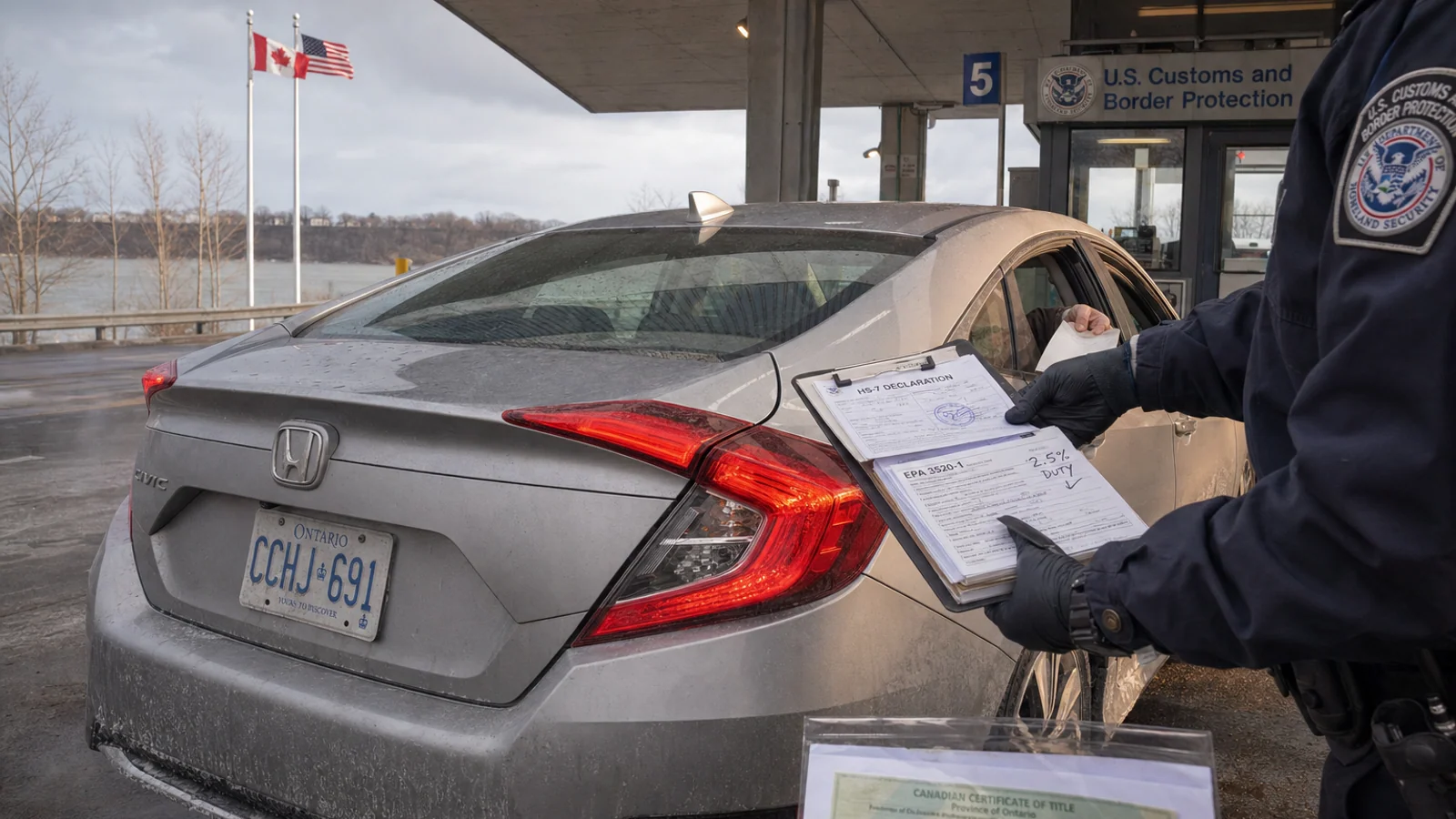
Quick answer A passenger car imported from Canada to the United States pays 2.5% duty on its declared customs value; cargo pickups and light trucks pay 25%. Add the Merchandise Processing Fee, a possible Section 232 duty, broker charges, transport, then state sales tax, title and plates. USMCA-qualifying vehicles can enter at 0%.
- Passenger cars enter at 2.5% duty under HTSUS heading 8703; cargo pickups and light trucks pay 25% under heading 8704 — the chicken tax.
- Vehicles that qualify as originating under USMCA, and US-built vehicles returning under HTSUS 9801.00.10, can clear at 0% duty with documented proof of origin.
- Any vehicle manufactured 25 or more years before the import date is exempt from FMVSS safety compliance; EPA applies a separate 21-year rule for original-configuration engines.
- Canada requires the title and export filing to reach the US port of entry at least 72 hours before the crossing, with an ITN from AESDirect.
Spanish-speaking buyers search for a calculadora importar carro de canada a usa because the duty is only one line of the bill. This guide breaks down every line, and the calculator on this page quotes the transport leg for your exact vehicle and route.
Get your quote for this vehicle
Enter the vehicle, the pickup city in Canada and the US delivery address. A Walio specialist confirms carrier space and sends your exact price within one business day.
How much does it cost to import a car from Canada to the USA?
Quick answer Importing a car from Canada to the United States costs duty plus federal fees plus state charges. Passenger cars pay 2.5% duty, cargo pickups 25%, motorcycles 0 to 2.4%. Add the Merchandise Processing Fee, a possible Gas Guzzler Tax, broker charges, transport, and state sales tax, title and plates at registration.
The cost stack has three layers. Federal duty and user fees go to CBP at the border. Transport goes to the carrier. State charges land at your DMV when you title and plate the car.
Customs value is the transaction price on your bill of sale. CBP converts it from Canadian dollars to US dollars using its own published exchange rate for the date of entry, not the rate your bank gave you on purchase day.
| Cost line | Paid to | Rate or basis |
|---|---|---|
| Duty — passenger car / SUV | CBP | 2.5% of customs value |
| Duty — cargo pickup / light truck | CBP | 25% of customs value |
| Duty — motorcycle | CBP | 0% to 2.4% by engine displacement |
| Merchandise Processing Fee (MPF) | CBP | 0.3464% of value, within published min and max |
| Harbor Maintenance Fee (HMF) | CBP | 0.125% — ocean arrivals only |
| Section 232 automobile duty | CBP | 25% where it applies, with a US-content mechanism |
| Gas Guzzler Tax | Federal, collected at entry | Tiered; passenger cars below the EPA threshold only |
| Customs broker entry + bond | Licensed broker | Quoted per entry; ask in writing |
| Transport Canada → US address | Carrier | Quoted in the calculator on this page |
| Sales or use tax | State DMV | State rate on the purchase price |
| Title, plates, VIN verification | State DMV | State fee schedule |
The Harbor Maintenance Fee applies only to vehicles arriving by ocean vessel. A car trucked or driven across a land border never pays it.
Gas Guzzler Tax hits passenger cars below the EPA fuel-economy threshold. Most modern Canadian-market sedans and all light trucks fall outside it.
The costo nacionalizar carro canadiense does not end at the border. State sales or use tax is usually the largest line after the purchase price, and your DMV charges it at registration.
Get your quote for this vehicle
Vehicle details, pickup city and delivery ZIP. A specialist confirms carrier space and sends your exact transport price within one business day.
How do I calculate the 2.5% duty on a car bought in Canada?
Quick answer Convert the purchase price from Canadian dollars to US dollars using the CBP exchange rate for the entry date, then multiply by 2.5% for a passenger car. Add the Merchandise Processing Fee at 0.3464% of value, within its published minimum and maximum. Section 232 duty, if it applies, is calculated separately.
Any honest calculadora importar carro de canada a usa runs the same four steps.
- Take the vehicle value in CAD from the bill of sale.
- Convert it to USD at the CBP rate for your entry date.
- Apply the duty rate for the correct HTSUS heading.
- Add MPF, plus any Section 232 amount and Gas Guzzler Tax.
The Merchandise Processing Fee is a user fee of 0.3464% of declared value, capped by a published minimum and maximum per entry. Confirm the current figures with CBP or your broker, because they are adjusted for inflation.
Informal entries below the CBP informal-entry threshold use a flat MPF instead of the percentage calculation. Most car imports are formal entries, so expect the percentage path.
On a FOB-style purchase, freight and insurance paid after export are normally excluded from customs value. List the vehicle price, the transport charge and the insurance as separate lines on your paperwork. A single bundled number invites CBP to dutiable the whole amount.
What duty rate applies to my vehicle type?
Quick answer Duty depends on the HTSUS classification, not on the badge or the dealer's description. Passenger cars and most SUVs fall under heading 8703 at 2.5%. Cargo pickups and light trucks fall under 8704 at 25%, the chicken tax. Motorcycles range from free to 2.4%. Trailers and motorhomes carry their own rates.
A four-door SUV on a truck frame is usually still 8703 at 2.5%, because it is principally designed to carry people. A crew-cab pickup with an open bed sits in 8704 at 25%. That single classification line decides most Canada-to-US import budgets.
| Vehicle type | HTSUS heading | Duty rate | Notes |
|---|---|---|---|
| Passenger car / sedan | 8703 | 2.5% | Gas Guzzler Tax possible below the EPA threshold |
| SUV / crossover | 8703 | 2.5% | Truck frame does not change the heading |
| Pickup / light cargo truck | 8704 | 25% | The chicken tax; applies to crew cabs with open beds |
| Motorcycle | 8711 | 0% – 2.4% | Rate set by engine displacement |
| Motorhome (self-propelled RV) | 8703 | 2.5% | Classified as a motor vehicle, not a trailer |
| Travel trailer / fifth wheel | 8716 | Generally free | Towed units are classified apart from motorhomes |
| Classic, 25+ years old | Its own heading | Same as the heading rate |
Age exempts a classic from FMVSS safety compliance. It does not exempt it from customs duty. A 1996 coupe still pays 2.5% at entry.
Which Canadian cars enter the USA duty-free?
Quick answer Vehicles that qualify as originating under USMCA enter at 0% duty, and US-built vehicles returning home may enter free under HTSUS 9801.00.10. Qualification rests on documented origin, not on where you bought the car. A VIN starting with 1, 4 or 5 signals US assembly; 2 signals Canadian assembly.
USMCA preference requires a certification of origin carrying the producer or exporter data. The dealer invoice alone is not enough for CBP. Ask the manufacturer for the build record before you commit to a crossing date.
HTSUS 9801.00.10 covers US-origin goods returning without being advanced in value. For a car, that means US manufacture, proven by the VIN plus supporting documents.
Section 232 duty of 25% on imported automobiles has applied since 2025, with a mechanism that recognizes US content in USMCA-qualifying vehicles. Verify the current status with CBP or a licensed customs broker before you budget, because the program has changed more than once.
| Line item | Origin claim accepted | No origin claim |
|---|---|---|
| Purchase price | CAD 30,000 | CAD 30,000 |
| Customs value in USD (illustrative rate 0.73) | 21,900 | 21,900 |
| Duty at 2.5% | 0 | 547.50 |
| Section 232 at 25% | 0 | 5,475.00 |
| MPF at 0.3464% | 75.86 | 75.86 |
| State sales tax (illustrative 6%) | 1,314.00 | 1,314.00 |
| Broker entry, bond and transport | Quoted separately | Quoted separately |
| Federal + state subtotal | 23,289.86 | 29,312.36 |
The exchange rate and the state tax rate above are illustrative. The pattern is what matters: the same CAD 30,000 vehicle can land about USD 6,000 apart depending on whether the origin claim is accepted.
Buying from a Canadian private seller makes origin proof harder. A franchised dealer can pull the build record from the manufacturer; a driveway seller cannot.
Get your quote for this vehicle
Tell the calculator what you are moving and where. A specialist confirms the carrier and sends your exact price within one business day.
What is the 25-year rule, and the EPA 21-year rule?
Quick answer The 25-year rule lets any vehicle manufactured 25 or more years before the import date enter the United States without meeting FMVSS safety standards. EPA applies a separate 21-year rule for vehicles in original configuration. Newer nonconforming vehicles need a Registered Importer, and many models are simply not eligible.
NHTSA counts 25 years from the month and year of manufacture on the door jamb label, not from the model year printed on the title. A car sold as a 2001 model can be built in mid-2000, which moves the eligible date earlier.
A Registered Importer is a NHTSA-licensed company that modifies and certifies a nonconforming vehicle. Without one, a sub-25-year nonconforming car cannot stay in the country.
| Scenario | Safety requirement | Forms | Registered Importer | Modification cost |
|---|---|---|---|---|
| US-certified Canadian vehicle | Meets FMVSS, label present | HS-7 Box 1, EPA 3520-1 code B | No | None |
| Canadian-market, admissible with letter | Manufacturer letter of conformity | HS-7 Box 2B, EPA 3520-1 | No | Minor items the letter lists |
| Nonconforming, under 25 years | Must be brought into compliance | HS-7 Box 3, DOT bond | Yes | Quoted by the RI; often exceeds the car's value |
| 25+ years from month of manufacture | FMVSS exempt | HS-7 exemption box | No | None; duty still due |
| 21+ years, original configuration | EPA exempt | EPA 3520-1 code E | No | Engine must be unmodified |
Most Canadian-market vehicles are built to US FMVSS with small differences. Typical ones: speedometer in kilometers, daytime running lights, bumper standards, immobilizer systems and French-language labels.
California adds CARB rules on top of EPA. A federally legal import can still fail California registration when the engine family is not CARB-certified.
What documents do I need to import my car from Canada?
Quick answer You need eight core documents: the original Canadian title or ownership, the bill of sale, the provincial registration, NHTSA form HS-7, EPA form 3520-1, CBP forms 3461 and 7501, and a manufacturer's letter of conformity or recall clearance. The AES filing with its ITN completes the Canadian export side.
- Original Canadian title or provincial ownership document — photocopies are refused at the export office.
- Bill of sale showing the price in CAD, both parties and the VIN.
- Provincial registration from Ontario, Quebec, British Columbia or wherever the car is plated.
- NHTSA form HS-7 — the safety declaration CBP reads first.
- EPA form 3520-1 — the emissions declaration.
- CBP form 3461 — entry / immediate delivery.
- CBP form 7501 — entry summary recording duty, MPF and the HTSUS number.
- Manufacturer's letter of conformity or recall clearance — the slowest document to obtain, so order it weeks ahead.
On HS-7 you pick the box that matches your vehicle. Box 1 for a US-certified vehicle, Box 2B with a manufacturer letter, and the exemption box for a 25-year-plus import.
EPA 3520-1 works the same way. Code B covers a US-EPA certified vehicle; code E covers an original-configuration vehicle over 21 years old.
A lien stops the export cold
The requisitos importar vehiculo canadiense usa include lien-free proof. A title showing an active lien will be rejected before the vehicle reaches CBP. Get a written lien release from the Canadian lender and carry the original with the title.
How do I export the car from Canada and clear CBP?
Quick answer Canada requires the vehicle title and export filing to reach the US port of entry at least 72 hours before the crossing. File the Electronic Export Information in AESDirect to get your ITN, then present the originals to the CBP export office during business hours, not at the primary inspection lane.
Those 72 hours are business hours at a staffed export office. A Friday filing rarely clears before Monday, so plan a midweek crossing and build in a buffer.
Send or deliver the title, bill of sale and ITN to the specific port you will use. CBP offices do not share submissions between crossings, so filing at Buffalo does not help you at Detroit.
 Montreal(Lacolle)
 New York(Champlain)Toronto(Windsor)Chicago(Detroit)Vancouver(Pacific Hwy)Seattle(Blaine)
Ontario vehicles usually exit through Windsor-Detroit or Fort Erie-Buffalo. Quebec and the Atlantic provinces use Lacolle-Champlain. Western Canada uses Pacific Highway-Blaine.
Why CBP refuses vehicles at the line
The repeat causes are a photocopied title, a VIN mismatch between title and vehicle, a title name different from the importer, a missing recall letter and expired insurance. Each one sends the car back into Canada. Hire a licensed customs broker when the entry is commercial, needs a customs bond, or carries a USMCA or Section 232 claim — and ask for the entry fee and bond cost in writing first.
Drive it across the border or ship it: which is better?
Quick answer Driving the car across costs the least in cash but requires valid insurance, plates or a transit permit, and a crossing during export-office hours. Hiring a carrier costs more and adds days, yet the driver handles the 72-hour window, the border paperwork and the long highway miles for you.
Drive it yourself
You need a Canadian transit permit or valid plates plus US-valid insurance. Many Canadian policies stop covering a vehicle the moment it is sold. You also have to reach the export office within its working hours, which rules out most evening and weekend crossings.
Hire a carrier
An open auto transporter is standard for a daily driver. Enclosed transport suits classics, low-clearance sports cars and high-value collector vehicles. The carrier works to the 72-hour export window and your odometer stays where it was.
| Factor | Drive it yourself | Hire a carrier |
|---|---|---|
| Cash cost | Fuel, lodging, permit, insurance | Quoted in the calculator on this page |
| Elapsed time | 1-2 days of your own driving | 1-5 days depending on the lane |
| Odometer impact | Hundreds of extra miles | Zero |
| Plates and permits | Transit permit required | Not required |
| Insurance | You arrange US-valid cover | Carrier liability coverage included |
| Non-running vehicle | Not possible | Winch or flatbed, quoted by a specialist |
| Winter risk | Road salt, storms, closures | Carrier absorbs the driving risk |
Importing a car from Montreal to the United States by truck typically routes through Lacolle-Champlain and then down I-87. A Vancouver vehicle crosses at Blaine on I-5.
Vehicles moving from Atlantic Canada or Vancouver to a distant US coast sometimes move by ocean container instead. That adds the 0.125% Harbor Maintenance Fee, which a land crossing avoids.
Get your quote for this vehicle
Open or enclosed, running or not. Submit the request and a specialist sends your exact price within one business day.
Import car from Canada to USA calculator: how to get your quote
Quick answer The calculator on this page takes your vehicle, pickup city in Canada and delivery address in the United States. A Walio specialist confirms carrier space and sends your exact transport price within one business day. Duty, MPF and state taxes stay separate because you pay those to CBP and your state.
CBP requires the title and export filing at the port of entry 72 business hours before the vehicle arrives. Carriers on this lane build their schedules around that window.
Five fields drive the transport price: make, model, year, running or non-running status, and the pickup and delivery postal codes. Everything else adjusts the number at the margin.
- Price depends on distance to the crossing, open versus enclosed equipment, vehicle size and weight, and the season on northern lanes.
- The quote covers door-to-door transport and carrier liability coverage.
- It does not cover duty, MPF, broker entry fees, customs bond or state sales tax.
- Oversized pickups, lifted trucks and non-running cars are quoted after a space check with the carrier.
- No signup and no follow-up calls — the price comes back by email.
What you still pay your state after the border
- Sales or use tax on the purchase price at registration, with credit in some states for tax already paid in Canada.
- Title and plate fees, which vary by state; several states also require a VIN verification by a police officer or DMV inspector.
- California requires CARB compliance plus a smog check; Colorado, New York and other states run their own emissions programs.
- US insurance must be active before the car is plated — most insurers need the VIN and the CBP 7501 entry summary.
What the specialist confirms before quoting
- Carrier availability on your crossing and route, including winter capacity on northern lanes.
- Whether the vehicle needs enclosed equipment, a flatbed or a winch.
- Pickup access: residential street, dealer lot or auction yard, each with different loading requirements.
Treat this page as your working calculadora importar carro de canada a usa: the duty and fee rules above, plus a real transport quote for your route. The aduana CBP vehiculo Canada side stays with CBP and your broker.
Get your quote for this vehicle
Enter the vehicle and both addresses. A Walio specialist confirms carrier space and sends your exact price within one business day — no signup, no calls.
A passenger car pays 2.5% duty on its customs value, plus the Merchandise Processing Fee of 0.3464% within its published minimum and maximum. Cargo pickups and light trucks pay 25% instead. Your state then charges sales or use tax at registration, which is usually the largest single line after the purchase price.
Yes, if the vehicle qualifies as originating under USMCA or is a US-built vehicle returning under HTSUS 9801.00.10. Both routes need documented proof of origin, not just a VIN that starts with 1, 4 or 5. Ask the manufacturer or dealer for the build record before you cross.
Twenty-five years from the month of manufacture exempts a vehicle from FMVSS safety compliance, and 21 years exempts an original-configuration vehicle from EPA emissions certification. Age does not exempt the car from duty, which is still charged at the HTSUS rate for its classification.
HS-7 is the NHTSA safety declaration every imported vehicle needs at the US border. You check the box that matches your vehicle's status: US-certified, admissible with a manufacturer letter, or exempt as 25 years or older. Checking the wrong box is the fastest way to have an import refused.
No for a straightforward personal import you clear yourself at the border, yes when the entry is commercial, needs a customs bond, or involves a USMCA or Section 232 claim. A licensed customs broker files CBP 3461 and 7501 for you and fixes classification errors before they become penalties.
Duty rates, the 25-year rule and the 72-hour export window are set by CBP, NHTSA and EPA, and they apply the same way at every crossing. The part that changes with your car and your route is transport. Enter your vehicle and both addresses in the calculator above, and a Walio specialist sends your exact price within one business day — no signup, no follow-up calls.