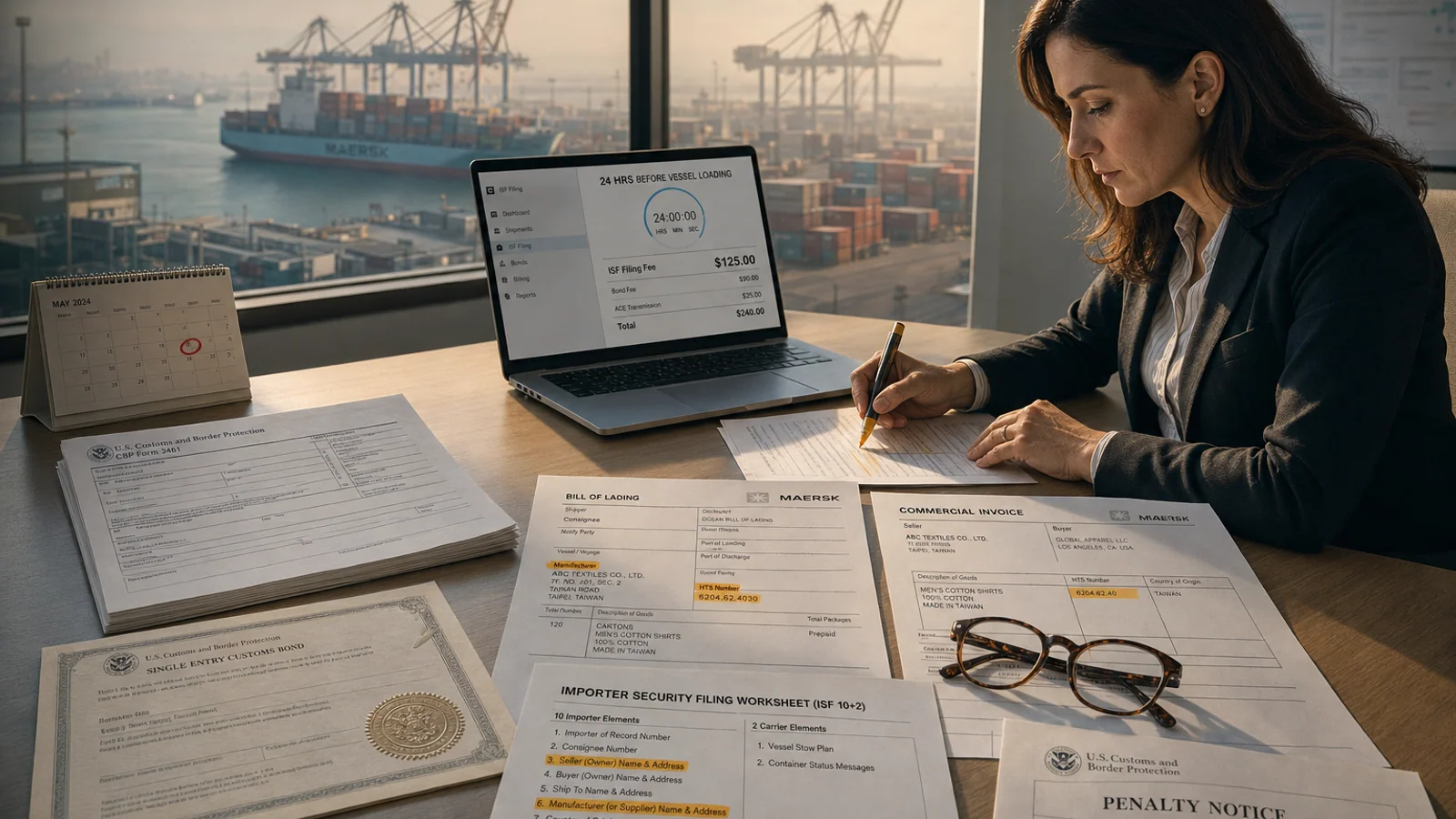
Quick answer ISF 10+2 is a CBP filing due 24 hours before your cargo loads onto a US-bound vessel. A late or missing filing exposes the importer to $5,000 in liquidated damages, capped at $10,000 per shipment. Walio's US customs clearance, which includes the ISF filing, starts at $745 for a full container.
- ISF 10+2 must be transmitted to CBP at least 24 hours before the container is loaded at the foreign port — not before arrival in the US.
- CBP liquidated damages for a late, inaccurate or missing ISF are $5,000 per violation, with a $10,000 cap per shipment; first offenses are often mitigated downward.
- Walio's US customs clearance package — customs entry, bond, ISF/AMS filing, handling and CBP fee minimums — starts at $745 FCL, $695 LCL and $610 air, before duties and door delivery.
- ISF applies only to ocean cargo; air shipments file ACAS instead, and there is no ISF fee or ISF bond on an air freight import.
Most importers looking for a "calculadora ISF 10+2" want one number: what the filing, the bond and a mistake will cost them. This page explains each line item, then the calculator prices your actual US clearance, duties and delivery.
See your price in seconds
Real carrier rates, no signup, no follow-up calls.
What is ISF 10+2 and who has to file it?
Quick answer ISF 10+2, or Importer Security Filing, is a CBP data transmission required for all ocean cargo bound for the United States. The importer of record files 10 data elements and the ocean carrier files 2. It is a security rule under the SAFE Port Act, codified at 19 CFR 149.
The ISF is an advance electronic filing submitted through ACE before the box is loaded overseas. CBP created it under the SAFE Port Act of 2006 to screen containers before they sail, not after they arrive.
The importer of record is legally responsible even when a licensed customs broker or NVOCC forwarder presses the send button. ISF covers FCL, LCL and consolidated ocean cargo, including commercial samples moving by sea. ISF applies to ocean cargo only — air shipments file ACAS instead.
Exemptions are narrow. ISF-5 covers FROB, transit and transshipment cargo; everything imported for consumption needs the full ISF-10.
Why your Mexican or Colombian supplier keeps asking about ISF
The US buyer files the ISF, but the supplier holds most of the data: manufacturer name and address, country of origin, stuffing location and the HTS number. If the exporter sends documents late, the buyer absorbs the penalty.
ISF 10+2 calculator: what does it actually compute?
Quick answer An ISF 10+2 calculator estimates the full cost of getting your ocean shipment cleared, not just the filing line. It combines container type, shipment frequency and bond status into one itemized figure. Walio's calculator goes further: it prices US customs clearance, duties, CBP fees and delivery from the port.
Three inputs move the number: shipment type (20ft FCL, 40ft FCL or LCL), ocean shipments per year, and whether you already hold a continuous customs bond. A one-off importer buys a single transaction bond; a repeat importer does not.
Walio's calculator on this page prices the US side in seconds: customs entry, bond, ISF/AMS filing, handling, CBP fee minimums (MPF and HMF), duties and tariffs, plus delivery from the port to your ZIP code. The calculator does not price the ocean freight itself — a Walio specialist quotes the international leg within 1 business day.
You need four things for a real number: the HS/HTS code, country of origin, commercial value and destination ZIP. That is the same data the ISF demands, which is why a "calculadora ISF 10+2" and a landed-cost calculator ask the same questions. Pricing a full container? See the Nicaragua to USA Container Calculator: Cost 2026.
Run the calculator before you confirm the purchase order, not after the booking. If the duty rate plus Section 301 surcharge changes your margin, you still have room to renegotiate the unit price with the supplier.
How much does it cost to file ISF 10+2 in the US?
Quick answer ISF cost has three parts: the filer's transmission fee, the ISF bond, and any amendment fee. Walio bundles the ISF filing into US customs clearance, which starts at $745 for a full container, $695 for LCL and $610 for air, before duties and door delivery.
Break the cost into line items and nothing hides. You pay a transmission fee, an ISF bond (single transaction, or covered by your continuous bond), an amendment fee if data changes, and the demurrage risk that follows a "do not load" hold.
Standalone broker rates for an ISF filing and a single transaction ISF bond vary by filer and surety, so treat any figure you see elsewhere as market reference, not Walio pricing. Walio's US customs clearance starts at $745 for a full container, with the ISF filing inside the package.
| Shipment type | Walio US clearance from | ISF required | HMF applies | Priced separately |
|---|---|---|---|---|
| 20ft FCL | $745 | Yes | Yes | Duties, delivery, ocean freight |
| 40ft / 40HC FCL | $745 | Yes | Yes | Duties, delivery, ocean freight |
| LCL (shared container) | $695 | Yes | Yes | Duties, delivery, ocean freight |
| Air cargo | $610 | No (ACAS) | No | Duties, delivery, air freight |
MPF and HMF are CBP fees, not filer fees. MPF is charged ad valorem with CBP's published minimum and maximum per entry; HMF applies to ocean cargo only, which is one reason air imports price differently. Consolidating less than a container? Read the LCL Colombia to USA Calculator: Landed Cost 2026.
See your price in seconds
Real carrier rates, no signup, no follow-up calls.
When must the ISF 10+2 be filed before the vessel loads?
Quick answer The ISF must reach CBP no later than 24 hours before the cargo is loaded onto the vessel at the foreign port. The clock runs from loading, not from departure or US arrival. Carriers enforce it with their own earlier cut-off, usually 48 to 72 hours before vessel ETD.
Three deadlines get confused. The ISF 24-hour rule runs from loading. The carrier's documentation cut-off comes earlier. The port container cut-off sits before vessel ETD and has nothing to do with CBP.
A "do not load" message leaves your box on the terminal and resets your sailing. The real cost is the missed vessel plus storage, not the filing fee. Two elements — container stuffing location and consolidator — may be updated later, but no later than 24 hours before arrival at the first US port.
 Cartagena(COCTG)
 Miami(USMIA)
Short Latin American transits leave no repair time
Cartagena and Caucedo to PortMiami run only a few days. An ISF error discovered after sailing often cannot be corrected before arrival. Ask your supplier for the draft HBL and packing list a week before the booking cut-off.
What is the penalty for filing the ISF 10+2 late?
Quick answer CBP issues liquidated damages of $5,000 per ISF violation — late, inaccurate, incomplete or missing — with a cap of $10,000 per shipment. Penalties are claimed against the ISF bond. First offenses with a clean record and a petition for relief are frequently mitigated well below the headline figure.
According to CBP, liquidated damages run $5,000 per violation, capped at $10,000 per shipment, and are claimed against the ISF bond.
Mitigation works in a sequence. CBP issues the liquidated damages claim, the bond principal files a petition for relief, and the outcome depends on prior violations, a documented compliance plan and whether the cargo was examined.
Each violation type stands alone: late filing, no filing, wrong data, and failure to withdraw a filing for a cancelled booking. The fine also hides its companions — CBP hold, CET or VACIS exam fees, drayage to and from the exam site, and daily demurrage while the container waits.
Repeat offenders lose mitigation and can see higher exam rates on every future entry under their importer of record number. For an open penalty case, work with a licensed customs broker or trade attorney; Walio is a shipping platform, not legal counsel.
Do you need a customs bond to file an ISF 10+2?
Quick answer Yes. CBP requires bond coverage for every ISF. You either buy a single transaction ISF bond for that shipment or rely on an annual continuous customs bond, which already covers ISF plus your entries. The break-even usually arrives after a handful of ocean shipments per year.
An ISF bond is a surety guarantee: it lets CBP collect liquidated damages if the filing is late or wrong. Premiums are set by the surety, not by CBP, so the real decision is how many bonds you buy in a year.
| Ocean shipments per year | Single transaction ISF bonds needed | Entry bonds also needed | Continuous bonds needed | Usually cheaper |
|---|---|---|---|---|
| 1 | 1 | 1 | 1 | Single transaction |
| 2 | 2 | 2 | 1 | Single transaction |
| 4 | 4 | 4 | 1 | Close to break-even |
| 6 | 6 | 6 | 1 | Continuous |
| 12 | 12 | 12 | 1 | Continuous |
Note the third column: a continuous customs bond covers ISF and entries together, so the comparison is never bond-for-bond. Count the single transaction entry bonds you would otherwise buy alongside each ISF bond.
CBP sets continuous bond amounts at 10% of duties, taxes and fees paid in the prior year, subject to its published minimum. As of 2026, rising Section 301 and Section 232 tariffs push many importers into a mid-year bond increase. Walio's clearance package includes the bond, so you do not buy a separate single transaction bond per shipment.
See your price in seconds
Real carrier rates, no signup, no follow-up calls.
What data do you need before you can file the ISF?
Quick answer The importer files 10 elements and the carrier files 2. Every importer element sits on a document you already have: the commercial invoice, the packing list, or the house bill of lading. Gather them before the booking, because missing data is what makes ISF filings late.
| ISF element | Filed by | Source document |
|---|---|---|
| Seller | Importer | Commercial invoice |
| Buyer | Importer | Commercial invoice / purchase order |
| Importer of record number | Importer | EIN or CBP-assigned number |
| Consignee number | Importer | EIN or CBP-assigned number |
| Manufacturer or supplier | Importer | Commercial invoice |
| Ship-to party | Importer | Purchase order / delivery instructions |
| Country of origin | Importer | Commercial invoice / certificate of origin |
| HTS number (6 digits) | Importer | Commercial invoice / classification file |
| Container stuffing location | Importer | Packing list / supplier confirmation |
| Consolidator | Importer | HBL / forwarder booking |
| Vessel stow plan | Ocean carrier | Carrier system |
| Container status messages | Ocean carrier | Carrier system |
HTS to six digits is the element importers guess at most. A wrong classification is an inaccurate ISF and a duty error on the entry — two problems from one field. Sending samples by sea? They still need origin and HTS data; see the Sample Shipping Mexico to USA Calculator: 2026 Costs.
Who files the ISF — the importer, the broker or the forwarder?
Quick answer The importer of record is legally responsible, but the transmission is usually made by a licensed customs broker or an NVOCC freight forwarder with ACE access. The supplier never files it. Choosing one party to handle both the ISF and the entry prevents the mismatches CBP flags.
Self-filing in ACE
You hold the ACE connection and pay no filer fee. You also own every typo, every amendment and every liquidated damages claim. It works for importers with a steady program, a classification database and in-house compliance staff.
Broker or forwarder filing
A licensed filer transmits the ISF, matches it to the entry and flags mismatched HTS or consignee data before CBP does. You pay for the service, and your ISF and entry tell the same story — the single biggest cause of avoidable holds.
| Filing | Who files | Deadline | Mode | Penalty |
|---|---|---|---|---|
| ISF 10+2 | Importer of record (via broker/NVOCC) | 24 hours before loading | Ocean | $5,000 per violation, $10,000 cap |
| AMS | Ocean carrier / NVOCC | 24 hours before loading | Ocean | Carrier penalties, cargo not loaded |
| ACAS | Air carrier / forwarder | Before wheels-up (as early as possible) | Air | Carrier penalties, cargo not loaded |
Amendments are allowed before arrival and carry a fee from most filers. Withdraw the ISF if the booking is cancelled, or the stale filing becomes its own violation. Courier and document shipments need no ISF at all — see the Parcel Calculator Colombia to USA: Instant Quotes (2026) and Document Shipping Italy to USA Calculator: 2026 Costs.
See your price in seconds
Real carrier rates, no signup, no follow-up calls.
Stop hunting for a "calculadora ISF 10+2" that only guesses at a filing fee. Enter your HTS code, country of origin, value and ZIP in the calculator above and see your US clearance, duties, CBP fees and door delivery in seconds — no signup, no follow-up calls. A specialist adds the ocean freight quote within 1 business day.
The cost has three parts: the filer's transmission fee, the ISF bond, and any amendment fee. Walio includes the ISF filing inside US customs clearance, which starts at $745 for a full container, $695 for LCL and $610 for air, before duties and door delivery. The calculator on this page adds your duties, CBP fees and delivery in seconds.
At least 24 hours before the container is loaded onto the vessel at the foreign port. The deadline runs from loading, not from sailing or US arrival, and most ocean carriers set their own cut-off 48 to 72 hours earlier. Two elements, stuffing location and consolidator, may be updated up to 24 hours before US arrival.
CBP assesses $5,000 in liquidated damages per ISF violation, capped at $10,000 per shipment. A first offense with a clean compliance record is often mitigated below that figure after a petition for relief. The bigger expense is usually the CBP hold: exam fees, drayage and daily demurrage while the container waits.
The importer of record is legally responsible, not the foreign supplier. A licensed customs broker or an NVOCC freight forwarder with ACE access normally transmits the data on the importer's behalf. The supplier's job is to send the commercial invoice, packing list and manufacturer details fast enough to meet the 24-hour deadline.
Yes, CBP requires bond coverage on every ISF. You can buy a single transaction ISF bond for one shipment or hold an annual continuous customs bond that covers ISF filings and customs entries together. Importers running several ocean shipments a year usually save money with the continuous bond.