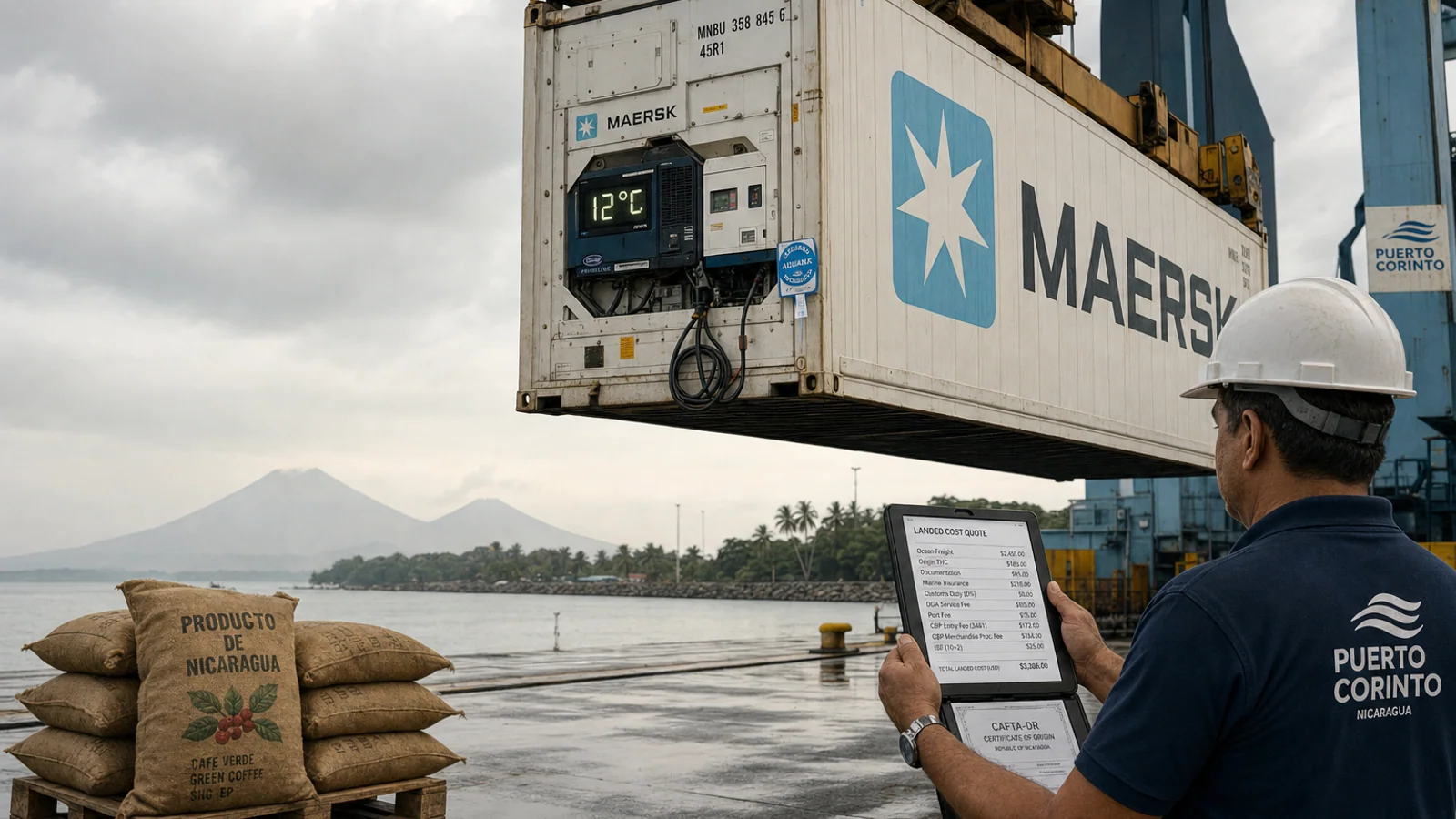
Quick answer Importing a container from Nicaragua starts at $745 for US customs clearance on a full container (FCL), $695 on a shared container (LCL) and $610 on air cargo — Walio quoting system rates, before duties and delivery. Most Nicaraguan goods enter duty-free under CAFTA-DR. The calculator prices duties, CBP fees and door delivery in seconds.
- Walio US customs clearance from Nicaragua starts at $745 FCL, $695 LCL and $610 air cargo, before duties and door delivery.
- Most originating Nicaraguan goods enter the USA duty-free under CAFTA-DR when the importer holds a valid certification of origin.
- Corinto to Miami usually transships through Balboa, Kingston or Caucedo; door-to-door transit commonly runs 14–25 days.
- The calculator prices US duties, MPF, HMF, clearance and delivery instantly; a specialist quotes the ocean freight from Nicaragua within one business day.
Importers searching in Spanish for a calculadora contenedor nicaragua estados unidos usually want one number: the landed cost of the box at their warehouse door. This page explains every piece of that number and hands you the US side of it instantly.
See your price in seconds
Real carrier rates, no signup, no follow-up calls.
How much does it cost to import a container from Nicaragua?
Quick answer US customs clearance on a container from Nicaragua starts at $745 for a full container, $695 for a shared container and $610 for air cargo, from Walio's quoting system on 2026-11-14. Duties and door delivery are added on top. The ocean freight itself is quoted separately by a specialist.
Those three figures cover a defined scope of work on the US side. They include the customs entry, the bond, the ISF and AMS filings, document handling and the CBP fee minimums. Duties and inland delivery are separate and the calculator prices both.
Walio's starting rate for US customs clearance on a full container from Nicaragua, as of 2026-11-14. No signup, no phone call, no waiting for an emailed quote.
The ocean freight from Corinto, Puerto Sandino or El Rama is not priced instantly. Space on the Nicaragua lane moves with sailing schedules, equipment availability and the coffee season. A Walio specialist returns the freight leg within one business day after you submit the shipment in the calculator.
The four cost blocks of a Nicaragua import
- Ocean freight and its surcharges — the base rate plus BAF, CAF, ISPS and origin terminal charges, quoted by a specialist.
- US customs clearance — entry, bond, ISF/AMS, handling; from $745 FCL, $695 LCL, $610 air.
- Duties and CBP fees — the HTS rate, the merchandise processing fee and, on ocean entries, the harbor maintenance fee.
- Inland delivery — drayage or LTL from the discharge port to your ZIP code, priced instantly in the calculator.
Six variables move the total: the HS code of the product, the declared commercial invoice value, CAFTA-DR eligibility, container size, the US discharge port and the final ZIP. Change any one of them and the landed cost changes. That is exactly why a static price list fails and a calculadora contenedor nicaragua estados unidos works.
See your price in seconds
Real carrier rates, no signup, no follow-up calls.
What does the Nicaragua to USA container calculator price?
Quick answer The Nicaragua to USA container calculator prices the US side of your import: customs clearance, duties and tariffs at the published HTS rate, CBP fees such as MPF and HMF, and delivery from the discharge port to your ZIP code. You enter four inputs and see the landed cost in seconds.
A container calculator converts four facts about your shipment into a landed-cost figure without a sales call. You do not fill in a lead form and wait. The result appears on screen while you are still reading.
The four inputs you need
- HS or HTS code — the product classification. Green coffee, beef, cigars and apparel each carry a different rate.
- Country of origin — Nicaragua, which triggers the CAFTA-DR eligibility question.
- Commercial invoice value in USD — the transaction value CBP uses as the duty base.
- US delivery ZIP code — this sets the discharge port and the inland leg.
| Quote element | In the instant estimate? | How it is produced |
|---|---|---|
| US customs entry and bond | Yes | From $745 FCL / $695 LCL / $610 air |
| ISF "10+2" and AMS filing | Yes | Included in clearance scope |
| Import duty at HTS rate | Yes | Calculated on declared value |
| MPF and HMF | Yes | Published CBP rates applied |
| Port-to-door delivery | Yes | Priced from discharge port to ZIP |
| Ocean freight Nicaragua → USA | No | Specialist quote within 1 business day |
| Reefer, oversized, project cargo | No | Submitted in the same form, specialist follows up |
Three numbers trip up first-time importers. Declared value is the price on the commercial invoice, not what you expect to resell for. Gross weight includes pallets and packaging. CBM is cubic meters: length × width × height in meters, per piece, added together.
Temperature-controlled, oversized and project cargo go through the same form. The calculator captures the details and a specialist comes back with the freight and equipment plan.
What duties and tariffs apply to goods from Nicaragua?
Quick answer Most originating Nicaraguan goods enter the United States duty-free under CAFTA-DR, provided the importer holds a valid certification of origin. Non-originating goods pay the published HTS rate. CBP also collects the merchandise processing fee and, on ocean cargo, the harbor maintenance fee. Section 232 and executive-action surcharges can apply on top.
Nicaragua is a party to the Dominican Republic–Central America–United States Free Trade Agreement. According to CBP, the preference claim is made at entry and the importer must have the certification of origin in its possession when the claim is filed. There is no official government form; the certification can be prepared by the producer, exporter or importer, with the required data elements.
Section 301 tariffs target China, not Nicaragua. Section 232 measures on steel and aluminum articles still apply by product, regardless of origin, and any surcharge in force under executive action on your entry date applies as well. The calculator applies the rates current on the day you run it.
How the CBP fees work — a worked example
MPF is charged ad valorem on formal entries, with a published minimum and maximum per entry. HMF applies to ocean shipments only, at the published ad valorem rate. Here is the arithmetic on a $40,000 invoice of a duty-free CAFTA-DR originating good:
- Duty: $40,000 × 0% under CAFTA-DR = $0
- MPF at the published 0.3464% rate: $40,000 × 0.003464 = $138.56 (within the published min/max band)
- HMF at the published 0.125% rate: $40,000 × 0.00125 = $50.00
- Government total: $188.56, with zero duty
Those percentages are published US rates from CBP and the USITC Harmonized Tariff Schedule. They are not Walio prices. If the same cargo did not qualify for CAFTA-DR, the HTS column 1 general rate would apply on top.
Do not claim CAFTA-DR on transshipped goods
Goods that merely passed through Nicaragua do not originate there. CAFTA-DR requires the product to meet the agreement's rules of origin, usually a tariff shift or regional value content test. A false claim exposes the importer of record to duty recovery and penalties. Ask a licensed customs broker for binding classification and origin opinions — Walio is a shipping platform, not legal counsel.
See your price in seconds
Real carrier rates, no signup, no follow-up calls.
Which ports and transit times link Nicaragua and the USA?
Quick answer Corinto handles most Nicaraguan container exports on the Pacific side, with Puerto Sandino, El Rama (Arlen Siu) and Bluefields on the Caribbean side. Services transship at Balboa, Manzanillo, Caucedo or Kingston. Port-to-port transit to Miami or Houston commonly runs 10–18 days, plus inland time to your door.
 Corinto(NICIO)
 Miami(USMIA)
| Lane | Usual transshipment | Port-to-port days | Door-to-door days |
|---|---|---|---|
| Corinto → Miami | Balboa or Caucedo | 10–18 | 14–23 |
| Corinto → Port Everglades | Balboa or Kingston | 11–18 | 15–24 |
| Corinto → Houston | Balboa or Manzanillo (PA) | 12–18 | 16–25 |
| Corinto → Los Angeles/Long Beach | Manzanillo (MX) or direct feeder | 12–20 | 16–26 |
| Puerto Sandino → US Gulf | Balboa | 13–20 | 17–27 |
| El Rama (Arlen Siu) → Miami | Kingston or Caucedo | 9–15 | 13–21 |
| Bluefields → Port Everglades | Kingston | 10–16 | 14–22 |
| Managua → Puerto Cortés (HN) land bridge → Miami | Caucedo or direct | 7–12 + 2–3 trucking | 12–20 |
| Corinto → New York/New Jersey | Caucedo or Kingston | 14–22 | 18–28 |
| Corinto → Savannah | Caucedo | 13–20 | 17–26 |
Direct Nicaragua–USA sailings are rare. Most boxes ride a feeder to a hub, wait for a mainline vessel, then continue. Each transshipment adds 3–6 days and a second handling risk, which is where damage claims and short-shipped pallets usually start.
Which US gateway does your region use?
- Florida → PortMiami or Port Everglades, the shortest lane from the Caribbean side.
- Texas and the central states → Port Houston.
- The Southeast → Savannah.
- The Northeast → New York/New Jersey.
- California and the Southwest → Los Angeles/Long Beach.
- The Midwest → rail inland from Houston or Savannah through Chicago.
Port cut-off is not vessel ETD. Cut-off is the deadline for the container to be inside the terminal, usually 24–72 hours before departure, with documentation and VGM due earlier. Book two weeks ahead and the cut-off stops being a problem. Mode mixing changes the math too — the same logic drives the Sea-Air Cargo China to USA Calculator: 18-Day Transit 2026, where a sea leg plus an air leg beats pure ocean on time.
The Puerto Cortés land bridge is the quiet winner for Florida-bound cargo. Trucking from Managua to Honduras takes 2–3 days, and Puerto Cortés has far denser Caribbean sailings than El Rama. When the next Corinto sailing is eight days out, the land bridge often arrives first.
See your price in seconds
Real carrier rates, no signup, no follow-up calls.
Is LCL or a full container cheaper from Nicaragua?
Quick answer LCL wins below roughly 10–15 CBM; above that, a 20-foot container usually costs less per cubic meter and moves faster because it skips deconsolidation at the CFS. A 20-foot container holds about 33 CBM, a 40-foot about 67 CBM and a 40HC about 76 CBM.
FCL means a full container load: the box is yours alone. LCL means less than container load, where your pallets share a box with other shippers' cargo. LCL is priced per CBM with a minimum; FCL is a flat box rate. The two lines cross near 10–15 CBM on Nicaragua lanes.
| Equipment | Internal L×W×H (m) | Max CBM | Typical payload | Typical Nicaragua use |
|---|---|---|---|---|
| 20 ft dry | 5.90 × 2.35 × 2.39 | 33 | ~28,000 kg | Coffee, sugar, one car plus boxes |
| 40 ft dry | 12.03 × 2.35 × 2.39 | 67 | ~26,500 kg | Apparel, furniture, light volume cargo |
| 40 ft high cube | 12.03 × 2.35 × 2.70 | 76 | ~26,000 kg | Full household moves, bulky packaging |
| 40 ft reefer | 11.56 × 2.28 × 2.25 | 59 | ~27,000 kg | Chilled and frozen beef, seafood |
| 20 ft open top | 5.90 × 2.35 × 2.35 | 32 | ~28,000 kg | Machinery loaded by crane |
| Factor | LCL (grupaje) | FCL 20 ft |
|---|---|---|
| Pricing basis | Per CBM or per 1,000 kg, with minimum | Flat rate per box |
| Best volume | 1–12 CBM | 13 CBM and up |
| Walio US clearance from | $695 | $745 |
| Extra US handling | CFS deconsolidation, per-piece fees | Direct drayage from terminal |
| Release after discharge | 3–7 days | 1–3 days |
| Damage exposure | Higher — shared, restacked | Lower — sealed at origin |
The hidden LCL costs sit at the US end. Your pallets go to a container freight station, get stripped out of the shared box, then wait for pickup. CFS deconsolidation and per-piece handling can erase the savings once you pass about 12 CBM. The clearance difference between $695 and $745 is small, so volume decides.
What is CBM and how do you calculate it?
CBM is cubic meters: length × width × height in meters, measured per piece and summed. A standard pallet of Nicaraguan green coffee at 1.20 m × 1.00 m × 1.60 m is 1.92 CBM. Ten of those pallets equal 19.2 CBM, which is past the break-even and into 20-foot container territory.
Carriers charge on the revenue ton: whichever is greater, 1 CBM or 1,000 kg. Dense cargo like sugar or coffee often pays on weight, not volume. Measure the outermost points of odd-shaped crates, including skids and protruding brackets. Understated measurements are the number one reason a quote changes after booking.
Can you ship a car or household goods from Nicaragua?
Yes. One sedan or small SUV plus personal boxes commonly fills a 20-foot container, with the vehicle braced and the cartons stacked around it. Household goods need a packing inventory and a used-goods declaration for CBP, and returning residents file US Customs Form 3299 for personal effects.
Vehicle entries add EPA Form 3520-1 and DOT Form HS-7 plus the original title. Eligibility depends on the model, year and whether the car was originally built to US standards. A specialist reviews the paperwork before booking. Duty rates differ sharply by origin and vehicle type — compare how the math works in the Import Car Germany to USA Calculator: 2026 Quotes and the Import Car Canada to USA Calculator: 2.5% Duty (2026).
Pickup trucks are the classic trap: the US applies a far higher duty rate to light trucks than to passenger cars. The JDM Car Import Calculator: Japan to USA Rates (2026) walks through how classification, age and origin change the rate on the same vehicle.
See your price in seconds
Real carrier rates, no signup, no follow-up calls.
What does a Nicaragua container quote include, line by line?
Quick answer A full Nicaragua to USA quote has four groups: ocean freight with its surcharges, origin charges in Nicaragua, US arrival charges, and duties with government fees. Surcharges like BAF, CAF, ISPS, THC and documentation are standard. Demurrage and detention only appear when free time runs out.
| Line item | Who charges it | When it applies | In the instant estimate? |
|---|---|---|---|
| Ocean freight base rate | Carrier / NVOCC | Every shipment | No — specialist quote |
| BAF (bunker adjustment factor) | Carrier | Fuel cost adjustment | No — in freight quote |
| CAF (currency adjustment factor) | Carrier | Exchange rate swings | No — in freight quote |
| ISPS / security | Terminal | Both ends | No — in freight quote |
| THC origin (Corinto) | Terminal operator | Loading | No — in freight quote |
| Export documentation, seal | Origin agent | Per B/L | No — in freight quote |
| DTHC destination | US terminal | Discharge | No — in freight quote |
| US customs entry, bond, ISF/AMS | Walio | Every formal entry | Yes — from $745 FCL |
| Duty at HTS rate | CBP | Non-originating goods | Yes |
| MPF / HMF | CBP | Formal entry / ocean cargo | Yes |
| Drayage and chassis | Trucker | Port to door | Yes |
| CFS handling (LCL only) | Deconsolidator | Shared containers | Yes |
| Demurrage | Terminal | Box sits past free time | No — avoidable |
| Detention | Carrier | Box out, returned late | No — avoidable |
Free time is the window to move the container without penalty. Demurrage runs when the box sits at the terminal past that window. Detention runs when you have the box at your warehouse and return it late. Negotiate 5–7 free days at booking, not after the vessel arrives.
All-in quotes hide the destination charges
A single lump-sum number with no breakdown almost always excludes DTHC, chassis, customs exam fees and per diem. Ask for the itemized list before you accept. If a line item has no name and no amount, it will show up later as an invoice.
See your price in seconds
Real carrier rates, no signup, no follow-up calls.
What documents does CBP require for Nicaraguan imports?
Quick answer CBP requires the commercial invoice, packing list, bill of lading, importer of record number, a customs bond and an ISF "10+2" filing submitted 24 hours before vessel loading. CAFTA-DR claims need a certification of origin. Food, coffee, beef and tobacco add FDA, USDA or TTB requirements.
- Factura Comercial — the commercial invoice with full product description, quantity, unit value and Incoterm.
- Certificado de Origen — the CAFTA-DR certification of origin, held by the importer at entry.
- Packing list — pieces, weights and dimensions per carton or pallet.
- Bill of Lading or Sea Waybill — issued by the carrier or NVOCC at Corinto.
- SOLAS VGM — verified gross mass, filed before loading.
- Importer of record number — EIN or CBP-assigned number, plus the bond.
ISF must be filed at least 24 hours before the cargo is loaded on the vessel at the foreign port. Per CBP, late or inaccurate filings expose the importer to liquidated damages claims. On a transshipped Nicaragua lane, file against the first loading, not the mainline leg.
A single transaction bond is usually priced as a percentage of value plus duties, so it makes sense for one or two shipments a year. A continuous bond covers all entries for twelve months and typically pays for itself around four to six entries. If you buy Nicaraguan coffee every quarter, buy the continuous bond.
Partner government agencies matter on this lane. FDA prior notice applies to coffee and food shipments. USDA/FSIS controls beef. TTB and FDA both touch tobacco products. US exporters shipping the other direction file AES/EEI when the value threshold is met. For classification rulings and agency questions, use a licensed customs broker.
How do coffee, beef and tobacco ship in reefers?
Quick answer Nicaragua's top container exports are coffee, beef, tobacco, sugar, peanuts and apparel. Green coffee usually moves in dry containers with liners; beef and some specialty cargo need a reefer at a set temperature with a genset for the inland leg. Each cargo type triggers its own federal agency review.
Dry container cargo
Green coffee from Matagalpa and Jinotega ships in 20-foot dry boxes lined with kraft paper to control condensation. Sugar, peanuts and apparel also move dry. The box is sealed at origin and opened at your warehouse, which keeps handling and claims low. Weight hits the limit before volume does on coffee and sugar.
Reefer cargo
Chilled and frozen beef needs a reefer set to a specified temperature and recorded throughout the voyage. The drayage leg requires a genset on the chassis, which is a separate charge. Terminal plug-in time counts against free time, so reefer demurrage builds fast. Submit reefer shipments through the calculator and a specialist confirms equipment.
Premium tobacco leaf from Estelí needs humidity-controlled packing rather than refrigeration. CAFTA-DR apparel benefits run through rules of origin and tariff preference levels that depend on yarn and fabric sourcing — ask a licensed customs broker before you commit to a program.
The coffee harvest from December through April tightens space on every Nicaragua lane. Bookings fill, equipment goes short at Corinto, and rolled containers become common. Plan those shipments earlier than the rest of the year.
How do you lower your landed cost from Nicaragua?
Quick answer Four moves cut real money: claim CAFTA-DR correctly, verify the HTS classification before entry, buy a continuous bond once you clear more than a few entries a year, and negotiate free time at booking instead of arguing about demurrage later. Incoterm choice decides who carries the risk.
- Classification review first. A wrong HTS code can cost more over a year of entries than the freight itself.
- Pick the Incoterm deliberately. FCA or FOB Corinto gives the US buyer control of the carrier and visibility of every surcharge. CIF buries them in the seller's margin. DDP moves import liability onto the Nicaraguan seller, which few are set up to carry.
- Consolidate orders. Combine two small purchases into one LCL booking, or step up to a 20-foot box once you pass the 10–15 CBM break-even.
- Negotiate free time in writing. Seven days at origin and destination, agreed at booking, beats any demurrage dispute.
- Book 2–3 weeks before cut-off during the coffee harvest and the Q4 peak season.
Set the delivery appointment before the vessel arrives, not after discharge. On Florida and Gulf lanes, the gap between discharge and the first available trucking appointment is where most demurrage is born. Walio compares carriers such as Maersk, MSC, CMA CGM and Hapag-Lloyd on the ocean leg, but the appointment is yours to schedule early.
Run the numbers before you commit to the purchase order. Enter the HS code, the declared value and the destination ZIP, and the calculadora contenedor nicaragua estados unidos returns the US landed cost on screen. The freight leg follows from a specialist within one business day.
See your price in seconds
Real carrier rates, no signup, no follow-up calls.
US customs clearance on a full container from Nicaragua starts at $745 with Walio, before duties and door delivery. The ocean freight from Corinto or Puerto Sandino is quoted separately by a specialist within one business day, because rates move with sailing, equipment and season. Enter your HS code, cargo value and ZIP in the calculator to see the duty and delivery side instantly.
Port-to-port transit from Corinto to Miami commonly runs 10 to 18 days because the service transships at Balboa, Caucedo or Kingston rather than sailing direct. Add 2 to 5 days for customs release and drayage to your door. Caribbean-side cargo moving through El Rama or the Puerto Cortés land bridge can be faster for Florida destinations.
Add four numbers: ocean freight with its surcharges, US customs clearance, duties plus CBP fees, and inland delivery to your ZIP code. Walio's calculator prices the last three instantly from your HS code, country of origin, declared value and destination ZIP. A specialist adds the Nicaragua freight leg within one business day.
Most originating Nicaraguan goods enter duty-free under CAFTA-DR when you hold a valid certification of origin. Non-originating goods pay the published HTS rate, and CBP collects the merchandise processing fee on every formal entry plus the harbor maintenance fee on ocean cargo. Section 232 metals measures and any executive-action surcharge in force on the entry date apply on top.
Yes, below roughly 10 to 15 cubic meters LCL is usually cheaper because you pay only for the volume you use. Above that point a 20-foot container normally wins on cost per CBM and clears faster, since it skips deconsolidation at the CFS. Walio clears LCL from $695 and FCL from $745, so the volume decides, not the clearance fee.
Stop guessing at your landed cost on the Nicaragua lane. Enter your route, HS code, cargo value and ZIP in the calculator above and see your US duties, CBP fees, clearance and door delivery in seconds — no signup, no follow-up calls. A specialist adds the ocean freight from Corinto within one business day.