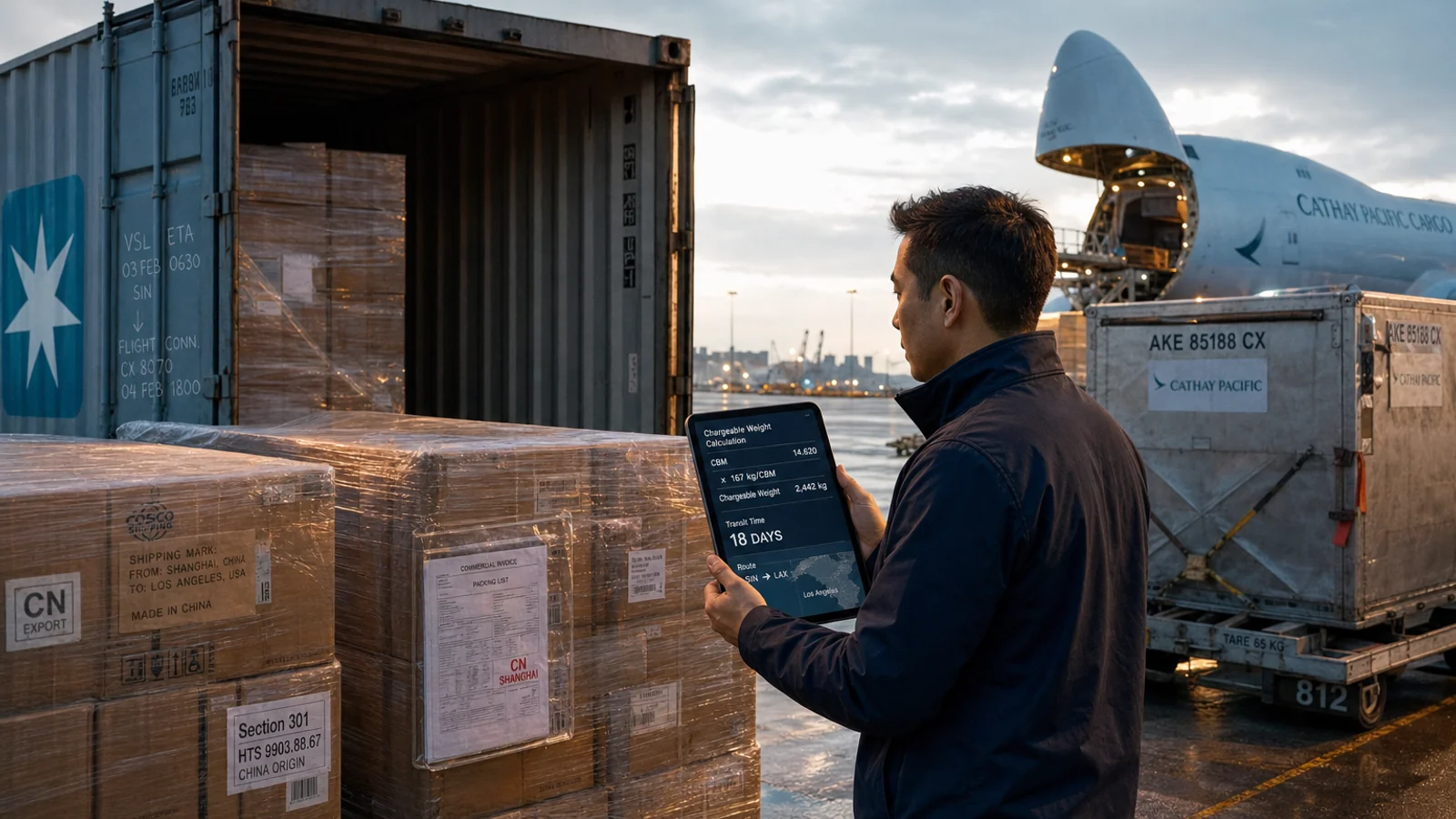
Quick answer Sea-air cargo from China to the USA moves your freight by ocean to a transshipment hub, then by air to the final US airport, landing in roughly 18-22 days door to door. It costs well below pure air freight and beats ocean LCL on speed. Request your rate in the calculator on this page.
- Sea-air China to USA takes about 18-22 days door to door, versus 30-45 days for ocean LCL and 5-8 days for air freight.
- Chargeable weight decides your air and sea-air price: divide volume in cm by 6,000 for air, 5,000 for express, and compare against actual kilos.
- Section 301 duties, IEEPA tariffs and the end of Section 321 de minimis mean duty is now a larger line than freight on many China to USA shipments.
- Walio's calculator takes your China to USA sea-air request and a specialist confirms space and the exact price with the carrier within 1 business day.
This guide shows how a sea air cargo calculator china usa turns cartons and kilos into a quotable shipment, and where sea-air fits against FCL, LCL, standard air and express. If you also ship into Latin America, the Sea-Air China to Mexico Calculator: 2026 Rates covers the same mode on a different lane.
Get your China to USA sea-air quote
Submit your cargo details and a Walio specialist confirms carrier space and your exact price within 1 business day.
What is sea-air cargo from China to the USA?
Quick answer Sea-air cargo is a multimodal service that ships containers from China by ocean to a transshipment hub, then flies the cargo on to the US destination airport. It lands in roughly 18-22 days door to door, priced between ocean LCL and pure air freight, with one through booking and one set of documents.
Sea-air is one booking covering two legs under a single rate. The forwarder loads your cargo in a container at origin, sails it to a hub, then tenders it to an airline for the final flight. You deal with one party, not two.
The handoff happens at a container freight station (CFS) inside the hub. Cargo is deconsolidated, re-weighed, re-measured, screened for air security, then built onto aircraft pallets. That re-measure is binding, which is why your declared dimensions need to be accurate in China.
Which transshipment hubs serve this lane?
Operators route China to USA sea-air through a short list of hubs with deep ocean calls and strong airline capacity:
- Dubai (DXB) — the classic sea-air hub, strong westbound and transatlantic capacity into JFK and ORD.
- Singapore — fast feeder sailings from South China, broad long-haul lift to the US West Coast.
- Incheon (ICN) — short ocean leg from North China ports, heavy freighter frequency to LAX, ORD and ATL.
- Los Angeles — ocean to LA/Long Beach, then US domestic air on-carriage to inland cities like Chicago, Dallas and Atlanta.
What paperwork covers a two-leg move?
An ocean Bill of Lading or Sea Waybill covers China to the hub. An Air Waybill (AWB) is issued at the hub for the flight leg. Your forwarder usually acts as NVOCC on the ocean side and as the cargo agent on the air side.
Sea-air suits US importers with roughly 500 kg to 5,000 kg of medium-density cargo. Typical users missed an ocean cut-off, face a retail reset date, or need to refill fast-moving SKUs without paying airline rates on the full journey.
Sea-air space at the hub is allocated weekly, not sold on an open spot market. Book one sailing earlier than you think you need. A missed feeder from Yantian can push the whole shipment a full week, because the air leg is tied to a specific hub arrival window.
Get your China to USA sea-air quote
Submit your cargo details and a Walio specialist confirms carrier space and your exact price within 1 business day.
How does the sea air cargo calculator china usa work?
Quick answer Enter your pickup city in China, your US delivery ZIP, total cartons, weight and dimensions. The calculator computes CBM and chargeable weight, then takes your sea-air request for the United States. A Walio specialist confirms space and price with the carrier and sends your exact rate within 1 business day.
The tool works the same way a forwarder's rate desk does, only faster to fill in. You describe the cargo once and the system reads it for every mode.
- Origin and destination. Pickup city or port in China, delivery ZIP in the USA. Shenzhen to Chicago, for example.
- Cargo. Carton count, dimensions per carton, gross weight per carton, stackability.
- Commercial terms. Incoterm, commodity description, HS code, declared value.
- Mode. Request sea-air, and request FCL, LCL, air or express alongside it to compare the responses.
A worked example: Shenzhen to Chicago
Take 42 cartons at 60 x 40 x 40 cm, 18 kg each. Volume per carton is 0.096 m³, so total volume is 42 x 0.096 = 4.03 CBM. Actual gross weight is 756 kg.
Volumetric weight for the air leg is 4,032,000 cm³ ÷ 6,000 = 672 kg. Actual weight is higher, so chargeable weight is 756 kg. That single number drives the sea-air and air quotes. The LCL quote, by contrast, is built on 4.03 CBM.
Why this lane is quoted rather than instant
Sea-air allocation is capacity-controlled at the hub. The forwarder has to confirm a block on a specific feeder and a specific flight before a rate means anything. So the calculator takes your request for the United States and a specialist comes back with confirmed space and the exact price within 1 business day. No phone call, no sales script.
Give the HS code at quote stage even though freight pricing rarely depends on it. It tells the desk whether your cargo triggers air security screening restrictions, FDA prior notice or battery handling, all of which change which hub and which carrier can take the shipment.
How do I calculate CBM and chargeable weight for a shipment from China?
Quick answer CBM is length x width x height in meters, multiplied by the number of cartons. Chargeable weight is the higher of actual weight and volumetric weight. For air freight, divide cubic centimeters by 6,000; for express, by 5,000; for US domestic trucking, by 166 when working in inches and pounds.
Three divisors cover almost everything you will ship out of China. Use the right one and your quote will match the invoice.
| Mode | Formula | Divisor | Worked example | Result |
|---|---|---|---|---|
| Air freight (IATA) | L x W x H in cm ÷ divisor | 6,000 | 120 x 100 x 150 cm | 300 kg per pallet |
| Express courier | L x W x H in cm ÷ divisor | 5,000 | 60 x 40 x 40 cm | 19.2 kg per carton |
| US domestic LTL/air | L x W x H in inches ÷ divisor | 166 | 48 x 40 x 48 in | 555 lb per pallet |
| Ocean LCL (W/M) | Greater of CBM or metric tons | 1 CBM vs 1,000 kg | 4 CBM / 5,200 kg | Bills as 5.2 tons |
| Ocean FCL | Flat per container | n/a | 40HQ, 24 pallets | One container rate |
The density rule that decides your price
Cargo under 167 kg per CBM is volume-driven and will pay volumetric weight on air and sea-air. Above that, it pays actual kilos. Pillows, lampshades and plastic housewares sit far below the line. Hardware, tiles and batteries sit far above it.
Worked China example: 10 pallets at 120 x 100 x 150 cm equals 18 CBM. Volumetric weight is 18,000,000 cm³ ÷ 6,000 = 3,000 kg. Actual weight is 2,200 kg. Chargeable weight is 3,000 kg, and that is what the airline bills.
The re-measure always wins
Carriers re-measure at the CFS in China and again at the transshipment hub. Carton bulge, shrink wrap and pallet overhang add centimeters that your supplier's packing list never shows. A pallet quoted at 150 cm tall that arrives at 165 cm adds 30 kg of chargeable weight per pallet. Measure the loaded pallet, not the empty one.
Sea vs air vs sea-air vs express: which is cheaper from China to the USA?
Quick answer Ocean FCL is cheapest per kilo, express is fastest and most expensive, and sea-air sits between them at roughly half the transit of ocean LCL. Air freight wins on urgent, high-value or dense cargo. Sea-air wins when you need 18-22 day delivery without paying airline rates on the full journey.
| Mode | Door-to-door days | Pricing unit | Minimum charge basis | Best shipment size | Schedule reliability |
|---|---|---|---|---|---|
| Ocean FCL | 30-40 | Per container | One container | 15 CBM and up | Medium |
| Ocean LCL | 30-45 | Per CBM or W/M ton | 1 CBM | 2-15 CBM | Medium-low |
| Sea-air | 18-22 | Per chargeable kg | Several hundred kg | 500-5,000 kg | High |
| Standard air | 5-8 | Per chargeable kg, tiered | 45 kg or flat minimum | 100-3,000 kg | High |
| Express courier | 3-5 | Per chargeable kg (÷5,000) | 0.5 kg | Under 200 kg | Very high |
How air rate tiers actually work
Airlines price in breaks: minimum, +45 kg, +100 kg, +300 kg, +500 kg and +1,000 kg. Each break drops the per-kilo rate. A 290 kg shipment sometimes costs more than a 300 kg shipment, because the heavier tier carries a cheaper rate. Fuel and security surcharges then apply per chargeable kilo on top.
Sea-air is quoted the same way, per chargeable kilo on a lower rate base, because only the final leg burns jet fuel. The trade-off is a higher minimum: most sea-air programs will not take a 60 kg shipment.
When does LCL beat FCL?
LCL wins under roughly 10 CBM. Somewhere between 10 and 15 CBM a 20GP container usually wins on cost per CBM, and it skips CFS deconsolidation at destination entirely. Above 25 CBM, a 40HQ almost always beats two 20GPs.
| Container | Internal dimensions (L x W x H) | Usable CBM | Max payload | Typical pallets |
|---|---|---|---|---|
| 20GP | 5.90 x 2.35 x 2.39 m | 26-28 | ~28,000 kg | 10 standard |
| 40GP | 12.03 x 2.35 x 2.39 m | 55-58 | ~26,500 kg | 20-21 standard |
| 40HQ | 12.03 x 2.35 x 2.70 m | 65-68 | ~26,000 kg | 20-24 standard |
| 45HQ | 13.56 x 2.35 x 2.70 m | 75-78 | ~25,500 kg | 26-27 standard |
Ocean schedule reliability on the transpacific still swings season to season, especially around Chinese New Year and the August peak. Air and sea-air hold tighter windows because the final leg runs on a published flight schedule.
Compare sea-air, ocean and air on one request
One cargo entry, multiple modes. A specialist returns confirmed pricing within 1 business day.
At what weight does air beat sea from China to the USA?
Quick answer Air beats sea when cargo is dense, high-value or time-critical, not at a single magic weight. The break-even depends on density, inventory carrying cost and duty exposure. Low-volume, high-value shipments under roughly 300 kg often cost less by air once drayage, demurrage and LCL destination fees are counted.
Four inputs decide the break-even, and only one of them is freight:
- Chargeable weight versus CBM. Dense cargo flies relatively cheaply and sails relatively expensively under W/M rules.
- Cargo value per kilo. A kilo of phone accessories justifies air; a kilo of ceramic tile never will.
- Cost of capital over 25 extra days. Money sitting on a vessel is money not turning over.
- Destination handling on LCL. CFS deconsolidation, delivery order and chassis fees are fixed, so they hit small shipments hardest.
Why small LCL shipments disappoint
A 2 CBM LCL shipment pays the same delivery order fee, the same CFS handling and the same drayage minimum as a 12 CBM shipment. Those destination charges are flat. Spread over two cubic meters, they can match or exceed the ocean freight itself. That is where air quietly wins on landed cost.
Sea-air cuts roughly two to three weeks off ocean LCL while keeping the ocean rate base on the long leg. That is why it solves the break-even problem for mid-size shipments instead of forcing a choice between slow and expensive.
The decision rule
Compare landed cost per unit, not freight per kilo. Divide total landed cost — freight, origin charges, destination charges, duty and delivery — by the number of sellable units. Run it for each mode. The cheapest freight rate loses that comparison more often than importers expect.
Duty no longer shifts with mode the way it once did. With de minimis closed to Chinese-origin goods, a low-value air parcel and a low-value ocean carton face the same classification and the same duty stack.
How long does sea freight take from Shanghai to Los Angeles?
Quick answer Shanghai to Los Angeles runs about 14-18 days port to port on a direct transpacific service, plus 3-5 days for customs clearance, drayage and delivery. East Coast calls via Savannah or New York/New Jersey add 10-14 days. Sea-air through a hub typically lands in 18-22 days door to door.
| Origin | US gateway | Ocean port-to-port days | Air airport-to-airport days |
|---|---|---|---|
| Shanghai (CNSHA / PVG) | Los Angeles / Long Beach | 14-18 | 2-4 |
| Ningbo (CNNGB) | Los Angeles / Long Beach | 15-19 | 3-5 |
| Shenzhen-Yantian (CNYTN / CAN) | Los Angeles / Long Beach | 15-20 | 3-5 |
| Qingdao (CNTAO) | Seattle / Tacoma | 15-19 | 4-6 |
| Shanghai (CNSHA) | New York / New Jersey | 28-34 | 3-5 |
| Shenzhen-Yantian (CNYTN) | Savannah | 26-32 | 4-6 |
| Hong Kong (HKHKG / HKG) | Houston | 30-36 | 3-5 |
| Beijing (PEK) / Shanghai (PVG) | Chicago O'Hare (ORD) | via LA rail +5-8 | 2-4 |
 Shenzhen(CNYTN)
 Chicago(ORD)
Cut-off dates matter more than sailing dates
The vessel ETD is not your deadline. Documentation cut-off, VGM cut-off and CY cut-off fall days earlier, and each one is hard. Miss the VGM submission and your container rolls to the next sailing, which on a weekly transpacific string costs a full week.
Which US gateway serves your region?
- California and the Southwest: LA/Long Beach, then local drayage.
- Midwest: rail from LA to Chicago, or direct air into ORD on sea-air.
- Northeast: New York/New Jersey, or JFK on the air leg.
- Southeast: Savannah for ocean, ATL for air.
- Texas and the Gulf: Port Houston, or DFW and IAH for air.
- Pacific Northwest: Seattle/Tacoma.
On many sea-air programs, Los Angeles itself acts as the transshipment point. Ocean to LA/Long Beach, then US domestic air on-carriage to inland airports, which keeps the long-haul on water and the short hop in the air.
What does a China to USA shipment actually cost end to end?
Quick answer Freight is one line out of twelve. Your landed cost includes origin charges, the ocean or air leg, destination THC, ISF filing, customs clearance, duty and tariffs, MPF, HMF, a customs bond, chassis, drayage and last-mile delivery. Walio's calculator takes your sea-air request and a specialist returns the exact price within 1 business day.
| Line item | Paid under EXW | Paid under FOB | Paid under CIF | Paid under DDP | In a typical online quote? |
|---|---|---|---|---|---|
| Factory pickup / export trucking | Buyer | Seller | Seller | Seller | Only if requested |
| Origin THC and export customs | Buyer | Seller | Seller | Seller | Often excluded |
| Ocean / air freight | Buyer | Buyer | Seller | Seller | Yes |
| BAF, CAF, GRI, peak season surcharge | Buyer | Buyer | Seller | Seller | Sometimes bundled |
| Destination THC (DTHC) and delivery order | Buyer | Buyer | Buyer | Seller | Often excluded |
| ISF 10+2 and AMS filing | Buyer | Buyer | Buyer | Seller | Rarely |
| Customs brokerage and bond | Buyer | Buyer | Buyer | Seller | No |
| Duty, Section 301, MPF, HMF | Buyer | Buyer | Buyer | Seller | No |
| Chassis, drayage, last mile | Buyer | Buyer | Buyer | Seller | Sometimes |
| Demurrage and detention | Buyer | Buyer | Buyer | Buyer | Never |
The charges competitors leave off the first page
Watch for THC and DTHC, bunker adjustment factor (BAF), currency adjustment factor (CAF), general rate increase (GRI), peak season surcharge, AMS filing, the delivery order fee and the chassis split. None of them are exotic. They simply arrive after the headline number.
Demurrage and detention start on discharge
Free time at the terminal is finite, commonly four to five calendar days on the US West Coast. The clock starts when the container is discharged, not when your broker clears the entry or when your warehouse has a door open. A customs exam can burn the entire free period before you ever see the box. Plan clearance documents before arrival, not after.
Single-entry or continuous customs bond?
A single-entry bond covers one import. A continuous bond covers twelve months of entries and also satisfies ISF bonding. Importers filing more than roughly five entries a year usually find the continuous bond cheaper and far less administrative. Your licensed customs broker can run the comparison on your entry volume.
This lane is quoted, not instantly priced. The calculator takes your request, a specialist confirms carrier space and returns the exact price within 1 business day — in writing, with the inclusions itemized, and without a phone call.
Request your itemized China to USA rate
Confirmed space, exact price, itemized inclusions — back within 1 business day.
What tariffs and duties apply to China to USA cargo in 2026?
Quick answer Duty on China-origin goods now stacks: the base HTS rate, Section 301 lists, and IEEPA-based tariffs, with Section 321 de minimis no longer available for Chinese shipments. CBP also collects Merchandise Processing Fee and, on ocean cargo, Harbor Maintenance Fee. Confirm your HTS classification with a licensed customs broker.
The stack applies in order to the declared customs value:
- HTS base rate for your classification under the Harmonized Tariff Schedule of the United States.
- Section 301 list rate if your HTS code appears on an active list.
- IEEPA or reciprocal duty where it applies to China-origin goods.
- CBP fees: Merchandise Processing Fee on formal entries, plus Harbor Maintenance Fee on ocean arrivals only.
What the end of de minimis changed
Low-value Chinese parcels no longer clear duty-free under Section 321. They now require informal or formal entry, with classification, valuation and duty on every shipment. For ecommerce importers, that erased the economics of flying thousands of single parcels and pushed volume back toward consolidated air, sea-air and ocean.
Because HMF applies to ocean arrivals and not to air arrivals, duty-heavy cargo gains a small relative advantage on the air and sea-air legs. It rarely flips a decision on its own, but it belongs in the landed-cost model.
ISF still applies to sea-air
Per CBP, the Importer Security Filing ("10+2") must be transmitted at least 24 hours before the container is loaded onto the vessel at the Chinese port. Sea-air starts with an ocean leg, so the obligation stands. Late or inaccurate filings draw liquidated damages and cargo holds. Walio ships freight — for classification, valuation and duty exposure, use a licensed customs broker.
Which documents do I need for sea-air cargo China to USA?
Quick answer Seven documents cover most China to USA sea-air shipments: commercial invoice, packing list, ocean Bill of Lading or Sea Waybill, Air Waybill for the flight leg, ISF 10+2 filing, a customs power of attorney for your broker, and a single-entry or continuous customs bond.
- Commercial invoice — issued by the supplier; needed before ISF and at entry. Must show value, Incoterm and country of origin.
- Packing list — supplier; carton count, dimensions and gross weight per carton.
- Ocean Bill of Lading or Sea Waybill — issued by the NVOCC or carrier at the Chinese port for the first leg.
- Air Waybill (AWB) — issued at the transshipment hub, not in China, after re-weighing and security screening.
- ISF 10+2 — filed by your broker 24 hours before vessel loading in China.
- Customs power of attorney — signed by the importer of record for the broker.
- Customs bond — single-entry or continuous, in place before arrival.
Commodity-specific paperwork
Food and beverages need FDA prior notice. Radio-enabled electronics need an FCC declaration. Vehicles and vehicle parts may need DOT and EPA forms. Many buyers also request a certificate of origin, and any chemical or battery shipment needs a current safety data sheet.
Lithium batteries and magnets fly under IATA rules
The first leg moved by sea, but the second leg is a flight. IATA Dangerous Goods Regulations apply in full at the hub: UN 38.3 test summaries, state of charge limits, correct packing instructions and labeling. Loose magnets need a field strength test report. Cargo that fails screening at the hub sits there at your cost. Declare batteries and magnets at quote stage.
Shipping the same mode into other markets? See the Sea-Air China to Peru Calculator: 2026 Rates, the Sea-Air China to Guatemala Calculator: 2026 Rates, the Sea-Air China to Colombia Calculator: Rates in Seconds and the Sea-Air Cargo Vietnam to Paraguay Calculator: Rates 2026.
Choose sea-air when
You have 500 to 5,000 kg of medium-density cargo, a firm in-stock date three weeks out, and a margin that cannot absorb full airline rates. Sea-air holds the ocean rate base on the long leg and buys back two to three weeks against LCL.
Choose standard air when
Your cargo is dense, high-value or genuinely urgent, under roughly 300 kg, or you are rescuing a stockout. Five to eight days door to door costs more per kilo, but it costs less than an empty shelf during a selling season.
Start your China to USA sea-air request
Enter your cargo once. A specialist confirms space and sends the exact price within 1 business day.
Frequently asked questions
The cost depends on container size, origin port, US gateway, sailing season and the surcharges in force that week, so there is no single figure. Transpacific rates swing with GRI, peak season surcharges and bunker costs, and destination drayage varies by delivery ZIP. Enter your route and cargo in the calculator on this page and a specialist sends your exact price within 1 business day.
Sea freight is cheaper per kilogram on almost every China to USA shipment, often by a wide margin. Air wins on landed cost only when cargo is dense, high-value or urgent enough that 25 extra days of inventory cost more than the airline rate. Sea-air sits in the middle and is usually the better answer for 500 to 5,000 kg of medium-density freight.
Sea-air typically takes 18 to 22 days door to door, compared with 30 to 45 days for ocean LCL and 5 to 8 days for standard air freight. The ocean leg to the transshipment hub takes most of that time, and the flight leg plus US customs clearance adds a few days. Inland delivery beyond the arrival airport adds one to three days.
Most online calculators leave out duty and tariffs, Merchandise Processing Fee, Harbor Maintenance Fee, the customs bond, chassis and detention, and any inspection or exam fees charged by CBP. They also exclude origin charges when you buy EXW rather than FOB. Walio itemizes what the quote covers so you can see exactly which charges sit outside it.
Yes. The ocean leg from China to the transshipment hub still triggers Importer Security Filing requirements, and the 10+2 data must be filed 24 hours before the container is loaded at the Chinese port. Missing the window can bring penalties and a hold, so give your customs broker the data early.
Sea-air is the mode most US importers never price, and the one that solves the most problems between a missed ocean cut-off and an airline invoice. Enter your route, cartons and weights in the calculator above, request sea-air for the United States, and a Walio specialist confirms carrier space and your exact itemized price within 1 business day — no signup, no sales calls, just the number in writing.