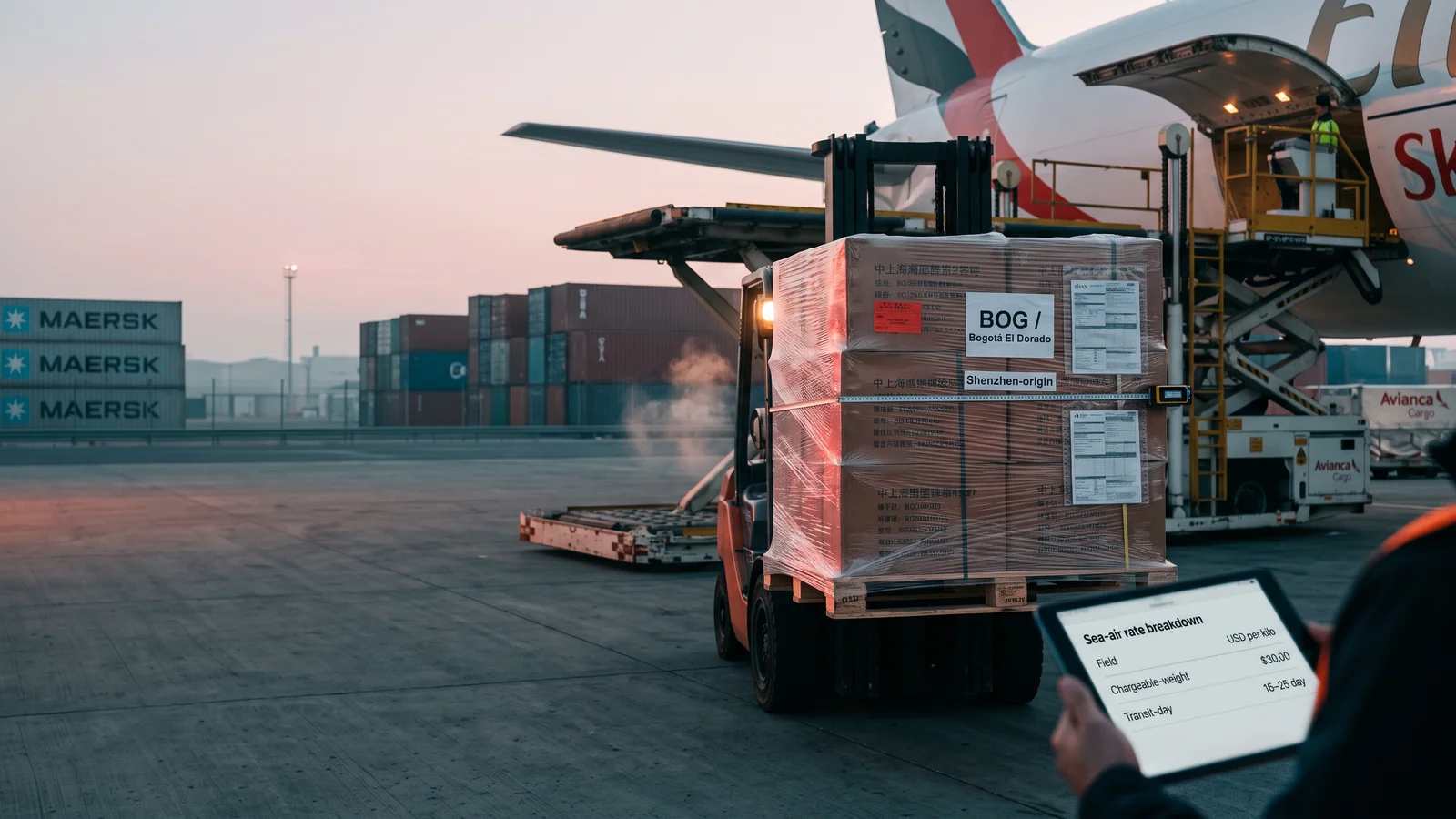
Quick Answer: Sea-air freight from China to Colombia moves in 16-25 days port to airport, with rates from $3.10/kg for 5,000+ chargeable kilos on Walio's live 2026 table. Cargo sails to Los Angeles, trucks to Miami, then flies to Bogota, Medellin, Cali or Barranquilla. Price your exact shipment in seconds.
- Sea-air China to Colombia takes 16-25 days total: 12-18 days ocean to Los Angeles, 3-5 days truck to Miami, 1-2 days air to Colombia.
- Walio 2026 rates start at $5.15/kg for 300-499 kg and drop to $3.10/kg from 5,000 kg, port to airport.
- Minimum billed weight is 300 kg, and chargeable weight is the greater of actual weight or volume x 167 kg per cubic meter.
- Colombia charges duty on the CIF value plus 19% IVA on CIF + duty, paid through a DIAN import declaration.
Colombian importers buying in Shenzhen, Ningbo or Qingdao face one recurring question: ocean is too slow, air is too expensive, so what sits in between? Sea-air does, and the calculadora sea-air china colombia on this page prices it instantly.
What is sea-air shipping from China to Colombia?
Quick Answer: Sea-air is one multimodal service that sails cargo across the Pacific, then flies the final leg. From China the box moves by ocean to Los Angeles, by truck to Miami, then by air to Bogota, Medellin, Cali or Barranquilla. Total transit runs 16-25 days port to airport.
Sea-air — written mar-aire or carga marítimo aérea by Colombian importers — combines two transport modes under one transit clock and one price. You do not buy an ocean quote and an air quote and glue them together. You buy a single port-to-airport service with one booking, and the operator handles the transfer in the middle.
Walio's China-Colombia routing is fixed and predictable. Cargo sails from the origin port to Los Angeles/Long Beach in 12-18 days. It then trucks across the United States to Miami in 3-5 days. From Miami it flies to Barranquilla (BAQ), Bogota (BOG), Cali (CLO) or Medellin (MDE) in 1-2 days.
 Shanghai(CNSHA)
 Los Angeles(USLAX)Los Angeles(USLAX)Miami(USMIA)Miami(MIA)
 Bogota(BOG)
The lane serves nine Chinese ocean gateways: Dalian, Fuzhou, Guangzhou, Ningbo, Qingdao, Shanghai, Shenzhen, Xiamen and Xingang. Your factory's nearest port drives both the sailing frequency and where you land inside the 16-25 day band.
Pro tip
The one real handoff risk sits at the US hub. Your cargo is deconsolidated at a CFS, re-weighed and re-manifested onto an air waybill before it flies. Label every carton with the house bill number and the consignee, so nothing goes astray during deconsolidation.
How much does sea-air China to Colombia cost per kilo?
Quick Answer: Walio's 2026 sea-air rates for China to Colombia start at $5.15/kg for 300-499 chargeable kilos, $4.25/kg for 500-999 kg, $3.56/kg for 1,000-4,999 kg and $3.10/kg from 5,000 kg. Those are port-to-airport freight rates on the cheapest port and airport pairing.
| Chargeable weight | Rate per kg (from) | Basis | Transit |
|---|---|---|---|
| 300-499 kg | from $5.15/kg | Port to airport | 16-25 days |
| 500-999 kg | from $4.25/kg | Port to airport | 16-25 days |
| 1,000-4,999 kg | from $3.56/kg | Port to airport | 16-25 days |
| 5,000 kg and above | from $3.10/kg | Port to airport | 16-25 days |
Every figure is a "from" rate on the cheapest port and airport pairing. Move the origin from Shenzhen to Dalian, or the destination from Bogota to Cali, and the number changes. The calculator prices your exact port and airport rather than an average.
Origin and destination handling charges are added per shipment, itemized, inside the calculator. They are never folded into the per-kg figure, because handling scales with the shipment, not with each kilo. Any quote that hides handling inside a single blended rate is hard to compare honestly.
Port to airport means exactly what it says: you deliver the cargo to the Chinese port, and your consignee collects it at the Colombian airport. Door pickup at the Chinese factory and door delivery in Bogota or Medellin are quoted on request — start in the calculator and add the legs you need.
Calculadora sea-air China Colombia: how it prices your shipment
Quick Answer: The calculator on this page asks for your Chinese port, Colombian airport, weight and dimensions, then returns a live sea-air price in seconds. It applies the 300 kg minimum, computes chargeable weight at 167 kg per cubic meter and adds origin and destination handling per shipment. No signup, no follow-up calls.
The calculadora sea-air china colombia needs four inputs:
- Origin port — Dalian, Fuzhou, Guangzhou, Ningbo, Qingdao, Shanghai, Shenzhen, Xiamen or Xingang.
- Destination airport — BAQ, BOG, CLO or MDE.
- Gross weight — the loaded weight in kilos, pallets included.
- Dimensions or CBM — so the tool can compute volumetric weight.
From that same input set you can toggle between ocean LCL, sea-air and air freight, and compare all three modes on one screen. That comparison is the whole point: sea-air only makes sense relative to its alternatives.
A 120 kg trial order still bills as 300 kg. Below roughly 300 chargeable kilos, courier or consolidated LCL usually wins — the calculator shows you both so you can see the crossover.
The price includes freight plus itemized handling. It excludes Colombian duty, IVA, customs brokerage and inland delivery beyond the airport. The number comes from real carrier rates and books online, not from a quote request waiting in someone's inbox.
For cargo that needs a human — oversize pieces, lithium batteries above the air thresholds, dangerous goods — the calculator takes your request and a Walio specialist follows up.
How is chargeable weight calculated on the air leg?
Quick Answer: Chargeable weight is the greater of actual gross weight and volumetric weight. On Walio's sea-air lane, volumetric weight equals cubic meters times 167 kg. The classic air formula divides length x width x height in centimeters by 6,000, which produces the same 167 kg per cubic meter result.
Two formulas, one answer:
- CBM × 167 kg — use this when you already know your cubic meters.
- (L × W × H in cm) ÷ 6,000 — the IATA air divisor, per carton or per pallet.
- Both give the same result, because 1,000,000 cm³ ÷ 6,000 = 167 kg.
Ocean LCL works differently. It bills per revenue ton, comparing cubic meters against 1,000 kg per CBM, so a dense shipment pays by weight and a light one pays by volume. Air is six times stricter on volume, which is why density decides whether sea-air is affordable.
Worked example: 500 actual kilos in 3 CBM. Volumetric weight is 3 × 167 = 501 kg. Since 501 beats 500, you bill 501 chargeable kilos and land in the 500-999 bracket at from $4.25/kg — roughly from $2,125 in freight, plus itemized handling.
Measure the loaded pallet, not the cartons
Pallet height and skid weight both count. A 15 cm pallet under a 100 cm stack adds 15% to your volumetric weight. Suppliers who quote carton dimensions only will consistently under-report your chargeable weight — then the re-weigh at the Miami CFS corrects it, and the invoice moves.
Sea-air vs ocean LCL vs direct air freight to Colombia
Quick Answer: Ocean LCL is the cheapest and slowest, direct air is the fastest and most expensive, and sea-air sits between them at 16-25 days port to airport. Sea-air suits cargo that is too urgent for a 35-45 day ocean transit and too heavy or low-margin to justify a full air rate.
| Mode | Transit (port/door) | Pricing unit | Minimum | Delay risk | Ideal cargo |
|---|---|---|---|---|---|
| Ocean LCL | 35-45 days | Per m³ / revenue ton | 1 m³ typical | Moderate: rollovers, CFS queues | Bulky, low value, base stock |
| Ocean FCL | 30-40 days | Per container | Full 20'/40' | Lower: no deconsolidation | 10-15 m³ and above |
| Sea-air | 16-25 days | Per chargeable kg | 300 kg | One extra hub handoff | Dense, high-value replenishment |
| Direct air | 5-9 days | Per chargeable kg | 45-100 kg typical | Lowest transit variance | Samples, emergencies, tiny dense parts |
LCL wins under roughly 10-15 m³, and FCL takes over above it. But neither wins when a 40-day transit costs you a stockout on your best-selling SKU. The freight premium is only expensive next to freight — it is cheap next to lost margin.
The risk profile matters. Sea-air adds one handoff that pure ocean does not have, so build a 2-3 day buffer into dates you promise your customers. And remember: anything restricted on an aircraft is restricted on the air leg — lithium batteries above IATA thresholds, aerosols, flammables and magnetized material all need declaration.
Which transshipment hubs serve sea-air to Colombia?
Quick Answer: A transshipment hub is the port-airport pair where cargo leaves the ship and joins a flight. Walio's China-Colombia sea-air routes through Los Angeles by sea, Miami by truck, then air to Colombia. Dubai, Panama and Vancouver are used on other carriers' networks with different transit and frequency profiles.
The hub decides your transit time and your reliability, far more than the vessel does. Walio's chain discharges at Los Angeles/Long Beach, trucks 3-5 days to Miami, and departs from the Miami air gateway — the densest cargo link to Colombia in the hemisphere.
| Hub | Sea leg from China | Air leg to Colombia | Flight frequency to BOG | Typical cargo |
|---|---|---|---|---|
| Los Angeles → Miami (Walio) | 12-18 days | 1-2 days | Daily, widebody and freighter | General, e-commerce, spare parts |
| Dubai (Jebel Ali / DXB) | 18-24 days | 2-3 days | Several weekly, via Europe or US | Project parts, Middle East consolidations |
| Panama (Colon / Tocumen) | 22-28 days | 1 day | Daily short-haul | Regional distribution, Free Zone stock |
| Vancouver | 11-15 days | 2-3 days | Limited, usually via a US hub | Western Canada consolidations |
Miami is the natural Colombia gateway because frequency absorbs problems. With daily widebody and freighter departures to BOG, MDE, CLO and BAQ, a missed flight means hours of delay, not days. Thin-frequency hubs turn one missed connection into a week.
The vessel is rarely the problem
Most sea-air delays happen on the ground: terminal congestion at the discharge port and CFS deconsolidation queues at the hub during peak season. Ask your operator for the CFS cut-off, not just the vessel ETA.
How do you calculate duties and IVA on a sea-air import?
Quick Answer: Colombia builds the CIF value as FOB plus all freight plus insurance. On a sea-air shipment that means FOB + ocean leg + hub handling + trucking + air leg + seguro. DIAN then applies the arancel for your subpartida arancelaria, and 19% IVA on CIF plus duty.
The sequence, per DIAN's published import rules:
- FOB value from the factura comercial.
- + freight — every leg: ocean, hub handling, US trucking and the air segment.
- + insurance (seguro) = CIF value.
- + arancel at your subpartida's rate on CIF.
- + 19% IVA on CIF plus arancel.
- + local charges: airport handling, brokerage, inland delivery.
On sea-air, every leg counts toward CIF — including hub handling and the Los Angeles to Miami trucking segment. Importers who declare only the air-leg freight understate the customs value, and DIAN corrects it with penalties.
| Commodity | Typical arancel band | Duty on CIF $10,000 | 19% IVA | Total tax |
|---|---|---|---|---|
| Electronics / IT equipment | 0% | $0 | $1,900 | $1,900 |
| Industrial machinery | 0-5% | $0-500 | $1,900-1,995 | $1,900-2,495 |
| Auto spare parts | 5-10% | $500-1,000 | $1,995-2,090 | $2,495-3,090 |
| Textiles | 10-15% | $1,000-1,500 | $2,090-2,185 | $3,090-3,685 |
| Footwear | 15% | $1,500 | $2,185 | $3,685 |
Paperwork your agente de aduanas will need:
- Factura comercial with FOB value and Incoterms 2020 term
- Packing list with carton dimensions and gross weight
- Certificado de origen where a trade agreement applies
- Declaración de importación filed with DIAN
- RUT and NIT of the Colombian importer
- Bill of lading or sea waybill for the ocean leg, air waybill for the air leg
Classification is a legal act. A licensed agente de aduanas determines your subpartida arancelaria and files the declaration. Walio is a shipping platform, not a customs or tax adviser.
When is sea-air worth paying for?
Quick Answer: Sea-air pays off when the cost of waiting exceeds the freight premium. Use it for high-value, high-margin or seasonal cargo where 20 extra ocean days mean lost sales. It rarely pays for bulky, low-value goods where freight is a large share of the landed cost.
Three break-even rules decide it:
- Freight share of value: if freight stays under roughly 10-15% of the goods' value, sea-air is defensible.
- Stockout cost: if 20 extra days cost you more gross margin than the premium, the math is already made.
- Density: above roughly 167 kg per CBM you pay on actual weight, which keeps sea-air competitive.
Dense electronics: 500 kg / 3 CBM
Volumetric weight is 501 kg, just above actual. You bill 501 chargeable kilos in the 500-999 bracket at from $4.25/kg. One extra cubic meter would push you to 668 kg and change nothing about the bracket — so tightening the packing barely helps here. Value density is high, so the freight premium disappears into the margin.
Light apparel: 1,200 kg / 9 CBM
Volumetric weight is 9 × 167 = 1,503 kg, well above the 1,200 actual kilos. You bill 1,503 chargeable kilos at from $3.56/kg, paying for air you are not filling with weight. Compressing garment cartons or vacuum-packing can move real money here, because every cubic meter you remove cuts 167 billed kilos.
Smart importers split the order. Base stock moves by ocean LCL or FCL; the fast-moving SKUs and the sizes you always run out of move sea-air. One more advantage: with no import container arriving in Colombia, you carry no demurrage or detention exposure at the destination.
How do you check a sea-air quote before you book?
Quick Answer: Compare quotes on chargeable weight, not gross weight, and confirm whether origin and destination handling are itemized or hidden. Ask which hub is used, whether the rate is port to airport or door to door, and what the airline's restrictions are for your commodity. Then match it against the calculator.
Run every offer against this checklist:
- Origin terminal handling and CFS charges at the load port
- Hub handling and deconsolidation at the transshipment point
- AWB fee, fuel surcharge and security surcharge on the air leg
- Destination airport handling and storage after free time
- Whether the rate is port to airport or true door to door
Get the routing, the hub and the air carrier in writing. That lets you verify flight frequency to BOG, MDE, CLO or BAQ yourself. Confirm the chargeable-weight basis is 167 kg per CBM and that the 300 kg minimum is stated, otherwise per-kg numbers are not comparable.
Know your documents, too. The ocean leg travels on a bill of lading or sea waybill; the air leg travels on an air waybill. The AWB is what releases your cargo at the Colombian airport, so confirm the consignee details on it match your NIT exactly.
Personal effects are a different shipment
Sea-air is a commercial cargo service. If you are importing household goods or personal belongings rather than merchandise, the documentation path changes — see our guide to moving to Colombia in 2026 and its documents and regulations before you book anything.
Walio compares real carrier rates across the lane — the ocean legs move with carriers such as Maersk, MSC, CMA CGM and Hapag-Lloyd, and the air leg on the scheduled Miami-Colombia services. The calculadora sea-air china colombia shows the result without a sales conversation.
Enter your Chinese port, your Colombian airport and your weight and dimensions in the calculator above, and see your sea-air price in seconds — no signup, no follow-up calls.
Sea-air from China to Bogota takes 16-25 days port to airport, depending on the origin port. The ocean leg to Los Angeles runs 12-18 days, the truck to Miami 3-5 days, and the Miami-Bogota flight 1-2 days. Add a 2-3 day buffer for hub deconsolidation during peak season.
Walio's 2026 sea-air rates start at $5.15/kg for 300-499 chargeable kilos and fall to $3.10/kg from 5,000 kilos, port to airport on the cheapest port and airport pairing. Origin and destination handling are added per shipment. The calculator on this page returns your exact rate in seconds.
Use sea-air when 35-45 days of ocean transit costs you more in lost sales than the freight premium, but full air freight would erase your margin. It fits high-value, seasonal and replenishment cargo. Bulky low-value goods almost always ship cheaper by ocean LCL or FCL.
Chargeable weight is the greater of actual gross weight and volumetric weight, where volumetric weight equals cubic meters times 167 kg. That matches the standard air divisor of 6,000 for dimensions in centimeters. Walio bills a minimum of 300 kg, so lighter shipments are still charged as 300 kg.
No. The calculator prices freight and itemized handling, not taxes. DIAN charges the arancel for your subpartida arancelaria on the CIF value, then 19% IVA on CIF plus duty, and a licensed agente de aduanas files your declaracion de importacion.