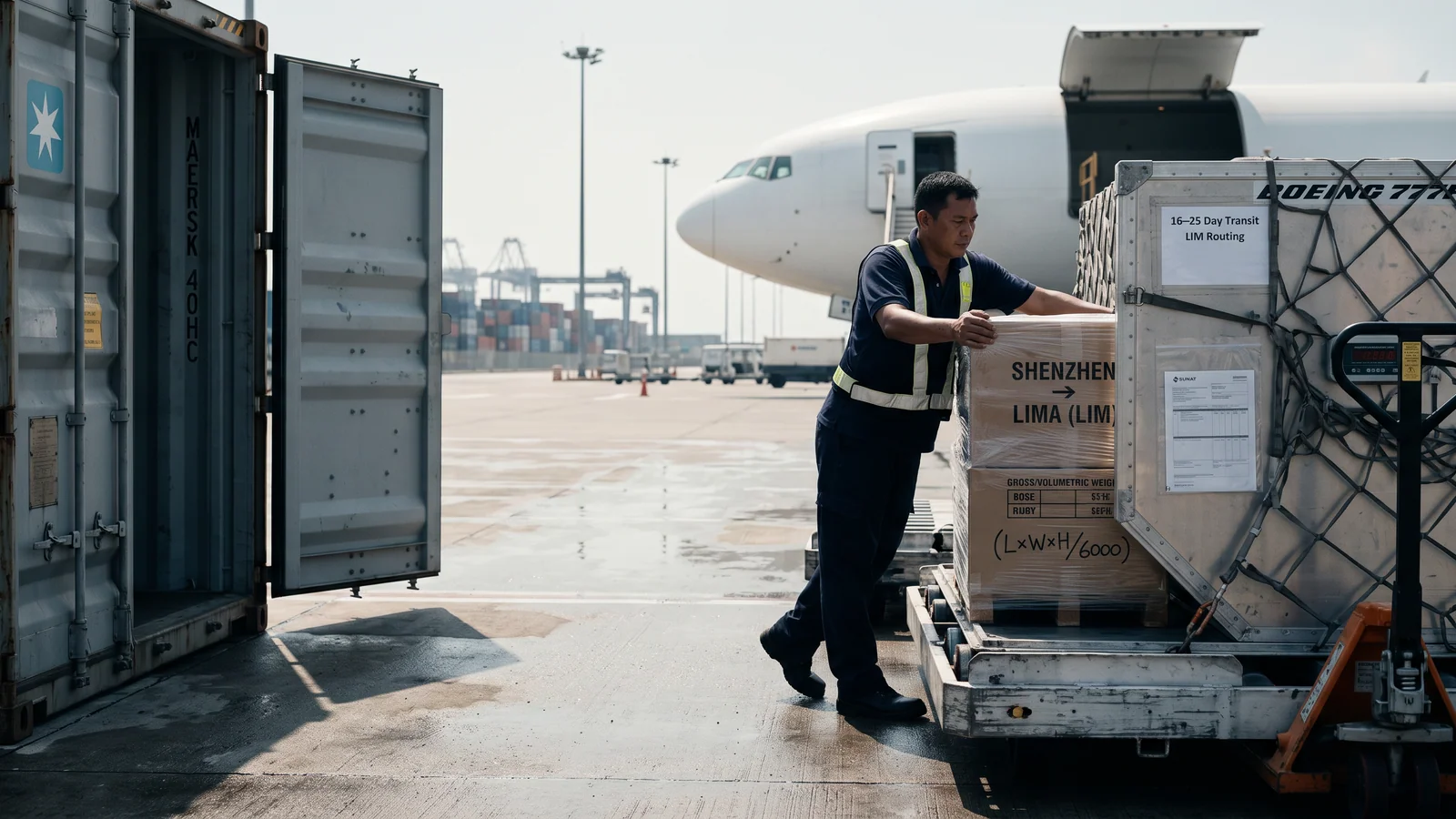
Quick Answer: Sea-air cargo from China to Peru runs 16-25 days port to airport and starts from $4.36/kg at 5,000+ kg, from $6.39/kg at 300-499 kg. Cargo moves by ocean to Los Angeles, by truck to Miami, then by air to Lima. Minimum billed weight is 300 kg.
- Sea-air China to Peru takes 16-25 days total: 12-18 days ocean to Los Angeles, 3-5 days truck to Miami, 1-2 days air to Lima (LIM).
- Rates start from $6.39/kg for 300-499 kg and drop to from $4.36/kg at 5,000+ kg, port to airport, on the cheapest port-airport pairing.
- Chargeable weight is the greater of actual weight and volume × 167 kg per m³; anything under 300 kg is billed as 300 kg.
- Sea-air pays off for dense, mid-value goods that need speed: spare parts, electronics accessories, fashion restocks and seasonal SKUs that would miss their window on a 35-45 day ocean sailing.
Peruvian importers buying in China face one recurring problem: ocean freight to Callao is affordable but slow, and a direct flight to Jorge Chávez destroys the margin. Sea-air sits in the middle, and this page prices it instantly.
What is sea-air cargo from China to Peru?
Quick Answer: Sea-air cargo is one multimodal service that combines an ocean leg, a truck leg and a flight under a single booking. From China it sails to Los Angeles in 12-18 days, trucks to Miami in 3-5 days, then flies to Lima in 1-2 days. Total transit: 16-25 days.
The service moves your cargo across three legs under one booking and one chargeable weight. You do not manage three suppliers or reconcile three invoices. Walio books the chain end to end and prices it as a single rate per kilo.
The three legs on this lane are fixed:
- Ocean leg: your Chinese origin port to the Port of Los Angeles/Long Beach, 12-18 days depending on the port.
- Truck leg: Los Angeles to Miami by road, 3-5 days across the southern corridor.
- Air leg: Miami International to Jorge Chávez International Airport in Lima (LIM), 1-2 days.
Nine Chinese ports feed this service: Dalian, Fuzhou, Guangzhou, Ningbo, Qingdao, Shanghai, Shenzhen, Xiamen and Xingang. Transit varies by port, and the northern ports sit at the long end of the range.
Is the service door to door?
No. Sea-air on this lane is port to airport. The shipper delivers the cargo to the origin port in China, and the consignee collects it at Jorge Chávez. Door pickup at a Chinese factory and door delivery in Lima, Arequipa or Trujillo are quoted on request through the calculator.
Why does Peru's sea-air route go through Miami?
Classic Asian sea-air hubs such as Dubai and Seoul feed Europe, Africa and the Middle East. They have no reliable, high-frequency airlift into Lima. The Americas corridor via Los Angeles and Miami does, because Miami is the largest air cargo gateway to Latin America. Reliability beats theoretical shortcuts, and 16-25 days port to airport is the number to remember.
Pro tip
Because the ocean leg ends in the United States, your cargo passes through a US transit process before the Miami flight. Keep your commercial invoice and packing list accurate and consistent with the ocean bill of lading. A description mismatch is the single most common cause of a delay on this corridor.
 Shenzhen(CNSZX)
 Lima(LIM)
How much does sea-air shipping from China to Peru cost in 2026?
Quick Answer: Sea-air freight from China to Peru starts from $6.39/kg for 300-499 chargeable kg, from $5.49/kg for 500-999 kg, from $4.81/kg for 1,000-4,999 kg and from $4.36/kg for 5,000+ kg. Those are the cheapest port-airport pairings; origin and destination handling are added per shipment.
Rates come from Walio's live multimodal rate table, port to airport, as of October 2, 2026. The brackets work like air freight: the more chargeable weight you ship, the lower the rate per kilo.
| Chargeable weight bracket | Rate per kg (from) | Scope |
|---|---|---|
| 300-499 kg | $6.39 | Port to airport |
| 500-999 kg | $5.49 | Port to airport |
| 1,000-4,999 kg | $4.81 | Port to airport |
| 5,000+ kg | $4.36 | Port to airport |
What does the per-kilo rate include?
The per-kilo figure is freight only: ocean, truck and air across the three legs. Origin handling at the Chinese port and destination handling at Lima appear as separate per-shipment lines in the calculator. Walio never folds them into the kilo rate, because doing so hides the real cost of a small shipment.
These charges sit outside the freight quote entirely:
- Peruvian ad valorem duty, IGV and IPM — SUNAT charges, not Walio charges
- Customs brokerage by your agente de aduana in Lima
- Door pickup in China and door delivery in Peru, quoted on request
- Cargo insurance, priced on your declared value
- Airport storage if you clear late at the Jorge Chávez terminal
How does the 300 kg minimum change your cost per kilo?
The minimum billed weight is 300 kg. A 180 kg shipment is billed as 300 kg, so your effective cost per actual kilo rises sharply. Run the math before booking: if your consignment sits well under 300 kg, express courier is usually the better answer.
Rates also vary by origin port and destination airport pairing. The figures above reflect the cheapest pairing on the lane. From $4.36/kg at 5,000+ kg is the volume break where sea-air starts competing hard with consolidated ocean on total landed cost.
How is chargeable weight calculated for sea-air to Peru?
Quick Answer: Chargeable weight is the greater of actual gross weight and volumetric weight. For sea-air, volumetric weight equals cubic meters multiplied by 167 kg per m³. A 4 m³ shipment weighing 500 kg bills at 668 kg, because 4 × 167 = 668. The minimum billed weight is 300 kg.
The formula is short: chargeable weight = max(actual kg, CBM × 167). Everything else follows from it.
This is the density break for sea-air. Cargo denser than 167 kg per cubic meter bills on actual weight. Lighter cargo bills on volume, and the rate per real kilo climbs fast.
Worked example A: dense cargo wins
You ship 3 m³ of automotive brake components weighing 1,200 kg. Volumetric weight is 3 × 167 = 501 kg. Actual weight is higher, so chargeable weight is 1,200 kg. That lands in the 1,000-4,999 kg bracket, from $4.81/kg. Dense cargo gets the best value from this service.
Worked example B: light cargo loses
You ship 6 m³ of plastic storage bins weighing 420 kg. Volumetric weight is 6 × 167 = 1,002 kg. Volume drives the bill, so you pay for 1,002 kg while moving 420 real kilos. Sea-air stops making sense below 167 kg per m³ — put that cargo on ocean LCL.
How does this differ from air and LCL rules?
| Mode | Volumetric rule | 1 m³ equals |
|---|---|---|
| Sea-air | CBM × 167 | 167 kg |
| Pure air freight | (L × W × H in cm) ÷ 6,000 | 167 kg |
| Ocean LCL | 1 CBM = 1,000 kg | 1,000 kg (1 revenue ton) |
| Express courier | (L × W × H in cm) ÷ 5,000 | 200 kg |
Pure air's /6000 divisor produces the same 167 kg per cubic meter, just expressed in centimeters. Ocean LCL is far more forgiving on light cargo, which is exactly why bulky goods belong there.
Three packing habits that cut your bill
- Palletize tight and square. Void space inside a pallet is weight you pay for.
- Measure the pallet, not the carton. Carriers remeasure at the port and bill the larger figure.
- Declare real dimensions in your booking. A remeasure dispute at origin can cost you the sailing.
Which merchandise justifies sea-air from China to Peru?
Quick Answer: Sea-air pays for itself when cargo is dense, mid to high value, and tied to a date. Spare parts, electronics accessories, phone cases, tools, fashion restocks, cosmetics packaging and seasonal SKUs all qualify. Low-value bulk goods such as furniture, plastic housewares and empty containers stay on ocean LCL or FCL.
Run a 10-second density test first: divide total kilos by total cubic meters. Above 167, sea-air prices well. Below it, you are paying for air.
Good fits for sea-air
- Automotive and machinery spare parts for a machine sitting idle in a Lima workshop
- Electronics, accessories, phone cases, chargers and small appliances
- Apparel and footwear restocks where a best-selling size ran out mid-season
- Medical consumables and laboratory supplies with contract delivery dates
- Promotional goods for a dated campaign — Fiestas Patrias, Navidad, Cyber Wow
- First production runs and product launch samples that gate your whole launch
Poor fits for sea-air
- Furniture, mattresses and upholstered goods — far under 167 kg per m³
- Plastic housewares, buckets, bulk packaging and empty bottles
- Low-value ceramics and tiles where freight exceeds goods value
- Anything where a 35-45 day ocean sailing costs you nothing in lost sales
How do you decide in money, not in feelings?
Compare the freight premium per kilo against the margin you lose by arriving late. If a stockout on a top SKU costs you three weeks of sell-through, the premium is cheap. If the goods sit in a warehouse until next quarter, it is not. Sea-air also rescues factory delays: lose three weeks at the supplier and you can still hit the season.
Lithium batteries and dangerous goods
The air leg follows the IATA Dangerous Goods Regulations. Lithium-ion batteries, power banks, aerosols, magnets and flammable liquids all need declaration before booking, correct UN packaging and specialist handling. Declaring them after the cargo ships gets it offloaded in Miami at your cost. Flag them in the calculator and a Walio specialist follows up.
Sea-air vs ocean vs air freight China to Peru: which wins?
Quick Answer: Ocean LCL to Callao is cheapest but slow at 35-45 days plus customs. Pure air to Jorge Chávez is fastest at 5-8 days and the most expensive per kilo. Sea-air sits between them: 16-25 days port to airport, from $4.36/kg at 5,000+ kg, with weekly departures from nine Chinese ports.
| Factor | Ocean LCL/FCL | Sea-air | Pure air |
|---|---|---|---|
| Transit to Peru | 35-45 days + customs | 16-25 days port to airport | 5-8 days |
| Cost position | Lowest | Middle | Highest |
| Minimum shipment | 1 m³ (LCL) | 300 kg billed | Varies, often 45 kg |
| Best cargo density | Under 167 kg/m³ | Above 167 kg/m³ | Above 167 kg/m³ |
| Frequency ex-China | Weekly | Weekly, 9 ports | Multiple weekly |
| Rollover risk | Moderate on LCL | Low on the air leg | Higher in peak season |
| Insurance cost | Lowest premium | Middle | Lowest risk, short exposure |
Where does each volume band belong?
| Option | Volume range | Door-to-door time | Who it suits |
|---|---|---|---|
| Express courier | Under 0.3 m³ | 4-7 days | Samples, urgent small parts |
| Ocean LCL | 0.1-15 m³ | 40-55 days | Bulky, low-value, no deadline |
| Sea-air | Any, 300 kg minimum billed | 18-30 days | Dense cargo with a date |
| Ocean FCL 20'/40' | 15 m³ and above | 40-55 days | Full-container volume buyers |
The LCL-to-FCL break point sits near 10-15 m³. Past that, a 20' container usually beats per-CBM consolidation. Sea-air does not compete on that axis at all — it competes on weight, because its price is driven by chargeable kilos.
What about transshipment on the pure ocean route?
Most China-to-Callao ocean services transship at Manzanillo, Balboa or Busan. Each relay adds days and one more chance of a rollover. Chancay's new deepwater terminal is opening direct options for Peru, and schedules are still settling as of 2026 — treat the published transit with care. Walio compares carriers such as Maersk, MSC, CMA CGM and Hapag-Lloyd on the ocean side.
Shipping to more than one market? The same logic applies next door: compare the Sea-Air China to Mexico Calculator: 2026 Rates for your Mexican entity, and the Sea-Air China to Colombia Calculator: Rates in Seconds for the Andean lane into Bogotá.
How long does sea-air from China to Peru take by origin port?
Quick Answer: Total transit is 16-25 days port to airport, depending on the Chinese origin port. The ocean leg to Los Angeles takes 12-18 days, the truck leg to Miami 3-5 days and the flight to Lima 1-2 days. North China ports such as Dalian, Qingdao and Xingang sit at the long end.
| Origin port | Region | Ocean leg to LA (days) | Total to Lima (days) |
|---|---|---|---|
| Shenzhen / Yantian | South China | 12-15 | 16-22 |
| Guangzhou | South China | 12-15 | 16-22 |
| Xiamen | South China | 13-16 | 17-23 |
| Fuzhou | South China | 13-16 | 17-23 |
| Ningbo | East China | 13-16 | 17-23 |
| Shanghai | East China | 13-17 | 17-24 |
| Qingdao | North China | 14-17 | 18-24 |
| Xingang / Tianjin | North China | 15-18 | 19-25 |
| Dalian | North China | 15-18 | 19-25 |
South China ports generally sail faster to Los Angeles, because they sit closer to the transpacific trunk routes. Northern ports add a coastal feeder or a longer rotation.
Why does the port cut-off matter more than the ETD?
The port cut-off — the last moment your cargo and documents can be received — usually falls 2-4 days before the vessel's ETD. Miss it and your cargo waits a full week for the next sailing. That one week erases the entire advantage you bought by choosing sea-air. Book with the cut-off in your calendar, not the departure date.
What if my goods come from Yiwu?
Yiwu is a market city, not a port. Cargo trucks to Ningbo or Shanghai first, which adds 1-2 days before the ocean leg starts. Build that into your supplier's handover date.
Pro tip
Three windows tighten space and push rates up: the four weeks before Chinese New Year, Golden Week in early October, and the Q3 peak season when general rate increases and peak season surcharges apply. Book two to three weeks earlier than usual in those windows, or your sea-air advantage disappears at the origin port.
What documents and Incoterms do you need for China to Peru?
Quick Answer: A sea-air shipment to Peru travels on an ocean bill of lading for the sea leg and an air waybill into Lima, plus a commercial invoice, packing list and, for tariff preference, the Peru-China FTA certificate of origin (Form F). Incoterms 2020 decide who pays each leg.
Document checklist
- Factura Comercial (commercial invoice) with HS code, Incoterm and value
- Packing list with real weights and dimensions per package
- Ocean bill of lading (B/L) for the China-Los Angeles leg
- Air waybill (AWB) for the Miami-Lima leg
- Certificado de Origen Form F for Peru-China FTA tariff preference
- Insurance certificate if you buy cover separately
- Importer RUC registered and active with SUNAT
Which Incoterm should a Peruvian importer ask for?
| Incoterm 2020 | Who pays freight | Who insures | Who clears in Peru |
|---|---|---|---|
| EXW | Buyer | Buyer | Buyer |
| FCA | Buyer | Buyer | Buyer |
| FOB | Buyer | Buyer | Buyer |
| CIF | Seller | Seller (minimum cover) | Buyer |
| DAP | Seller | Seller | Buyer pays duty/tax |
| DDP | Seller | Seller | Seller |
FOB is usually the right ask. Your supplier delivers to the Chinese port and you control the freight leg, which means the rate you see in the calculator is the rate you pay. Under CIF or DDP, the freight is buried in the goods price and you never see it itemized.
DDP from a Chinese supplier also shifts import responsibility in a way that can create problems with SUNAT, because the declared value and the importer of record stop lining up with your books. Many experienced Peruvian importers avoid it for that reason.
Form F must match exactly
The Peru-China FTA certificate of origin must match the commercial invoice description, quantity and HS code line by line. A mismatch voids the preference and you pay the general ad valorem rate. Ask your supplier for a draft Form F before shipment and check it against the invoice yourself.
Do you need both a forwarder and a broker?
Yes, in almost every case. The agente de carga (freight forwarder) moves the cargo and issues the transport documents. The agente de aduana (customs broker) files your declaration with SUNAT and releases the goods. They are different licenses and different jobs.
If you are comparing origins beyond China, the same multimodal structure runs from Southeast Asia — see the Sea-Air Vietnam to Colombia Calculator: Rates 2026 for how a Vietnam origin prices on a comparable Andean lane.
What taxes does SUNAT charge on imports from China to Peru?
Quick Answer: Peru applies ad valorem duty by tariff heading (commonly 0%, 6% or 11%), IGV at 16% plus IPM at 2% on the CIF value plus duty, and an advance percepción of IGV for many importers. The Peru-China FTA can reduce or remove the ad valorem rate with a valid Form F.
Per SUNAT, the calculation runs in a fixed order:
- Establish the CIF value: goods value plus freight plus insurance to Peru.
- Apply ad valorem duty by partida arancelaria — commonly 0%, 6% or 11%.
- Apply IGV at 16% plus IPM at 2% on CIF plus duty.
- Pay the percepción del IGV where it applies — an advance credit, not an extra tax.
A valid Form F under the Peru-China FTA can reduce or eliminate the ad valorem line. Without it, you pay the general rate, full stop.
What do SUNAT's clearance channels do to your timeline?
| Channel | What happens | Typical effect on timeline |
|---|---|---|
| Verde (green) | Automatic release | No added delay |
| Naranja (orange) | Document review | 1-3 days |
| Rojo (red) | Physical inspection | 2-7 days plus storage |
Filing a despacho anticipado — the DAM declared before arrival — is the single best move for sea-air cargo. It shortens dwell at the Jorge Chávez terminal and avoids airport storage charges, which accrue daily. Despacho excepcional, filed after arrival, costs you both time and storage.
Which goods need a permit before they fly?
- DIGESA: food, beverages, hygiene and household cleaning products
- DIGEMID: medicines, medical devices, cosmetics and supplements
- SENASA: plant and animal products, including wooden packaging
- MTC: homologation for telecom devices and radio equipment
- IATA DGR: lithium batteries, aerosols and other dangerous goods on the air leg
Duty and tax figures above are Peru's published rates, not Walio charges, and they never sit inside your freight quote. Have a licensed customs broker confirm your HS classification before you order — a wrong partida is the most expensive mistake in the chain. For a regional point of comparison, the Sea-Air Hong Kong to Costa Rica Calculator: 2026 Rates shows how a different Central American tax regime changes the landed cost.
How do you get your sea-air China to Peru price in seconds?
Quick Answer: Enter the Chinese origin port, Lima as the destination airport, your chargeable weight and dimensions in the calculator on this page. The price appears in seconds from live carrier rates, with freight and handling itemized. No signup, no forms waiting for an email, no follow-up calls.
- Pick your origin port from the nine on the lane.
- Pick Lima (LIM) as the destination airport.
- Enter total weight and cubic meters, or piece dimensions.
- Read the itemized price and book online.
What the quote shows
Freight per chargeable kilo at your weight bracket, origin handling at the Chinese port, and destination handling at Jorge Chávez — each as its own line. You see the full freight cost before you commit, and nothing is bundled to hide a margin.
What sits outside the quote
Peruvian ad valorem duty, IGV and IPM, customs brokerage with your agente de aduana, and door legs in China or Peru. Door pickup and door delivery are quoted on request through the same calculator.
Should you insure the shipment?
Yes for electronics and high-value spare parts. Cover is priced on declared value and follows the Institute Cargo Clauses: ICC A is all-risk, ICC B is named perils plus water damage, ICC C is the narrowest. Carrier liability alone is capped by weight and will not make you whole on a lost pallet of phone accessories.
When should a specialist look at your shipment?
- Dangerous goods and lithium batteries needing IATA DGR handling
- Oversized or overweight single pieces for the air leg
- Permit-controlled merchandise under DIGESA, DIGEMID or SENASA
- Project cargo and multi-origin consolidations
Submit those through the calculator or open the chat, and a Walio specialist follows up. The same instant pricing runs on other long-haul lanes — see the Sea-Air Hong Kong to Jamaica Calculator: 2026 Rates for an example.
Sea-air China to Peru gives you ocean economics on the long leg and air speed into Lima, in 16-25 days port to airport. Enter your route in the calculator above and see your price in seconds — no signup, no follow-up calls.
Sea-air freight from China to Peru starts from $6.39/kg for 300-499 chargeable kg and drops to from $4.36/kg at 5,000+ kg, port to airport. Those rates apply to the cheapest port-airport pairing on the lane; origin and destination handling are added per shipment. The calculator on this page prices your exact port, airport and weight in seconds.
Sea-air takes 16 to 25 days port to airport, depending on the Chinese origin port. The ocean leg to Los Angeles runs 12-18 days, the truck leg to Miami 3-5 days and the flight into Lima 1-2 days. South China ports such as Shenzhen and Guangzhou sit at the fast end of that range.
The minimum billed weight is 300 kg. A shipment of 150 kg is still charged as 300 kg, so very small consignments usually do better on express courier or consolidated LCL. Chargeable weight is the greater of actual weight and volume multiplied by 167 kg per cubic meter.
Yes. Sea-air costs meaningfully less per kilo than a direct flight from China to Jorge Chávez because the long leg travels by ocean. It is slower than pure air at 16-25 days versus 5-8 days, but far faster than a 35-45 day ocean sailing to Callao, which makes it the middle option for dated cargo.
Peru charges ad valorem duty by tariff heading, then IGV at 16% plus IPM at 2% on the CIF value plus duty, and an advance percepción of IGV for many importers. A valid Peru-China FTA certificate of origin (Form F) can reduce or remove the ad valorem rate. Confirm your HS classification with a licensed customs broker.