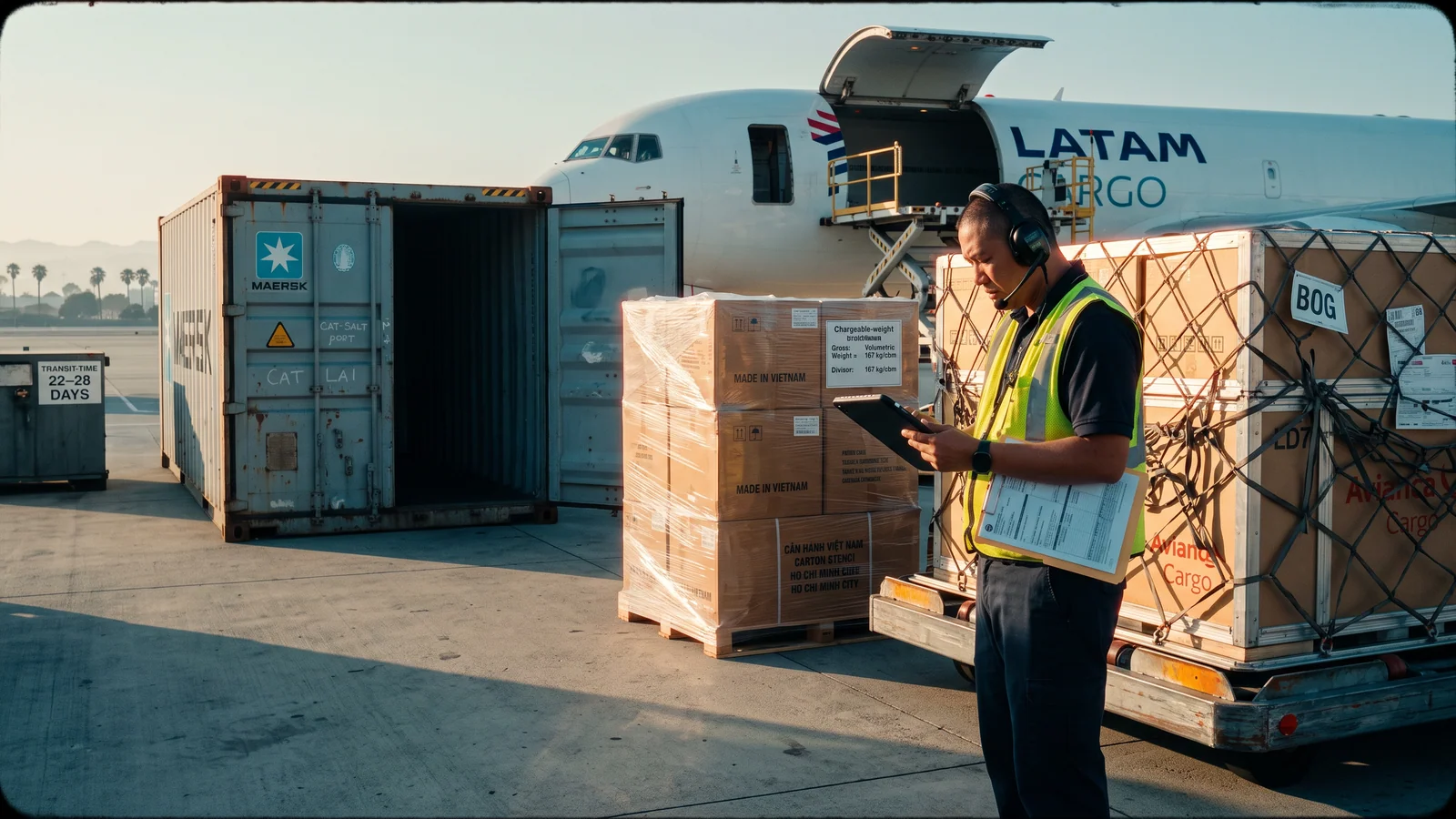
Quick Answer: Sea-air freight from Vietnam to Colombia takes 22-28 days and starts from $3.19/kg for shipments of 5,000+ kg, port to airport. Cargo sails from Ho Chi Minh City to Los Angeles, trucks to Miami, then flies to Bogotá, Barranquilla, Cali or Medellín. The calculator prices your exact port, airport and weight in seconds.
- Sea-air Vietnam to Colombia moves in 22-28 days: 18-21 days ocean to Los Angeles, 3-5 days truck to Miami, 1-2 days air to BOG, BAQ, CLO or MDE.
- Walio sea-air rates per chargeable kg start from $5.42 (300-499 kg), $4.41 (500-999 kg), $3.64 (1,000-4,999 kg) and $3.19 (5,000+ kg), port to airport.
- Minimum billed weight is 300 kg, and chargeable weight is the greater of actual weight or volume × 167 kg per m³.
- Colombia applies MFN duty plus 19% IVA on imports from Vietnam — there is no Colombia-Vietnam free trade agreement.
Colombian importers buying furniture in Ho Chi Minh City, textiles in Hai Phong or electronics in Da Nang face one recurring problem: 40 days of ocean transit kills replenishment. A sea air calculator vietnam to colombia solves it by pricing both modes on the same shipment, instantly.
What is sea-air freight and how does it work from Asia to Latin America?
Quick Answer: Sea-air freight is one service that moves cargo by ocean for the long leg, then by air for the final leg. From Vietnam, containers sail to Los Angeles, cargo is trucked to Miami, deconsolidated, and flown into Colombia. You pay one chargeable-weight rate and get ocean economics with air-style delivery windows.
Ocean covers distance, air covers speed, and one rate card covers both. Sea-air is a multimodal service sold as a single booking, not two shipments you stitch together yourself. The forwarder controls the handoff, so you never own the risk of a missed connection between modes.
Where does the cargo physically change hands?
The container is discharged at Los Angeles/Long Beach, then drayed to a warehouse near the port. A truck runs the cargo to Miami across the southern corridor. At a Miami CFS the consolidation is broken down — deconsolidation — and each consignment is rebuilt as air cargo for uplift into Colombia.
- Ocean leg: Ho Chi Minh City to Los Angeles, 18-21 days on the water.
- Road leg: Los Angeles to Miami by truck, 3-5 days including drayage.
- Air leg: Miami to Barranquilla (BAQ), Bogotá (BOG), Cali (CLO) or Medellín (MDE), 1-2 days.
Why route through the United States instead of Singapore or Panama?
Classic Asia-Latin America ocean routings transship at Singapore or Busan, then again at Manzanillo or Balboa, before calling Cartagena or Buenaventura. Each transshipment adds waiting time for the next connecting vessel. The US land bridge replaces two ocean transshipments with a truck run, which cuts calendar days rather than sailing speed.
One booking also means one document set: ocean bill of lading for the sea leg, air waybill for the flight, and one party accountable end to end. That is what makes multimodal shipping Vietnam Bogota practical for a mid-size importer without an in-house logistics team.
Pro tip
Sea-air is priced like air freight but moves like ocean freight for most of the journey. That means your packing decisions matter more than your port choice — volumetric weight, not the vessel, usually sets your final bill.
Sea air calculator Vietnam to Colombia: what does it price instantly?
Quick Answer: The calculator prices sea-air Vietnam to Colombia port to airport, by chargeable kg. Rates start from $5.42/kg for 300-499 kg, $4.41/kg for 500-999 kg, $3.64/kg for 1,000-4,999 kg and $3.19/kg for 5,000+ kg on the cheapest port and airport pairing. Handling charges are added per shipment on screen.
The per-kg band drops as your volume rises. That is the direct answer to Vietnam to Colombia air freight cost per kilo searches: there is no single number, there is a ladder. A 400 kg order and a 5,200 kg order on the identical route pay very different unit rates.
| Chargeable weight band | Sea-air rate per kg (from) | Billing basis | Service scope |
|---|---|---|---|
| Under 300 kg | Billed as 300 kg | Minimum billed weight | Port to airport |
| 300-499 kg | from $5.42 | Chargeable kg | Port to airport |
| 500-999 kg | from $4.41 | Chargeable kg | Port to airport |
| 1,000-4,999 kg | from $3.64 | Chargeable kg | Port to airport |
| 5,000 kg and above | from $3.19 | Chargeable kg | Port to airport |
Every figure is a "from" rate. The exact number depends on your origin port in Vietnam and your arrival airport in Colombia, which the calculator resolves on screen. As of 2026, these come from Walio's live multimodal rate table.
What exactly is included, and what is not?
The scope is port to airport. The shipper delivers the cargo to the origin port in Vietnam, and the consignee collects it at BAQ, BOG, CLO or MDE. Origin and destination handling charges appear as separate per-shipment lines in the calculator — they are never folded into the per-kg rate, because that is how forwarders hide cost.
- Sea-air freight per chargeable kg, shown against your weight band
- Origin handling at the Vietnamese port, itemized per shipment
- Destination handling at the Colombian airport, itemized per shipment
- Door pickup in Vietnam and door delivery in Colombia, quoted on request through the same flow
Why does the 300 kg minimum matter?
A 180 kg shipment is billed as 300 kg. Below roughly 250 kg, courier or parcel service often lands cheaper because it has no ocean-side minimum to absorb. Above 300 kg, sea-air pulls ahead quickly and keeps improving with every band. Importers bringing personal effects rather than commercial cargo should read our Moving to Colombia in 2026 guide to documents and regulations before choosing a mode.
How long does sea freight take from Vietnam to Colombia?
Quick Answer: Pure ocean freight from Vietnam to Colombia runs 30-45 days port to port, with transshipment at Singapore, Busan or Manzanillo/Panama before Cartagena or Buenaventura. Air freight lands in 3-8 days. Sea-air through Los Angeles and Miami delivers in 22-28 days total, depending on your origin port.
| Mode | Transit | Typical routing | Scope quoted |
|---|---|---|---|
| FCL ocean | 30-45 days | HCMC → Singapore/Busan → Manzanillo → Cartagena | Port to port |
| LCL ocean | 35-45 days | Consolidation + CFS deconsolidation at destination | Port to port / CFS |
| Sea-air | 22-28 days | HCMC → Los Angeles → Miami → BOG/BAQ/CLO/MDE | Port to airport |
| Air cargo | 3-8 days | SGN/HAN → hub → BOG | Airport to airport |
| Express parcel | 4-7 days | Integrator network, door to door | Door to door |
The sea-air clock breaks into three legs you can audit: 18-21 days on the water, 3-5 days on the road, 1-2 days in the air. Add a day or two at the Miami CFS for deconsolidation and air build-up. That is where the 22-28 day range comes from.
Sea-air removes roughly two weeks versus pure ocean on the Vietnam-Colombia lane, without paying full air freight per kilo.
Why do shipments lose a week before they even sail?
Importers blame slow vessels. The real culprit is usually the documentation cut-off, which closes days before the vessel ETD. Miss the cut-off in Ho Chi Minh City and your cargo rolls to the next sailing — a full week gone. Get the commercial invoice, packing list and shipping instructions to the forwarder before the cut-off, not before the ETD.
Does the arrival point change inland time?
Yes, and it matters for flete Vietnam Colombia tiempo de transito comparisons. Cartagena on the Caribbean trucks to Bogotá in roughly two days and Medellín in about a day and a half. Buenaventura on the Pacific is closer to Cali but climbs a difficult corridor to Bogotá. Sea-air skips all of it by landing the cargo at the airport nearest your warehouse.
Is air freight or sea freight cheaper from Vietnam to Colombia?
Quick Answer: Ocean freight is cheapest per kilo but slowest; air is fastest and most expensive; sea-air sits between them on both. For dense, mid-size shipments of roughly 300 kg to 5,000 kg that cannot wait 40 days, sea-air usually wins on total cost of ownership once you price inventory and stockout risk.
| Factor | Ocean (FCL/LCL) | Sea-air | Air cargo |
|---|---|---|---|
| Transit | 30-45 days | 22-28 days | 3-8 days |
| Billing basis | Container, or 1 CBM = 1,000 kg | Chargeable kg, volume × 167 kg/m³ | Chargeable kg, cm³ ÷ 6,000 |
| Minimum | 1 CBM typical on LCL | 300 kg | 45-100 kg typical |
| Best for | Furniture, bulk, 10+ CBM | Textiles, electronics, 300-5,000 kg | Samples, urgent SKUs, spares |
| Schedule reliability | Lower — two transshipments | Medium — one land bridge | Highest |
| CO₂ per kg moved | Lowest | Medium | Highest |
The break-even is a working-capital calculation, not a freight-rate calculation. When your LCL cost per cubic meter plus 40 days of inventory carrying cost exceeds the sea-air cost on chargeable weight, sea-air is the cheaper decision. Dense cargo tips that balance fastest, because dense cargo wastes money on volume-based ocean billing.
Choose FCL
Above roughly 10-15 m³, a 20 ft or 40 ft container usually undercuts per-cubic-meter LCL pricing, and it undercuts sea-air decisively. Vietnamese rattan, case goods and upholstered furniture are volume-heavy and light — exactly the profile that should sail in a box you control. You also avoid CFS deconsolidation handling at both ends.
Choose sea-air
Between about 300 kg and 5,000 kg of dense cargo, sea-air is the sweet spot. Cotton knitwear, footwear, small appliances and consumer electronics carry high value per cubic meter, so the chargeable-weight math works in your favor. You cut roughly two weeks of transit and land the goods at your city's airport.
Many Colombian importers on replenishment cycles run both. Bulk and seasonal stock sails FCL to Cartagena; fast-moving SKUs and late reorders come by sea-air into BOG or MDE. Splitting the order by velocity, not by supplier, is the cheapest inventory strategy on this lane.
How do I calculate chargeable weight for air cargo from Vietnam to Colombia?
Quick Answer: Chargeable weight is the greater of actual gross weight and volumetric weight. For Walio sea-air, volumetric weight is volume in cubic meters × 167 kg per m³. Pure air cargo uses the 1:6000 rule (length × width × height in cm ÷ 6000). LCL ocean bills 1 CBM as 1,000 kg.
Start with CBM. Multiply length × width × height in meters for each carton or pallet, then add them up. That single number drives every mode's pricing, so measure the packed pallet, not the product.
| Mode | Conversion rule | 1 m³ equals | What wins the bill |
|---|---|---|---|
| Pure air cargo | cm³ ÷ 6,000 | 167 kg | Greater of actual or volumetric |
| Walio sea-air | m³ × 167 kg | 167 kg | Greater of actual or volumetric |
| LCL ocean | 1 CBM = 1,000 kg | 1,000 kg | Greater of weight or measure (W/M) |
| FCL ocean | Flat per container | Not applicable | Container size and payload limit |
Three worked examples on this lane
- 3 CBM of Vietnamese textiles, 400 kg actual. Volumetric = 3 × 167 = 501 kg. Volumetric wins, so you pay on 501 kg — and you land in the 500-999 kg band at from $4.41 per chargeable kg.
- 6 CBM of electronics, 1,400 kg actual. Volumetric = 1,002 kg, actual = 1,400 kg. Actual wins and places you in the 1,000-4,999 kg band from $3.64 per kg.
- 1.2 CBM of samples, 150 kg actual. Volumetric = 200 kg. Both are under the floor, so the shipment bills at the 300 kg minimum.
Pro tip
Palletize to kill voids. One repacked pallet of knocked-down furniture parts can cut volumetric weight enough to drop a full rate band — the jump from 300-499 kg to 500-999 kg is more than a dollar per kilo. Ask your Vietnamese supplier for carton dimensions before booking, not after loading.
Which Vietnamese ports and Colombian airports serve this lane?
Quick Answer: Sea-air cargo leaves Vietnam from Cat Lai and Cai Mep in Ho Chi Minh City, with feeder connections from Hai Phong and Da Nang. It arrives in Colombia at Barranquilla (BAQ), Bogotá (BOG), Cali (CLO) or Medellín (MDE). Your port and airport pairing sets both the rate and the transit.
Cat Lai and Cai Mep handle the direct Ho Chi Minh City sailings to Los Angeles. Hai Phong and Da Nang cargo either feeds south to the HCMC gateway or transships at Singapore or Busan, which adds days. That is why the calculator asks for your exact loading port instead of guessing "Vietnam".
 Ho Chi Minh City(Cat Lai)
 Bogotá(BOG)Cai Mep(VNCMT)Barranquilla(BAQ)Hai Phong(VNHPH)Medellín(MDE)
Match the airport to your warehouse. Bogotá buyers take BOG, Antioquia manufacturers take MDE, Valle del Cauca importers take CLO, and Caribbean coast or Barranquilla free-zone users take BAQ. BOG sits at roughly 2,600 m altitude, which reduces aircraft payload on departure and is one reason per-kg rates differ by arrival airport.
Pure ocean alternatives remain Cartagena, Buenaventura, Barranquilla and Santa Marta, each with its own inland trucking bill to Bogotá or Medellín. Walio compares carriers such as Maersk, MSC, CMA CGM and Hapag-Lloyd on those ocean legs. The calculator prices your exact port-airport pair rather than a lane average.
What surcharges and accessorials belong in a real quote?
Quick Answer: A complete sea-air quote covers origin port charges, the per-kg sea-air freight, and destination airport handling in Colombia. Outside the freight sit customs clearance, duty, IVA and any storage. Calculators that show only a per-kg number hide THC, ISPS, AMS filing and destination handling — Walio itemizes them on screen.
Origin side, in Vietnam
- Terminal handling charge (THC) at Cat Lai, Cai Mep or Hai Phong
- Documentation and bill of lading issuance fees
- ISPS security charge
- AMS and ISF "10+2" manifest filings required for the US ocean leg, per CBP
- Vietnamese export declaration
Freight side
Sea-air freight bills per chargeable kg. BAF and CAF apply where the carrier publishes them, and peak season surcharges appear out of Asia in the third and fourth quarters. Panama Canal surcharges do not apply here, because a Los Angeles-Miami land bridge never transits the Canal — a genuine saving over Caribbean-routed ocean services.
Colombian destination side
- Airport handling and deconsolidation at BOG, BAQ, CLO or MDE
- Customs clearance fees and your broker's fee
- VUCE processing for permits filed through the single window
- ICA or INVIMA inspection fees on regulated goods such as wood, food contact items and cosmetics
- Warehouse storage once free time expires — airport storage is charged per day
On the ocean leg, demurrage runs when a container sits in the terminal past free time, and detention runs when you hold the box outside the terminal too long. Sea-air limits your exposure, since the container never reaches Colombia. At the airport, count storage days from release, not from arrival.
Cargo insurance is a separate, optional line, typically quoted at 0.3%-0.5% of CIF value. It is not included in freight and never automatic.
| Cost block | EXW | FOB | CIF | DDP |
|---|---|---|---|---|
| Vietnamese inland + port charges | Buyer | Seller | Seller | Seller |
| Main freight (sea-air) | Buyer | Buyer | Seller | Seller |
| Insurance | Buyer | Buyer | Seller | Seller |
| Colombian destination handling | Buyer | Buyer | Buyer | Seller |
| Duty and 19% IVA | Buyer | Buyer | Buyer | Seller |
DDP from a Vietnamese supplier is not risk-free
DDP under Incoterms 2020 shifts import liability to the seller, including clearance and taxes. But the Colombian importer of record still needs its own NIT on the declaración de importación to claim the IVA credit. If the supplier's agent clears under someone else's NIT, you can lose the credit entirely. Confirm the arrangement with a licensed Colombian customs broker before you sign the purchase order.
What import taxes do I pay in Colombia on goods shipped from Vietnam?
Quick Answer: Colombia charges MFN import duty plus 19% IVA on most goods from Vietnam, because the two countries have no free trade agreement. Duty depends on the HS classification of your product. DIAN assesses both on the CIF value, so freight and insurance enter the tax base — not just the invoice.
Duty rates vary by HS code. Common published bands on furniture, textiles and electronics fall at 0%, 5%, 10% and 15%, with 19% IVA layered on top. These are government rates set in Colombia's tariff schedule, not Walio charges.
- FOB value + freight + insurance = CIF value
- Duty is assessed on the CIF value
- IVA at 19% is assessed on CIF value plus duty
Because freight enters the tax base, a cheaper freight rate reduces your duty and IVA too. That compounding is why importers should compare modes on landed cost, not on freight alone.
A Vietnamese certificate of origin will not cut your duty
There is no preferential tariff between Colombia and Vietnam, so the Certificado de Origen serves compliance and traceability, not savings. Per DIAN, Asian textiles and some steel and ceramic lines also face price-reference scrutiny and antidumping measures, which can raise the declared value used on your declaración de importación. Registered importers usually recover IVA as a credit, while duty is a real cost — confirm your position with a licensed customs broker or tax adviser.
Which documents, and how do you check the estimate against a forwarder quote?
Quick Answer: You need a commercial invoice, packing list, bill of lading for the ocean leg, air waybill for the air leg, certificate of origin and your Colombian RUT and NIT. To validate any calculator estimate, compare it line by line: chargeable weight, freight per kg, origin charges, destination handling and taxes.
- Factura Comercial — commercial invoice with HS codes and Incoterm stated
- Lista de empaque — packing list with carton dimensions and gross weights
- Bill of Lading (B/L) for Ho Chi Minh City to Los Angeles
- Air Waybill (AWB) for Miami to your Colombian airport
- Certificado de Origen from the Vietnamese exporter
- RUT and NIT of the Colombian importer of record
- Mandato aduanero authorizing your customs broker to file with DIAN
Confirm HS classification before booking. A wrong code changes duty, can trigger ICA or INVIMA review, and strands cargo in airport storage while the file is corrected.
How do you audit a forwarder quote?
- Check whether the quote prices chargeable weight, not gross weight — the difference on textiles is often 25% or more
- Confirm it names the exact origin port and the exact arrival airport, not "Vietnam to Colombia"
- Confirm freight, handling and taxes appear as three separate blocks
- Ask what free time applies at the destination airport before storage begins
Pro tip
Book around Tet. Vietnamese factories close for one to two weeks between late January and mid-February, and space tightens both before and after the holiday. Add Q3-Q4 peak season surcharges out of Asia and the pre-December US trucking crunch, and the safest windows for sea-air are March-May and September.
For household goods, Menaje de Casa filings and used-goods declarations, the rules differ from commercial cargo — start with our complete guide to moving to Colombia in 2026. When cargo is oversized, hazardous or project scale, submit it through the calculator and a Walio specialist follows up with the routing options.
Stop trading emails for rates. Enter your Vietnamese port, your Colombian airport and your chargeable weight in the sea air calculator vietnam to colombia above, and see the price in seconds — no signup, no follow-up calls.
Container pricing depends on size, port pair and sailing week, so Walio prices 20 ft, 40 ft and 40 HC FCL live in the calculator on this page. For faster mid-size cargo, sea-air from Vietnam to Colombia starts from $3.19/kg for 5,000+ kg, port to airport. Enter your port and weight to see both options in seconds.
Pure ocean freight takes 30-45 days port to port, usually with transshipment at Singapore, Busan or Manzanillo before Cartagena or Buenaventura. Sea-air cuts that to 22-28 days by sailing to Los Angeles, trucking to Miami and flying into Colombia. Air cargo lands in 3-8 days.
Sea freight is cheaper per kilo, and air freight is faster. Sea-air sits between them: 22-28 days at rates from $5.42/kg for 300-499 kg down to $3.19/kg for 5,000+ kg, port to airport. For dense shipments that cannot wait 40 days, sea-air usually delivers the lowest total cost.
Chargeable weight is the greater of your actual gross weight and your volumetric weight. For Walio sea-air, multiply cubic meters by 167 kg per m³; pure air cargo uses length × width × height in cm divided by 6,000. The minimum billed weight on this lane is 300 kg.
Colombia applies MFN import duty based on your HS code plus 19% IVA, since there is no Colombia-Vietnam free trade agreement. DIAN calculates both on the CIF value, so freight and insurance are part of the tax base. Confirm your exact rate with a licensed Colombian customs broker.