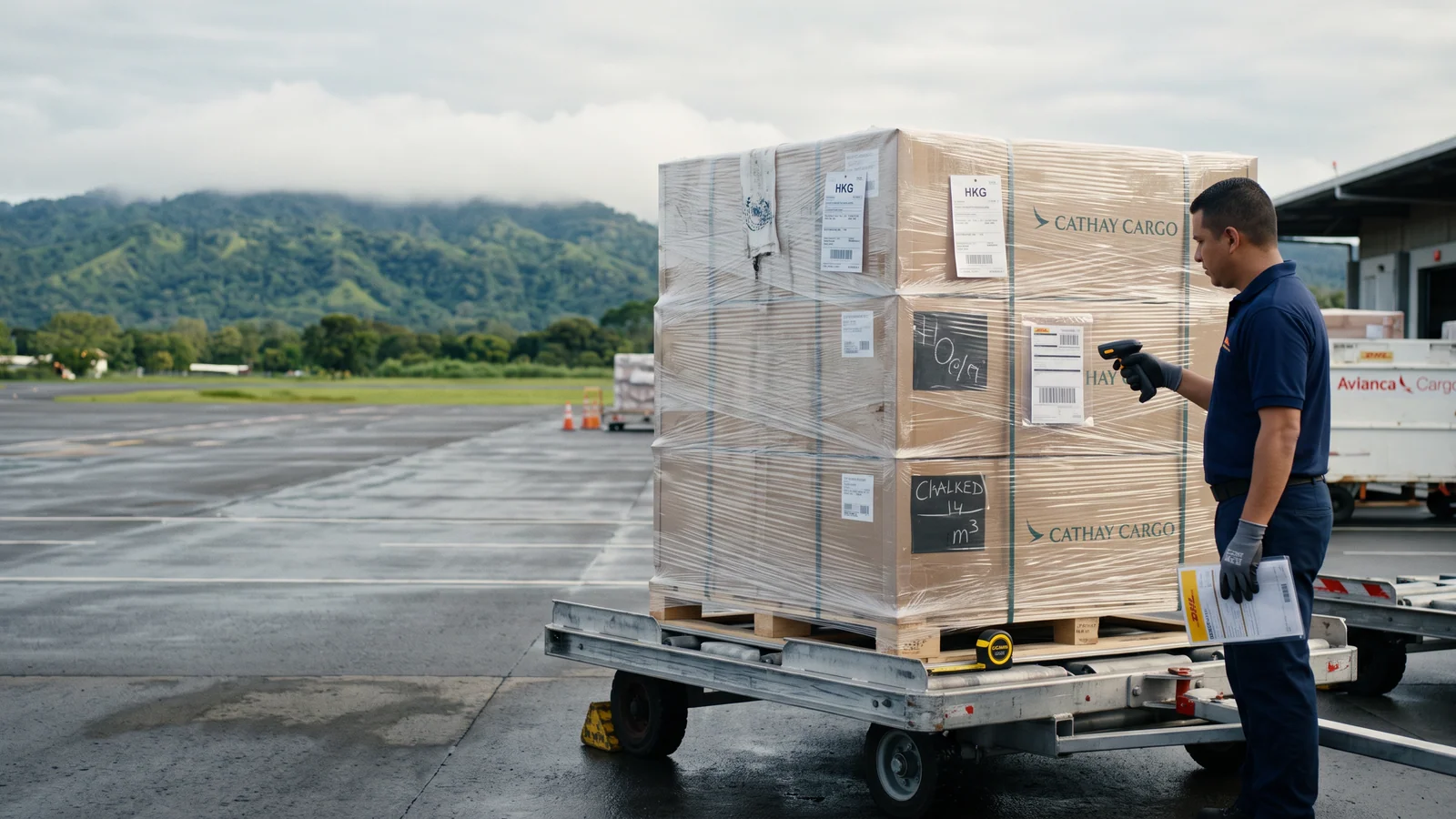
Quick Answer: Sea-air freight from Hong Kong and South China to Costa Rica starts at $3.40/kg for 5,000+ kg and $5.45/kg for 300-499 kg, port to airport, with a 300 kg minimum billed weight. Transit runs 16-25 days: ocean to Los Angeles, truck to Miami, air to San Jose (SJO).
- Sea-air from South China ports to San Jose takes 16-25 days total: 12-18 days ocean to Los Angeles, 3-5 days trucking to Miami, 1-2 days flying to SJO.
- Walio sea-air rates start at $5.45/kg for 300-499 kg and drop to $3.40/kg at 5,000+ kg, port to airport, on the cheapest port-airport pair.
- Chargeable weight is the greater of actual kilos and volume x 167 kg per cubic meter; anything under 300 kg is billed as 300 kg.
- Costa Rica charges DAI by HS code, the 1% Ley 6946 levy, selective consumption tax where it applies, and 13% IVA on top of the accumulated base.
This guide breaks down the rate bands, the chargeable weight math, the transit segments and the Costa Rican tax stack. The calculator on this page prices your exact port, airport and weight instantly.
What is sea-air freight and how does the Hong Kong to Costa Rica route work?
Quick Answer: Sea-air freight moves one shipment on an ocean vessel for the long leg, then transfers it to an aircraft for the final leg. From South China it sails to Los Angeles in 12-18 days, trucks to Miami in 3-5 days, then flies to San Jose in 1-2 days. Total: 16-25 days.
Sea-air is a single multimodal service booked under one contract, with an ocean bill of lading covering the water leg and an air waybill covering the flight. You book once. The forwarder handles the transfer between modes at the hub, so the cargo never sits idle waiting for a second booking.
On the Walio lane, cargo sails from Dalian, Fuzhou, Guangzhou, Ningbo, Qingdao, Shanghai, Shenzhen, Xiamen or Xingang to Los Angeles. From the Los Angeles/Long Beach complex it moves by truck to Miami in 3-5 days. Miami then flies it to Juan Santamaría International (SJO) in 1-2 days.
 Shenzhen(CNSZX)
 San Jose(SJO)
Hong Kong cargo usually consolidates through neighboring Pearl River Delta ports. Shenzhen (Yantian, Shekou) and Guangzhou (Nansha) sit a short truck run from Kowloon and carry more sailings to Los Angeles. The calculator prices whichever origin port your supplier actually loads from.
Port to airport means a clear split of responsibility. The shipper delivers cargo to the origin port terminal. The consignee collects it at the SJO cargo terminal after clearance. Door pickup in China and door delivery in Costa Rica are quoted on request through the same calculator.
Pro tip
Sea-air sits between pure air and LCL on both price and speed. Importers in San Jose use it for restock runs on proven SKUs, not for a first shipment of unknown demand. Test demand with a small courier order, then refill by sea-air once the sell-through is real.
How much does sea-air cargo from Hong Kong to Costa Rica cost per kilo?
Quick Answer: Walio sea-air rates from South China to San Jose start at $5.45/kg for 300-499 chargeable kilos, $4.53/kg for 500-999 kg, $3.86/kg for 1,000-4,999 kg and $3.40/kg for 5,000 kg and up. These are port-to-airport freight rates on the cheapest port-airport pair; handling is added per shipment.
| Chargeable weight band | Sea-air rate (port to airport) | Billing basis |
|---|---|---|
| Under 300 kg | Billed as 300 kg | Minimum charge |
| 300-499 kg | from $5.45/kg | Chargeable kg |
| 500-999 kg | from $4.53/kg | Chargeable kg |
| 1,000-4,999 kg | from $3.86/kg | Chargeable kg |
| 5,000 kg and up | from $3.40/kg | Chargeable kg |
Every figure above is a "from" rate on the cheapest port-airport pair on the lane. The exact number depends on your origin port and destination airport. A Shanghai booking and a Xingang booking do not price the same.
The 300 kg minimum billed weight matters more than most importers expect. A 180 kg shipment still pays for 300 kg. Below that line, international courier almost always wins on total cost and door service.
The rate steps down hard at each break. That is why buyers combine two purchase orders from the same supplier cluster to cross 1,000 kg or 5,000 kg. One consolidated booking at a lower band often beats two separate shipments at a higher band.
What the freight rate covers, and what is billed separately:
- Included: the ocean leg, the Los Angeles to Miami trucking leg, and the Miami to SJO air leg
- Added per shipment: origin handling, destination handling, delivery order (DO) fee
- Billed at destination: SJO airport terminal charges and Costa Rica customs clearance
- Paid to the DGA: DAI, Ley 6946, selective consumption tax and 13% IVA
Run your numbers in the calculadora sea air hong kong costa rica at #quote-calc. It returns your chargeable weight, your band and your total in seconds, with no signup and no follow-up call.
How do you calculate chargeable weight for a sea-air shipment?
Quick Answer: Chargeable weight for sea-air is the greater of actual gross weight and volumetric weight, where volumetric weight equals cubic meters multiplied by 167 kg. One cubic meter of cargo under 167 kg bills as 167 kg. Pure air uses a 6,000 cm³/kg divisor; ocean LCL uses 1,000 kg per cubic meter.
Three formulas govern three different modes. Learn all three and you will never be surprised by a quote again.
- Air: length × width × height in cm ÷ 6,000 = volumetric kg. That equals 167 kg per cubic meter.
- Ocean LCL: weight or measure, whichever is greater, at 1,000 kg per cubic meter.
- Sea-air: uses the air basis of 167 kg per CBM, compared against actual gross weight.
Worked example. You ship 12 pallets measuring 120 × 80 × 70 cm each. Volume is 0.672 CBM per pallet, so 8.06 CBM total. Volumetric weight is 8.06 × 167 = 1,346 kg. Actual gross weight is 900 kg.
Chargeable weight is 1,346 kg, not 900 kg. That lands in the 1,000-4,999 kg band, which starts from $3.86/kg. The volumetric figure won because the cargo is light for its size.
This is the density break-even for sea-air. Cargo denser than 167 kg per CBM bills on actual weight and is the ideal profile. Lighter cargo pays on volume, so compression and smarter cartonization pay for themselves.
One extra centimeter of pallet height rounds the CBM up and can push you into a worse rate band. Measure the outer carton or the loaded pallet footprint, including the pallet itself. Never measure the product box inside.
Ask your supplier for carton dimensions before the goods are packed, not after. Restacking at origin to shave 5 cm of height is cheap. Paying volumetric weight on 8 CBM for the whole run is not.
How long does a sea-air shipment from Hong Kong to San Jose take?
Quick Answer: Total transit is 16-25 days from origin port to San Jose. The ocean leg to Los Angeles runs 12-18 days depending on the port, trucking Los Angeles to Miami takes 3-5 days, and the Miami to SJO flight takes 1-2 days. Costa Rica customs release is additional.
| Segment | Mode | Days | Document |
|---|---|---|---|
| South China port → Los Angeles | Ocean vessel | 12-18 | Ocean B/L |
| Los Angeles transfer and trucking → Miami | Road | 3-5 | Trucking manifest |
| Miami → San Jose (SJO) | Air | 1-2 | MAWB / HAWB |
| Total port to airport | Multimodal | 16-25 | Both |
| DGA clearance at SJO | Customs | 1-4 | DUA in TICA |
Port cut-off is not the same as vessel ETD. Cargo must be at the terminal several days before the ship sails, and documentation cut-off comes earlier still. Miss the cut-off and your whole chain slips by a full week, because sailings are weekly.
Shenzhen and Guangzhou sailings land at the fast end of 12-18 days. They are closer to the Pacific crossing lane and carry direct services. Dalian, Qingdao and Xingang sit at the slow end because northern loops add coastal calls before heading east.
Importers often ask about Dubai, Vancouver or Panama transshipment. Those hubs work for other destinations, but Costa Rica is served best from Miami, which has the most frequent lift into SJO. Here is how the options compare on structure.
| Hub | Ocean days from South China | Hub dwell | Air days to SJO | Best fit |
|---|---|---|---|---|
| Los Angeles → Miami (Walio lane) | 12-18 | 1-2 | 1-2 | Costa Rica, Central America |
| Miami direct ocean call | 28-35 | 1-2 | 1-2 | Non-urgent East Coast routings |
| Dubai | 14-18 | 2-3 | 2-3 | Europe, Africa, Middle East |
| Vancouver | 11-15 | 2-3 | 2-3 | Canada, US Pacific Northwest |
| Panama (Colón) | 26-32 | 2-4 | 1 | Regional distribution, not speed |
Seasonality compresses everything. Chinese New Year, Golden Week in early October and the Q4 peak all push space tight and dwell times up. Book earlier in those windows, or accept that the 25-day end of the range becomes normal. The same pattern shows up on Caribbean lanes — compare our Sea-Air Hong Kong to Jamaica Calculator: 2026 Rates for a neighboring benchmark.
Sea-air vs air freight vs LCL vs FCL from Hong Kong: which wins?
Quick Answer: Sea-air wins when the deadline is 3-4 weeks and the cargo is dense enough to bill on actual weight. Pure air wins under 10 days or for high-value, low-weight goods. LCL wins below roughly 10-15 cubic meters with no deadline. FCL wins above 15 cubic meters.
| Mode | Cost basis | Transit (port/airport) | Minimum viable size | Ideal cargo |
|---|---|---|---|---|
| Pure air | Per kg, 6,000 divisor | 4-8 days | Any weight | High value, light, urgent |
| Sea-air | Per kg, 167 kg/CBM | 16-25 days | 300 kg minimum | Dense restock cargo |
| LCL | Per CBM, W/M 1,000 kg | 32-42 days | 1 CBM | Non-urgent, under 10-15 CBM |
| FCL 20' | Flat per container | 30-40 days | ~15 CBM to fill | Full-container volume runs |
The LCL-to-FCL break-even sits at roughly 10-15 cubic meters. Past that, a 20 ft container beats per-CBM consolidation pricing, and you skip CFS deconsolidation at destination. Below it, LCL is the cheaper path if you have no deadline.
When sea-air is the right call
An online store in San Jose sells out of its best-selling SKU six weeks before December. Pure air on the whole range costs too much. Sea-air refills only that SKU in 16-25 days, at a per-kilo rate roughly a third below pure air, while slower LCL cargo covers the rest of the catalog.
When sea-air is the wrong call
A 150 kg first-order sample run does not fit. The 300 kg minimum billed weight means you pay for kilos you never shipped. Very light, bulky goods such as foam or packaging also lose, because 167 kg per CBM punishes low density far harder than ocean's 1,000 kg per CBM basis.
Sea-air carries two transport documents: an ocean bill of lading for leg one and a master plus house air waybill for the final leg. That matters for liability limits and for how your cargo insurance certificate is worded. Tell your insurer the shipment is multimodal.
Splitting one purchase order across two modes to chase a rate band usually backfires. You duplicate handling, documentation and clearance fees at destination. For a neighboring lane benchmark, see our Sea-Air China to Mexico Calculator: 2026 Rates.
What duties and taxes apply when importing from Hong Kong to Costa Rica?
Quick Answer: Costa Rica applies DAI (import duty) by HS code, the 1% Ley 6946 levy, selective consumption tax on certain categories, and 13% IVA. Each tax stacks on the accumulated base, so the effective rate is higher than the sum of the headline percentages. A licensed agente aduanal files the calculation.
| Charge | Typical rate | Applied to | Order |
|---|---|---|---|
| DAI — raw materials | 0-5% | CIF customs value | 1st |
| DAI — intermediate goods | 5-10% | CIF customs value | 1st |
| DAI — finished consumer goods | 10-15% | CIF customs value | 1st |
| Ley 6946 levy | 1% | CIF customs value | 2nd |
| Selective consumption tax | 0% to 50%+ by category | CIF + DAI + Ley 6946 | 3rd |
| IVA | 13% | Accumulated base above | 4th |
Worked example on a CIF value of $10,000 with 10% DAI and no selective consumption tax. DAI is $1,000. Ley 6946 is $100. The IVA base becomes $11,100, so IVA is $1,443. Total tax is $2,543, an effective rate of 25.4% against a 24% headline.
Landed cost is the real number to budget. It equals CIF customs value plus DAI, Ley 6946, selective consumption tax and IVA, plus clearance, airport handling and inland delivery into the Greater Metropolitan Area (GAM).
The customs value is built from the commercial invoice value plus freight and insurance. That is why the declared Incoterm matters. An EXW invoice still needs freight added back to reach the CIF base the DGA assesses.
Walio's rate is freight, not duty
The sea-air rates on this page cover transport only. Duties and taxes are Costa Rica's published rates, assessed by the Dirección General de Aduanas and paid through your agente aduanal. DAI varies widely between similar products, so confirm your HS classification with a licensed customs broker or tax adviser before you place the order.
How does customs clearance work at SJO with the DGA and TICA?
Quick Answer: Costa Rica clears imports through the Dirección General de Aduanas using the TICA system. A licensed agente aduanal files the DUA electronically against the air waybill and commercial invoice. Release typically follows within days once documents match, unless the shipment is selected for physical inspection.
- The airline transmits the arrival manifest for the SJO cargo terminal.
- Your agente aduanal files the DUA in TICA against the AWB and invoice.
- TICA assigns a channel: green (release), yellow (document review), red (physical inspection).
- You pay DAI, Ley 6946, any selective consumption tax and IVA.
- The terminal releases the cargo for pickup or inland delivery.
The document set the broker will ask for:
- Factura Comercial with full product descriptions and unit values
- Packing list with carton counts, dimensions and gross weights
- Master air waybill and house air waybill for the Miami to SJO leg
- Ocean bill of lading covering the first leg
- Certificado de Origen where a trade preference applies
- Import permits or prior registry for controlled categories
Importers must be registered with a cédula jurídica or cédula física. For most commercial entries, Costa Rican law requires a licensed agente aduanal to file on your behalf. Appoint one before the cargo departs China, not after it lands.
Late documents cost storage
Cargo sitting at the SJO terminal accrues storage from arrival. If the invoice value is questioned or the HS code is challenged, the clock keeps running while the file is reviewed. Send scanned originals to your broker the day the flight departs Miami.
Food, cosmetics, medical devices and agrochemicals need prior registration with the relevant ministry before arrival. Registration takes weeks, not days. Importing personal effects instead of commercial cargo? Read Requirements for Moving to Costa Rica: Complete Guide 2026.
What surcharges show up on a sea-air quote and who bills them?
Quick Answer: A sea-air quote carries origin handling and THC, documentation and DO fees, fuel and security surcharges on the air leg, destination airport handling, and Costa Rica clearance. The Incoterm decides who pays each line. EXW pushes everything to the buyer; DDP puts duty and import liability on the seller.
| Charge | Leg | Billed by | Buyer pays under |
|---|---|---|---|
| Export clearance and docs | Origin | Origin agent | EXW only |
| Origin THC and ISPS | Ocean | Terminal | EXW, FOB (varies) |
| Ocean freight + BAF | Ocean | Carrier / forwarder | EXW, FOB |
| Fuel (FSC) and security (SSC) | Air | Airline | EXW, FOB |
| Destination handling + DO fee | SJO | Destination agent | EXW, FOB, CIF |
| DUA filing and broker fee | SJO | Agente aduanal | EXW, FOB, CIF, DAP |
| DAI, Ley 6946, IVA | SJO | DGA | All except DDP |
All-in quotes hide which lines move. An itemized quote lets you verify the per-kilo rate against the handling lines, and spot a forwarder loading margin into a "documentation fee". Walio adds origin and destination handling per shipment inside the calculator, never folded into the per-kg figure.
Insurance deserves two minutes of your time. Carrier liability is capped under Hague-Visby rules on the ocean leg and the Montreal Convention on the air leg. Both caps sit far below the commercial value of typical electronics or apparel. Buy all-risk cargo cover on the invoice value plus freight.
Calculadora sea air hong kong costa rica: how do you get your price in seconds?
Quick Answer: Enter your origin port, destination airport, gross weight and carton dimensions in the calculator on this page. It returns your chargeable weight, the applicable rate band and the all-in sea-air price from real carrier rates in seconds. No signup, no forms waiting for an email, no follow-up calls.
The calculadora sea air hong kong costa rica needs five inputs:
- Origin port — Shenzhen, Guangzhou, Shanghai, Ningbo, Xiamen, Qingdao, Dalian, Fuzhou or Xingang
- Destination airport — San Jose (SJO)
- Number of pieces or pallets
- Actual gross weight in kilograms
- Outer dimensions per piece, or total CBM
The result shows your chargeable weight, the rate band applied, origin and destination handling, and the total port-to-airport price. You see the math, not a black box. That is the whole point of a calculadora sea air hong kong costa rica rather than a quote request form.
Prepare four things before you quote: the supplier packing list with carton dimensions, the HS code, the declared commercial value, and the agreed Incoterm. With those in hand, pricing takes under a minute.
Pro tip
Red flags in third-party quotes: no stated chargeable-weight basis, no weight break shown, "contact us" pricing, and surcharges revealed only after booking. A legitimate sea-air quote always names the divisor, the band and the handling lines up front.
Door pickup in China and door delivery into the GAM are quoted on request through the same calculator. Anything oversized, hazardous or restricted goes to a Walio specialist, who follows up in the platform. Comparing Asian origins? See our Sea-Air Vietnam to Colombia Calculator: Rates 2026.
Walio compares real carrier rates across the ocean, road and air legs — the same networks served by carriers such as Maersk, MSC, CMA CGM and Hapag-Lloyd on the water side. As of 2026, the rates on this page come from Walio's live multimodal rate table. The calculadora sea air hong kong costa rica on this page reprices them for your exact shipment.
Walio sea-air rates start at $5.45/kg for 300-499 chargeable kilos and fall to $3.40/kg at 5,000 kg and above, port to airport on the cheapest port-airport pair. The 500-999 kg band starts at $4.53/kg and the 1,000-4,999 kg band at $3.86/kg. Origin and destination handling are added per shipment, and the calculator on this page prices your exact port, airport and weight in seconds.
Total transit is 16 to 25 days, depending on the origin port. The ocean leg to Los Angeles runs 12-18 days, trucking from Los Angeles to Miami takes 3-5 days, and the Miami to San Jose flight takes 1-2 days. Costa Rica customs release at SJO is additional and depends on your agente aduanal and the TICA inspection channel.
Chargeable weight is the greater of the actual gross weight and the volume multiplied by 167 kg per cubic meter. A 6 CBM shipment weighing 800 kg bills as 1,002 kg because the volumetric figure is higher. The minimum billed weight on this lane is 300 kg, so lighter shipments still pay for 300 kg.
Sea-air wins when you need delivery in three to four weeks and your cargo is dense enough to bill on actual weight rather than volume. Pure air freight makes sense only when you need the goods in under ten days or the cargo is very light and high value. LCL stays cheaper when you have no deadline, and FCL takes over above roughly 15 cubic meters.
Costa Rica charges DAI import duty based on your HS code, a 1% Ley 6946 levy, selective consumption tax on certain product categories, and 13% IVA. These stack on an accumulated base, so the effective rate exceeds the sum of the headline percentages. A licensed agente aduanal files the DUA in TICA and calculates the exact amount for your classification.
You now have the rate bands, the chargeable weight formula, the transit segments and the Costa Rican tax stack. The only number left is yours. Enter your origin port, weight and carton dimensions in the calculator above and see your price in seconds — no signup, no follow-up calls.