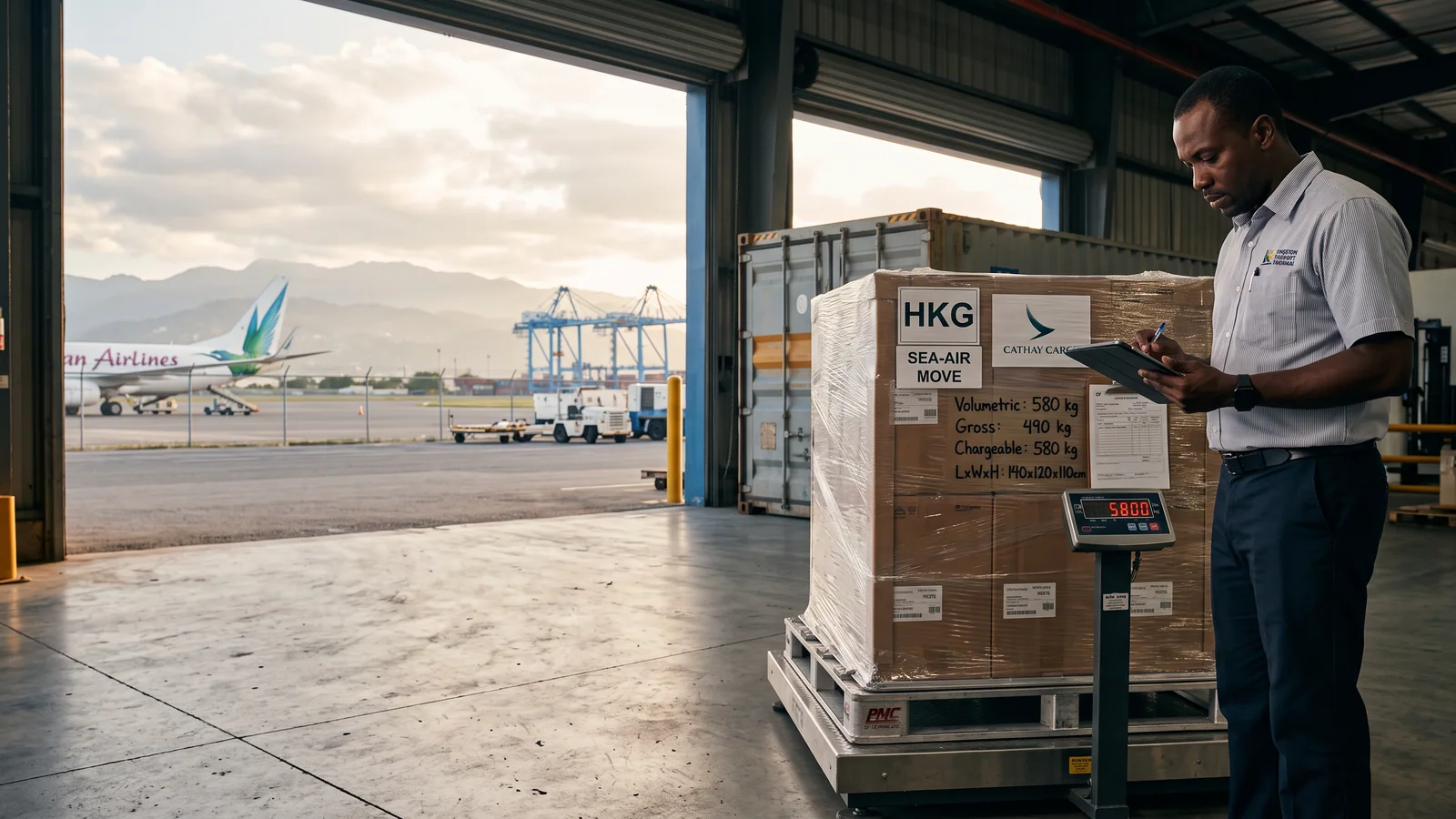
Quick Answer: Sea-air freight from Hong Kong to Jamaica starts at $7.39/kg for 300–499 kg and drops to $5.24/kg from 5,000 kg, port to airport, on Walio's September 30, 2026 rate table. Transit runs 16–22 days: ocean to Los Angeles, truck to Miami, air to Kingston or Montego Bay.
- Sea-air Hong Kong to Jamaica moves ocean to Los Angeles (12–15 days), truck to Miami (3–5 days), then air to Kingston or Montego Bay (1–2 days) — 16–22 days total.
- Walio sea-air rates start at $7.39/kg for 300–499 kg, $6.41/kg for 500–999 kg, $5.68/kg for 1,000–4,999 kg and $5.24/kg from 5,000 kg, port to airport.
- Minimum billed weight is 300 kg, and chargeable weight is the greater of actual weight or volume × 167 kg per m³.
- Jamaica charges Import Duty, 15% GCT, Standards Compliance Fee and Environmental Levy on the CIF value, and a licensed customs broker must file your eSAD in ASYCUDA World.
Jamaican importers buying in Hong Kong face one repeated trade-off: ocean freight is cheap but slow, and air freight lands fast but wrecks the margin. Sea-air splits the difference, and this guide prices it, times it and clears it through Jamaica Customs.
How much does sea-air shipping from Hong Kong to Jamaica cost per kilo in 2026?
Quick Answer: Sea-air freight from Hong Kong to Jamaica starts at $7.39/kg for 300–499 chargeable kg, $6.41/kg for 500–999 kg, $5.68/kg for 1,000–4,999 kg and $5.24/kg from 5,000 kg. Rates are port to airport, from Walio's live table on September 30, 2026, and vary by port and airport.
Those four figures are the starting points for the cheapest port and airport combination on the lane. Every rate carries the word from for a reason. Your exact number depends on which Hong Kong port terminal you load at and whether the cargo flies into Norman Manley (KIN) or Sangster (MBJ).
| Chargeable weight band | Sea-air rate (port to airport) | Typical cargo profile |
|---|---|---|
| 300–499 kg | from $7.39/kg | Samples, first trial order, urgent spare parts |
| 500–999 kg | from $6.41/kg | E-commerce restock, small appliance batch |
| 1,000–4,999 kg | from $5.68/kg | Full retail order, hardware, LED and lighting |
| 5,000 kg and up | from $5.24/kg | Seasonal stock build, multi-supplier consolidation |
Port to airport means you deliver the cargo to the Hong Kong port and your consignee collects it at the Jamaican airport. Origin and destination handling charges are added per shipment inside the calculator. Walio never folds them into the per-kilo figure, because that is how hidden costs appear at the worst moment.
The 300 kg minimum matters more than anything else for small buyers. A 180 kg consignment still bills as 300 kg. If your supplier has 180 kg ready, ask what else you can add before the container cut-off.
Door pickup at a Hong Kong factory and door delivery to any Jamaican parish are quoted on request. Add the request in the calculator and the price comes back with the freight.
What is sea-air shipping and how does the Hong Kong to Jamaica route actually run?
Quick Answer: Sea-air is a multimodal service that moves cargo by ocean for the long leg, then by air for the final leg. From Hong Kong, the box sails to Los Angeles in 12–15 days, trucks to Miami in 3–5 days, then flies to Kingston or Montego Bay in 1–2 days.
 Hong Kong(HKHKG)
 Los Angeles(USLAX)Los Angeles(USLAX)Miami(USMIA)Miami(MIA)
 Kingston(KIN)
The Los Angeles to Miami truck leg exists for a simple commercial reason. Transpacific ocean capacity is the cheapest long-haul freight in the world, and Miami is the air gateway for the entire Caribbean. Combining them beats paying airline rates across the Pacific.
Pure ocean freight to Kingston runs on a different logic. Boxes from Kwai Tsing Container Terminals sail east or west and transship through Panama, Cartagena or Caucedo before reaching Kingston Freeport Terminal. That routing adds weeks compared with the 16–22 day sea-air schedule.
Hong Kong's status as a free port helps at origin. There is no import or export duty, and exporters file a Trade Declaration rather than a full export customs entry. Export release is usually faster than from mainland China.
Pro tip
Watch the port cut-off, not the vessel ETD. Cargo that misses the documentation cut-off by hours rolls to the next sailing, which can add a full week to a 16–22 day schedule.
How is chargeable weight calculated on sea-air from Hong Kong?
Quick Answer: Chargeable weight is the greater of your actual gross weight and your volume multiplied by 167 kg per cubic meter. Sea-air uses the 1:167 ratio, not the 1:6000 divisor of pure air freight. Light, bulky cargo almost always bills on volume, so measure and record every carton.
The sea-air volumetric ratio. One cubic meter of cargo bills as at least 167 kg, no matter how light it is.
Worked example one. A Kingston lighting retailer ships 4 m³ of LED fixtures weighing 380 kg. Volume weight is 4 × 167 = 668 kg. The shipment bills at 668 kg and falls in the 500–999 kg band, at from $6.41/kg.
Worked example two. A machine shop ships 1,200 kg of parts in only 3 m³. Volume weight is 501 kg, so actual weight wins. The shipment bills at 1,200 kg in the 1,000–4,999 kg band, at from $5.68/kg.
Worked example three. A trading company sends a 0.9 m³ sample order weighing 110 kg. Volume weight is 150 kg, but the 300 kg minimum billed weight applies, so the invoice is built on 300 kg.
Pure air freight from HKIA uses a different rule. Airlines divide length × width × height in centimeters by 6,000, which equals 167 kg per m³ as well — but airlines apply it per piece, and sea-air applies it to total volume. Odd-shaped single pieces can therefore price very differently on straight air.
Pro tip
Consolidate two or three Hong Kong suppliers into one warehouse before booking. Crossing from 490 kg into 520 kg moves you from $7.39/kg to $6.41/kg, and the extra cargo can effectively ship for free.
Sea-air vs ocean FCL, LCL, air and express from Hong Kong to Jamaica
Quick Answer: Sea-air sits between ocean and air: roughly three weeks port to airport, at a fraction of pure air freight. FCL wins on cost per cubic meter above 15 m³, LCL suits 2–15 m³ when time is loose, express suits parcels under 70 kg, and sea-air suits urgent restocks of 300 kg and up.
| Mode | Priced by | Transit | Ideal size | Cargo type | Departures | Main risk |
|---|---|---|---|---|---|---|
| Sea-air | Chargeable kg | 16–22 days | 300 kg – 5,000 kg+ | Urgent restock, parts, electronics | Weekly | Extra handling points |
| Ocean FCL | Per container | 35–50 days | 15 m³ and up | Furniture, bulk retail stock | Multiple weekly | Demurrage at Kingston |
| Ocean LCL | Per m³ or 1,000 kg | 40–55 days | 2–15 m³ | Mixed, non-urgent goods | Weekly | CFS deconsolidation delays |
| Pure air (HKIA–KIN) | Chargeable kg | 4–8 days | 50–2,000 kg | High value, perishable, launch stock | Daily via hubs | Highest freight cost |
| Express courier | Per kg, door to door | 3–6 days | Under 70 kg | Documents, samples | Daily | Cost per kg at volume |
The break-even logic is about time, not only money. LCL beats sea-air on freight cost per cubic meter almost every time. Sea-air wins when the goods are already sold and the shelf is empty. FCL takes over around 10–15 m³, where paying for a whole 20 ft box costs less than per-cubic-meter LCL pricing.
Express courier still wins under 70 kg. A Hong Kong trading company sending three sample cartons should not build a sea-air booking around a 300 kg minimum. Pure air from HKIA earns its premium on perishables and launch-critical stock, where one extra week of selling time outvalues the freight gap.
Kingston electronics retailer
Christmas stock ordered in October. Ocean LCL lands in December — too late. Sea-air at 16–22 days puts 900 kg of audio equipment on shelves in November, at from $6.41/kg, and the season pays for the difference.
Montego Bay hotel supplier
Forty cubic meters of guest-room furniture for a March reopening. Bulk, low value per kilo, fixed deadline months out. A 40 ft FCL to Kingston Freeport Terminal is the correct call, not sea-air.
Hong Kong vs mainland China as your origin: what changes?
Quick Answer: Hong Kong is a free port with zero import and export duty and a simple Trade Declaration, while mainland exports from Shenzhen, Guangzhou or Yantian require a full customs export declaration and VAT refund paperwork. Hong Kong also offers denser consolidation options, faster cut-offs and more frequent airline capacity.
| Factor | Hong Kong SAR | Shenzhen / Yantian / Guangzhou |
|---|---|---|
| Export clearance | Trade Declaration, no export duty | Full customs declaration, VAT refund file |
| Typical clearance time | Same day to 1 day | 1–3 days |
| Ocean freight cost | Slightly higher per TEU | Usually lowest per TEU |
| Sailing frequency | Daily transpacific options | Daily transpacific options |
| Consolidation warehouses | Very dense, many bonded CFS | Dense, but export-entry bound |
| Restricted goods | TID licences for strategic commodities | Broader licensing and inspection regime |
Hong Kong requires a Trade Declaration for exports through its Trade and Industry Department. Some electronics, encryption hardware and dual-use items also need a TID strategic commodities licence before the cargo can leave. Ask your supplier to confirm licence status before you pay a deposit.
The Hong Kong Air Cargo Transshipment Facilitation Scheme lets cargo trucked in from Shenzhen move through HKIA under simplified handling. Many mainland factories use it deliberately, because Hong Kong's air and ocean schedules are denser than their local options.
Lithium batteries are checked, not assumed
Hong Kong handlers enforce IATA packing instructions strictly and demand the UN38.3 test report plus a valid MSDS. Any product with a battery inside — speakers, e-bikes, power tools — needs this file before the booking is accepted.
Cross-border trucking from Shenzhen into Hong Kong adds one to two days and a per-truck fee. It still often beats mainland export clearance on total time, especially in the weeks before Chinese New Year.
What documents do I need to ship cargo from Hong Kong to Jamaica door to door?
Quick Answer: You need a commercial invoice, packing list, the ocean Bill of Lading and the air waybill for the Miami–Jamaica leg, a certificate of origin where a preference applies, and your Jamaican TRN. A licensed customs broker files the eSAD in ASYCUDA World on your behalf.
- Hong Kong export: commercial invoice, packing list with carton weights and dimensions, Trade Declaration, Bill of Lading or Sea Waybill, TID licence if applicable.
- Miami transfer: air waybill (AWB) issued for the Miami to Kingston or Montego Bay flight, plus the transfer manifest handled by the forwarder.
- Jamaica import: eSAD lodged in ASYCUDA World, TRN, AWB, commercial invoice, certificate of origin, C73 valuation declaration where Jamaica Customs requires it.
- Cargo specific: UN38.3 report for batteries, Bureau of Standards Jamaica approvals for regulated goods, import permits for food, pharmaceuticals and telecom equipment.
The Taxpayer Registration Number is not optional. Every Jamaican importer, individual or company, needs a TRN on file before an entry can be lodged. Cargo arriving without one sits in the airport warehouse accruing storage.
Jamaica Customs Agency requires a licensed customs broker for most commercial entries. The broker classifies your goods under the HS tariff, files the eSAD, calculates duty and GCT, and releases the cargo. Appoint the broker before the cargo departs Hong Kong, not after it lands.
HS classification drives everything downstream. Get the six-digit code from your supplier, then have your broker confirm the Jamaican tariff line. Other Latin American and Caribbean regimes work the same way — our guide to moving to Colombia in 2026 and its document and regulation rules shows how closely customs authorities police classification and valuation.
The three document errors that stop cargo
Invoice values below market price trigger a valuation query. Packing lists without carton weights block the eSAD. A supplier name on the invoice that differs from the shipper name on the Bill of Lading forces an amendment fee and a delay.
What taxes do I pay when importing Chinese goods into Jamaica?
Quick Answer: Jamaica charges Import Duty by HS code, 15% General Consumption Tax, the Standards Compliance Fee, the Environmental Levy and, on some goods, Special Consumption Tax. All are calculated on the CIF value — cost, insurance and freight — so your freight cost feeds directly into your tax bill.
CIF value comes first. It is the goods value, plus insurance, plus freight to the Jamaican port or airport of entry. Jamaica Customs builds every charge on that base, not on the invoice alone.
| Charge | Base | Illustrative calculation on $12,000 CIF |
|---|---|---|
| CIF value | Goods + insurance + freight | $12,000 |
| Import Duty (illustrative 20% rate) | CIF | $2,400 |
| Standards Compliance Fee (0.3%) | CIF | $36 |
| Environmental Levy (0.5%) | CIF | $60 |
| GCT (15%) | CIF + duty + applicable fees | $2,174 |
| Total government charges | — | $4,670 |
The duty rate above is illustrative only. Your actual rate depends on the HS code, and rates range widely across the Jamaican tariff. GCT is charged on the duty-inclusive value, not on CIF alone, which is why a higher duty rate raises your GCT too.
None of these charges are Walio freight rates. They are Jamaican government charges collected by Jamaica Customs Agency. Walio prices the freight; your broker calculates the tax.
For duty relief, CARICOM preference questions or a contested classification, use a licensed customs broker or a tax adviser. Walio is a shipping platform, not legal counsel.
How do Incoterms 2020 change who pays what on this lane?
Quick Answer: Under FOB Hong Kong the supplier delivers to the port and you pay freight onward. CIF Kingston puts freight and insurance on the supplier. DDP Jamaica moves duty, GCT and delivery onto the seller. EXW leaves everything, including Hong Kong export clearance, with you.
| Incoterm 2020 | Main freight | Insurance | HK export clearance | Jamaican duty | GCT | Final delivery |
|---|---|---|---|---|---|---|
| EXW Hong Kong | Buyer | Buyer | Buyer | Buyer | Buyer | Buyer |
| FOB Hong Kong | Buyer | Buyer | Seller | Buyer | Buyer | Buyer |
| CIF Kingston | Seller | Seller | Seller | Buyer | Buyer | Buyer |
| DDP Jamaica | Seller | Seller | Seller | Seller | Seller | Seller |
FOB Hong Kong is the practical default for Jamaican importers buying sea-air. You control the forwarder, the routing and the destination airport. You also see the real freight cost instead of a marked-up figure hidden inside the goods price.
CIF quotes carry a quiet tax cost. Because Jamaica Customs values on CIF, a supplier's inflated freight figure raises your taxable base and your GCT. FOB keeps freight visible and priced by you.
Be careful with DDP from unfamiliar suppliers
DDP puts import liability on a seller with no Jamaican TRN and no relationship with Jamaica Customs. When the entry stalls, the cargo is yours to fix and the storage clock is yours to pay.
On insurance, ICC A covers all risks with named exclusions, ICC B covers listed major events, and ICC C is the narrowest cover. Sea-air passes through a port, a truck terminal and two air warehouses. Those extra handling points argue strongly for ICC A.
What surcharges and delays should Jamaican importers plan for?
Quick Answer: Budget for terminal handling at both ends, ISPS, BAF and peak season surcharges, plus demurrage and detention if your broker is slow. Chinese New Year and the pre-Christmas rush tighten both ocean and air capacity out of Hong Kong, lifting rates and stretching transit by days.
- THC and DTHC — terminal handling at Hong Kong and at destination, normally paid by whoever controls that leg under the Incoterm.
- ISPS — the security fee applied at the port, usually a fixed amount per shipment.
- BAF and CAF — fuel and currency adjustment factors on the ocean leg, moved by bunker prices.
- Peak season surcharge — applied by carriers when transpacific space tightens, typically August to November.
- Demurrage and detention — charged after free time expires, and the clock starts on arrival, not on clearance.
Free time at the destination air warehouse is short. Kingston and Montego Bay handlers typically allow only a few days before storage accrues. The fix is administrative, not logistical: file the eSAD early.
| Jamaican destination | Nearest gateway | Road distance from gateway | Typical delivery after clearance | Last mile |
|---|---|---|---|---|
| Kingston | Norman Manley (KIN) | 19 km | Same day | Quoted on request |
| Spanish Town | Norman Manley (KIN) | 35 km | Same day | Quoted on request |
| Mandeville | Norman Manley (KIN) | 98 km | 1 day | Quoted on request |
| Ocho Rios | Sangster (MBJ) | 110 km | 1 day | Quoted on request |
| Montego Bay | Sangster (MBJ) | 5 km | Same day | Quoted on request |
Chinese New Year 2026 deserves a calendar note. Hong Kong and mainland factories shut for one to two weeks, and capacity tightens for weeks afterward. Book three to four weeks ahead of the holiday or accept a late-February arrival.
Track the shipment on two numbers. The Bill of Lading covers the ocean leg to Los Angeles, and the air waybill covers the Miami to Jamaica flight. Watch three milestones: vessel departure, Miami arrival, and flight uplift.
Get your Hong Kong to Jamaica sea-air price in seconds
Quick Answer: Enter your origin port, destination airport, weight and dimensions in the calculator on this page. Walio prices your exact shipment against live carrier rates in seconds, shows handling charges per shipment, and lets you book online. No signup, no forms that wait for an email, no follow-up calls.
Four inputs drive your final number: chargeable weight band, origin port, destination airport (KIN or MBJ), and handling at each end. Change any one of them and the price moves, which is why a static rate sheet cannot answer your question.
- Enter dimensions per carton so the calculator applies the 167 kg per m³ volumetric rule correctly.
- Compare sea-air against LCL and pure air in the same tool before you commit.
- Request door pickup in Hong Kong or door delivery to your parish and get both priced together.
- For oversized, hazardous or battery-containing cargo, submit the request and a Walio specialist follows up.
Freight and tax are separate lines in your landed cost. Walio prices the freight and handling. Jamaican Import Duty, GCT, the Standards Compliance Fee, the Environmental Levy and your broker's fee sit outside the freight rate, and your broker calculates them.
Shipping personal effects rather than commercial cargo works differently, with inventories and used-goods declarations instead of HS codes. Our Guatemala moving guide with the complete document checklist and the complete requirements guide for moving to El Salvador both show that regime in detail. Readers relocating elsewhere in the region can also check the Costa Rica moving requirements guide and the Venezuela relocation requirements guide.
Searches for envío marítimo aéreo Hong Kong Jamaica almost always end in the same question: what will it cost for my weight, this week? That is the question the calculator answers directly.
Sea-air takes 16–22 days total: 12–15 days ocean from Hong Kong to Los Angeles, 3–5 days by truck to Miami, then 1–2 days by air to Kingston or Montego Bay. Pure ocean freight to Kingston Freeport Terminal takes considerably longer because it transships through Panama, Cartagena or Caucedo.
Walio sea-air rates start at $7.39/kg for 300–499 chargeable kg and fall to $5.24/kg from 5,000 kg, port to airport, on the September 30, 2026 rate table. The exact rate depends on your origin port and destination airport, and handling charges are added per shipment. The calculator on this page prices your exact weight in seconds.
Sea-air is the middle option and usually the right one for urgent restocks of 300 kg or more. Pure ocean LCL or FCL costs less per cubic meter but takes far longer, while pure air from HKIA is fastest and most expensive. High-value, time-critical cargo justifies air; bulky, low-value goods belong on the water.
The minimum billed weight is 300 kg. A shipment weighing 150 kg is still charged as 300 kg, so small orders cost the same as a 300 kg consignment. Consolidating several Hong Kong suppliers into one shipment is the usual way to make the minimum work in your favor.
Yes. Jamaica Customs Agency requires a licensed customs broker to file the electronic Single Administrative Document (eSAD) in ASYCUDA World for most commercial entries. You also need a Taxpayer Registration Number (TRN) before your cargo arrives, or the entry cannot be lodged.
Walio compares live rates from carriers such as Maersk, MSC, CMA CGM and Hapag-Lloyd alongside airline capacity out of Miami, so the number you see is a real bookable rate. Enter your route, weight and dimensions in the calculator above and see your price in seconds — no signup, no follow-up calls.