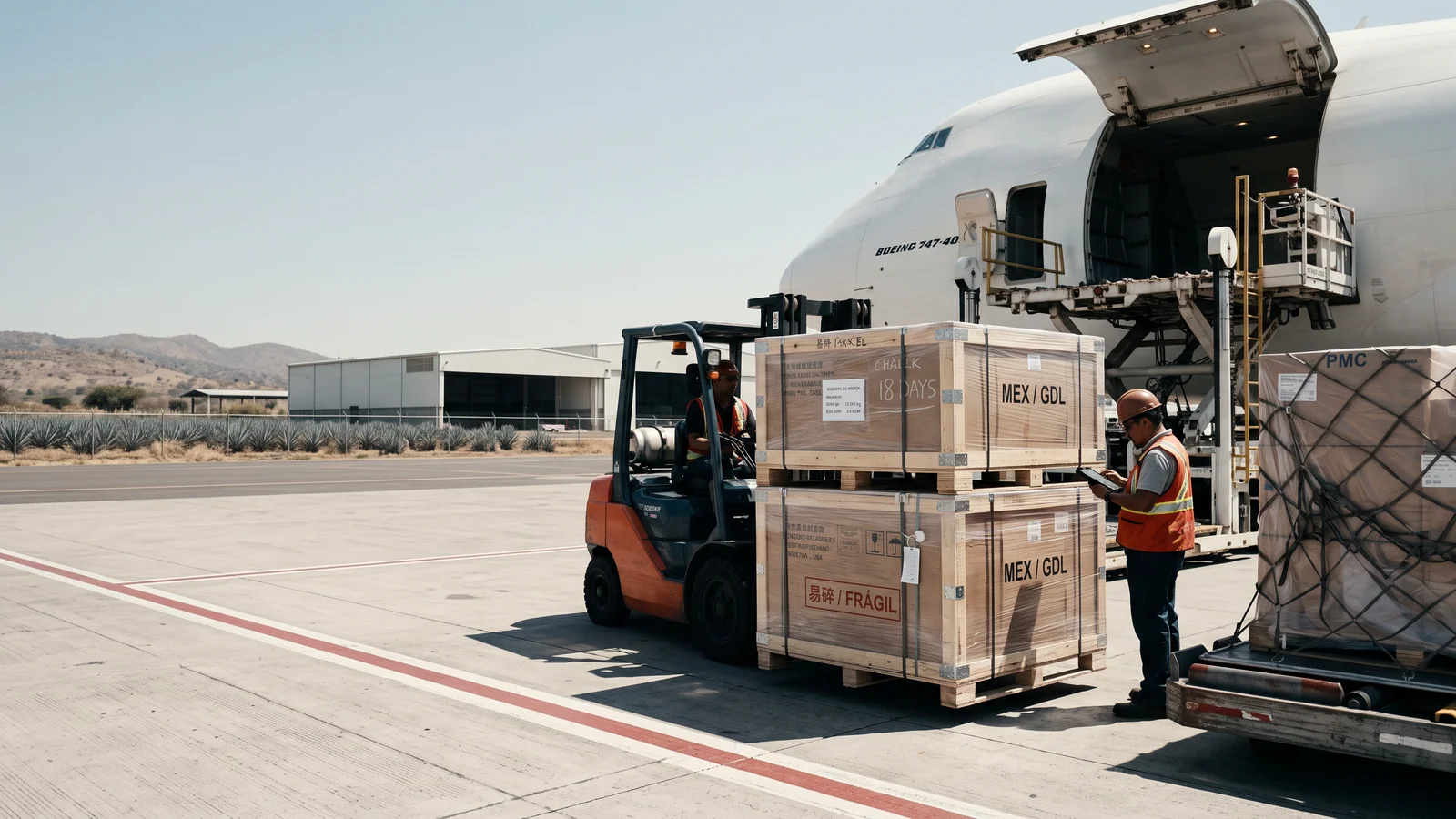
Quick Answer: Sea-air cargo from China to Mexico moves in 16–25 days and starts from $3.98/kg for shipments over 5,000 kg, port to airport. Ocean runs to Los Angeles, truck to Miami, then air to MEX, GDL, MTY, CUN, MID or NLU. The calculator on this page prices your exact port and weight in seconds.
- Sea-air China to Mexico takes 16–25 days total: 12–18 days ocean to Los Angeles, 3–5 days truck to Miami, 1–2 days air into Mexico.
- Walio rates run from $6.03/kg at 300–499 kg down to from $3.98/kg at 5,000+ kg, port to airport, cheapest port and airport on the lane.
- Chargeable weight is the greater of actual weight or volume × 167 kg per m³, with a 300 kg minimum billing.
- Mexican import tax is calculated on customs value: IGI by fracción arancelaria, plus DTA, prevalidación and 16% IVA — not part of the freight rate.
Mexican importers searching for a calculadora marítimo aéreo china méxico want one thing: a real number for a real shipment, without waiting two days for a broker's email. The calculator on this page gives you that number from live carrier rates, priced on your chargeable weight.
What is the sea-air China to Mexico calculator and what does it price?
Quick Answer: The sea-air China to Mexico calculator is an instant pricing tool for multimodal cargo: ocean from China to Los Angeles, truck to Miami, then air into Mexico. You enter port, airport, weight and dimensions, and see a port-to-airport price in seconds — no forms, no sales call.
Sea-air is one service, not three separate bookings. The ocean leg, the road leg and the air leg sit under a single movement with a single price per chargeable kilo. That is what multimodal means in practice: several modes, one contract, one transit clock.
The service exists because the two classic options leave a gap. Full container ocean freight to Manzanillo is cheap and slow. Pure air freight from Shanghai is fast and expensive. Sea-air lands between them at 16–25 days for cargo that cannot wait a month but cannot carry an air freight budget either.
Which ports and airports does the lane cover?
Walio prices the sea-air lane from nine Chinese ports into six Mexican airports.
- Origin ports (China): Dalian, Fuzhou, Guangzhou, Ningbo, Qingdao, Shanghai, Shenzhen, Xiamen, Xingang.
- Destination airports (Mexico): Mexico City (MEX), Guadalajara (GDL), Monterrey (MTY), Cancún (CUN), Mérida (MID), Santa Lucía (NLU).
- Routing: ocean to Los Angeles, truck Los Angeles to Miami, air Miami to your Mexican airport.
- Scope: port to airport — you deliver cargo to the origin port, your consignee collects it at the destination airport.
Port to airport is the honest way to quote this lane. The price covers the international movement. Factory-to-port trucking in China and last-mile delivery in Mexico are separate services, and the calculator handles both as a request when you need them.
Pro tip
If your supplier already quotes FOB Shanghai or FOB Shenzhen, the port-to-airport rate plugs straight into your costing with no gaps. FOB means the seller delivers the cargo to the origin port and clears it for export, which is exactly where the sea-air rate begins.
 Shanghai(CNSHA)
 Mexico City(MEX)Shenzhen(CNSZX)Guadalajara(GDL)Qingdao(CNTAO)Monterrey(MTY)
How do I calculate the cost of a sea or air shipment from China to Mexico?
Quick Answer: Five steps: measure each carton in meters to get CBM, convert volume to chargeable weight at 167 kg per m³ for sea-air, compare that with actual gross weight, take the higher figure, then apply the weight-break rate and add origin and destination handling.
Every freight quote on this lane is built on one number: chargeable weight. Get that right and the rest is arithmetic. Get it wrong and your landed cost model is wrong by hundreds of dollars.
- Measure and get CBM. CBM = length × width × height in meters, per carton. Multiply by the number of cartons. Measure the outer carton or pallet footprint, not the product.
- Convert volume to weight. Sea-air uses 167 kg per m³. Pure air freight uses cm³ ÷ 6000. LCL ocean bills W/M, where 1 CBM counts as 1,000 kg.
- Compare and take the higher figure. Chargeable weight is the greater of actual gross weight and volumetric weight. Sea-air applies a 300 kg minimum billed weight.
- Match the weight break. Rates step down at 300–499 kg, 500–999 kg, 1,000–4,999 kg and 5,000+ kg.
- Add handling. Origin and destination handling is charged per shipment, itemized separately, never buried in the per-kilo rate.
| Mode | Volume-to-weight rule | Billing unit | Minimum |
|---|---|---|---|
| Sea-air (China–Mexico) | 1 m³ = 167 kg | Chargeable kg | 300 kg |
| Pure air freight | cm³ ÷ 6000 = 1 kg | Chargeable kg | 45–100 kg typical |
| LCL ocean (W/M) | 1 m³ = 1,000 kg | Revenue ton (per m³ or ton) | 1 m³ |
| FCL ocean | Not applicable | Per container | 1 container |
| Express courier | cm³ ÷ 5000 = 1 kg | Chargeable kg | 0.5 kg |
Notice how the divisor changes the answer. The same 1.8 CBM pallet bills as 300.6 kg on sea-air, 300 kg on pure air at the 6000 divisor, and 1.8 revenue tons on LCL. That is why a calculadora marítimo aéreo china méxico has to hold both formulas in one tool instead of guessing.
What is CBM, volumetric weight and chargeable weight?
Quick Answer: CBM is cubic meters of cargo volume: length × width × height in meters. Volumetric weight converts that volume into a billable weight figure. Chargeable weight is whichever is higher — actual kilos or volumetric kilos — and it is the number every China to Mexico freight quote is built on.
Start with a worked example. A carton measuring 1.2 × 0.8 × 1.0 m gives 0.96 CBM. Forty of those cartons give 38.4 CBM, which is a 40 ft container's worth of space, not a sea-air shipment.
Now convert. At the sea-air density factor of 167 kg per m³, 1.8 CBM becomes 300.6 chargeable kilos. On pure air freight the same single carton of 120 × 80 × 100 cm divided by 6000 gives 160 volumetric kilos.
The sea-air density factor. Cargo denser than 167 kg per m³ bills on actual weight. Anything lighter bills on volume, which is why furniture and packaging waste money and machine parts do not.
Which cargo bills on weight and which bills on volume?
Density decides. Dense freight bills on actual kilos, light freight bills on cubic meters, and your product's density tells you which column you sit in before you ever open a rate sheet.
- Bills on actual weight: machine parts, hardware, fasteners, ceramic tile, batteries, tooling, compressors.
- Bills on volume: textiles, apparel, plastic housings, furniture, lampshades, foam packaging, empty bottles.
- Sits near the line: boxed electronics, small appliances, auto accessories — repacking can flip these to actual weight and cut the bill.
LCL ocean works the same way through the W/M rule. One CBM equals 1,000 kg, so a pallet of tile bills on its tonnage while a pallet of cushions bills on its cube. Ask your supplier for carton dimensions and gross weights per SKU, not just totals.
How much does sea-air cargo from China to Mexico cost in 2026?
Quick Answer: Walio sea-air rates from China to Mexico start from $6.03/kg at 300–499 chargeable kg, from $5.13/kg at 500–999 kg, from $4.44/kg at 1,000–4,999 kg and from $3.98/kg at 5,000 kg and above. These are port-to-airport rates for the cheapest port and airport on the lane.
Rates are per chargeable kilo and drop at each weight break. Consolidating three small purchase orders into one booking often moves you a full break down and lowers the unit cost across the whole shipment.
| Chargeable weight | Rate per kg (from) | Basis | Scope |
|---|---|---|---|
| Under 300 kg | Billed as 300 kg | Minimum weight | Port to airport |
| 300–499 kg | from $6.03 | Chargeable kg | Port to airport |
| 500–999 kg | from $5.13 | Chargeable kg | Port to airport |
| 1,000–4,999 kg | from $4.44 | Chargeable kg | Port to airport |
| 5,000 kg and above | from $3.98 | Chargeable kg | Port to airport |
These figures come from Walio's live multimodal rate table as of September 30, 2026, and they reflect the cheapest port and airport combination on the lane. Your exact rate depends on which Chinese port and which Mexican airport you select, so the calculator prices the pair you actually ship.
What is not inside the per-kilo rate?
Freight is one line on a landed cost sheet. Three other buckets sit alongside it, and mixing them up is the most common budgeting error importers make.
| Cost item | Who charges it | Basis | In the calculator? |
|---|---|---|---|
| Sea-air freight | Walio / carriers | Per chargeable kg | Yes |
| Origin handling | Origin terminal / agent | Per shipment | Yes, itemized |
| Destination handling | Destination station | Per shipment | Yes, itemized |
| Door pickup in China | Local trucker | Per pickup | On request |
| Door delivery in Mexico | Local trucker | Per delivery | On request |
| Agente aduanal fees | Licensed customs broker | Per pedimento | No — billed locally |
| DTA and prevalidación | Mexican government / agent | Published rate | No — government charge |
| IGI (import duty) | Mexican government | % by fracción arancelaria | No — government charge |
| IVA | Mexican government | 16% of customs value + IGI + DTA | No — government charge |
| Maniobras and almacenaje | Airport terminal in Mexico | Per shipment / per day | No — billed locally |
Pro tip
Watch the weight breaks. A 480 kg shipment bills at from $6.03/kg, but adding 20 kg of stock to reach 500 kg moves you to from $5.13/kg — and the cheaper rate applies to every kilo. Run both scenarios in the calculator before you finalize the packing list with your factory.
How many days does sea-air cargo take from China to Mexico?
Quick Answer: Total transit is 16–25 days depending on the origin port: 12–18 days ocean from China to Los Angeles, 3–5 days truck from Los Angeles to Miami, then 1–2 days air from Miami into Mexico City, Guadalajara, Monterrey, Cancún, Mérida or Santa Lucía.
South China and central China sail fastest. Shenzhen, Guangzhou, Xiamen, Ningbo and Shanghai sit at the short end of the ocean leg into Los Angeles. Dalian, Xingang and Qingdao add days because of the northern rotation.
| Origin port | Ocean to Los Angeles | Truck LA–Miami | Air Miami–Mexico | Total transit |
|---|---|---|---|---|
| Shenzhen (CNSZX) | 12–14 days | 3–5 days | 1–2 days | 16–21 days |
| Guangzhou (CNCAN) | 12–15 days | 3–5 days | 1–2 days | 16–22 days |
| Ningbo (CNNGB) | 12–15 days | 3–5 days | 1–2 days | 16–22 days |
| Shanghai (CNSHA) | 13–16 days | 3–5 days | 1–2 days | 17–23 days |
| Xiamen (CNXMN) | 13–16 days | 3–5 days | 1–2 days | 17–23 days |
| Fuzhou (CNFOC) | 13–16 days | 3–5 days | 1–2 days | 17–23 days |
| Qingdao (CNTAO) | 14–17 days | 3–5 days | 1–2 days | 18–24 days |
| Xingang (CNTXG) | 15–18 days | 3–5 days | 1–2 days | 19–25 days |
| Dalian (CNDLC) | 15–18 days | 3–5 days | 1–2 days | 19–25 days |
The air leg out of Miami reaches all six Mexican airports in 1–2 days. MEX and NLU serve central Mexico, GDL covers the Bajío and the west, MTY serves the industrial north, and CUN and MID serve the southeast.
Why does port cut-off matter more than the sailing date?
Cut-off is not ETD. Cargo generally has to be gated in at the terminal two to three days before the vessel sails, and documentation cut-off can be earlier still. Miss it and you wait for the next weekly sailing, which erases the entire speed advantage you paid for.
- Confirm the cargo and documentation cut-off with your supplier, not just the sailing date.
- Book factory-to-port trucking in China with a full day of buffer.
- Remember the transit clock starts at the origin port, never at the factory gate.
- Plan around Chinese New Year and Golden Week, when terminals and factories both slow down.
For context, straight FCL ocean service into Manzanillo, Lázaro Cárdenas or Veracruz is commonly planned at 30–40+ days from booking to delivered, including terminal and customs time. Pure air freight from China runs 5–8 days. Sea-air sits in the middle at 16–25 days.
Sea-air vs FCL vs LCL vs pure air: which is cheaper to Mexico?
Quick Answer: Sea-air wins when cargo is too urgent for ocean and too heavy for pure air — typically 300 kg to 5,000 kg of mid-value goods. FCL wins above roughly 15 CBM of non-urgent freight. LCL suits 2–15 CBM. Pure air suits small, high-value or deadline-critical shipments.
| Mode | Billing basis | Transit (China–Mexico) | Ideal volume | Best for | Delay risk |
|---|---|---|---|---|---|
| FCL ocean | Per container | 30–40+ days | 15 CBM and up | Bulk restocking, heavy goods | High (rollovers, port congestion) |
| LCL ocean | Per m³ / W/M | 35–45+ days | 2–15 CBM | Mixed small orders | High (CFS deconsolidation) |
| Sea-air | Per chargeable kg | 16–25 days | 300–5,000+ kg | Mid-value replenishment | Medium |
| Pure air | Per chargeable kg | 5–8 days | Under 500 kg | High-value, deadline cargo | Low |
| Express courier | Per chargeable kg | 3–6 days | Under 100 kg | Samples, spare parts | Low |
Worked example: 3 pallets, 1.8 CBM, 420 kg
Run the math the way the carrier does. Volumetric weight is 1.8 × 167 = 300.6 kg. Actual gross weight is 420 kg, which is higher, so chargeable weight is 420 kg.
That lands in the 300–499 kg break at from $6.03/kg, giving from $2,532.60 in port-to-airport freight, plus origin and destination handling per shipment. If the same 420 kg were spread across 3.2 CBM, volumetric weight would be 534.4 kg — a higher chargeable weight, but at the cheaper from $5.13/kg break, so from $2,741.47. Density, not just weight, moves the total.
Choose sea-air
Your cargo weighs 300 kg to 5,000 kg, carries mid-range unit value, and you need it in under a month. You are replenishing fast-moving SKUs, covering a forecast miss, or protecting a retail launch date. Sea-air costs a fraction of pure air freight and arrives in less than half the time of an ocean container to Manzanillo.
Choose FCL ocean
Your shipment exceeds roughly 15 CBM, the goods are dense or low value per kilo, and the delivery date sits eight weeks out. One 20 ft container holds about 28 CBM of usable space and beats LCL on cost per cubic meter above 10–15 CBM. You accept congestion and rollover risk in exchange for the lowest freight bill.
The break-even rule is simple. When the cost of a delay — lost sales, stockouts, penalty clauses, idle production — exceeds the freight difference, the faster mode pays for itself. A calculadora marítimo aéreo china méxico lets you test that trade-off in minutes instead of arguing about it for a week.
What surcharges and fees apply on the China–Mexico lane?
Quick Answer: Ocean legs carry THC, BAF, CAF, ISPS, GRI and peak season surcharges. Air legs carry fuel (FSC) and security (SSC) surcharges. On Walio sea-air, origin and destination handling is itemized per shipment in the calculator, so you see what you pay before you book.
Surcharges are where all-in pricing and "cheap" quotes separate. A rate that looks low often excludes four or five lines that reappear at destination.
- THC / DTHC: terminal handling at origin and destination, charged per shipment or per container.
- BAF: bunker adjustment factor, the carrier's fuel surcharge on the ocean leg.
- CAF: currency adjustment factor, applied when exchange rates move.
- ISPS: port security charge mandated under the international ship and port facility code.
- GRI and PSS: general rate increases and peak season surcharges, announced by carriers such as Maersk, MSC, CMA CGM and Hapag-Lloyd, usually mid-month or ahead of peak.
- Air FSC and SSC: fuel and security surcharges per chargeable kilo on the air leg.
- Local Mexican charges: maniobras, almacenaje, prevalidación and agente aduanal fees, billed on arrival.
Free time runs out fast at the airport
Air cargo terminals in Mexico grant only a short free storage window before almacenaje starts accruing daily. If your agente aduanal does not have the invoice, packing list and AWB ready on arrival, storage charges can outgrow the savings you booked. Send documents to your broker while the cargo is still in the air.
How much tax and IVA do I pay importing from China to Mexico?
Quick Answer: Mexico charges IGI (import duty) by fracción arancelaria on the customs value, plus DTA and prevalidación, and 16% IVA calculated on the customs value plus IGI and DTA. Rates vary by HS code. Confirm your classification with a licensed agente aduanal before you budget.
Customs value is normally the transaction value plus freight and insurance to the point of entry, which is a CIF-style basis. Your freight cost therefore feeds the tax base — one reason importers model freight and duty together, not separately.
- IGI: the general import duty, set by your fracción arancelaria. Some Chinese-origin goods also carry compensatory or antidumping duties.
- DTA: the customs processing fee, applied at the published rate on the customs value.
- Prevalidación: a small fee paid for electronic validation of the pedimento before filing.
- IVA: 16% nationwide, calculated after IGI and DTA are added to the customs value.
- Padrón de Importadores: the importer of record must be registered, and sensitive goods require the padrón sectorial.
Manufacturers should ask about PROSEC and IMMEX. Both programs can reduce or defer duty on qualifying inputs, but eligibility depends on your registration and your product. Your customs broker confirms whether you qualify before the pedimento is filed.
Classification is not a guess
Walio prices freight, not duty. IGI rates, antidumping measures and padrón requirements change by HS code and by decree. Confirm your fracción arancelaria and your tax exposure with a licensed agente aduanal or tax adviser before you commit to a purchase order. A wrong classification means reclassification, fines and a stopped shipment.
What documents does a sea-air shipment from China to Mexico need?
Quick Answer: You need a commercial invoice (factura comercial), packing list, the ocean Bill of Lading and the air waybill for the Miami–Mexico leg, a certificate of origin when claiming preference, and the pedimento filed by your agente aduanal. Incoterms 2020 decide who pays each leg.
| Document | Who issues it | Purpose | Required? |
|---|---|---|---|
| Factura comercial | Chinese supplier | Value, HS code, Incoterm, currency | Always |
| Packing list | Supplier | Cartons, dimensions, gross weight | Always |
| Bill of Lading (B/L) | Ocean carrier / NVOCC | Contract for the ocean leg | Always |
| Air Waybill (AWB) | Airline | Contract for the Miami–Mexico leg | Always |
| Certificado de origen | Supplier / chamber | Preference claims | If claiming preference |
| Pedimento | Agente aduanal | Mexican customs declaration | Always |
| RFC / padrón registration | Importer | Importer of record status | Always |
| Permits / NOM certificates | Regulator or lab | Regulated products, labeling | By product |
Write descriptions like a customs officer reads them. "Steel brackets, galvanized, 4 mm, 2,400 pcs" clears. "Hardware" invites a documentary review and days of almacenaje. On sea-air, both a B/L and an AWB exist under one booking, because the cargo physically changes mode in Los Angeles and Miami.
Which Incoterm fits sea-air best?
FOB origin port is the natural match for port-to-airport pricing. The seller delivers to the port and clears export; you control the international movement and the cost. EXW puts Chinese inland trucking and export clearance on you. CIF hands control of the freight leg to your supplier, and DDP moves import liability onto the seller, which usually means you never see the real freight or duty numbers.
Book three to four weeks ahead of Chinese New Year, Golden Week and Q4 peak. Space tightens, GRIs land, and factory output surges before every shutdown. That is the season when a calculadora marítimo aéreo china méxico earns its keep, because you can compare weight breaks and lock a booking the same day.
Ready to price your shipment? Enter your Chinese port, your Mexican airport, your cartons and your weights in the calculator above and see your price in seconds — no signup, no follow-up calls. If your cargo needs door pickup in China, door delivery in Mexico, or a look from a specialist, submit the request through the calculator and a Walio specialist follows up.
Walio sea-air rates start from $6.03/kg at 300–499 chargeable kg and fall to from $3.98/kg at 5,000 kg and above, port to airport on the cheapest port and airport combination. Origin and destination handling is added per shipment and shown itemized. Enter your port, airport and dimensions in the calculator on this page to see your exact price in seconds.
Total transit is 16 to 25 days, depending on the origin port. That splits into 12–18 days ocean from China to Los Angeles, 3–5 days trucking to Miami, and 1–2 days flying into Mexico City, Guadalajara, Monterrey, Cancún, Mérida or Santa Lucía.
No. Pure air freight is the fastest option but costs the most per kilo, while full ocean container service is the cheapest and slowest. Sea-air sits between them, moving cargo in 16–25 days at rates from $3.98/kg for volumes over 5,000 kg.
CBM equals length × width × height measured in meters, multiplied by the number of cartons. For sea-air, convert volume at 167 kg per m³, then compare with actual gross weight and bill the higher figure. The minimum billed weight is 300 kg, so lighter shipments still bill as 300 kg.
Mexico applies IGI (import duty) set by your fracción arancelaria, plus the DTA and prevalidación fees, and 16% IVA on the customs value once IGI and DTA are added. Rates change by HS code and some Chinese goods carry antidumping duties. Confirm classification with a licensed agente aduanal before budgeting.