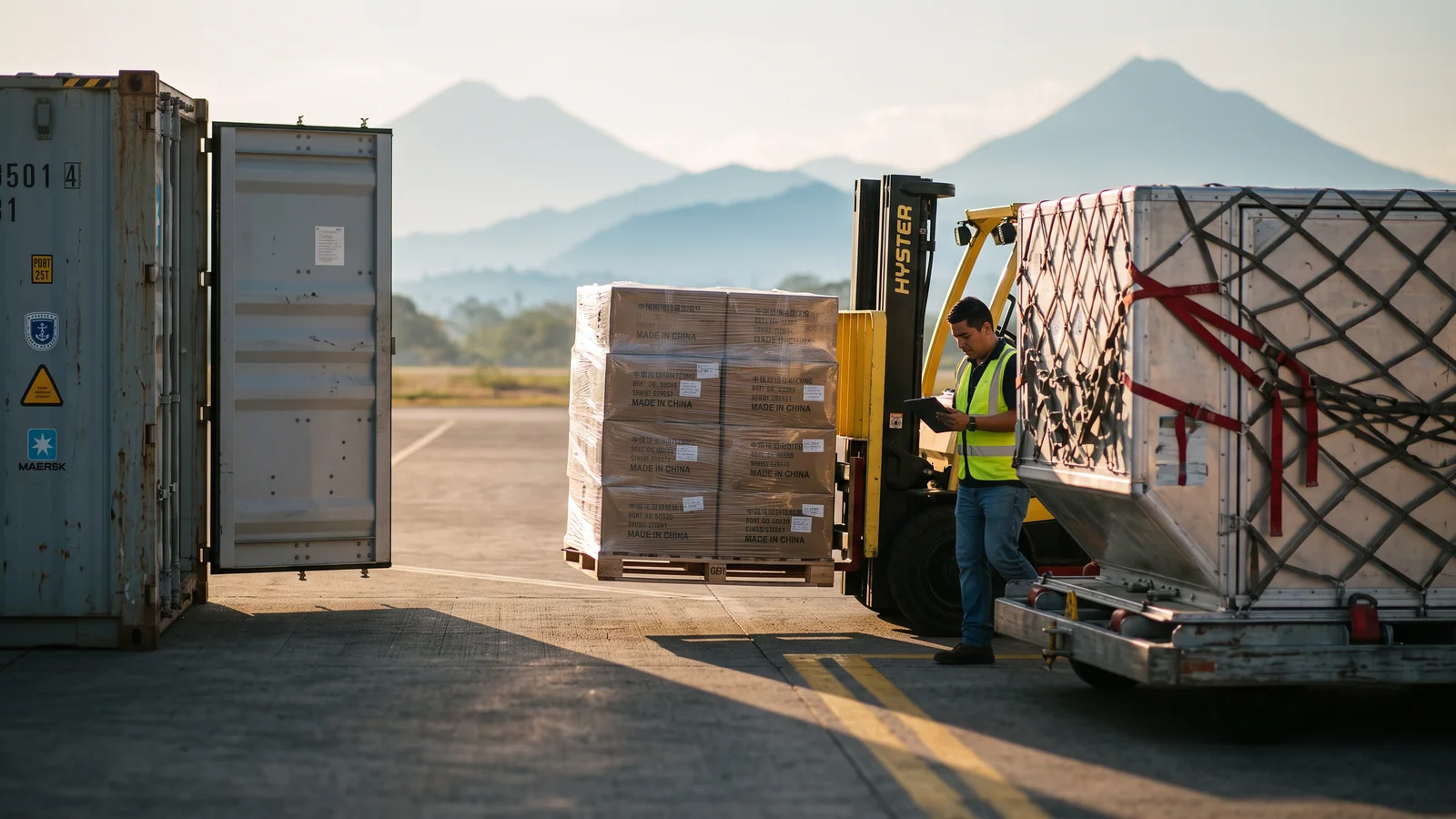
Quick Answer: Sea-air freight from China to Guatemala runs 16–25 days total and starts from $3.72/kg for 5,000+ kg, port to airport. Cargo sails to Los Angeles (12–18 days), trucks to Miami (3–5 days), then flies to Guatemala City in 1–2 days. The calculator on this page prices your exact port and weight in seconds.
- Sea-air China to Guatemala moves in 16–25 days: ocean to Los Angeles (12–18 days), truck to Miami (3–5 days), air to GUA (1–2 days).
- Walio sea-air rates start from $5.76/kg at 300–499 kg and drop to $3.72/kg at 5,000+ kg, cheapest port and airport on the lane.
- Chargeable weight is the greater of actual weight or volume × 167 kg per m³, with a 300 kg minimum billed weight.
- Guatemala charges DAI by SAC tariff code plus 12% IVA on the CIF value — duties are government rates, not freight.
Guatemalan importers who search for a calculadora marítimo aéreo china guatemala want one thing: a real number, right now. This page explains how the rate is built, then hands you the calculator so you can price your own cargo.
How does the sea-air China to Guatemala calculator work?
Quick Answer: A sea-air freight calculator turns four inputs into a price: origin port in China, destination airport, gross weight and cargo dimensions. Walio's calculator reads live multimodal rates, applies the 167 kg per m³ chargeable-weight rule and the 300 kg minimum, then shows your total in seconds — no signup, no follow-up call.
A freight calculator replaces the quote cycle. Instead of emailing a forwarder and waiting two days, you type your shipment details and read the price on screen. That is the whole point of a calculadora marítimo aéreo china guatemala: the price appears before you talk to anyone.
What inputs does the calculator need?
- Origin port in China: Shanghai, Shenzhen, Ningbo, Qingdao, Xiamen, Guangzhou, Dalian, Fuzhou or Xingang.
- Destination: Guatemala City (GUA), La Aurora International Airport.
- Gross weight in kilograms, including pallets, crates and all packaging.
- Dimensions in centimeters for every carton or pallet, so the system can build your volume.
- Commodity description, because batteries, liquids and aerosols change what can fly.
What does port to airport mean?
Walio prices this lane port to airport. Your supplier or your trucker delivers the cargo to the Chinese port named in the booking. Your consignee collects the shipment at Guatemala City airport after clearance. Door pickup in China and door delivery in Guatemala are quoted on request through the same calculator, and a specialist follows up with the added legs.
Sea-air is a multimodal service: one rate covers an ocean leg, a trucking leg and an air leg, under one booking and one set of documents. You do not stitch three contracts together. The forwarder controls the handoffs at Los Angeles and Miami.
Pro tip
Measure the cartons yourself before you quote. Chinese suppliers often send product dimensions, not packed carton dimensions. A 6 cm corrugated allowance on 40 cartons can add a full cubic meter to your volume, and volume is what sets chargeable weight on this lane.
What is the sea-air route from China to Guatemala?
Quick Answer: Sea-air cargo sails from a Chinese port to Los Angeles in 12–18 days, trucks across the United States to Miami in 3–5 days, then flies Miami to Guatemala City in 1–2 days. Total transit is 16–25 days depending on the origin port, far faster than all-water and far cheaper than pure air.
The route uses the North American land bridge. Cargo crosses the Pacific on the busiest trans-Pacific service in the world, then moves overland instead of waiting for a Panama Canal transit slot. The final hop into Central America flies out of Miami, which is the main air gateway between the United States and Guatemala.
 Shanghai(CNSHA)
 Los Angeles(USLAX)Los Angeles(USLAX)Miami(USMIA)Miami(MIA)
 Guatemala City(GUA)
| Leg | Mode | Transit | What happens |
|---|---|---|---|
| China → Los Angeles | Ocean | 12–18 days | Container sails trans-Pacific; carriers include Maersk, MSC, CMA CGM and Hapag-Lloyd |
| Los Angeles | Deconsolidation | 1–2 days | Cargo is stripped at a CFS and re-palletized for air |
| Los Angeles → Miami | Truck | 3–5 days | Land bridge across the US, no canal queue |
| Miami → Guatemala City | Air | 1–2 days | Flight to La Aurora (GUA), then clearance |
| Total | Sea-air | 16–25 days | Depends on the Chinese origin port |
Why port cut-off matters more than vessel ETD
Port cut-off is not the sailing date. Documentation cut-off and container gate-in usually fall three to five days before the vessel departs. Miss the gate-in and your cargo rolls to the next sailing, which can add a week to a 16-day plan. Book your cargo-ready date with that buffer built in.
Compared with all-water service into Puerto Quetzal or Santo Tomás de Castilla, sea-air cuts roughly two weeks off the clock. All-water routings to Guatemala typically run 28–45 days with transshipment at Balboa, Manzanillo or Cartagena. For restock orders and seasonal lines, those two weeks decide whether the goods sell.
How much does sea-air freight from China to Guatemala cost in 2026?
Quick Answer: Walio sea-air rates from China to Guatemala start from $5.76/kg for 300–499 kg, $4.86/kg for 500–999 kg, $4.18/kg for 1,000–4,999 kg and $3.72/kg for 5,000 kg and above. These are port-to-airport rates for the cheapest port and airport on the lane, from Walio's live rate table on October 3, 2026.
| Chargeable weight band | Sea-air rate (port to airport) | Billing unit |
|---|---|---|
| 300–499 kg | from $5.76/kg | Chargeable kg |
| 500–999 kg | from $4.86/kg | Chargeable kg |
| 1,000–4,999 kg | from $4.18/kg | Chargeable kg |
| 5,000 kg and above | from $3.72/kg | Chargeable kg |
Every figure is a from rate for the cheapest port and airport on the lane. Your exact rate depends on the Chinese port you load from. Dalian and Xingang do not price like Shenzhen, and the calculator shows each one separately.
A 180 kg shipment is still billed as 300 kg on this lane. Below that line, consolidating two purchase orders into one booking costs you nothing extra and gets you real value for the minimum.
What the rate includes and what it does not
- Included: ocean freight China to Los Angeles, deconsolidation, trucking to Miami, and the air leg to Guatemala City.
- Added per shipment in the calculator: origin handling and destination handling, shown as separate lines, never folded into the per-kg rate.
- Not included: DAI, 12% IVA, customs brokerage in Guatemala, airport storage after free time, and inland trucking past GUA.
- Quoted on request: door pickup at your supplier's factory in China and door delivery to your warehouse in Guatemala City.
Rates move with capacity. Comparing lanes helps you see the pattern — our Sea-Air China to Mexico Calculator: 2026 Rates and Sea-Air China to Colombia Calculator: Rates in Seconds break down the same weight-break logic for two neighboring markets.
How do you calculate chargeable weight and CBM?
Quick Answer: Chargeable weight on this lane is the greater of actual gross weight and volume × 167 kg per m³. CBM equals length × width × height in meters. Pure air cargo uses a different divisor — L × W × H in cm ÷ 6,000 — while ocean LCL uses the W/M rule where 1 CBM equals 1,000 kg.
Step by step
- Measure each carton or pallet in centimeters: length, width, height.
- Convert to CBM: divide each dimension by 100, then multiply the three. Add every piece together.
- Multiply CBM by 167 to get the volumetric weight for sea-air.
- Compare with actual gross weight and take the higher number.
- Apply the 300 kg minimum if the result falls below it.
Worked examples on the China–Guatemala lane
| Shipment | Volume | Actual kg | Volumetric (CBM × 167) | Chargeable kg | Rate band |
|---|---|---|---|---|---|
| Textile samples | 0.5 CBM | 80 kg | 84 kg | 300 kg (minimum) | from $5.76/kg |
| LED fixtures | 2.0 CBM | 250 kg | 334 kg | 334 kg | from $5.76/kg |
| Hardware, dense | 3.0 CBM | 900 kg | 501 kg | 900 kg | from $4.86/kg |
| Auto parts | 12 CBM | 1,800 kg | 2,004 kg | 2,004 kg | from $4.18/kg |
| Packaged consumer goods | 35 CBM | 5,200 kg | 5,845 kg | 5,845 kg | from $3.72/kg |
Read the third row carefully. Dense cargo bills on actual weight, light cargo bills on volume. Hardware, fasteners and ceramics beat the 167 kg per m³ threshold easily. Lampshades, foam, plastic housings and empty bottles never do, so their price is driven by the space they occupy.
Why the air divisor is different
Pure air freight uses the IATA volumetric formula: length × width × height in centimeters divided by 6,000. That equals 167 kg per m³, the same density standard written a different way. Ocean LCL uses the W/M rule instead: one cubic meter equals one metric ton, billed on whichever is greater, with a one CBM minimum.
Pro tip
Ask your supplier to reduce carton height before packing, not after. Ten extra centimeters on a 120 × 80 cm pallet adds 0.096 CBM, which is 16 chargeable kilos per pallet. Across 20 pallets that is 320 kg of pure air you are paying to fly.
When is sea-air better than ocean or air freight?
Quick Answer: Sea-air wins when you need cargo in under a month but cannot absorb pure air rates. Full air from China to Guatemala lands in 4–8 days at the highest cost per kilo. All-water LCL or FCL to Puerto Quetzal takes 28–45 days. Sea-air sits between them at 16–25 days.
| Mode | Transit to Guatemala | Ideal volume | Billing unit | Best use case |
|---|---|---|---|---|
| Courier express | 3–6 days | Under 70 kg | Actual or /5,000 volumetric kg | Samples, spare parts, documents, door to door |
| Pure air freight | 4–8 days | 70–2,000 kg | Chargeable kg (/6,000) | High value, urgent, perishable or stock-out recovery |
| Sea-air | 16–25 days | 300 kg to 10+ tons | Chargeable kg (CBM × 167) | Restock orders that need speed without air pricing |
| Ocean LCL | 28–45 days | 1–15 CBM | CBM or ton, W/M, min 1 CBM | Mixed cargo, no rush, small importers |
| Ocean FCL (20'/40'/40HC) | 28–45 days | 15 CBM and up | Per container | Bulky, low-value volume with a long lead time |
Where the break-even sits
Volume decides the mode. Under 150 kg or one cubic meter, courier or straight air usually wins on total cost once you count handling. Between 1 and 15 m³, LCL is the cheap option if you have the time, and sea-air is the fast option if you do not. Around 10–15 m³ the cost per cubic meter of a 20 ft container drops below LCL, because a 20 ft holds roughly 28 m³ of usable space and the rate is fixed whether you fill it or not.
Run the two numbers the same way every time. Price the LCL cost per m³ against the 20 ft container price divided by the cubic meters you can realistically load. Stuffing a 20 ft to 24 m³ with cartons is normal; stuffing it to 28 m³ almost never happens.
What Chinese New Year does to your plan
Factories in China close for two to three weeks around Chinese New Year, and the four weeks before it are the heaviest booking window of the year. Space tightens, peak season surcharges appear, and rolled containers become common. If your goods must land in Guatemala in February, book the January sailings early and build in a one-week buffer.
Which Chinese ports serve the Guatemala lane?
Quick Answer: Walio prices sea-air from nine Chinese ports: Shanghai, Ningbo, Shenzhen, Guangzhou, Qingdao, Xiamen, Dalian, Fuzhou and Xingang. Ocean transit to Los Angeles runs 12–18 days depending on the port, and that variation drives your total 16–25 day transit. The calculator prices each port separately.
| Chinese port | Region | Ocean to Los Angeles | Typical total to GUA | Common cargo |
|---|---|---|---|---|
| Shenzhen (Yantian) | South China | 13–16 days | 17–23 days | Electronics, accessories |
| Guangzhou (Nansha) | South China | 14–18 days | 18–25 days | Furniture, appliances |
| Xiamen | South China | 13–17 days | 17–24 days | Footwear, stone, textiles |
| Fuzhou | South China | 14–18 days | 18–25 days | Garments, plastics |
| Shanghai | East China | 12–16 days | 16–23 days | Machinery, mixed consolidations |
| Ningbo | East China | 12–16 days | 16–23 days | Yiwu goods, hardware, furniture |
| Qingdao | North China | 14–17 days | 18–24 days | Tires, machinery, auto parts |
| Dalian | North China | 15–18 days | 19–25 days | Steel products, industrial goods |
| Xingang (Tianjin) | North China | 15–18 days | 19–25 days | Equipment, chemicals, bulk consumer goods |
Ask your supplier which port they load from before you commit to a price. A factory in Yiwu may ship through Ningbo or through Shanghai, and the two can differ in transit and rate. An FOB port change written into the contract after you quote will change your landed cost.
Buying from three suppliers in three provinces? Price each origin in the calculadora marítimo aéreo china guatemala separately, then decide whether to consolidate at one Chinese port. Consolidation often pushes you into the next weight break, which lowers your cost per kilo.
What duties and taxes apply when importing from China to Guatemala?
Quick Answer: Guatemala charges DAI (Derecho Arancelario a la Importación) at the rate set by the SAC tariff code for your product, plus 12% IVA. Both are calculated on the CIF value — goods, freight and insurance. These are published government rates collected by SAT, not Walio charges, and a licensed customs broker should confirm your classification.
The math runs in a fixed order. First build the CIF value: product cost plus freight plus insurance. Then apply DAI at your product's rate. Then apply 12% IVA to the CIF value plus the DAI already assessed. IVA is charged on top of the duty, not alongside it.
Documents your broker will ask for
- Factura Comercial from the Chinese supplier, with unit prices, Incoterm and currency.
- Packing list showing carton count, weights and dimensions that match the AWB.
- Air Waybill (AWB) for the Miami–Guatemala leg, or the Bill of Lading on all-water shipments.
- Certificado de Origen when a trade preference applies to the goods.
- NIT of the importing company, registered with SAT.
- DUCA, the Central American customs declaration, filed by your broker in Guatemala.
Classification is where importers lose money
The SAC tariff code sets your DAI rate, and a wrong code is the most expensive routine error in Guatemalan imports. It triggers reassessment, fines and cargo held at La Aurora while storage accrues. Walio is a shipping platform, not a tax adviser — have a licensed Guatemalan customs broker confirm the code before your supplier produces the goods.
Which Incoterm should you agree with your Chinese supplier?
Quick Answer: FOB is the standard choice for Guatemalan importers buying from China. The supplier delivers to the named Chinese port and clears export; you control the freight, the carrier and the price. EXW shifts origin inland haulage to you, CIF hands freight control to the seller, and DDP moves import liability onto the supplier.
Write the Incoterm with the named port on the purchase order: FOB Shanghai, FOB Shenzhen, FOB Ningbo. Under Incoterms 2020, FOB means the supplier handles Chinese inland trucking, export clearance and terminal charges up to the ship. That is exactly where Walio's port-to-airport rate starts, so the two fit together with no gap.
FOB — you control the freight
You pick the forwarder, you see the rate, you know the transit. Costs are visible and comparable across suppliers, because the unit price stops at the Chinese port. Most Guatemalan importers running repeat orders use FOB for exactly this reason: one freight relationship, many suppliers, one predictable landed cost.
CIF — the supplier controls the freight
The seller books the carrier and bundles freight into the invoice. It looks simpler, but you inherit destination charges you never negotiated, and the freight margin is invisible inside the unit price. You also lose routing choice, which matters when you need the sea-air option instead of all-water.
EXW looks cheapest on the quotation sheet because it excludes everything: factory pickup, Chinese inland trucking, export declaration and origin terminal charges all land on you. DDP moves import liability onto the supplier, which means a Chinese seller or its agent becomes the party responsible for your Guatemalan import. Check who is listed as importer of record before you accept it.
FCA works when the supplier delivers to a named CFS or forwarder warehouse rather than the ship. DAP places delivery at a named place in Guatemala, with duties still on you. Each term changes which legs the calculator must price, so pick the term first and quote second.
What local charges hit your shipment in Guatemala?
Quick Answer: Destination handling at La Aurora airport, customs brokerage, warehouse storage and inland trucking to Guatemala City all sit outside the per-kg freight rate. Walio adds origin and destination handling per shipment in the calculator. Storage and demurrage start once free time ends, so plan clearance before the cargo lands.
Origin and destination handling appear as their own lines in the calculator, per shipment, never buried inside the kilo rate. Everything after the airport belongs to you and your broker. Airport storage at GUA starts counting on arrival, not when your broker gets the documents, so send the invoice and packing list while the cargo is still in the air.
Charges to plan for
- Destination handling at La Aurora, priced per shipment in the calculator.
- Customs brokerage and DUCA filing by your licensed Guatemalan broker.
- Airport storage once free time expires, charged by weight and day.
- Inland trucking from GUA to warehouses in Guatemala City, Mixco or Villa Nueva.
- On all-water alternatives: THC, ISPS, demurrage and detention at Puerto Quetzal or Santo Tomás de Castilla after free time ends.
Three moves that genuinely cut cost
- Consolidate purchase orders into one booking and clear one DUCA instead of three.
- Chase the next weight break: at 4,800 chargeable kg, adding 200 kg moves you from the $4.18 band to the $3.72 band.
- Book outside the Chinese New Year window to avoid rolled containers and peak surcharges.
Pro tip
Commercial cargo and personal effects follow different rules in Guatemala. If you are moving household goods rather than importing stock, the paperwork changes completely — our Guatemala Moving Guide 2026: Complete Document Guide covers the Menaje de Casa inventory and the declarations SAT expects.
Sea-air takes 16–25 days total: 12–18 days ocean to Los Angeles, 3–5 days trucking to Miami, and 1–2 days flying to Guatemala City. Pure air freight lands in roughly 4–8 days, while all-water ocean service to Puerto Quetzal or Santo Tomás de Castilla runs 28–45 days. Your origin port decides where you fall in the sea-air range.
Walio sea-air rates start from $5.76/kg for 300–499 kg, $4.86/kg for 500–999 kg, $4.18/kg for 1,000–4,999 kg and $3.72/kg for 5,000 kg and above, port to airport on the cheapest port and airport on the lane. Origin and destination handling are added per shipment. Enter your exact port, airport and weight in the calculator for your real number.
Yes. The minimum billed weight is 300 kg, so a 150 kg shipment is still charged as 300 kg. Chargeable weight is the greater of your actual gross weight and your volume multiplied by 167 kg per cubic meter.
Guatemala applies DAI at the rate assigned to your product's SAC tariff code, plus 12% IVA, both calculated on the CIF value of the shipment. These are published SAT rates, not freight charges, and the exact DAI depends entirely on your classification. A licensed Guatemalan customs broker should confirm the code before you order.
Air freight wins when the cargo is light, high value or urgently needed, since it lands in 4–8 days. Ocean FCL wins on bulky, low-value volume above roughly 10–15 m³, where cost per cubic meter drops sharply. Sea-air sits in the middle at 16–25 days for importers who need speed without full air pricing.
You now have the formula, the route, the weight breaks and the charges that sit outside the freight rate. The only number missing is yours. Enter your Chinese port, your gross weight and your carton dimensions in the calculator above and see your price in seconds — no signup, no follow-up calls.