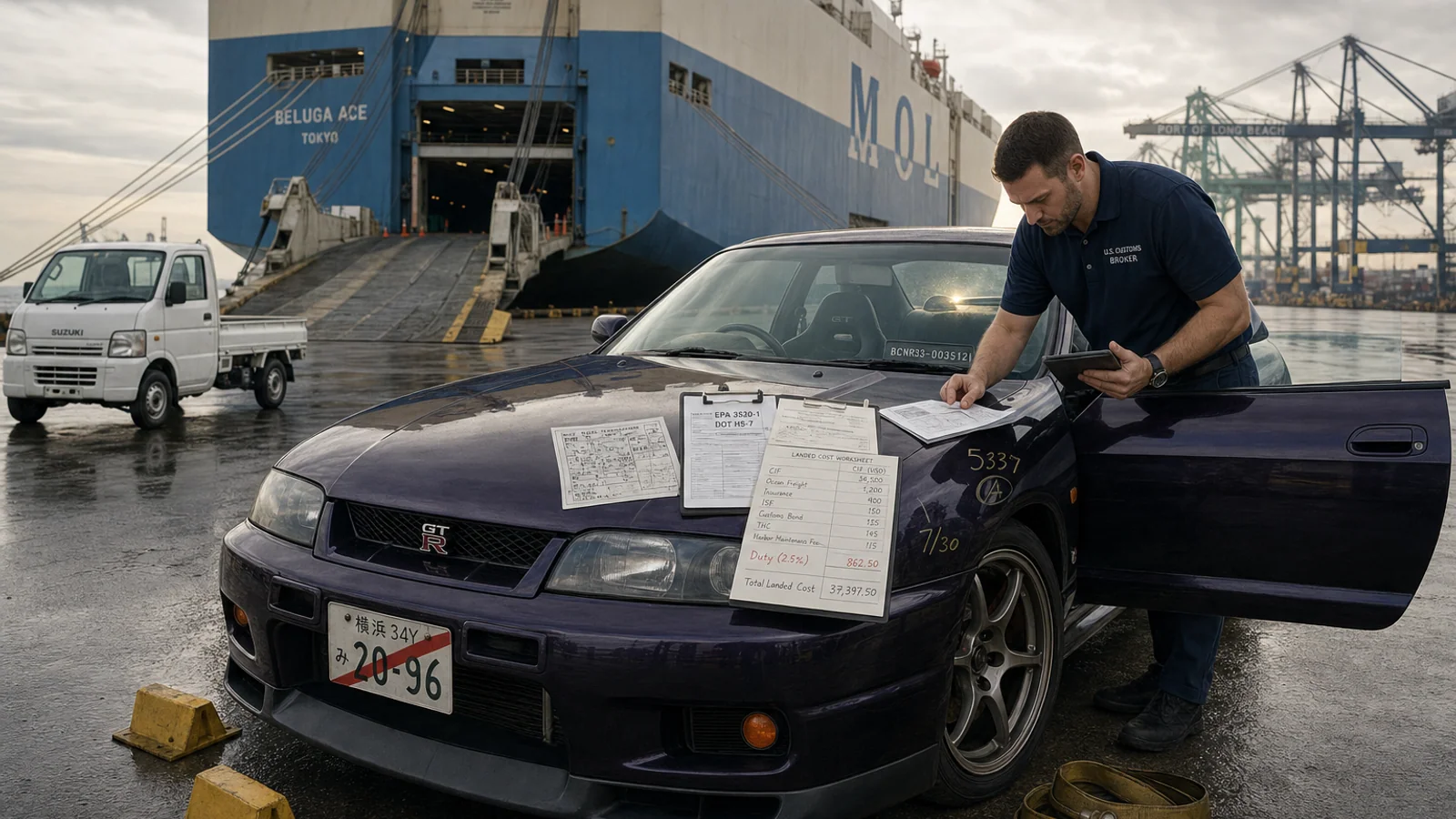
Quick answer US Customs charges 2.5% duty on imported passenger cars and 25% on trucks, both applied to CIF value (vehicle + freight + insurance). A JDM car is legal to import the month it turns 25. A JDM car import calculator stacks auction cost, ocean freight, duty, CBP fees and delivery into one landed cost.
- Duty = CIF × rate: 2.5% for passenger cars under HTS 8703, 25% for trucks and kei cargo vehicles under HTS 8704.
- A JDM car becomes importable the month it turns 25 — build month and year on the export certificate decide it, not the model year.
- RoRo from Yokohama to Long Beach sails about 14–18 days; Gulf and East Coast ports via the Panama Canal run roughly 30–40 days.
- Walio's calculator takes your vehicle, port pair and delivery address, and a specialist confirms carrier space and your exact price within one business day.
Importing from a Japanese auction hall is a sequence of about a dozen separate bills, paid to about six different parties. This guide shows every line, the customs math behind it, and where to send your route for a confirmed price.
Get your Japan to USA car shipping quote
Enter the vehicle, ports and delivery address. A Walio specialist confirms carrier space and your exact price within one business day.
What is a JDM car import calculator?
Quick answer A JDM car import calculator is a tool that adds every cost between a Japanese auction hall and your US driveway: hammer price, auction and agent fees, recycling fee, inland transport in Japan, ocean freight, marine insurance, duty, CBP user fees, customs broker charges, port handling and final delivery.
Three inputs drive every output. The vehicle value in yen sets the base. The HTS classification sets the duty rate. The arrival port sets freight, terminal charges and the length of the inland leg to your state.
Most online tools are black boxes. You type a number, a figure appears, and nothing explains how the two connect. A useful jdm car import calculator shows inputs, then the formula, then the output, so you can audit each line against your broker's entry summary.
The math behind an honest estimate comes from four data sets: the Harmonized Tariff Schedule of the United States for duty rates, the CBP user fee schedule for MPF and HMF, published carrier RoRo and container tariffs, and the JPY/USD rate in effect on the date of entry. Miss one and the estimate drifts.
This page reflects rules current as of January 2026. Duty rates and tariff proclamations change mid-year, so treat any figure as an estimate until a licensed customs broker files your entry. The goal is landed cost, not just freight, because freight is often the smaller half of the bill.
Build your estimate before you bid, not after you win. Auction deposits are hard to recover, and CIF is the tax base — so a high freight quote quietly raises your duty bill too.
How much does it cost to import a JDM car from Japan to the United States?
Quick answer The total depends on five things: the hammer price in yen, the duty rate for your HTS code, RoRo versus container, the arrival port, and the inland leg to your state. Walio's calculator takes your vehicle and route, and a specialist confirms carrier space and your exact price within one business day.
Split the bill into three buckets. Japan-side costs go to the auction house and your exporter. Ocean transport goes to the carrier or the forwarder. US-side clearance and delivery go to CBP, your broker, the terminal and the car hauler.
Japan-side costs most calculators skip
- Auction house fee — charged by USS, TAA, HAA or JU on every successful bid
- Exporter or agent commission — the buying agent who bids on your behalf and handles export
- Recycling fee — refundable or payable depending on how the seller registered the vehicle
- De-registration and export certificate — the Export Certificate that proves build month and ownership
- Export inspection and JEVIC where the destination or carrier requires it
- Inland transport from the auction yard to Yokohama, Nagoya, Kobe or Osaka
US-side costs after the vessel berths
- Ocean freight and marine insurance
- Terminal handling and destination charges (THC/DTHC)
- ISF 10+2 filing fee
- Customs bond — single entry for one car, continuous for repeat importers
- Customs broker fee and entry filing
- Duty, Harbor Maintenance Fee and Merchandise Processing Fee
- Port storage if the car sits past free time
- Final car carrier from the port to your address
No honest page prints one number for this lane. Space on pure car carriers moves week to week, and the duty rate depends on classification and build date. A $2,000 swing between two bookings on the same route is normal.
Pacific Northwest arrivals run shorter at 12–16 days. Gulf and East Coast ports through the Panama Canal stretch to 30–40 days, which changes your insurance window and your storage risk.
Enter the origin port, destination, vehicle details and shipping method in the calculator on this page. A Walio specialist confirms carrier space and sends your exact price within one business day — no phone call required.
Price your Japan to USA car move
Submit the vehicle and route. A specialist confirms space with the carrier and sends your exact price within one business day.
How do I calculate the total landed cost of importing a car from Japan?
Quick answer Landed cost = CIF value + duty + CBP user fees + clearance and port charges + domestic delivery. CIF is the vehicle price plus international freight plus marine insurance. Customs applies the duty rate to CIF, then adds the harbor maintenance fee and the merchandise processing fee on the same declared value.
Work the stack in five steps.
- Convert yen to dollars. Take the hammer price plus dutiable Japan-side fees and convert at the exchange rate in force on the date of entry, not the date you paid.
- Build CIF. Add international ocean freight and marine insurance to the converted vehicle value.
- Apply duty. Multiply CIF by your HTS rate — 2.5% for a passenger car, 25% for a cargo vehicle.
- Add CBP user fees. The Harbor Maintenance Fee is 0.125% of declared value on ocean shipments. The Merchandise Processing Fee is 0.3464% ad valorem, with a minimum and maximum that CBP adjusts annually — verify the current floor and ceiling.
- Add the rest. Broker fee, bond, ISF, terminal handling, storage and the car carrier to your door.
Worked example on a hypothetical CIF value of $20,000, used only to show the math: duty at 2.5% is $500, HMF at 0.125% is $25, and MPF at 0.3464% is $69.28. Broker, bond, ISF, terminal and trucking sit on top. The same CIF at the 25% truck rate produces $5,000 in duty instead of $500.
Auction fees paid in Japan are often dutiable as part of the price actually paid or payable. Your broker decides what belongs inside the declared value — that decision is their signature, not yours.
| Cost line | Who charges it | When it is paid | Part of CIF? |
|---|---|---|---|
| Hammer price | Auction house | Within days of the sale | Yes |
| Auction fee | Auction house | With the hammer price | Usually |
| Agent commission | Exporter / buying agent | With the balance payment | Broker decides |
| Recycling fee | Japanese registry | At de-registration | No |
| Export certificate | Japanese land transport office | Before loading | No |
| Inland transport in Japan | Exporter | Before port cut-off | No |
| Ocean freight | Carrier / forwarder | Before release | Yes |
| Marine insurance | Insurer | Before sailing | Yes |
| Duty 2.5% or 25% | CBP | At entry | Applied to CIF |
| HMF 0.125% | CBP | At entry | Applied to value |
| MPF 0.3464% | CBP | At entry | Applied to value |
| ISF 10+2 filing | Customs broker | 24h before loading | No |
| Customs bond | Surety via broker | At entry | No |
| Terminal handling | Port terminal | At pickup | No |
| Inland delivery | Car hauler | On delivery | No |
The same CIF logic drives duty on every lane, not just Japan. Our China to Guyana Import Tax Calculator: 2026 Rates walks the identical formula with a different tariff schedule, which is a useful sanity check on how freight inflates the tax base.
What is the import duty on a Japanese car and how is it calculated?
Quick answer Duty equals CIF value multiplied by the rate for your HTS classification. Passenger cars under heading 8703 carry 2.5%. Trucks and cargo vehicles under 8704 carry 25%. Motorcycles run from free to 2.4% depending on engine size. Section 232 automobile tariffs can stack on top of the base rate.
The formula is short: duty = CIF × rate. The classification does all the work.
- HTS 8703 — passenger cars: 2.5%
- HTS 8704 — vehicles for the transport of goods, including kei trucks: 25%
- HTS 8711 — motorcycles: free to 2.4% by engine displacement
- Spare parts shipped inside the car — classified separately, at their own rates, and declared separately on the entry
Where do Section 232 tariffs fit in 2026?
Section 232 automobile tariffs took effect in April 2025 on imported passenger vehicles and light trucks under a proclamation issued by the President. The additional ad valorem tariff layers on top of the 2.5% base rate rather than replacing it. A US–Japan trade arrangement later in 2025 adjusted the applied rate for Japanese-origin vehicles mid-cycle.
Two dates matter: the vehicle's build date, which decides 25-year eligibility, and the entry date, which decides which tariff action applies. Scope and exclusions for vehicles 25 years and older move by proclamation. Ask a licensed customs broker to confirm the live rate for your exact HTS code before you place a bid.
| Country | Base duty (passenger car) | VAT / GST | Extra charges | Age rule |
|---|---|---|---|---|
| USA | 2.5% (8703), 25% (8704) | None federal; state sales/use tax | HMF 0.125%, MPF 0.3464%, bond, broker | 25 years |
| Canada | 6.1% | 5% GST + provincial tax | Air-conditioning excise, RIV program fee | 15 years |
| UK | 10% | 20% VAT | Reduced VAT for qualifying historic vehicles, IVA test | No age bar; 30+ yr relief |
| Australia | 5% | 10% GST | Luxury Car Tax above threshold, import approval | 25 years |
| New Zealand | 0% | 15% GST | Entry certification, border levies | 20 years for some classes |
Duty bases differ more than duty rates do. Some countries tax on CIF, others add inland costs or apply levies before VAT — our Vietnam to Brazil Import Calculator: Rates & Rules 2026 shows how a stacked tax base changes the answer even when the headline rate looks modest.
Is my JDM car old enough to import under the 25-year rule?
Quick answer A vehicle becomes legal to import the month it turns 25, counted from the month and year of manufacture shown on the Japanese export certificate — not the model year. A February 2001 build clears in February 2026. Show or Display, off-road use and racing exemptions cover a short, specific list.
The rule is month-exact. NHTSA exempts vehicles 25 years old or more from Federal Motor Vehicle Safety Standards. A car built in March 2001 is not eligible on January 1, 2026 — it is eligible in March 2026.
EPA uses a different clock. Vehicles 21 years old or older qualify for an exemption from federal emissions requirements, provided the engine and chassis stay original. The four-year gap between the two rules trips up buyers who read one agency's page and stop.
| Model | Build years | HTS heading | Duty rate | Eligibility note |
|---|---|---|---|---|
| Nissan Skyline GT-R R33 | 1995–1998 | 8703 | 2.5% | Fully eligible |
| Nissan Skyline GT-R R34 | 1999–2002 | 8703 | 2.5% | Jan 1999 builds cleared Jan 2024 |
| Toyota Supra JZA80 | 1993–2002 | 8703 | 2.5% | Late builds still waiting by build month |
| Nissan Silvia S15 | 1999–2002 | 8703 | 2.5% | 1999 builds eligible from 2024 |
| Mitsubishi Lancer Evolution VI | 1999–2001 | 8703 | 2.5% | 1999 builds eligible from 2024 |
| Toyota AE86 Corolla Levin | 1983–1987 | 8703 | 2.5% | Fully eligible |
| Suzuki Carry (bed) | Any | 8704 | 25% | Chicken Tax applies |
| Daihatsu Hijet (bed) | Any | 8704 | 25% | Chicken Tax applies |
Show or Display, off-road and race cars
Show or Display lets a small number of historically or technologically significant vehicles enter before 25 years. NHTSA publishes the eligible list and approves each petition. Approved cars carry a 2,500-mile annual driving limit.
Off-road and racing imports follow separate declarations and cannot be registered for highway use. Dismantled vehicles and parts cars enter as parts, which changes classification, valuation and the inspection the port applies.
The auction sheet is not proof of age
Auction sheets usually show model year. The export certificate shows the manufacture month and year. CBP reads the export certificate. Buy a late-year car against a model-year date and it can sit in bond until the real anniversary arrives.
Why do kei trucks cost 25 percent in import duty instead of 2.5 percent?
Quick answer Kei trucks pay 25% because the Chicken Tax, a 1964 retaliatory tariff, still applies to vehicles classified under HTS 8704 for the transport of goods. A Suzuki Carry or Daihatsu Hijet with a cargo bed is a truck to CBP. The same chassis as a glazed passenger van can classify differently.
The Chicken Tax came from a 1963 trade dispute over European tariffs on American poultry. The retaliatory 25% duty on light trucks survived six decades of trade rounds. It still hits kei trucks, cab-chassis units, dump-bed conversions and flatbed variants.
The classification trap sits in the body. Rear seats, side glazing and factory seatbelt anchorages push a kei van toward heading 8703 and 2.5%. A cargo bed or a windowless panel body lands it in 8704 at 25%. Two vehicles on the same frame can face a 22.5-point rate gap.
On a hypothetical $12,000 CIF value, 2.5% produces $300 of duty and 25% produces $3,000. That $2,700 difference is often more than the ocean freight for the same unit.
Road registration adds a second layer. A handful of states restrict or refuse highway registration for kei trucks, which is why many buyers import them as off-road or farm equipment and keep them off public roads.
Get the classification in writing before you bid
Request a binding ruling from CBP or a written classification opinion from your customs broker for any borderline body style. A verbal "it should be 2.5%" is worth nothing at the entry desk, and reclassification after arrival triggers an amended entry plus storage.
RoRo or container: which Japan to USA car shipping method wins?
Quick answer RoRo loads the car on its own wheels and is usually the cheapest route for a running vehicle. A shared container protects the car and allows spare parts inside. A dedicated 20 ft container fits one car with spares; a 40 ft holds two. Yokohama to Long Beach sails about 14–18 days.
| Method | Relative cost | Transit | Spare parts | Damage/theft risk | Non-running cars |
|---|---|---|---|---|---|
| RoRo | Lowest | 14–18 days to Long Beach | Not allowed | Higher — open deck, many hands | Only with winching, often refused |
| Shared container | Middle | 16–22 days, consolidation adds time | Allowed, limited volume | Low | Yes, with winching |
| Dedicated 20 ft | Highest per car | 14–20 days | Allowed, full container | Lowest | Yes |
| Dedicated 40 ft (2 cars) | Middle per car | 14–20 days | Allowed, full container | Lowest | Yes |
Transit benchmarks by port pair
 Yokohama(JPYOK)
 Long Beach(USLGB)Nagoya(JPNGO)Tacoma(USTIW)Kobe(JPUKB)Houston(USHOU)
Savannah, Baltimore and NY/NJ run roughly 35–40 days through the Panama Canal. Walio compares sailings from carriers including Maersk, MSC, CMA CGM and Hapag-Lloyd alongside dedicated car-carrier services.
Which gateway should your region use?
- California and the Southwest — Los Angeles / Long Beach
- Pacific Northwest — Seattle or Tacoma
- Texas and the central states — Port Houston
- The Southeast — Savannah or Jacksonville
- The Northeast — New York / New Jersey
- The Midwest — West Coast discharge, then rail through Chicago
- Florida — PortMiami
Port cut-off is not vessel ETD. Cut-off is the last moment cargo can be received at the terminal, usually several days before the ship sails. Miss it by an hour and your car waits a full sailing week, which on this lane means seven extra days of exposure and storage.
Free time also differs by terminal type. RoRo terminals typically grant a short window before storage accrues, while container yards apply demurrage on the box and detention on the equipment. Confirm both before the vessel berths.
Choose RoRo when
The car runs and drives, you are shipping nothing extra, and a West Coast port is close to home. RoRo sailings are frequent, so you wait less for space on the Yokohama–Long Beach rotation.
Choose a container when
The car is a high-value build, a non-runner, or comes with a parts haul. Containers also travel inland by rail, which is useful for Midwest buyers clearing at the coast and railing to Chicago.
Air freight exists for exceptional builds and show cars, at a multiple of ocean cost. Multimodal routings can split the difference — see how sea-air works on other lanes in our Sea-Air China to Peru Calculator: 2026 Rates and Sea-Air Hong Kong to Jamaica Calculator: 2026 Rates.
Compare RoRo and container for your car
Tell the calculator the vehicle, the Japanese port and your delivery address. A specialist confirms space and your exact price within one business day.
Which EPA, DOT and CBP forms does a JDM import need?
Quick answer Every Japan to USA car import needs EPA Form 3520-1, DOT Form HS-7, the Japanese export certificate with an English translation, the bill of sale or auction invoice, the ocean bill of lading, and an ISF 10+2 filing before the vessel loads. Vehicles 25 years or older use EPA code E.
- DOT Form HS-7 — tick box 1 for vehicles 25 years old or older
- EPA Form 3520-1 — code E for vehicles 21 years or older with original engine and chassis
- Japanese export certificate plus a certified English translation
- Auction invoice or bill of sale showing the actual price paid
- Ocean bill of lading or the RoRo carrier's equivalent
- ISF 10+2 filing transmitted before loading in Japan
- Auction sheet and de-registration record for provenance and build-month verification
- JEVIC inspection certificate where the carrier or route requires it
Per CBP, the Importer Security Filing must be transmitted at least 24 hours before the cargo is laden aboard the vessel. Late or missing filings draw liquidated damages claims. Your customs broker files it, so give them the booking details early.
The bond question depends on volume. One car a year fits a single-entry bond. Three or more imports a year usually justify a continuous bond, which also covers ISF. Your broker arranges either through a surety.
Never declare below the auction invoice
Undervaluation is the fastest way to turn a cheap import into an expensive one. CBP can issue penalties, hold the vehicle for exam and seize it. The broker signs the entry under their license, and most will refuse a value that does not match the auction paperwork.
What hidden costs, FX swings and state taxes blow up the budget?
Quick answer Exchange rate movement changes the bill after you win the auction. A 5% yen move on a 3,000,000 JPY car shifts the cost by roughly 150,000 JPY, and duty rides on the dollar CIF value, so FX moves the tax base too. Demurrage, exams and state taxes land afterward.
Your money crosses the currency line three times. The auction deposit settles on one date, the balance payment on another, and the freight invoice on a third. Each uses a different JPY/USD rate, and CBP values the entry at the rate in force on the entry date.
US-side surprises
- Demurrage and port storage once free time expires
- CBP exam and VACIS scan fees, plus the drayage to the exam site
- Terminal chassis, congestion and gate charges
- Steam cleaning when soil or agricultural pests are found on the underbody
- Amended entry costs when a classification or value is corrected
Costs after the car reaches your driveway
- State sales or use tax on the purchase price, charged at registration
- Title application, VIN inspection and plate fees
- State emissions or safety inspection, which varies sharply by state
- Kei truck registration limits in states that classify them as off-road
Budget a 10% contingency on CIF before you bid, and confirm the arrival terminal's free time while the vessel is still at sea. Those two habits absorb almost every surprise on this lane.
Comparing routings before you commit saves more than negotiating any single line item — the approach in our Vietnam to Argentina Sea-Air Calculator: 2026 Rates applies equally to a Yokohama car booking.
Duty, tax and registration questions with money attached belong with a licensed customs broker or a tax adviser. Walio is a shipping platform, and we move the car and the paperwork, not the legal opinion.
Ready to price your JDM import?
Enter the vehicle, Japanese port, US destination and shipping method. A Walio specialist confirms carrier space and sends your exact price within one business day.
The cost is the sum of the hammer price, Japanese auction and export fees, ocean freight, marine insurance, 2.5% duty on CIF for passenger cars, CBP user fees, broker and bond charges, and inland delivery to your state. No two imports price the same because the arrival port and shipping method move the total. Enter your vehicle and route in the calculator on this page and a Walio specialist confirms carrier space and your exact price within one business day.
Duty equals CIF value multiplied by the HTS rate: 2.5% for passenger cars under heading 8703 and 25% for trucks and cargo vehicles under 8704. CIF means the vehicle price plus international freight plus insurance, so freight increases the tax base. Section 232 automobile tariffs can stack on the base rate, so confirm the live figure with a licensed customs broker before bidding.
Your car is eligible the month it turns 25, counted from the manufacture month and year printed on the Japanese export certificate. A car built in March 2001 clears US Customs in March 2026, not on January 1. Model year on the auction sheet does not control the date — CBP reads the export certificate.
Kei trucks fall under HTS 8704 as vehicles for the transport of goods, which still carries the 25% Chicken Tax imposed in 1964. A Suzuki Carry or Daihatsu Hijet with a cargo bed is a truck to CBP, while some glazed kei vans with rear seating can classify as passenger vehicles at 2.5%. Get a written classification opinion before you bid on a borderline body style.
Yokohama, Nagoya or Kobe to Long Beach runs about 14 to 18 days at sea, and Tacoma or Seattle about 12 to 16 days. Gulf and East Coast ports such as Houston, Savannah and NY/NJ take roughly 30 to 40 days through the Panama Canal. Add one to two weeks for booking, port cut-off, customs clearance and the final car carrier to your address.
You now have the full stack: CIF, duty rate, CBP user fees, clearance charges and the inland leg. Put your vehicle, Japanese port, US destination and shipping method into the calculator above — a Walio specialist confirms carrier space and sends your exact price within one business day, with no signup and no phone calls.