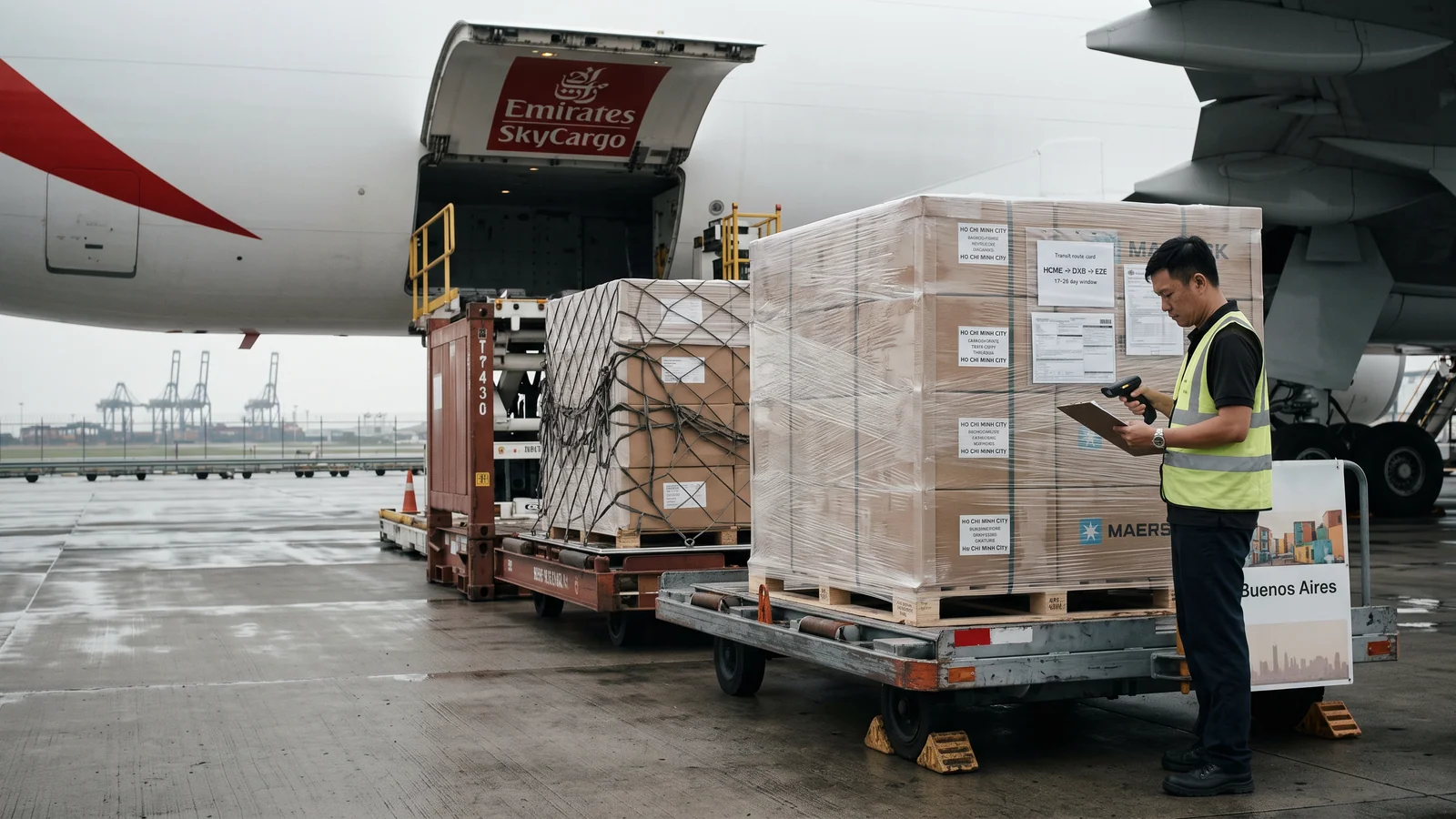
Quick Answer: Sea-air from Asia to Argentina moves in 17–26 days total: ocean to Los Angeles (12–18 days), truck to Miami (3–5 days), then air to Buenos Aires, Mendoza or Rosario (2–3 days). Walio's published Asia–Argentina sea-air rates start from $5.90/kg at 5,000+ kg. The calculator prices your exact Vietnam port and weight in seconds.
- Sea-air from Asia to Argentina takes 17–26 days total, against 35–55 days for pure ocean with transshipment and 5–9 days for pure air.
- Walio's published sea-air rates on the Asia–Argentina lane are from $7.93/kg (300–499 kg), from $7.03/kg (500–999 kg), from $6.35/kg (1,000–4,999 kg) and from $5.90/kg (5,000+ kg), port to airport.
- Sea-air chargeable weight is the greater of actual kilos and volume × 167 kg per m³, with a minimum billed weight of 300 kg.
- Freight is only part of the landed cost: Argentina adds derechos de importación, tasa estadística, IVA 21%, IVA adicional, Ganancias and IIBB on top.
Argentine buyers moving sourcing from China to Vietnam keep hitting the same wall: the ocean lane to Buenos Aires has no direct service. This page explains the sea-air alternative, the chargeable weight math behind it, and the Argentine taxes that sit on top of freight.
What is a sea-air calculator and how does it work?
Quick Answer: A sea-air calculator prices a shipment that travels part of the way by ocean and the rest by plane, then shows the total cost and transit in one figure. You enter origin port, destination airport, volume and weight. The tool converts that into chargeable weight and returns a live rate.
Sea-air is a single multimodal service: an ocean leg from Asia to a transfer gateway, a road leg across the gateway country, then an air leg to the final airport. It was built to sit between slow ocean freight and expensive direct air cargo. You pay more than a container and far less than a full flight, and you cut weeks off the calendar.
Walio's published Asia–Argentina routing runs ocean to Los Angeles in 12–18 days, truck from Los Angeles to Miami in 3–5 days, then air from Miami to Buenos Aires (EZE), Mendoza (MDZ) or Rosario (ROS) in 2–3 days. Total door-free transit is 17–26 days, depending on which origin port your cargo leaves from.
 Ho Chi Minh(VNSGN)
 Los Angeles(USLAX)Los Angeles(USLAX)Miami(USMIA)Miami(MIA)
 Buenos Aires(EZE)
The service is quoted port to airport. You deliver the cargo to the origin port, and your consignee collects it at the destination airport. Door pickup at a Vietnamese factory and door delivery inside Argentina are quoted on request through the same calculator.
Importers who are diversifying into Vietnam use sea-air for one reason above all: cash. A 45-day ocean transit ties up working capital and stretches your foreign-exchange exposure. If you want to see how the same service behaves into a second South American market, read our Sea-Air Vietnam to Colombia Calculator: Rates 2026 guide and compare the two lanes.
Pro tip
Spanish-speaking buyers searching for a calculadora marítimo aéreo vietnam argentina are usually comparing one urgent replenishment against a slow container already on the water. Price both in the same session: the split order — part FCL, part sea-air — often beats either pure option.
Vietnam to Argentina sea-air calculator: what does it cost in 2026?
Quick Answer: Walio's published sea-air rates on the Asia–Argentina lane, from the live multimodal table dated October 2, 2026, are from $7.93/kg for 300–499 kg, from $7.03/kg for 500–999 kg, from $6.35/kg for 1,000–4,999 kg and from $5.90/kg for 5,000+ kg, port to airport.
Always read those figures as "from". The exact rate depends on the origin port and the destination airport you select, and the calculator applies the live number for your pair.
| Chargeable weight band | Published rate (port to airport) | Typical shipment | When to move up a band |
|---|---|---|---|
| 300–499 kg | from $7.93/kg | Sample run, 2–3 pallets of garments | Above 450 kg, consolidate to cross 500 kg |
| 500–999 kg | from $7.03/kg | 4–6 pallets of footwear or small appliances | Above 900 kg, add stock to cross 1,000 kg |
| 1,000–4,999 kg | from $6.35/kg | Half-container of mid-value goods | Above 4,500 kg, combine POs to cross 5,000 kg |
| 5,000+ kg | from $5.90/kg | Full replenishment, 25–30 m³ of dense cargo | Compare against FCL ocean at this volume |
Minimum billed weight is 300 kg. A 120 kg shipment is still billed as 300 kg, so small parcels usually belong with an international courier instead. Run both in the calculator and let the numbers decide.
Origin and destination handling charges are added per shipment inside the calculator. Walio never folds them into the per-kilo figure, because that is how all-in quotes hide margin. You see the sea leg, the road leg, the air leg and the handling as separate lines.
The published table covers Chinese origin ports including Dalian, Fuzhou, Guangzhou, Ningbo, Qingdao, Shanghai, Shenzhen, Xiamen and Xingang. For a Ho Chi Minh, Hai Phong or Da Nang origin the calculator prices your exact port live. Rate drivers to keep in mind:
- Chargeable weight band — the single biggest lever on your per-kilo cost
- Origin port and destination airport pair
- Commodity and packaging density
- Season: Tet, peak-season surcharges and post-holiday capacity crunches
- Add-ons such as cargo insurance or door delivery
How do you calculate chargeable weight for sea, air and sea-air?
Quick Answer: Chargeable weight is the figure carriers actually bill: the greater of real weight and volumetric weight. Sea-air uses volume × 167 kg per m³. Pure air uses length × width × height in cm ÷ 6,000. LCL ocean uses 1 CBM = 1,000 kg, billed per cubic metre or tonne, whichever is higher.
Three rules, three different answers for the same pallet. Take 6 CBM of flat-packed furniture parts weighing 900 kg. Under sea-air the chargeable weight is 6 × 167 = 1,002 kg, which lands in the 1,000–4,999 kg band from $6.35/kg. Under pure air the volumetric figure is the same 1,000 kg range. Under LCL ocean you pay on 6 CBM, because 6 CBM outranks 0.9 tonnes.
The density rule of thumb is simple. Cargo under about 167 kg per m³ pays on volume. Cargo above it pays on actual kilos. Textiles, footwear and plastic housewares from Vietnam are almost always volume-paying.
| Cargo type | Typical density (kg/m³) | Which rule bites | Best mode |
|---|---|---|---|
| Garments on hangers | 60–100 | Volume | LCL or sea-air if urgent |
| Footwear in cartons | 100–150 | Volume | FCL above 15 m³ |
| Consumer electronics | 150–250 | Mixed | Sea-air |
| Hardware and fasteners | 400–700 | Actual weight | FCL ocean |
| Machine parts, castings | 600–1,200 | Actual weight | FCL ocean |
Measure the pallet, not the carton
Carriers measure the outer dimensions of the built pallet. Pallet height, shrink wrap and any carton overhang all count toward volume. A supplier quoting carton CBM will understate your chargeable weight by 8–15%, and the correction appears on the invoice, not the quote.
How many days does a shipment from Vietnam to Buenos Aires take?
Quick Answer: Sea-air from Asia to Argentina totals 17–26 days depending on the origin port. Pure ocean from Ho Chi Minh or Hai Phong to Buenos Aires runs far longer, because the lane has no direct service: boxes transship at Singapore, Port Klang, Santos or Montevideo, adding a week or more each time.
Transshipment means your container is discharged at a hub and reloaded onto a second vessel. Each transfer adds 7–20 days versus the headline transit and raises the risk of a rolled booking when the connecting ship is full. Carriers such as Maersk, MSC, CMA CGM and Hapag-Lloyd all route Vietnam–River Plate cargo this way, and Walio compares their schedules in the same search.
The Walio sea-air legs are fixed and visible: ocean 12–18 days to Los Angeles, truck 3–5 days to Miami, flight 2–3 days to EZE, MDZ or ROS.
| Mode | Realistic transit | Schedule reliability | Typical use case |
|---|---|---|---|
| Sea-air (via LAX + MIA) | 17–26 days | High | Mid-value replenishment, 300 kg to 5 tonnes |
| Pure ocean with transshipment | 35–55 days | Medium | Bulk, low value per kilo |
| Direct air (SGN/HAN → EZE) | 5–9 days | High | Emergency, high value per kilo |
| Express courier | 4–7 days | High | Samples and documents under 70 kg |
Two scheduling traps cost importers a full week each. The first is cut-off: documentation and container cut-offs fall several days before the vessel ETD, and missing one pushes you to the next sailing. The second is seasonality — Tet closes Vietnamese factories and terminals for one to two weeks, peak-season rate increases land from August, and blank sailings thin capacity after Chinese New Year.
Is air, ocean or sea-air cheaper from Vietnam to Argentina?
Quick Answer: Ocean FCL wins on cost per cubic metre for anything above roughly 15 m³. LCL suits 2–15 m³. Sea-air beats pure air on price and beats ocean on speed, which makes it the default for mid-value cargo of 300 kg to a few tonnes. Express courier only makes sense under 70 kg.
Break-even starts with value density. Cargo worth under about USD 10 per kilo almost always goes ocean, because freight would swallow the margin. Above roughly USD 40–50 per kilo, the inventory and currency cost of 45 extra days usually beats the freight saving, and sea-air or air wins.
The second break-even is volume. LCL stops being cheaper than a 20' container at around 10–15 m³, once per-CBM rates stack on top of CFS handling and deconsolidation fees at destination. Many Argentine importers discover this only after the destination invoice arrives.
| Mode | Cost basis | Transit | Minimum | Delay risk | Ideal cargo |
|---|---|---|---|---|---|
| FCL | Per container | 35–55 days | ~15 m³ to justify | Medium | Dense, bulk, low value/kg |
| LCL | Per CBM or tonne | 38–58 days | 1 m³ | Medium-high | 2–15 m³ orders |
| Sea-air | Per chargeable kg | 17–26 days | 300 kg billed | Low | Mid-value, time-sensitive |
| Direct air | Per chargeable kg | 5–9 days | 45 kg typical | Low | High value/kg, urgent |
| Express courier | Per kg, door to door | 4–7 days | None | Low | Samples under 70 kg |
A 4 m³ sample order
Four cubic metres of garments weighs around 350 kg. LCL looks cheap per CBM until CFS, deconsolidation and 50 days of transit enter the picture. Sea-air bills it at 4 × 167 = 668 kg, landing in the 500–999 kg band from $7.03/kg, and it lands in under a month. For a first order from a new Vietnamese supplier, speed buys you time to fix quality problems before the season closes.
A 28 m³ production order
Twenty-eight cubic metres fills a 40' container comfortably. Sea-air chargeable weight would reach roughly 4,676 kg, and even the 1,000–4,999 kg band cannot compete with a container rate on cost per cubic metre. Book FCL, accept the transshipment calendar, and plan inventory around 45–55 days. Keep sea-air in reserve for the one SKU that sells out first.
Which Vietnamese port and Argentine gateway fits your cargo?
Quick Answer: Southern Vietnam factories ship through Ho Chi Minh (Cat Lai) or Cai Mep. Northern suppliers around Hanoi, Bac Ninh and Hai Duong use Hai Phong. Central plants use Da Nang. In Argentina, choose Buenos Aires, Zárate or Rosario for ocean, and EZE, MDZ or ROS for the air leg.
Matching the supplier region to the right port stops you paying for unnecessary inland trucking inside Vietnam. A Bac Ninh electronics plant trucked to Ho Chi Minh burns two days and a lot of cash for nothing.
| Supplier region | Origin port | Common cargo | Note on routing |
|---|---|---|---|
| Ho Chi Minh, Binh Duong, Dong Nai | Cat Lai / Cai Mep | Garments, footwear, furniture | Widest mainline choice |
| Hanoi, Bac Ninh, Hai Duong | Hai Phong | Electronics, components | Often feeders to a southern hub first |
| Da Nang, Quang Nam | Da Nang | Textiles, seafood, handicrafts | Fewer sailings, longer totals |
Hai Phong sailings frequently feeder to a southern transshipment hub before joining the mainline. That is why northern origins often show longer total transits than Ho Chi Minh on the same service.
On the Argentine side, the gateway decision is about inland trucking. Zárate and Rosario can cut inland trucking for importers in the interior, while Ezeiza concentrates most of the country's air capacity. Mendoza (MDZ) and Rosario (ROS) are live sea-air destination airports on this service, not only Buenos Aires. Price and transit shift with the pair you pick, so the calculator prices the exact port-and-airport combination rather than a lane average.
What taxes do you pay importing from Vietnam to Argentina?
Quick Answer: Argentina charges derechos de importación under the Mercosur common external tariff, plus tasa estadística, IVA 21%, IVA adicional on resale goods, a Ganancias advance and provincial Ingresos Brutos. Vietnam has no trade agreement with Mercosur, so goods pay the full tariff rate for their HS classification.
These are the country's published rates, not Walio prices. As of 2026, the headline figures Argentine importers plan around are:
- Derechos de importación by HS code — commonly up to 35% under the Mercosur common external tariff
- Tasa estadística at 3%, subject to statutory caps
- IVA at 21%, or 10.5% on certain goods
- IVA adicional (percepción) — generally 20% on goods for resale
- Ganancias advance — commonly 6% for registered importers
- Ingresos Brutos percepción, which varies by province
Duties are assessed on the CIF value. Freight and insurance enlarge the tax base, which is exactly why you compare modes on landed cost rather than freight alone. The table below uses a FOB order of USD 20,000 and an assumed CIF base of USD 23,000 purely for the arithmetic — your real freight figure comes from the calculator, not from this example.
| Line | Basis | Rate | USD |
|---|---|---|---|
| FOB value | Supplier invoice | — | 20,000 |
| Freight + insurance (assumed) | Illustration only | — | 3,000 |
| CIF base | FOB + freight + insurance | — | 23,000 |
| Derechos de importación | CIF | 18% | 4,140 |
| Tasa estadística | CIF | 3% | 690 |
| Base imponible IVA | CIF + derechos + tasa | — | 27,830 |
| IVA | Base imponible | 21% | 5,844 |
| IVA adicional | Base imponible | 20% | 5,566 |
| Ganancias advance | Base imponible | 6% | 1,670 |
| IIBB percepción | Base imponible | 2.5% | 696 |
| Despachante and local charges | Quoted separately | — | Varies |
| Total before local charges | — | — | 41,606 |
HS classification drives every line above. The same "textile" can sit in two tariff lines with very different duty rates, and the gap between them can exceed your gross margin. A licensed despachante de aduana is mandatory in practice for Argentine imports. Confirm classification, IVA treatment and percepción rates with them or a tax adviser before you place the purchase order.
What is SEDI and which documents does Argentine customs require?
Quick Answer: SEDI is Argentina's Sistema Estadístico de Importaciones, the declaration an importer files through ARCA before shipping. It registers the operation and feeds the FX payment schedule for paying the overseas supplier. Without an approved SEDI, the despacho de importación cannot be completed and payment windows do not open.
ARCA is the successor to AFIP and runs the filing. The SEDI links your operation to the schedule for accessing foreign exchange through the MULC, which determines when you can legally remit funds to your Vietnamese supplier. File before the cargo moves, not after it lands.
- Factura Comercial from the Vietnamese supplier
- Packing list with pallet dimensions and gross weights
- Certificado de Origen — Vietnam Form B where applicable
- Ocean Bill of Lading covering the sea leg
- Air Waybill covering the onward flight to EZE, MDZ or ROS
- Insurance certificate, when cargo cover is contracted
- Despacho de importación filed by your despachante
Sea-air generates two transport documents — a B/L to the transfer gateway and an AWB onward. Consignee details must match exactly across both, or the air carrier will not release the cargo at destination.
On Incoterms 2020, FOB Ho Chi Minh is the common buy for Argentine importers, because it keeps control of the freight with you. EXW shifts Vietnamese origin handling and export clearance onto your account. CIF hides a freight margin inside the supplier's invoice and inflates your CIF tax base. DDP puts Argentine import liability on a seller who is probably not registered to carry it.
Rules change faster than your production lead time
Non-automatic licences, SIRA-era legacy requirements and FX payment timing in Argentina shift often. Verify current requirements with your despachante de aduana before you place the order, not after the container sails. Walio is a shipping platform, not a customs broker or tax adviser.
How do you get your Vietnam–Argentina price online in seconds?
Quick Answer: Enter the origin port in Vietnam, the Argentine destination airport, your cubic metres and kilos. The calculator converts the data into chargeable weight, applies the live rate band, adds origin and destination handling per shipment and shows the total with transit days. No signup, no form that waits for an email.
Anything lighter is still billed as 300 kg on sea-air. Below that threshold, price an international courier in the same calculator and compare the two totals before you book.
Three profiles cover most Vietnam–Argentina buyers:
- Sample order, 320 kg actual. Billed in the 300–499 kg band from $7.93/kg, port to airport.
- Mid-size order, 6 CBM and 900 kg. Chargeable weight 1,002 kg, which falls in the 1,000–4,999 kg band from $6.35/kg.
- Replenishment, 5 tonnes. Reaches the 5,000+ kg band from $5.90/kg, the lowest published rate on the lane.
The quote itemizes the sea leg, the road leg, the air leg and the handling as separate lines. It excludes Argentine duties and taxes, despachante fees, cargo insurance unless you add it, storage, demurrage and detention past free time, and inland delivery beyond the destination airport.
Door pickup in Vietnam and door delivery in Argentina are quoted on request through the calculator. Oversized, project or dangerous-goods cargo routes to a Walio specialist who follows up — no phone tag required. Rates come from live carrier tables and move with the market, so book while the figure on screen is still valid. Readers running the same comparison into Colombia can cross-check the method in our Vietnam to Colombia sea-air rates guide.
A calculadora marítimo aéreo vietnam argentina is only useful if it hands you a real number. Enter your route in the calculator above and see your price in seconds — no signup, no follow-up calls.
The cost depends on container size, origin port and season, and Walio prices it live rather than publishing a flat figure. For faster multimodal movements, Walio's published Asia–Argentina sea-air rates start from $5.90/kg at 5,000+ kg and from $7.93/kg at 300–499 kg, port to airport. Enter your port pair in the calculator to see the exact number for your shipment.
There is no direct service, so boxes transship at hubs such as Singapore, Port Klang, Santos or Montevideo, and each transfer adds 7 to 20 days. Sea-air is the fast alternative at 17–26 days total, combining 12–18 days of ocean, 3–5 days of trucking and 2–3 days of flying. The calculator shows the transit for your exact routing.
Ocean is cheaper per cubic metre, air is faster, and sea-air sits between them at a lower cost than a direct flight. Cargo worth under roughly USD 10 per kilo usually goes by sea, while high-value or urgent goods justify air or sea-air. Compare all three side by side in the calculator before you commit.
Air freight divides length × width × height in centimetres by 6,000 to get volumetric kilos, then bills the greater of that and the actual weight. Sea-air uses a different rule: volume in cubic metres × 167 kg per m³. Walio also applies a minimum billed weight of 300 kg on sea-air shipments.
Argentina applies derechos de importación under the Mercosur common external tariff, tasa estadística, IVA 21%, an IVA adicional on goods for resale, a Ganancias advance and provincial Ingresos Brutos. Vietnam has no agreement with Mercosur, so the full tariff rate for your HS code applies. Confirm the exact percentages with a licensed despachante de aduana.