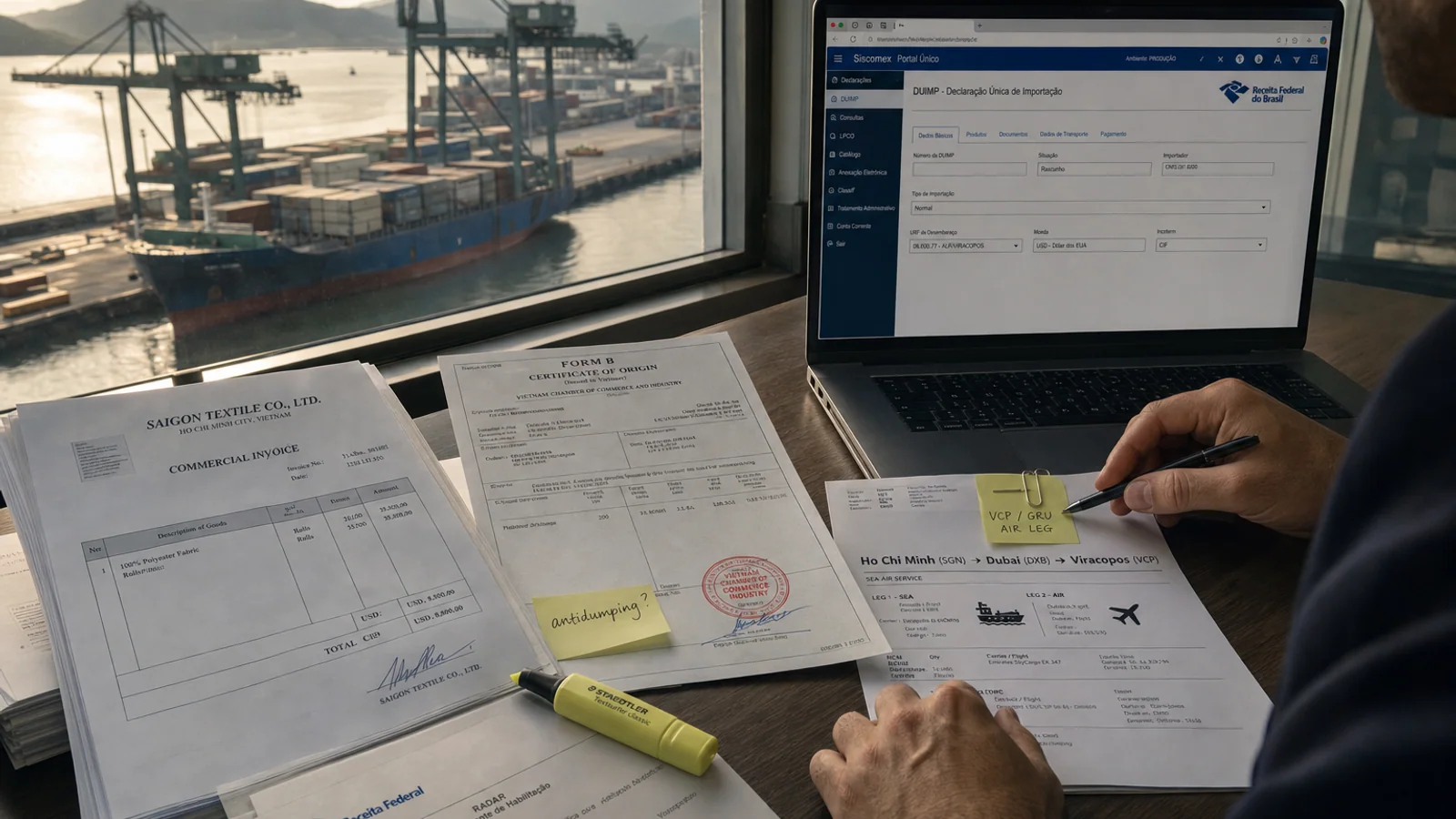
Quick answer Importing from Vietnam to Brazil requires seven things: an active CNPJ, a RADAR habilitation with the Receita Federal, an e-CNPJ digital certificate, Siscomex Portal Único access, the right NCM code, any LPCO license your product needs, and a DUIMP filed by a licensed despachante aduaneiro before the cargo arrives.
- No cargo clears Brazilian customs without RADAR habilitation — the Receita Federal usually answers a Habilitação Expressa request within 10 business days.
- The DUIMP replaced the old DI: you register products in the Catálogo de Produtos first, then file one declaration in the Portal Único Siscomex.
- Brazil and Vietnam have no free trade agreement, so the Mercosur TEC rate applies and a Form B certificate of origin does not reduce the Imposto de Importação.
- Walio's Asia–Brazil sea-air service runs 16–25 days port to airport, and the calculator on this page prices your exact origin, airport and weight in seconds.
This guide covers the full list of requisitos importación Vietnam Brasil — habilitation, licensing, taxes and documents — in the order Brazilian customs checks them. It also shows how a sea-air routing compresses Asia–Brazil transit to 16–25 days, and how to price that move right now.
See your price in seconds
Real carrier rates, no signup, no follow-up calls.
Vietnam to Brazil import requirements: what do you actually need?
Quick answer Seven requirements control every Vietnam to Brazil import: an active CNPJ with import activity, RADAR habilitation at the Receita Federal, an e-CNPJ digital certificate, Portal Único Siscomex access, correct NCM classification, any LPCO license from a consenting agency, and a DUIMP filed before arrival by a licensed customs broker.
Brazilian importing is a sequence, not a checklist you can do in parallel at the last minute. Each item below unlocks the next one. Skip step two and step six becomes impossible.
- CNPJ with import activity. Your company registration must carry a CNAE code consistent with importing and reselling the goods.
- RADAR habilitation. The Receita Federal authorizes the CNPJ to operate in foreign trade through Siscomex.
- e-CNPJ digital certificate (A1 or A3). Every Siscomex action is signed with it.
- Portal Único Siscomex access plus a procuração granting powers to your despachante aduaneiro.
- NCM classification and Catálogo de Produtos registration for each SKU and each Vietnamese manufacturer.
- LPCO or import licence if ANVISA, MAPA, INMETRO, ANATEL, IBAMA or the Exército must consent.
- DUIMP and tax payment — II, IPI, PIS/COFINS-Importação, ICMS, AFRMM and the Taxa de Utilização do Siscomex.
Items one through seven are the Brazilian importer's job. Your Vietnamese supplier is responsible for a smaller, equally critical set: the commercial invoice, the packing list, the Form B certificate of origin from VCCI, and the Bill of Lading or Air Waybill.
The sequencing mistake that strands cargo is simple. Importers negotiate with a factory in Hai Phong, pay a deposit, and only then discover that RADAR takes weeks. Start the habilitation three to four weeks before your first purchase order leaves Hai Phong or Cat Lai.
| Requirement | Who handles it | Where it is done | Lead time |
|---|---|---|---|
| CNPJ with import CNAE | Importer / accountant | Receita Federal | 1–5 days to amend |
| e-CNPJ certificate | Importer | Accredited certification authority | 1–3 days |
| RADAR (Habilitação Expressa) | Importer / broker | e-CAC, Receita Federal | About 10 business days |
| Broker credentialing | Importer | Submódulo Credenciamento | Same day |
| Catálogo de Produtos | Importer / broker | Portal Único Siscomex | 1–5 days per SKU batch |
| LPCO / import licence | Broker + agency | Portal Único Siscomex | 5–60 days by agency |
| Commercial invoice, packing list, Form B | Vietnamese exporter | Factory + VCCI | Before shipment |
Transit time raises the stakes. A direct ocean sailing from Vietnam to Santos gives you 38 to 50 days of slack. A sea-air routing lands your cargo in 16 to 25 days, which leaves far less time to fix a missing habilitation.
See your price in seconds
Real carrier rates, no signup, no follow-up calls.
What is RADAR and how do you get it from the Receita Federal?
Quick answer RADAR is the Receita Federal's registry that authorizes a Brazilian CNPJ to operate in foreign trade through Siscomex. Without it, no DUIMP can be filed and no Vietnamese cargo can clear. Most companies apply for Habilitação Expressa online with an e-CNPJ certificate and receive an answer within about ten business days.
RADAR is not a licence for a product. It is a licence for your company to exist inside Siscomex at all. The Receita Federal grants it in modalities tied to your financial capacity.
- Expressa: imports up to USD 50,000 in customs value per six-month period. Granted largely on automated analysis.
- Limitada: a ceiling set from your tax payment history and estimated capacity, reviewed by the Receita Federal.
- Ilimitada: no operational ceiling, for companies with proven financial capacity and a clean fiscal record.
The practical path runs in a fixed order. Each step depends on the previous signature.
- Buy the e-CNPJ digital certificate from an accredited authority, in A1 (file) or A3 (token) format.
- Confirm the legal representative registered in the CNPJ matches the person who will sign.
- Open the Habilitação dossier through the e-CAC portal and submit the financial capacity documents.
- Register the legal representative and any employees who will operate Siscomex.
- Credential your despachante aduaneiro in the Submódulo Credenciamento so the broker can act on your behalf.
That last step is the one new importers forget. A broker with no credentialing cannot touch your DUIMP, even with a signed contract and a notarized procuração.
Your RADAR limit can block your second shipment
Habilitação Expressa caps you at USD 50,000 per semester. An importer who tests the lane with one LCL and then orders a 40HC of Vietnamese furniture can blow through that ceiling mid-voyage. Request the upgrade to Limitada before you place the larger order, not when the vessel is already at sea.
One piece of good news: the habilitation is national, not per port. The same RADAR works whether your container lands at Santos or your air freight lands at Viracopos or Guarulhos.
What is the DUIMP and how is it different from the old DI?
Quick answer The DUIMP is the single import declaration of Brazil's Novo Processo de Importação, filed in the Portal Único Siscomex. It replaced the paper-era DI by pulling product data from the Catálogo de Produtos and licence data from LPCO, so the same information is typed once instead of once per shipment.
Three terms do all the work here, so define them once and the rest is mechanical.
- DUIMP — Declaração Única de Importação, the single declaration that replaced the DI and the licence paperwork around it.
- Catálogo de Produtos — your permanent product library, holding each SKU's NCM, attributes and the Vietnamese manufacturer's name and address.
- LPCO — Licenças, Permissões, Certificados e Outros documentos: the module where consenting agencies approve regulated goods.
The flow is linear. Register the Vietnamese exporter and each SKU in the catalog. Obtain any LPCO approvals. File the DUIMP, and the system calculates the tributes and assigns a clearance channel.
Repeat buyers gain the most. Once your factory in Bình Dương and its 40 SKUs sit in the catalog, every later DUIMP is close to a copy-paste of the previous one.
File the DUIMP under despacho antecipado, before the aircraft or vessel arrives. On a 16–25 day sea-air routing, anticipated clearance is the difference between collecting cargo the day after landing and paying airport storage while the declaration is keyed in.
Catalog quality decides your clearance channel. Wrong attributes — material, voltage, intended use, composition percentage — feed the parametrização engine and push the DUIMP into the yellow or red channel. Fix the catalog once and you stop paying for inspections forever.
Which Brazilian agencies must approve your Vietnamese product?
Quick answer Brazil requires consent from a specific agency depending on the goods: ANVISA for food, cosmetics and medical devices, MAPA for agricultural products, INMETRO for toys and electrical goods, ANATEL for telecom and wireless devices, IBAMA for chemicals and timber, and the Exército for controlled items. Approval is requested as an LPCO before shipment.
Licensing splits into two categories, and the difference is financial. An automatic licence is a registration step that clears quickly. A non-automatic licence is a real approval, and it must be granted before the cargo leaves Vietnam — not after it lands.
| Product category | Consenting agency | Licence type | Typical lead time |
|---|---|---|---|
| Food, food contact plastics | ANVISA / MAPA | LPCO, non-automatic | 15–60 days |
| Cosmetics | ANVISA | LPCO + product registration | 30–90 days |
| Electronics with radio (Bluetooth, Wi-Fi) | ANATEL | Homologation + LPCO | 30–60 days |
| Toys | INMETRO | Certification + non-automatic LI | 30–60 days |
| Power tools, electrical goods | INMETRO | Certification + LPCO | 30–90 days |
| Textiles, apparel | None (trade defense screening only) | Usually no licence | — |
| Machinery (non-regulated) | None / Ex-Tarifário if applicable | Automatic or none | 0–15 days |
| Wood furniture, timber | IBAMA | LPCO + legality proof | 10–30 days |
Vietnam-specific traps repeat constantly. A Bluetooth speaker from Hai Phong needs ANATEL homologation held by someone — usually the importer — before it can be sold. A toy needs an INMETRO certificate issued by an accredited Brazilian body, not a Vietnamese test report.
Electrical specification is a production decision, not a customs decision. Confirm the Brazilian plug standard (NBR 14136) and the 127 V or 220 V build with the factory before the production run starts. A container of wrong-plug appliances is a loss, not a correction.
Air arrival changes nothing about licensing. A sea-air shipment that lands at Viracopos or Guarulhos faces the same LPCO screening as a container discharged at Santos. The mode is faster; the rules are identical.
NCM code, certificate of origin and antidumping: what applies to Vietnam?
Quick answer Every Vietnamese product needs an 8-digit NCM code, which sets the Mercosur TEC rate for the Imposto de Importação. Brazil and Vietnam have no free trade agreement, so the Form B certificate issued by VCCI proves origin but grants no tariff cut. Several Vietnamese goods also face antidumping duties.
The NCM is the Mercosur version of the HS code. The first six digits match the World Customs Organization HS nomenclature your Vietnamese supplier already uses. The last two digits are Mercosur-specific, and they are where the duty rate actually lives.
Check the rate in the Siscomex tariff consultation before you negotiate price. Under the Tarifa Externa Común, the Imposto de Importação ranges from 0% to 35% depending on the NCM.
Now the part that surprises buyers coming from Asia. There is no free trade agreement between Vietnam and Brazil or Mercosur. The Form B certificate from the Vietnam Chamber of Commerce and Industry (VCCI) documents where the goods were made. It does not reduce a single percentage point of duty.
Triangulation from China is a real liability
Goods manufactured in China, transshipped through Vietnam and lightly repackaged can be hit with circumvention duties under Brazilian trade-defense rules. Ask your factory for production records, the manufacturer's own address, and confirmation that the Form B reflects substantial transformation in Vietnam. A Form B naming a Chinese manufacturer is a red flag to Brazilian customs.
Brazil maintains antidumping measures across categories that overlap heavily with Vietnamese export strengths: steel and steel products, footwear components, certain plastics, fibers and tyres. Measures change. Check the current list published by the Ministério do Desenvolvimento, Indústria, Comércio e Serviços for your exact NCM before you place an order.
One legal route cuts duty honestly. Ex-Tarifário grants a reduced Imposto de Importação on capital goods (BK) and IT and telecom goods (BIT) with no equivalent Brazilian producer. The filing is technical and evidence-based — use a licensed customs broker or a specialist consultancy.
How much tax do you pay importing from Vietnam to Brazil?
Quick answer Brazilian import taxes stack on the CIF value: Imposto de Importação at the TEC rate for your NCM, IPI, PIS-Importação, COFINS-Importação, state ICMS, AFRMM on ocean freight and the Siscomex fee. IPI, PIS, COFINS and ICMS are usually recoverable credits for a company on the regime of lucro real.
| Tribute | Calculation base | Typical rate | When paid | Recoverable credit |
|---|---|---|---|---|
| Imposto de Importação (II) | Customs value (CIF) | 0–35% by NCM | DUIMP registration | No |
| IPI-Importação | CIF + II | 0–30% | DUIMP registration | Yes (industry) |
| PIS-Importação | Customs value | 2.1% | DUIMP registration | Yes (lucro real) |
| COFINS-Importação | Customs value | 9.65% | DUIMP registration | Yes (lucro real) |
| ICMS | CIF + II + IPI + PIS/COFINS + fees, grossed up | 17–20% by state | Before release | Yes |
| AFRMM | Ocean freight | 8% | Before clearance | No |
| Taxa Siscomex | Per DUIMP + per addition | Fixed fee | DUIMP registration | No |
AFRMM deserves its own paragraph. The Adicional ao Frete para Renovação da Marinha Mercante is a merchant marine fund charge levied on the ocean freight of cargo arriving by sea at a Brazilian port. Cargo that enters Brazil by air through Viracopos or Guarulhos does not carry a Brazilian ocean freight leg. Confirm the treatment of your specific routing with a licensed customs broker before you model landed cost.
An illustrative landed-cost cascade
The numbers below are an illustrative tax calculation, not a Walio price. They use published Brazilian rates on a hypothetical CIF value of USD 100,000 with an II of 14%, IPI of 5% and ICMS of 18%.
- Customs value (CIF): 100,000
- II at 14%: 14,000
- IPI at 5% on 114,000: 5,700
- PIS at 2.1%: 2,100 · COFINS at 9.65%: 9,650
- Subtotal before ICMS: 131,450
- ICMS at 18% calculated "por dentro": 131,450 ÷ 0.82 × 0.18 = 28,855
- Total tax burden: roughly 60,305, or about 60% of CIF
That is why total import tax in Brazil commonly lands between 40% and 90% of FOB value, depending on NCM and state. Add AFRMM on an ocean routing, the Siscomex fee, broker fees and port storage.
State choice matters. Santa Catarina and Espírito Santo run long-standing ICMS incentive programs that attract import operations through Itajaí, Navegantes and Vitória. Resale into another state then triggers DIFAL, the interstate rate differential. Model the whole chain with a tax adviser, not just the entry point.
Two special regimes are worth knowing. Drawback suspends tax on inputs that will be re-exported after processing. Admissão Temporária covers equipment entering Brazil for a defined period, such as machinery for a trade fair or a project. Both need a licensed customs broker to structure.
See your price in seconds
Real carrier rates, no signup, no follow-up calls.
What documents must your Vietnamese supplier send for customs?
Quick answer Brazilian customs expects a commercial invoice, packing list, Bill of Lading or Air Waybill, Form B certificate of origin, and any technical certificates for the LPCO. The importer adds the DUIMP, catalog records, proof of tax payment and the broker's procuração. Missing or inconsistent data is the top cause of red-channel inspection.
| Document | Issued by | Deadline |
|---|---|---|
| Commercial invoice | Vietnamese exporter | At shipment |
| Packing list (net + gross weight) | Vietnamese exporter | At shipment |
| Bill of Lading / Air Waybill | Carrier or NVOCC | On departure |
| Form B certificate of origin | VCCI, Vietnam | Within days of shipment |
| Technical / sanitary certificates | Factory or accredited lab | Before LPCO filing |
| ISPM-15 fumigation mark | Vietnamese packer | At packing |
| Catálogo de Produtos records | Brazilian importer | Before DUIMP |
| DUIMP | Despachante aduaneiro | Before or on arrival |
| Procuração for the broker | Brazilian importer | Before credentialing |
| Proof of tax payment (DARF / GARE) | Brazilian importer | Before release |
Brazilian customs reads the invoice line by line. It must show the exporter and the real manufacturer with full addresses, the Incoterms 2020 rule plus the named place, the NCM, unit price, net and gross weight, country of origin and payment terms. "FOB Vietnam" is not a named place. "FOB Hai Phong" is.
What happens after parametrização
- Verde: automatic release. No human review, cargo available immediately.
- Amarelo: document review by an auditor. Add two to seven days.
- Vermelho: physical inspection plus documents. Add five to fifteen days and storage charges.
- Cinza: valuation fraud investigation. Weeks, sometimes months, with the cargo held.
Payment is its own workflow. The fechamento de câmbio — the FX contract with your Brazilian bank for the transfer to the Vietnamese supplier — must tie to the DUIMP and the invoice value. Mismatched amounts attract attention from both the bank and the Receita Federal.
Three blockers appear again and again on this lane: weights that disagree between the packing list and the B/L, a Form B naming a Chinese manufacturer, and wooden pallets without the ISPM-15 fumigation mark. All three are fixed by a 10-minute pre-shipment document check with your supplier.
Sea-air, FCL, LCL or air: which route from Vietnam wins?
Quick answer Direct ocean from Hai Phong or Ho Chi Minh to Santos takes roughly 38 to 50 days with transshipment. Walio's sea-air service moves cargo by ocean to Los Angeles, by truck to Miami and by air into Brazil in 16 to 25 days total. Pure air is fastest and the most expensive per kilo.
| Mode | Transit | Best cargo profile | Minimum | Storage / demurrage risk |
|---|---|---|---|---|
| FCL (20', 40', 40HC) | 38–50 days | Furniture, tiles, bulk SKUs | 15 m³ and up | High (demurrage + detention) |
| LCL | 42–55 days | Mixed pallets, trial orders | 1 m³ | Medium (CFS deconsolidation) |
| Sea-air | 16–25 days | Electronics, parts, seasonal goods | 300 kg chargeable | Low (short airport dwell) |
| Pure air | 4–7 days | Samples, urgent replacements | 45–100 kg | Low, highest cost per kg |
The sea-air routing is a multimodal service, and the legs are worth knowing precisely. Ocean from the Asian load port to Los Angeles runs 12 to 18 days. A truck moves the cargo Los Angeles to Miami in 3 to 5 days. The final air leg from Miami into Brazil takes 1 to 2 days.
 Miami(MIA)
 São Paulo(GRU)
Walio serves eleven Brazilian airports on the lane: Belo Horizonte (CNF), Campinas (VCP), Curitiba (CWB), Florianópolis (FLN), Manaus (MAO), Navegantes (NVT), Porto Alegre (POA), Rio de Janeiro (GIG), São José dos Campos (SJK), São Paulo (GRU) and Vitória (VIX). Walio prices the service port to airport: the shipper delivers to the origin port and the consignee collects at the destination airport.
| Brazilian gateway | Mode | Ocean transit from Vietnam | Storage cost pressure | ICMS treatment |
|---|---|---|---|---|
| Santos (SSZ) | Ocean | 38–50 days | High congestion | São Paulo standard rate |
| Itajaí / Navegantes | Ocean | 40–52 days | Medium | Santa Catarina incentive programs |
| Paranaguá | Ocean | 40–52 days | Medium | Paraná standard rate |
| Suape | Ocean | 36–48 days | Low | Pernambuco incentives |
| Viracopos (VCP) | Air / sea-air | 16–25 days total | Low, fast dwell | São Paulo standard rate |
| Guarulhos (GRU) | Air / sea-air | 16–25 days total | Medium, high volume | São Paulo standard rate |
When ocean wins
Dense, low-value, high-volume cargo belongs on the water. One 40HC of Vietnamese rattan furniture at 65 m³ is far cheaper by FCL, and the 45-day transit is acceptable because the goods are seasonal, not urgent. The LCL-to-FCL break-even sits around 10 to 15 m³.
When sea-air wins
A 600 kg electronics order with a launch date behind it belongs on sea-air. You buy back roughly 25 days against direct ocean for a fraction of pure air freight. Short airport dwell also means less exposure to demurrage and CFS storage charges.
Comparing neighboring South American lanes helps you benchmark. See the Sea-Air Vietnam to Colombia Calculator: Rates 2026 and the Vietnam to Argentina Sea-Air Calculator: 2026 Rates for how transit and pricing shift across the region.
See your price in seconds
Real carrier rates, no signup, no follow-up calls.
What does sea-air cargo into Brazil cost, and how do you price it now?
Quick answer Sea-air is billed per chargeable kilo, which is the greater of actual weight and volume times 167 kg per cubic meter, with a 300 kg minimum. On Walio's Asia to Brazil lane, rates start at $6.64/kg for 300-499 kg and $4.60/kg for 5,000 kg and up, at the cheapest port and airport pair.
These are Walio's published sea-air rates from the Asian ocean ports on the lane — Shanghai, Shenzhen, Ningbo, Guangzhou, Qingdao, Xiamen, Fuzhou, Dalian and Xingang — into the Brazilian airports listed above.
| Chargeable weight | Rate per kg (from) | Service | Transit |
|---|---|---|---|
| 300–499 kg | from $6.64 | Port to airport | 16–25 days |
| 500–999 kg | from $5.74 | Port to airport | 16–25 days |
| 1,000–4,999 kg | from $5.06 | Port to airport | 16–25 days |
| 5,000+ kg | from $4.60 | Port to airport | 16–25 days |
Every figure is a "from" rate at the cheapest port and airport pair on the lane. Your exact rate depends on which ocean port and which Brazilian airport you choose.
A lighter shipment is still billed as 300 kg. Chargeable weight is the greater of actual weight and volume × 167 kg/m³ — so 4 m³ weighing 400 kg on the scale bills as 668 kg.
Origin and destination handling charges are added per shipment in the calculator. They are never folded into the per-kg figure, which keeps the comparison honest when you benchmark quotes.
Cargo moving out of Vietnamese ports, plus door pickup in Asia and door delivery in Brazil, is quoted on request in the calculator. Enter your exact origin, destination airport and weight, and the price appears in seconds.
What sits entirely outside the freight price: Imposto de Importação, IPI, PIS/COFINS-Importação, ICMS, AFRMM, the Siscomex fee, customs broker fees and port or airport storage. Budget those separately with your broker.
Shipping to more than one Latin American market? Compare the Sea-Air Vietnam to Panama Calculator: 2026 Rates, the Vietnam to Dominican Republic Sea-Air Calculator: 2026 and the Sea-Air Cargo Vietnam to Paraguay Calculator: Rates 2026.
Readers searching requisitos importación Vietnam Brasil usually need two answers at once: the compliance list and a real number. The compliance list is above. The number is on this page.
See your price in seconds
Real carrier rates, no signup, no follow-up calls.
You need an active CNPJ authorized for foreign trade, RADAR habilitation with the Receita Federal, an e-CNPJ digital certificate, access to the Portal Único Siscomex, the correct NCM code, any LPCO license your product requires, and a DUIMP filed by a credentialed despachante aduaneiro. The RADAR must be active before the cargo arrives, so start the application three to four weeks before your first order ships. Without it, customs will not accept the declaration.
Brazilian imports pay Imposto de Importação at the Mercosur TEC rate for your NCM, plus IPI, PIS-Importação, COFINS-Importação, state ICMS, AFRMM on ocean freight and the Siscomex fee, all calculated on the CIF value. IPI, PIS, COFINS and ICMS are often recoverable tax credits for companies on lucro real. Check the exact rate for your NCM in Siscomex and confirm the calculation with a licensed customs broker.
A direct ocean container from Hai Phong or Ho Chi Minh to Santos usually takes 38 to 50 days with transshipment. Walio's sea-air service is far faster at 16 to 25 days total: 12 to 18 days on the water to Los Angeles, 3 to 5 days by truck to Miami, then 1 to 2 days by air into São Paulo, Campinas, Rio de Janeiro or another Brazilian airport. The calculator on this page shows the transit for your exact origin and airport.
No. Brazil and Vietnam have no free trade agreement, so imports pay the full Mercosur Common External Tariff rate for the product's NCM code. A Form B certificate of origin from VCCI proves where the goods were made and helps with antidumping screening, but it does not reduce the Imposto de Importação.
Your supplier must send the commercial invoice, the packing list with net and gross weights, the Bill of Lading or Air Waybill, the Form B certificate of origin from VCCI, and any technical or sanitary certificates your LPCO requires. The invoice must name the real manufacturer, the Incoterms 2020 rule and the NCM code. Weights and descriptions must match the transport document exactly, or the DUIMP can be routed to the red channel.
Get the compliance work started this week — RADAR first, then the Catálogo de Produtos, then the LPCO if your product needs one. While your broker handles the paperwork, price the freight yourself: enter your route in the calculator above and see your price in seconds, no signup and no follow-up calls.