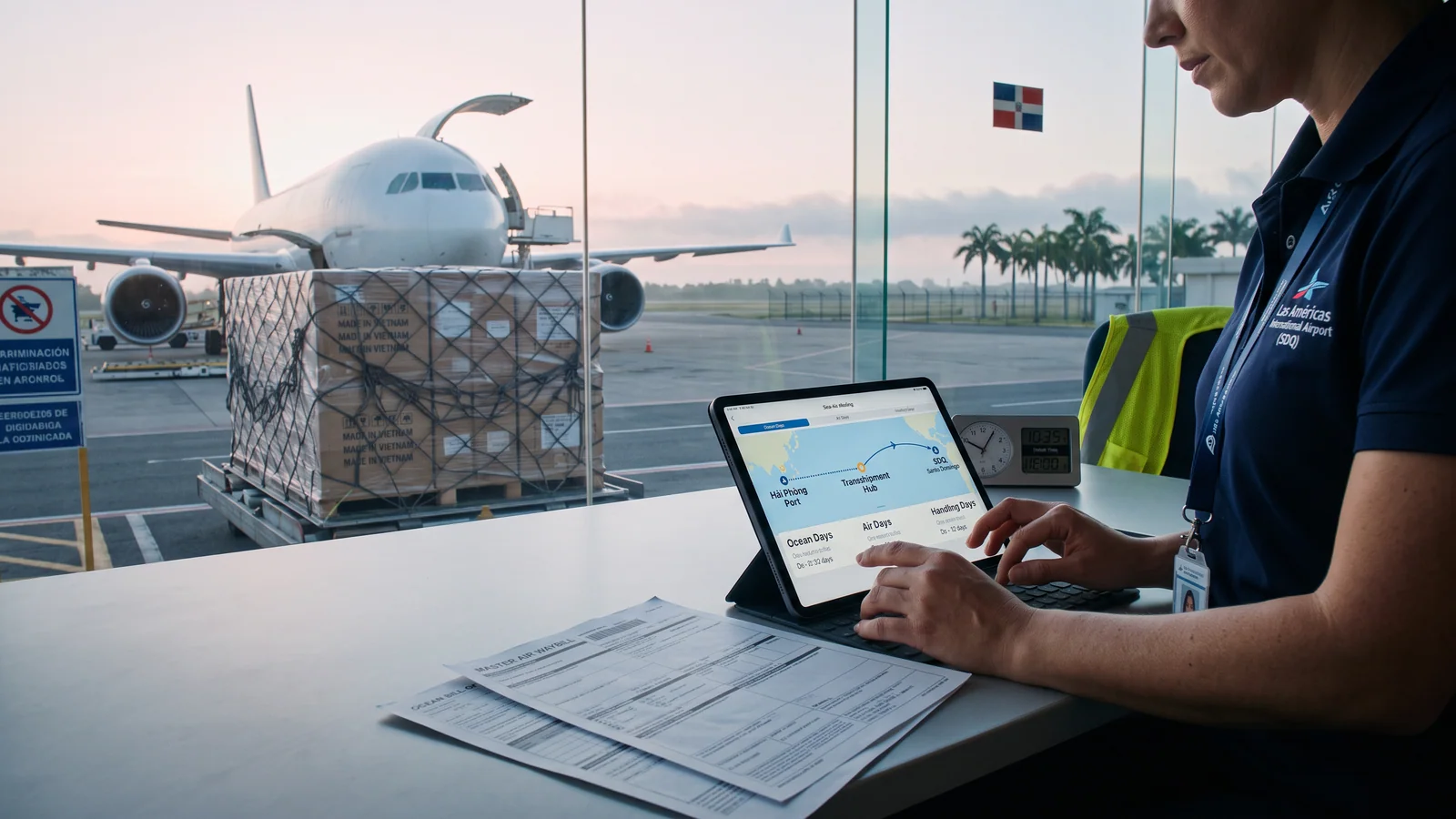
Quick Answer: A sea-air shipment from Vietnam to the Dominican Republic moves in three legs: ocean to Los Angeles, truck Los Angeles to Miami in 3–5 days, then air Miami to Santo Domingo (SDQ) in 1–2 days. On the same published routing, Chinese base ports total 16–25 days door-to-airport.
- Sea-air to Santo Domingo runs in three legs: ocean to Los Angeles, truck LA–Miami (3–5 days), air MIA–SDQ (1–2 days).
- The published benchmark lane on this exact routing (Chinese base ports → LA → Miami → SDQ) totals 16–25 days, depending on the origin port.
- Vietnam sailings usually transship before reaching Los Angeles, so the ocean leg is the only variable worth planning around.
- Chargeable weight is the greater of actual kilos or volume × 167 kg per m³, with a 300 kg minimum billed weight.
Dominican importers buying from factories in Hanoi, Haiphong or Ho Chi Minh City ask the same question: how many days, leg by leg. This page gives the published numbers for each leg and prices your exact booking in the calculator.
Vietnam to Dominican Republic Transit Time: How Many Days?
Quick Answer: Sea-air from Vietnam reaches Santo Domingo through Los Angeles and Miami. The two US legs are fixed and fast: 3–5 days by truck and 1–2 days by air. Only the ocean leg moves. On the same routing, Chinese base ports deliver port to airport in 16–25 days.
Sea-air is a multimodal service: it buys ocean economics for the long Pacific crossing and air speed for the final hop into the Caribbean. The cargo never flies across the ocean. It sails to the US West Coast, crosses the country by road, and flies only the last short sector to SDQ.
The three legs are fixed in shape:
- Leg 1 — ocean: Vietnam to Los Angeles / Long Beach, almost always with one transshipment call.
- Leg 2 — truck: Los Angeles to Miami, 3–5 days by road, in bond.
- Leg 3 — air: Miami to Santo Domingo (SDQ), 1–2 days, on daily lift.
The published benchmark on this exact routing runs from Chinese base ports — Shanghai, Ningbo, Shenzhen, Xiamen, Qingdao, Guangzhou, Fuzhou, Dalian and Xingang. Those ports show 12–18 days of ocean and 16–25 days port to airport in total. Vietnamese sailings follow the same US legs but usually add a transshipment call, so plan the ocean leg at the upper end of that band.
1–2 days Miami to Santo Domingo is the shortest and most reliable leg of the whole journey. Miami is the Caribbean's air hub, with daily departures to SDQ on multiple carriers.
Scope matters as much as the clock. These transits are port to airport: the shipper delivers the cargo to the origin port, and the consignee collects it at SDQ. Door pickup at the Vietnamese factory and door delivery in the Dominican Republic are quoted separately in the calculator. If the model itself is new to you, read What Is Sea-Air Shipping and When Should You Use It? before you book.
What Are the Real Days for Each Leg?
Quick Answer: Leg one is ocean from Vietnam to Los Angeles, almost always with a transshipment call. Leg two is a 3–5 day truck run from the LA/Long Beach complex to Miami. Leg three is the 1–2 day Miami–SDQ air hop. Handling at each break point sits between the legs.
| Leg | Mode | Route | Published days | What happens here |
|---|---|---|---|---|
| 1 | Ocean | Haiphong / Cat Lai (Ho Chi Minh) → Los Angeles / Long Beach | 12–18 (Chinese base-port benchmark) + transshipment | CFS stuffing, port cut-off, sailing, one transshipment call |
| 2 | Truck | Los Angeles → Miami | 3–5 | Deconsolidation, re-palletizing for air, in-bond road move |
| 3 | Air | Miami (MIA) → Santo Domingo (SDQ) | 1–2 | Air waybill issued, daily lift, consignee collects at SDQ |
 Miami(MIA)
 Santo Domingo(SDQ)
Leg 1: the ocean clock starts before the ship sails
The CFS cut-off comes days before the vessel ETD. Book against the port cut-off, not vessel ETD, or you lose a full week waiting for the next string. Walio compares services from carriers including Maersk, MSC, CMA CGM and Hapag-Lloyd on this leg.
Vietnamese volumes rarely get direct Pacific strings at the frequency Chinese base ports enjoy. Most boxes feeder to a hub, then load onto a mainline vessel. Treat the 12–18 day Chinese figure as the floor, not the Vietnam number.
Leg 2: where the quiet days hide
At the Los Angeles CFS the container is deconsolidated, your cargo is re-palletized to air standards, and drayage moves it to the line-haul trucker. That handover is the least visible part of the journey. A clean packing list and correct HS codes keep deconsolidation in Los Angeles down to hours instead of days.
Leg 3: the ocean B/L hands over to the AWB
Once the cargo is tendered at MIA, the air waybill becomes the governing transport document. The ocean bill of lading has done its job. From there it is a short, frequent sector into SDQ, the same hub pattern used on the China to Bahamas sea-air lane.
What Adds Days Between Haiphong and Santo Domingo?
Quick Answer: Four things stretch the calendar: Tet factory closures, rollover at the transshipment port, incomplete paperwork at the Los Angeles handover, and clearance at SDQ. Dominican customs releases quickly when the DUA, commercial invoice and certificate of origin match the air waybill exactly.
- Tet closures. Vietnamese Lunar New Year shuts factories for one to two weeks and jams bookings for weeks afterward. Set cargo ready dates well before it.
- Rollover at the transshipment hub. A missed connection costs a full service rotation. This is why the ocean leg is the only leg worth padding in your plan.
- US in-bond paperwork. The cargo transits Los Angeles and Miami in bond, so HS classification, shipper details and consignee details must be clean before the box lands.
- Clearance at SDQ. The Dirección General de Aduanas (DGA) processes the DUA. Have the file ready before the flight arrives.
For the DGA filing, prepare this set:
- DUA (Declaración Única Aduanera) filed under the importer's RNC
- Factura Comercial
- Certificado de Origen
- Packing list
- Air waybill (AWB)
As of 2026, no free trade agreement links Vietnam and the Dominican Republic. MFN tariff rates apply, plus 18% ITBIS on the taxable base. Confirm the exact duty line for your HS code with a licensed Dominican customs broker — duty classification is a legal determination, not a freight quote.
The single most common hold at SDQ
A certificate of origin naming Vietnam while the commercial invoice shows a Chinese or Hong Kong trading company triggers an origin query at the DGA. Align the exporter name, origin country and HS codes across the invoice, certificate and AWB before the cargo leaves Asia.
Sea-Air vs Full Ocean vs Full Air: Which One Fits?
Quick Answer: Full ocean to Caucedo is cheapest and slowest. Full air to SDQ is fastest and dearest. Sea-air sits between them and wins when the order is worth more per kilo than ocean patience allows but not enough to justify a full air waybill — typically restocking, samples and launch volumes.
| Mode | Routing | Speed profile | Typical cargo | Billing basis |
|---|---|---|---|---|
| Full ocean | Vietnam → Caucedo or Haina (FCL or LCL) | Slowest | Full production runs, bulky low-value goods | Per container (FCL) or per m³ (LCL) |
| Sea-air | Vietnam → Los Angeles → Miami → SDQ | Middle; US legs total 4–7 days | Restocking, samples, launch volumes | Per chargeable kg, 300 kg minimum |
| Full air | Vietnam → hub → SDQ | Fastest | Stockouts, deadline-critical goods | Per chargeable kg |
Choose full ocean when
You are landing a complete production run and the sales date is two months out. FCL or LCL into Caucedo or Haina costs the least per unit, and the DGA clearance file is the same one you already use.
Choose sea-air when
Your shelves empty in six weeks, the goods are dense, and a full air waybill would erase your margin. You pay per kilo, not per container, and you skip most of the ocean calendar.
Density decides it. Sea-air rewards dense cargo — furniture hardware, hand tools, electronics, spare parts — because the bill is set by the greater of actual weight or 167 kg per m³. Light, bulky goods like cushions or plastic housewares burn volume and pay for air they do not need.
Comparing neighboring lanes helps you benchmark. See the Sea-Air Vietnam to Panama Calculator: 2026 Rates and the Sea-Air Vietnam to Colombia Calculator: Rates 2026 for Caribbean and Andean routings, or the Vietnam to Argentina Sea-Air Calculator: 2026 Rates if you also buy for a South American entity.
What Drives the Price, and How Do I Get It in Seconds?
Quick Answer: Sea-air is priced per chargeable kilo, so weight brackets, the origin port and the destination airport set the number. Origin and destination handling is added per shipment, never folded into the per-kilo rate. The calculator on this page prices your exact port, airport and weight instantly.
Start with chargeable weight. It is the greater of the actual kilos or volume × 167 kg per m³, and the 300 kg minimum billed weight applies underneath. A 180 kg shipment still bills as 300 kg. Three cubic meters of light goods bill as 501 kg, whatever the scale says.
The table below shows Walio's published benchmark brackets on the China → Dominican Republic sea-air lane, cheapest port and airport, USD per chargeable kg, from the live multimodal rate table dated October 5, 2026.
| Chargeable weight bracket | Lane | Rate per chargeable kg (USD) |
|---|---|---|
| 300–499 kg | China → Dominican Republic, port to airport | from $6.06 |
| 500–999 kg | China → Dominican Republic, port to airport | from $5.15 |
| 1,000–4,999 kg | China → Dominican Republic, port to airport | from $4.48 |
| 5,000+ kg | China → Dominican Republic, port to airport | from $4.02 |
Read those as from rates. The exact figure depends on the origin port and the destination airport you select. Rates are quoted priced per chargeable kilo, port to airport: the shipper delivers to the origin port and the consignee collects at SDQ.
- Origin and destination handling charges are handling added per shipment in the calculator, never inside the per-kilo rate.
- Door pickup in Asia and door delivery to Santo Domingo, Santiago or Punta Cana are quoted on request through the calculator.
- Duties and the 18% ITBIS are Dominican government charges. They sit outside the freight rate entirely.
Pro tip
Consolidating two small purchase orders into one booking often pushes you into the next weight bracket. Moving from 480 kg to 520 kg changes the bracket and lowers the rate on every kilo, not just the extra ones. Ask your factories to align their cargo ready dates.
Run both scenarios in the calculator before you confirm with the supplier. You will see the price in seconds, no signup, and you can compare brackets side by side.
It moves in three legs: ocean to Los Angeles, 3–5 days by truck from Los Angeles to Miami, and 1–2 days by air from Miami to Santo Domingo (SDQ). On the same published routing, Chinese base ports total 16–25 days port to airport, and Vietnam sailings add the transshipment call. Enter your exact port in the calculator to see the transit for your booking.
Yes. Sea-air carries the long Pacific leg by ocean and only flies the short Miami–SDQ hop, so the per-kilo rate sits well below a full air waybill. The trade-off is time: you gain days over full ocean and give up days against full air.
The minimum billed weight is 300 kg. A shipment of 150 or 200 actual kilos still bills as 300 kg, and chargeable weight is the greater of the actual weight or volume × 167 kg per m³. Below that threshold, courier or LCL usually makes more sense.
No. The cargo moves in bond through Los Angeles and Miami, so it is not imported into the United States. Your formal clearance happens with the DGA in the Dominican Republic, using the DUA, commercial invoice, certificate of origin, packing list and air waybill.
The DGA requires the DUA, the Factura Comercial, the packing list, the certificate of origin and the air waybill, filed under the importer's RNC. Names, HS codes and values must match across every document or the shipment holds. Confirm duty rates and ITBIS treatment with a licensed Dominican customs broker.
You now have the days per leg, the paperwork the DGA expects, and the weight brackets that set your rate. Enter your route in the calculator above and see your price in seconds — no signup, no follow-up calls.