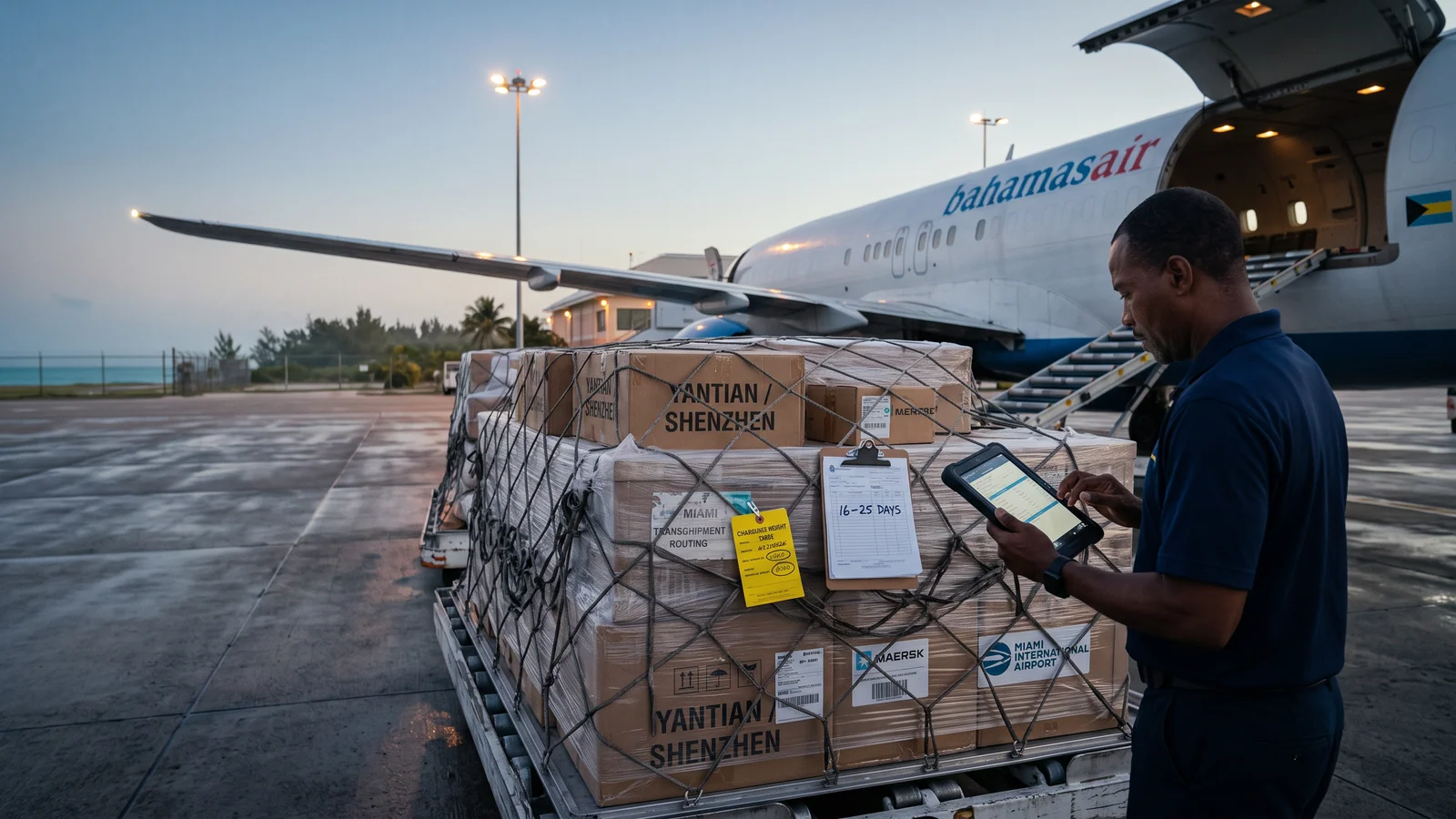
Quick Answer: Sea-air from China to the Bahamas moves cargo in 16-25 days: ocean to Los Angeles (12-18 days), truck to Miami (3-5 days), then air to Nassau or Freeport (1-2 days). Rates start from $9.15/kg for 300-499 kg and from $7.11/kg at 5,000+ kg, port to airport.
- Sea-air China to Bahamas takes 16-25 days port to airport, roughly half the time of pure ocean freight routed through transshipment hubs.
- Walio's sea-air rates run from $9.15/kg (300-499 kg) down to from $7.11/kg (5,000+ kg), port to airport, on the cheapest port-airport pair.
- Minimum billed weight is 300 kg, and chargeable weight is the greater of actual weight or volume × 167 kg per cubic meter.
- The Bahamas charges import duty by tariff code plus 10% VAT, a Customs Processing Fee and an Environmental Levy, all filed through Click2Clear.
This guide shows Bahamian retailers and resort suppliers how to price, book and clear a sea-air shipment from China without waiting on an email quote. Every rate on this page comes from Walio's live multimodal rate table dated October 3, 2026.
What is the sea air calculator China to Bahamas and how does it work?
Quick Answer: A sea-air calculator for China to the Bahamas prices a combined shipment instantly: ocean from a Chinese port, truck across the United States, then air into Nassau or Freeport. You enter the port of loading, destination airport, weight and dimensions. The calculator returns a per-kilo rate and transit window in seconds.
A sea-air freight calculator prices one combined ocean-plus-air movement instead of two separate quotes. That matters because a forwarder quoting the legs separately adds a margin twice and rarely guarantees the handover between them. Walio sells the whole chain under one booking.
Three inputs change the number the calculator returns:
- Port of loading. Dalian and Xingang price differently from Shenzhen or Ningbo because sailing time and vessel capacity to Los Angeles differ.
- Destination airport. Nassau (NAS) and Freeport (FPO) have different flight frequencies out of Miami, and that shows up in both price and transit.
- Chargeable weight. The rate drops as you cross each weight band, so 500 kg costs less per kilo than 450 kg.
Walio's sea-air service on this lane is quoted port to airport. The shipper delivers the cargo to the Chinese port of loading. The consignee collects it at Nassau or Freeport airport after customs release.
Door pickup at a factory in Dongguan or Yiwu, and door delivery to a store or resort in New Providence or Grand Bahama, are both quoted on request through the same calculator. You submit the request and a Walio specialist prices it — no phone call, no sales follow-up.
Pro tip
Before you price anything, ask your supplier for the packed carton dimensions and gross weight, not the product specs. Chinese factories frequently quote net weight and unpacked sizes. A re-measure at the Los Angeles gateway is the single most common reason an invoice lands above the original quote.
If sea-air is new to you, read What Is Sea-Air Shipping and When Should You Use It? for the mode explainer before you price your first booking.
What is sea-air combined transport and why does it suit the Bahamas?
Quick Answer: Sea-air combined transport moves cargo by ocean for the long leg, then by air for the final leg. For the Bahamas it solves a real problem: almost no direct sailings from China exist, so pure ocean cargo waits at transshipment hubs for weeks. Sea-air skips that wait entirely.
Walio routes this lane through the United States rather than through the Caribbean. Ocean carriers such as Maersk, MSC, CMA CGM and Hapag-Lloyd run high-frequency transpacific services into Los Angeles, which makes it the most reliable relay point for Bahamas-bound cargo.
 Shenzhen(CNSZX)
 Nassau(NAS)Shanghai(CNSHA)Freeport(FPO)
The three legs break down like this:
- Ocean, China to Los Angeles: 12-18 days. Containerized, on a scheduled transpacific service under an ocean Bill of Lading.
- Truck, Los Angeles to Miami: 3-5 days. Cargo is deconsolidated at a CFS, then moved cross-country to the Miami air gateway.
- Air, Miami to Nassau or Freeport: 1-2 days. Flown under an Air Waybill on the final sector, with handling at the destination airport.
Compare that with pure ocean. The Bahamas receives almost nothing direct from Asia. Containers relay through Kingston, Caucedo, Freeport Container Port or Panama, and each relay adds dwell time. In practice that is another 10-20 days of waiting, plus the risk that a box rolls to the next feeder.
Sea-air is a multimodal service: three carriers, three legs, one booking and one coordinated document set. The ocean B/L covers the China-to-US gateway sector. An AWB then covers the Miami-to-islands sector, and that AWB is the document your Bahamian broker needs for the entry.
That window covers all nine covered Chinese ports. Pure ocean via a Caribbean transshipment hub typically needs considerably longer, because the Bahamas sits at the end of a feeder chain rather than on a mainline string.
The same structure works on other island lanes. See Sea-Air Hong Kong to Jamaica Calculator: 2026 Rates for the comparable Caribbean routing and how its hub differs.
How do I calculate chargeable weight for air freight from China?
Quick Answer: Chargeable weight is the greater of actual gross weight and volumetric weight. For Walio sea-air, volumetric weight equals total cubic meters multiplied by 167 kg per cubic meter. Calculate CBM as length × width × height in meters per carton, multiplied by the number of cartons. The higher figure is billed.
What is CBM and how is it calculated for shipping?
CBM is the cubic meters of space your cargo occupies: length × width × height in meters, summed across every carton. Measure the outer carton, not the product, and round partial centimeters up.
Pallet overhang counts too. A 1.2 × 1.0 m pallet stacked to 1.6 m is 1.92 CBM, even if the goods inside only fill 1.5 CBM. Air carriers charge for the footprint they lose, not the box you imagine.
Three divisors show up in freight quotes, and mixing them up is expensive:
| Mode | Volumetric rule | Equivalent per CBM | Billing unit |
|---|---|---|---|
| Straight air freight | L × W × H (cm) ÷ 6,000 | 167 kg | Chargeable kg |
| Sea LCL | 1 CBM = 1,000 kg | 1,000 kg | Revenue ton (W/M) |
| Walio sea-air | CBM × 167 kg | 167 kg | Chargeable kg |
| Express courier | L × W × H (cm) ÷ 5,000 | 200 kg | Chargeable kg |
Worked example. You ship 20 cartons of resort amenity kits at 0.6 × 0.4 × 0.5 m each. That is 0.12 CBM per carton, so 2.4 CBM total. Volumetric weight is 2.4 × 167 = 401 kg. Actual gross weight is 280 kg. You are billed on 401 kg, in the 300-499 kg band.
Worked example: a 1 CBM, 200 kg shipment
Now take a smaller order: 1 CBM at 200 kg actual. Volumetric weight is 167 kg, actual is 200 kg, so chargeable weight is 200 kg. But the minimum billed weight on this lane is 300 kg, so you pay for 300 kg.
That is a 50% premium on paper weight. Consolidating two small supplier orders into one booking removes it instantly and pushes you toward the next band. A Nassau boutique importing from three Guangdong factories should ship them together, not separately.
Pro tip
Density decides who pays what. Resort linens, foam cushions, lampshades and lighting fixtures almost always bill on volume. Tile, hardware, bottled goods and ceramics bill on actual weight. Know which side your cargo sits on before you choose a mode — it changes the answer completely.
How much does sea-air from China to the Bahamas cost per kg?
Quick Answer: Walio sea-air rates from China to the Bahamas, port to airport, start from $9.15/kg for 300-499 kg, from $8.25/kg for 500-999 kg, from $7.57/kg for 1,000-4,999 kg and from $7.11/kg at 5,000 kg and above. Rates are from October 3, 2026, on the cheapest port-airport pair.
| Chargeable weight band | Sea-air rate (USD/kg) | Basis | Transit |
|---|---|---|---|
| 300-499 kg | from $9.15 | Port to airport | 16-25 days |
| 500-999 kg | from $8.25 | Port to airport | 16-25 days |
| 1,000-4,999 kg | from $7.57 | Port to airport | 16-25 days |
| 5,000 kg and above | from $7.11 | Port to airport | 16-25 days |
| Under 300 kg | billed as 300 kg | Minimum billed weight | 16-25 days |
Every figure carries "from" for a reason. The exact rate depends on your port of loading and whether the airport is NAS or FPO. The sea air calculator China to Bahamas on this page prices each combination separately and shows the real number for your shipment.
Port to airport means exactly that. You deliver cargo to the Chinese port. Your consignee collects at Nassau or Freeport airport once the Click2Clear entry is released. Nothing before the port and nothing after the airport is inside the per-kilo rate.
Origin and destination handling charges are added per shipment in the calculator, never folded into the per-kilo figure. That is deliberate: folding handling into a rate per kilo hides the cost and misleads small shipments, which carry the same fixed handling as large ones.
What is and is not inside the sea-air quote?
Inside the freight quote
Ocean carriage China to Los Angeles, origin terminal handling, deconsolidation at the US gateway, cross-country trucking to Miami, air carriage to NAS or FPO, the Air Waybill fee, security screening on the air sector, and documentation for the combined movement.
Outside the freight quote
Bahamian import duty, 10% VAT, the Customs Processing Fee, the Environmental Levy, your Bahamian customs broker's fee, cargo insurance, airport storage after free time, and door pickup or delivery at either end unless you request it in the calculator.
Covered origin ports on this lane are Dalian, Fuzhou, Guangzhou, Ningbo, Qingdao, Shanghai, Shenzhen, Xiamen and Xingang. If your factory is inland, ask the supplier which of these it normally trucks to — that port choice can shift both your rate and your transit by several days.
Comparing Latin American lanes at the same time? Sea-Air China to Mexico Calculator: 2026 Rates shows how band pricing works on a mainland lane with a different gateway.
Is air freight or sea freight cheaper from China to Nassau?
Quick Answer: Sea freight is cheaper per kilo; air freight is faster. Sea-air sits between them and usually wins when a shipment is urgent but too heavy for pure air. The break-even depends on cargo density, inventory carrying cost and how many weeks of stock a Nassau retailer can afford to hold.
| Mode | Typical transit | Best shipment size | Best cargo | Booking complexity |
|---|---|---|---|---|
| Sea FCL (20/40/40HC) | Longest, via transshipment | Above 13-15 CBM | Furniture, tile, generators, bulk stock | Medium |
| Sea LCL | Long, via transshipment | 2-15 CBM | Mixed pallets, non-urgent retail stock | Medium |
| Sea-air | 16-25 days | 300 kg to 10,000 kg chargeable | Season-critical retail, spa, uniforms | Low (one booking) |
| Straight air freight | Fastest after booking | Under ~500 kg | High-value, light, time-critical | Low |
| Express courier | Fastest door to door | Under ~70 kg | Samples, spares, documents | Very low |
Do not take a break-even number from a blog. Run your actual cartons through the calculator and compare the LCL, FCL, air and sea-air results side by side. That is the only comparison built on real carrier rates for your lane and your week.
Three rules do hold reliably:
- Density rule. Cargo under about 167 kg per CBM bills on volume, which makes air and sea-air disproportionately expensive. Light, bulky cargo is the worst fit for any air sector.
- Volume rule. LCL beats FCL up to roughly 10-15 CBM. Above that, a 20 ft container is usually cheaper per cubic meter, and one 20 ft box holds about 28-30 CBM of stackable cargo.
- Urgency rule. If a stockout costs more than the freight difference, sea-air pays for itself on the first reorder.
What should a resort supplier ship by sea-air?
Sea-air earns its premium on goods tied to a date. Spa products, staff uniforms, branded amenities, high-season menu items, replacement glassware and POS consumables all fit. They are dense enough to bill on actual weight and painful to run out of in December.
It does not earn its premium on tile, case goods, patio furniture, generators or anything you ordered six months ahead. Those belong in a container. A Nassau hotel refit should move the furniture by FCL and the linens by sea-air, not both by the same mode.
How long does shipping from China to the Bahamas take?
Quick Answer: Sea-air takes 16-25 days from China to Nassau or Freeport: 12-18 days ocean to Los Angeles, 3-5 days trucking to Miami, 1-2 days flying into the islands. Pure ocean via transshipment typically runs far longer, because no direct sailings serve the Bahamas from Chinese ports.
| Port of loading | Ocean to Los Angeles | Truck LA to Miami | Air Miami to NAS/FPO | Total |
|---|---|---|---|---|
| Shenzhen (CNSZX) | 12-15 days | 3-5 days | 1-2 days | 16-22 days |
| Guangzhou (CNCAN) | 12-16 days | 3-5 days | 1-2 days | 16-23 days |
| Shanghai (CNSHA) | 13-16 days | 3-5 days | 1-2 days | 17-23 days |
| Ningbo (CNNGB) | 13-16 days | 3-5 days | 1-2 days | 17-23 days |
| Xiamen (CNXMN) | 13-16 days | 3-5 days | 1-2 days | 17-23 days |
| Fuzhou (CNFOC) | 13-17 days | 3-5 days | 1-2 days | 17-24 days |
| Qingdao (CNTAO) | 14-17 days | 3-5 days | 1-2 days | 18-24 days |
| Dalian (CNDLC) | 15-18 days | 3-5 days | 1-2 days | 19-25 days |
| Xingang (CNTXG) | 15-18 days | 3-5 days | 1-2 days | 19-25 days |
These windows start at the vessel's departure, not at your purchase order. Two things routinely add a week before the clock even starts.
Cut-off versus ETD. The documentation cut-off usually falls 2-3 days before the vessel sails, and the physical gate cut-off a day or two before that. Miss either and your cargo rolls to the next sailing — typically a full week on a transpacific string.
Plan around Chinese New Year
Factory output and vessel space compress hard in the four weeks before Chinese New Year and stay disrupted for two to three weeks after. Peak season in late Q3 does the same to transpacific capacity. Book earlier in both windows, and expect the upper end of every transit range.
NAS versus FPO. Nassau takes far more daily lift out of Miami than Freeport. A Grand Bahama consignee may lose a day waiting for the next scheduled uplift, which is why the final leg shows as 1-2 days rather than a fixed figure.
For a lane with a completely different hub structure, see Sea-Air China to Colombia Calculator: Rates in Seconds.
What customs duties do I pay when importing from China to the Bahamas?
Quick Answer: The Bahamas charges import duty by tariff heading, plus 10% VAT on the duty-paid value, a Customs Processing Fee and an Environmental Levy on listed goods. Entries are filed electronically through Click2Clear, the Bahamas Customs single window. Duty rates vary widely by product, so classification drives your landed cost.
Click2Clear is the Bahamas Customs & Excise Department's electronic single window. Every import entry is lodged in it, and a licensed Bahamian customs broker normally files on the importer's behalf. There is no paper counter alternative for commercial cargo.
The charge stack runs in a fixed order, and each layer builds on the one before it:
| Step | Charge | Calculated on | Set by |
|---|---|---|---|
| 1 | CIF value | Goods + freight + insurance | Commercial invoice + freight docs |
| 2 | Import duty | CIF value, rate by tariff heading | Bahamas Customs tariff |
| 3 | VAT | 10% of duty-paid value | Government of The Bahamas |
| 4 | Customs Processing Fee | Per entry, per published schedule | Bahamas Customs |
| 5 | Environmental Levy | Listed goods only (tyres, batteries, vehicles, certain packaging) | Bahamas Customs |
| 6 | Broker fee | Per entry | Your licensed broker |
Classification is where budgets break
Bahamian duty rates swing enormously between tariff headings, so a single misclassified line can turn a profitable order into a loss. Get your HS codes confirmed by a licensed Bahamian customs broker before you place the purchase order, not when the cargo is sitting at Nassau airport.
Duty, VAT, the Customs Processing Fee and the Environmental Levy are published government rates, not Walio charges. Walio prices freight. A licensed customs broker or tax adviser should confirm the rates that apply to your specific goods.
Your broker will ask for these documents:
- Commercial Invoice with HS codes, unit values, Incoterm and currency
- Packing List with carton counts, dimensions and gross weight
- Air Waybill for the Miami-to-islands sector
- Certificate of Origin where a preference, quota or control applies
- Import permits for regulated goods such as food, pharmaceuticals or communications equipment
How to import from China to the Bahamas step by step
Quick Answer: Importing from China to the Bahamas runs in seven steps: agree Incoterms, book the sea-air service, deliver cargo to the Chinese port, clear export, move ocean-truck-air, file the Click2Clear entry, and collect at Nassau or Freeport airport. Clear Incoterms and accurate measurements prevent almost every surprise charge.
- Agree the Incoterm 2020. FOB suits port-to-airport sea-air best, because the supplier delivers to the port and clears Chinese export. EXW pushes origin cartage and export clearance onto you. DDP moves import liability and Bahamian duty onto a seller who has no Bahamian presence — treat it with caution.
- Price and book. Enter port of loading, destination airport, chargeable weight and dimensions in the calculator. Compare sea-air against LCL and air, then book online.
- Deliver to the port. Your supplier trucks the cartons to the nominated Chinese port before the gate cut-off. Labels must match the packing list exactly.
- Clear Chinese export. The supplier or origin agent files the export declaration and releases the cargo to the ocean carrier.
- Move ocean, truck, air. Ocean B/L to Los Angeles, deconsolidation and trucking to Miami, then an AWB covers the flight into NAS or FPO.
- File through Click2Clear. Your Bahamian broker lodges the entry, pays duty, VAT and fees, and secures release.
- Collect at the airport. The consignee picks up at Nassau or Freeport within the free storage window.
Pro tip
Appoint your Bahamian broker before the cargo departs China and send them the commercial invoice early. Entries pre-lodged in Click2Clear release faster, and airport storage charges start quickly once free time expires. Brokers cannot fix a vague invoice at the last minute.
Diversifying away from China? Sea-Air Vietnam to Panama Calculator: 2026 Rates covers the same mode from a Southeast Asian origin.
How do I cut my China to Bahamas freight cost?
Quick Answer: Four moves lower the bill: hit a higher weight band, fix your packaging density, choose the right Incoterm, and pick the right mode per order. Walio's sea-air rate drops from $9.15/kg at 300-499 kg to from $7.11/kg at 5,000 kg and above, so consolidation pays directly.
Anything lighter is billed as 300 kg. A single 180 kg order pays for 120 kg of air it never used — combining it with a second supplier's cartons removes that waste entirely.
- Consolidate suppliers. Pull orders from several Chinese factories into one booking. Crossing from 499 kg to 500 kg moves you from a rate starting at $9.15/kg to one starting at $8.25/kg.
- Cut volumetric weight. Flat-pack, remove void fill, reduce carton height and nest where you can. Every CBM you remove cuts 167 kg of chargeable weight on volume-billed cargo.
- Split the order by urgency. Sea-air the high-season and fast-selling SKUs; move the slow movers by LCL or FCL on a longer lead time.
- Pick the right Incoterm. Choose FOB when the supplier sits near the port. Avoid DDP unless the seller genuinely understands Bahamian duty, VAT and Click2Clear obligations.
- Protect your free time. Give your broker the documents early so classification is settled before the flight lands, not while storage accrues at the airport.
Rerun the sea air calculator China to Bahamas after each change. Repacking a light, bulky order often saves more than renegotiating the unit price with the factory.
Frequently asked questions
Container cost depends on the size, origin port and routing, and Walio's calculator prices 20 ft, 40 ft and 40 HC containers for your exact lane in seconds. For sea-air, pricing is per chargeable kilo instead, starting from $9.15/kg at 300-499 kg and from $7.11/kg at 5,000 kg and above, port to airport. Enter your details in the calculator on this page to compare FCL, LCL and sea-air side by side.
Sea-air takes 16-25 days total, depending on the port of loading. The routing is ocean from China to Los Angeles in 12-18 days, trucking from Los Angeles to Miami in 3-5 days, then a 1-2 day flight into Nassau (NAS) or Freeport (FPO).
Chargeable weight is the greater of your actual gross weight and your volumetric weight. For Walio sea-air, volumetric weight equals total cubic meters multiplied by 167 kg per cubic meter, and the minimum billed weight on the lane is 300 kg. A 2 CBM shipment weighing 250 kg therefore bills at 334 kg.
Sea freight is cheaper per kilo, but it is much slower to the Bahamas because no direct sailings exist and cargo transships through hubs like Kingston, Caucedo or Panama. Sea-air costs more than ocean and less than straight air while landing in 16-25 days. Run all three modes through the calculator and compare the actual numbers for your cargo.
The Bahamas applies import duty by tariff heading, plus 10% VAT, a Customs Processing Fee and an Environmental Levy on listed goods. Entries are filed electronically through Click2Clear, usually by a licensed Bahamian customs broker. Duty rates vary by product, so confirm your classification with a licensed broker before you order.
You now have the routing, the weight bands, the transit windows and the Click2Clear charge stack. The last piece is your own number. Enter your port of loading, destination airport, weight and dimensions in the calculator above and see your price in seconds — no signup, no follow-up calls.