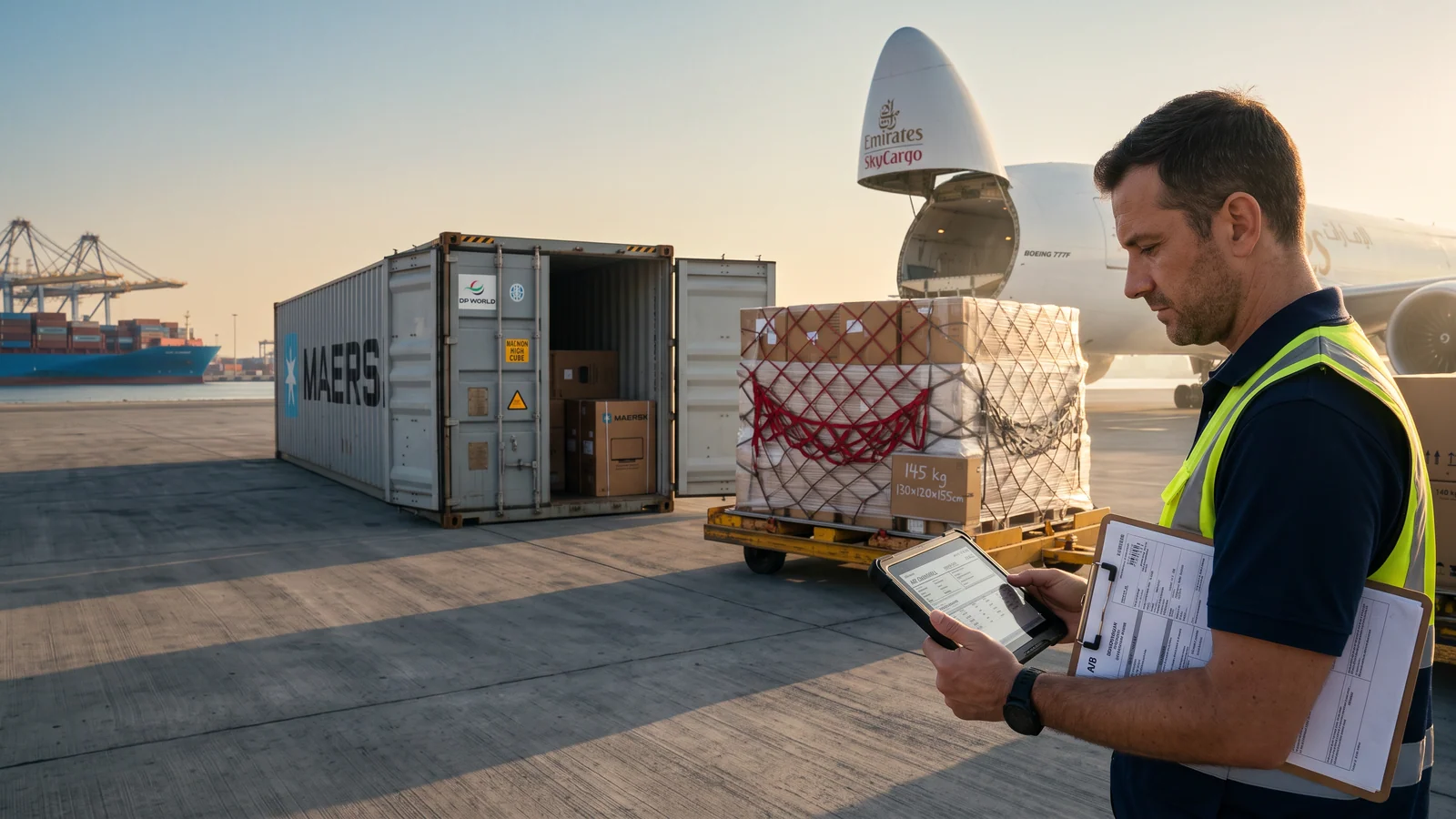
Quick Answer: Sea-air shipping moves cargo by ocean vessel to a transshipment hub, then by aircraft to the final airport — typically 18 to 25 days door to door from Asia, roughly half the time of pure ocean freight and a fraction of the cost per kilo of pure air. It suits urgent, high-value, non-hazardous cargo.
- Sea-air is one booking, two legs: ocean to a hub like Dubai, Singapore, Colombo, Busan or Los Angeles, then air to the destination airport.
- Typical Asia to Latin America sea-air transit runs 18–25 days door to door, versus 30–45 days all-ocean and 5–8 days all-air.
- Price sits between ocean and air per kilo, and the air leg is billed on chargeable weight — volume often beats actual weight.
- Dangerous goods, most lithium batteries, oversized pieces and perishables are disqualified from the air leg, so they cannot run sea-air.
This guide explains what is sea air shipping in practical terms: how the two legs connect, which hubs handle the transfer, what sets the price, and when the premium over ocean freight pays for itself. Everything below applies to importers buying from China, Vietnam, India and Korea for delivery into Latin America, the Caribbean, Europe and North America.
What Is Sea-Air Shipping?
Quick Answer: Sea-air shipping is a multimodal service that moves one consignment by ocean vessel to an intermediate hub, then by aircraft to the destination airport. One forwarder controls both legs under one booking. It lands between ocean freight and air freight on both speed and cost, which is why importers use it for urgent replenishment.
Ocean first, air second, one forwarder, one booking. That is the whole product. The vessel covers the long, cheap distance, and the aircraft covers the final stretch where speed actually changes the delivery date.
The terminology trips people up. Multimodal transport means two or more modes under a single transport contract with one responsible operator. Intermodal transport means the same container moves ship to rail to truck without anyone touching the cargo inside. Sea-air is firmly multimodal: the cargo is handled, because a 40 ft container cannot board a passenger belly.
The product exists because of a gap. Ocean capacity is cheap but slow and increasingly unreliable. Air is fast but expensive per kilo. Sea-air buys back roughly half the ocean transit time at a fraction of the full air rate, which is exactly the trade importers want when a season launch is three weeks away.
Four players touch the shipment: the NVOCC or ocean carrier moving the first leg, the freight forwarder coordinating both legs, the consolidator at the hub who breaks down and rebuilds the load, and the airline that issues the Air Waybill (AWB) for the flight.
Pro tip
Mini-glossary before you book. Transshipment hub: the port-airport pair where cargo switches modes. Chargeable weight: the higher of gross and volumetric weight on the air leg. Deconsolidation: breaking a container or sea pallet down to individual cartons. Transloading: rebuilding those cartons onto air pallets or ULDs. CFS: the container freight station where that work happens. Through bill of lading: one document covering both legs with one responsible operator.
What is a transshipment hub in sea-air freight?
A transshipment hub is the port-airport pair where cargo leaves the vessel and gets re-handled for the aircraft. The two facilities usually sit within 30–80 km of each other, because every extra kilometer of bonded trucking adds cost and a customs touchpoint.
A working hub needs three things: bonded in-transit clearance so cargo never enters local commerce, a CFS with deconsolidation capacity, and daily airline capacity to the destination region. The hubs importers meet most often are Jebel Ali/DXB in Dubai, Colombo/CMB, Singapore/SIN, Busan with Incheon, Los Angeles/LAX, Vancouver/YVR and Barcelona/BCN.
What is chargeable weight in sea-air shipping?
Chargeable weight is the higher of actual gross weight and volumetric weight, and the air leg always bills on it. The standard IATA divisor is length × width × height in centimeters divided by 6,000, which gives kilos.
Run the math before you commit. One cubic meter is 1,000,000 cm³, so it bills at 166.6 kg. A 1 m³ carton of folded apparel weighing 90 kg still pays for 166.6 kg. Density, not weight, decides whether sea-air makes financial sense.
How Does Sea-Air Shipping Work Step by Step?
Quick Answer: Sea-air works in six steps: pickup and export clearance at origin, ocean sailing to the hub, bonded in-transit transfer from port to airport, deconsolidation and re-palletization at a CFS, the air leg on a commercial or freighter flight, then import clearance and final delivery.
- Origin pickup and export declaration. Cargo loads into an LCL consolidation box or a shipper's FCL feeding the hub. The export declaration is filed in the origin country before the port cut-off.
- Ocean leg. Shenzhen or Ningbo to Jebel Ali runs 10–16 days. South China to Singapore or Colombo runs 7–12 days. Transpacific to Los Angeles runs 12–18 days.
- Bonded transfer. Cargo moves port to airport under customs in-transit control. It never enters the hub country's commerce, so no duties are triggered there.
- Deconsolidation and transloading. Sea pallets are broken down at the CFS, rebuilt onto air pallets or ULDs, then reweighed and remeasured. Chargeable weight is finally fixed at this point, not at origin.
- Air leg. The airline issues the AWB and the shipment flies on belly capacity or a freighter, depending on pallet height and volume.
- Import clearance and last mile. The customs broker files the entry at the destination airport, duties and taxes are paid, and a truck completes the delivery.
What happens during transloading at the hub?
Air-ready packing is where sea-air shipments get expensive without warning. Narrow-body belly loads have strict pallet height limits, no overhang is tolerated, and every piece needs shrink wrap plus IATA-compliant labelling.
Budget 2–5 days of hub dwell for deconsolidation, security screening and flight booking. Build those days into your transit estimate rather than treating the ocean ETA as the handover.
Weak cartons fail at the hub, not at sea
Export cartons that survived stacked ocean handling routinely fail air screening and handling standards. The CFS repacks them, bills the repack, and the new dimensions raise your chargeable weight. Specify double-wall cartons and palletized loads with your supplier before the first leg sails.
Which Hubs and Lanes Handle Sea-Air Freight?
Quick Answer: The main sea-air corridors run from South China, Vietnam and India through Dubai's Jebel Ali/DXB, Colombo, Singapore, Busan, Los Angeles or Vancouver, then fly to Europe, Latin America, the Caribbean and Africa. Hub choice sets both transit time and available flight frequency on the second leg.
Asia to Latin America usually routes via Los Angeles or Dubai. Asia to Europe routes via Dubai, Colombo or Singapore. Asia to the Caribbean often routes via Miami or Dubai, depending on which airline holds capacity that month.
| Origin port | Transshipment hub | Destination airport | Total transit (days) | Cost index vs air | Peak-season availability |
|---|---|---|---|---|---|
| Shenzhen / Yantian | Jebel Ali → DXB | Frankfurt (FRA) | 16–21 | 55–70% | Good |
| Ningbo | Colombo → CMB | Amsterdam (AMS) | 17–22 | 55–70% | Moderate |
| Shanghai | Los Angeles → LAX | Mexico City (MEX) | 18–24 | 60–75% | Good |
| Shenzhen | Los Angeles → LAX | Bogotá (BOG) | 19–25 | 60–75% | Moderate |
| Ho Chi Minh / Haiphong | Singapore → SIN | Bogotá (BOG) | 20–26 | 60–75% | Moderate |
| Hong Kong | Miami → MIA | Kingston (KIN) | 19–25 | 60–75% | Tight in Q4 |
| Busan | Incheon (ICN) | Santiago (SCL) | 18–24 | 60–75% | Moderate |
| Nhava Sheva | Jebel Ali → DXB | São Paulo (GRU) | 20–27 | 55–70% | Tight in Q4 |
Transpacific-to-LAX sea-air is usually the shortest option for Mexico, Central America and Colombia, because US domestic and regional flights depart daily from LAX. For lane-specific numbers, see our Sea-Air China to Mexico Calculator: 2026 Rates and the Sea-Air China to Colombia Calculator: Rates in Seconds. For Ho Chi Minh and Haiphong origins, the Sea-Air Vietnam to Colombia Calculator: Rates 2026 covers the routing in detail.
 Shenzhen(CNSZX)
 Bogotá(BOG)
 Hong Kong(HKHKG)
 Kingston(KIN)
How Long Does Sea-Air Shipping Take From China to Europe or Latin America?
Quick Answer: Sea-air from China to Europe typically runs 16–22 days door to door via Dubai or Colombo. China to Mexico, Colombia or Central America runs 18–25 days via Los Angeles or Dubai. Pure ocean on the same lanes takes 30–45 days; pure air takes 5–8 days including clearance.
| Mode | Average transit (days) | Relative cost per kg | gCO2e per tonne-km | Schedule reliability | Best-fit cargo | Booking lead time |
|---|---|---|---|---|---|---|
| Ocean (FCL/LCL) | 30–45 | 1x (baseline) | 10–40 | Moderate | Bulk, low-density, non-urgent | 10–14 days |
| Sea-air | 16–25 | 6–12x ocean | 100–200 | Good | Dense, mid-to-high value, time-sensitive | 5–8 days |
| Air | 5–8 | 10–20x ocean | 500–1,000 | High | Critical, high-value, light | 1–3 days |
The carbon difference is large and easy to calculate. Ocean container shipping runs roughly 10–40 gCO2e per tonne-km. Air freight runs roughly 500–1,000 gCO2e per tonne-km. Splitting the journey cuts emissions sharply.
Worked example. Take 500 kg from Shanghai to Mexico City, about 16,000 km. Flown end to end at 600 gCO2e/tonne-km: 0.5 t × 16,000 km × 600 g = 4,800 kg CO2e. Now sail 80% of the distance at 20 gCO2e/tonne-km and fly the last 3,200 km: 128 kg + 960 kg = 1,088 kg CO2e. That is roughly a 77% reduction versus flying the whole way.
Port cut-off is not vessel ETD
The cargo cut-off at the origin terminal usually falls 2–4 days before the vessel sails, and documentation cut-off falls earlier still. Missing it by hours costs a full week on the ocean leg and pushes your flight booking at the hub with it. Confirm both cut-offs in writing when you book.
Island and Central American destinations behave slightly differently because flight frequency is thinner. Our Sea-Air Hong Kong to Jamaica Calculator: 2026 Rates and the Sea-Air Hong Kong to Costa Rica Calculator: 2026 Rates break down those two lanes day by day.
Is Sea-Air Cheaper Than Air Freight — and What Drives the Price?
Quick Answer: Yes. Sea-air costs less per kilo than pure air because the long haul sails instead of flies, and more than pure ocean because the final leg is billed on chargeable weight. Density, hub choice, flight frequency, season and the destination's handling fees set the final number.
The IATA volumetric divisor of 6,000 turns one cubic meter into 166.6 chargeable kilos. If your cartons weigh less than that per cubic meter, you pay for air, not goods.
Five factors move the number: chargeable weight on the air leg, cargo density, hub dwell and handling fees, airline capacity on the destination route, and the season. Q3–Q4 peak tightens vessel space and belly space at the same time.
A complete sea-air quote should itemize all of this:
- Origin pickup and export clearance
- Ocean freight plus origin THC
- Bonded transfer from port to airport at the hub
- CFS deconsolidation, re-palletization and hub THC
- AWB fee and air freight on chargeable weight
- Airline fuel and security surcharges
- Destination handling and import clearance
- Last-mile trucking to the delivery address
Ask about the charges that quietly appear later: BAF (bunker adjustment), CAF (currency adjustment), peak season surcharge, DTHC at destination, the airline fuel surcharge, and duties and taxes. Duties and taxes fall on the importer unless the Incoterm is DDP.
Low-density cargo is where sea-air turns expensive fast. Cushions, lampshades and empty plastic housings bill on volume and should sail. Walio's calculator on this page prices your exact origin, hub and destination in seconds from real carrier rates — compare and book online, no forms waiting for an email.
What Is the Difference Between Sea-Air and Air-Sea Shipping?
Quick Answer: Sea-air sails first and flies second. Air-sea flies first and sails second, usually to clear an inland bottleneck or reach an island or coastal market with poor direct air service. Sea-air is the common commercial product; air-sea is a niche fix used when the origin leg is the slow part.
Sea-air
The vessel covers the long, cheap distance first, then a short flight closes the gap. This is where the savings live, because the expensive mode handles the smallest share of the kilometers. It is the standard product for Asia to Europe, Latin America and the Caribbean.
Air-sea
The flight clears a bottleneck at the start — a landlocked origin, a congested inland corridor, a factory far from any port. A feeder vessel then completes the journey to an island or coastal market. It is rare, situational and almost always more expensive per kilo.
| Attribute | Sea-air | Air-sea |
|---|---|---|
| Leg order | Ocean first, air second | Air first, ocean second |
| Typical use case | Urgent replenishment from Asia | Landlocked origin or island destination |
| Common routings | Shenzhen → Jebel Ali → Frankfurt | Almaty → Dubai → Caribbean feeder |
| Transit time | 16–25 days | 12–20 days |
| Cost profile | 55–75% of pure air | Often above 80% of pure air |
| Documentation | B/L then AWB | AWB then B/L |
Confirm the leg order in writing. Some forwarders use "sea-air" loosely for any ocean-plus-air combination, and the difference changes your transit, your documents and your insurance.
Which Cargo Suits Sea-Air — and Which Is Disqualified?
Quick Answer: Sea-air fits dense, high-value, time-sensitive cargo: apparel and footwear, consumer electronics, spare parts, medical devices and e-commerce replenishment. It excludes anything the air leg will not accept — dangerous goods, most standalone lithium batteries, oversized or overheight pieces, live or perishable goods and heavily restricted commodities.
- Fashion and footwear arriving ahead of a retail season
- Consumer electronics with short product cycles
- Automotive and machinery spare parts holding up a production line
- Medical devices and instruments with firm installation dates
- E-commerce replenishment stock for a best-seller running low
What the air leg will refuse
IATA dangerous goods, UN3480 lithium batteries shipped standalone, aerosols, unshielded magnets, flammable liquids, live plants, and chilled or frozen food are all out. Size limits also bite at the hub: a pallet taller than roughly 160 cm loses narrow-body belly options and waits for a freighter. Declare battery content and commodity details before booking, not at the CFS.
Low-density, low-value goods — furniture, bottled drinks, bulk plastics — belong on pure ocean freight. The volumetric math makes sea-air indefensible for them.
Correct HS/HTS classification matters twice: once at export clearance and again at import. A misclassification can hold cargo at the destination airport while airport storage accrues daily. Have your customs broker confirm the codes before the vessel sails.
What Documents, Liability and Insurance Cover Both Legs?
Quick Answer: Sea-air generates two transport documents unless the forwarder issues a through bill of lading: an ocean B/L or Sea Waybill for the first leg and an Air Waybill for the second. Liability switches from Hague-Visby rules at sea to the Montreal Convention in the air, with a gap at the hub.
A through B/L gives you one claim point and one responsible operator across both legs. Separate documents mean two carriers, two liability regimes, and an argument about where the damage happened. Ask which one you are getting.
Carrier liability limits are low under both regimes, and the handling gap at the hub is the real weak point. Damage during deconsolidation and re-palletization can fall outside both carrier conventions. All-risk cargo insurance covering door to door, including hub handling, is the practical answer.
- Commercial Invoice (Factura Comercial)
- Packing list with carton dimensions and weights
- Ocean B/L or Sea Waybill for the first leg
- Air Waybill for the second leg
- Certificate of Origin where a trade agreement applies
- Importer tax ID — RUT in Colombia, RFC in Mexico, NIT in Guatemala
| Incoterm 2020 | Who books the ocean leg | Who books the air leg | Who pays import duty |
|---|---|---|---|
| EXW | Buyer | Buyer | Buyer |
| FOB | Buyer | Buyer | Buyer |
| CIF | Seller (to discharge port only) | Buyer | Buyer |
| DAP | Seller | Seller | Buyer |
| DDP | Seller | Seller | Seller |
Note the CIF trap: CIF ends at the discharge port and does not cover the air leg. DDP moves import liability onto the seller, which many Asian suppliers price aggressively and then under-deliver on. Duty and tax questions belong with a licensed customs broker — Walio moves the freight, not the tax filing.
When Should You Use Sea-Air Shipping Instead of Ocean Freight?
Quick Answer: Use sea-air when ocean freight arrives too late to be useful but air freight destroys the margin. Typical triggers: a missed vessel, a season launch, a stockout costing more than the freight premium, a blanked sailing, or canal and Red Sea reroutings adding two weeks to the ocean schedule.
Four questions settle it. Is the cargo dense enough to survive the volumetric math? Is the delay cost higher than the freight premium? Is the cargo air-legal? Do you have 5–8 days of lead time to book?
| Benefit | Measurable impact | Trade-off / risk | Mitigation |
|---|---|---|---|
| Faster than ocean | Saves 12–20 days | Costs 6–12x ocean per kg | Split the order: sea-air the launch volume |
| Cheaper than air | 55–75% of pure air cost | Adds 10–17 days vs flying | Book 5–8 days ahead to lock belly space |
| Lower emissions than air | Around 75% less CO2e | Still far above pure ocean | Report the split leg separately |
| One forwarder, one booking | Single point of contact | Liability gap at the hub | Buy all-risk door-to-door insurance |
| Avoids blanked sailings | Reduces schedule exposure | Hub dwell adds 2–5 days | Confirm dwell days before booking |
As of 2026, Red Sea diversions around the Cape of Good Hope continue adding 10–14 days to Asia–Europe ocean transits, and Panama Canal draft restrictions keep reshuffling Latin America routings. Both push more cargo onto sea-air during Q3 and Q4.
Pro tip
Blend the modes instead of choosing one. Send the first 20% of the order by sea-air to cover the launch date, and sail the remaining 80% by FCL or LCL behind it. You protect the on-sale date and keep the landed cost close to an all-ocean program.
Before you confirm, ask the forwarder six things:
- Which hub, and which port-airport pair?
- Confirm the leg order: ocean first, air second?
- What chargeable weight assumption is in the quote?
- How many hub dwell days are built in?
- Is a through B/L issued, or a separate B/L plus AWB?
- Are destination handling and last mile included?
That is what is sea air shipping in practice: a deliberate compromise you choose on purpose, not a fallback. Price your lane, check the chargeable weight, and decide with the number in front of you.
Sea-air shipping is a multimodal service that moves one consignment by ocean vessel to a transshipment hub, then by aircraft to the destination airport under a single booking. At the hub, cargo clears as a bonded in-transit movement, gets deconsolidated and re-palletized for the air leg, then flies out. One forwarder manages both legs and both documents.
Yes — sea-air costs less per kilo than pure air freight because the longest part of the journey sails instead of flies. It still costs more than pure ocean freight, since the final leg is billed on chargeable weight, the higher of actual and volumetric weight. Enter your shipment in the calculator on this page to see your exact number in seconds.
China to Europe by sea-air typically takes 16 to 22 days door to door, routing through Dubai, Colombo or Singapore. Pure ocean on the same lane runs 30 to 40 days and can stretch further with Red Sea diversions, while pure air takes 5 to 8 days including clearance.
Sea-air sails first and flies second; air-sea flies first and sails second. Sea-air is the standard commercial product because the ocean leg covers the long, cheap distance before the fast final hop. Air-sea is a niche routing used when the origin is landlocked or the destination is an island with weak direct air service.
Use sea-air when the cost of arriving late is higher than the freight premium — a stockout on a best-seller, a stopped production line, a season launch, or a blanked sailing. The cargo also has to be air-legal and dense enough that volumetric weight does not blow up the price.
Stop guessing which mode fits your deadline. Walio compares real carrier rates from Maersk, MSC, CMA CGM, Hapag-Lloyd and airline partners across ocean, sea-air and air on the same screen. Enter your route in the calculator above and see your price in seconds — no signup, no follow-up calls.