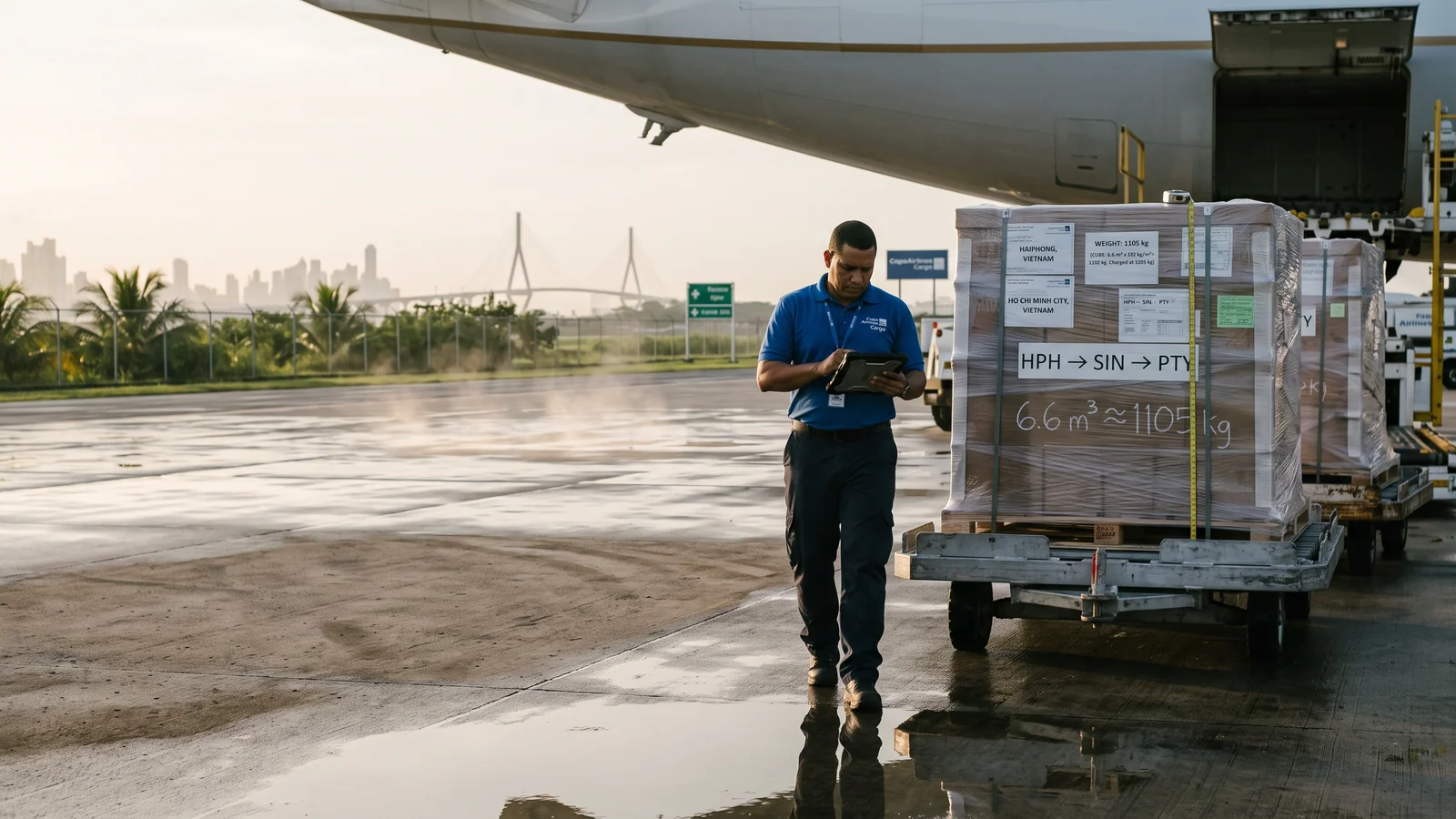
Quick Answer: Sea-air from Vietnam to Panama moves cargo by ocean to a transshipment hub, then by air into Tocumen (PTY). Carriers bill chargeable weight — the greater of actual kilos or volume × 167 kg per m³ — with a 300 kg minimum. Walio's calculator prices your exact port, airport and weight in seconds.
- Sea-air (flete marítimo-aéreo) sits between ocean and air: roughly half the transit of pure LCL and a fraction of a full air freight bill.
- Chargeable weight (peso facturable) on the air leg is the greater of gross weight and volume × 167 kg per m³; shipments under 300 kg are billed as 300 kg.
- Vietnam sea-air usually transships at Singapore, Jebel Ali, Busan or a US gateway (Los Angeles/Miami) before the final flight to Tocumen (PTY).
- Panama charges ITBMS on imports at the published national rate, plus duty by HS code — unless the cargo enters the Zona Libre de Colón for re-export.
This guide gives Panamanian importers and traders the full mechanics of the lane: hubs, transit blocks, chargeable-weight math, Tocumen clearance and the charges most quotes hide. Everything here feeds one tool — the calculadora sea air vietnam panamá on this page.
What is sea-air freight from Vietnam to Panama?
Quick Answer: Sea-air freight is a multimodal service: the cargo sails from Vietnam to a transshipment hub, is deconsolidated there, then flies on to Panama City. It exists because pure ocean takes 35–50 days to Panama and pure air costs several times more per kilo.
Sea-air — transporte marítimo-aéreo combinado — splits one shipment into an ocean leg and an air leg under a single booking and a single rate per chargeable kilo. You do not buy two freights and stitch them together. You buy one movement, priced one way, tracked on one thread.
The hub step is where the mode changes. Cargo arrives at the hub CFS (container freight station) under an ocean Sea Waybill or Bill of Lading, gets deconsolidated, re-weighed and re-measured, then tendered to an airline under a new Air Waybill (AWB) issued at the hub. That handoff is the whole product.
The cargo profile that fits is narrow and predictable:
- Apparel and footwear from Binh Duong and Dong Nai factories feeding Panamanian retail cycles
- Furniture components and hardware kits where a 45-day ocean transit breaks the installation date
- Electronics accessories, small appliances and phone parts with mid-range unit value
- Auto parts and spare parts where a stockout costs more than the freight
- E-commerce replenishment for Zona Libre de Colón distributors who re-export across the region
Sea-air is the wrong tool for some shipments. A single pallet under 300 kg pays the minimum and loses its advantage. Hazardous goods face air restrictions. And a genuine full container load usually wins on cost per cubic meter as straight FCL.
Pro tip
Ask your Vietnamese supplier for carton dimensions before you compare modes, not after. Sea-air is priced on the air leg's volumetric rules, so a 10 cm change in carton height can move the bill more than a 50 kg change on the scale.
How long does a sea-air shipment from Vietnam to Panama take?
Quick Answer: Plan on roughly 18 to 30 days of relevant transit, depending on the hub. The ocean leg from Cat Lai or Cai Mep runs 5–18 days to the transshipment point, hub handling adds 2–4 days, and the flight into Tocumen takes 1–2 days plus clearance.
Transit on this lane is four measurable blocks, not one number. Each block has its own failure mode, and the one that ruins schedules most often is the first.
| Transit block | Days | What controls it |
|---|---|---|
| Origin CFS + port cut-off | 3–5 | Packing, weighing, VGM filing, export clearance |
| Ocean leg to hub | 5–18 | Hub choice: Singapore 4–6, Jebel Ali 8–12, US gateway 12–18 |
| Hub deconsolidation + air booking | 2–4 | CFS throughput and freighter space |
| Air leg to PTY + recovery | 1–3 | Flight frequency, terminal release, broker filing |
Port cut-off is not vessel ETD. Cut-off is the documentation and container-yard closing, often 48–72 hours before the ship sails. Vietnamese services to the main hubs are largely weekly, so missing cut-off costs a full week — not a day.
Benchmark against the alternatives before you accept a transit. Pure LCL from Ho Chi Minh to Balboa or MIT Manzanillo commonly runs 35–50 days with transshipment. Direct air out of SGN lands in 3–6 days with connections, at a very different price per kilo.
Build 3–5 extra days into purchase orders around Tet and the Q4 peak. Hub air capacity sells out before ocean space does, and that is exactly when sea-air bookings roll. Walio's calculator shows the transit band tied to the exact origin port and airport pair you select, not a lane average.
 Ho Chi Minh(Cat Lai)
 Panama City(PTY)
Which transshipment hub should route your Vietnam–Panama cargo?
Quick Answer: Four hubs dominate this lane: Singapore, Jebel Ali (Dubai), Busan/Incheon and the US gateways of Los Angeles and Miami. Singapore and Jebel Ali give the shortest ocean leg; the US routing gives the most frequent and cheapest flights into Panama City.
| Hub | Ocean leg from Vietnam | Air leg to PTY | Weekly frequency | Best for |
|---|---|---|---|---|
| Singapore | 4–6 days | 2–3 days (1–2 connections) | Multiple sailings weekly | Fast ocean leg, mixed consolidations |
| Jebel Ali (Dubai) | 8–12 days | 2–3 days via Europe or the Americas | Weekly+ | Purpose-built sea-air CFS, heavy consignments |
| Busan / Incheon | 6–9 days | 2–3 days via a US gateway | Weekly | Electronics and high-density cargo |
| Los Angeles → Miami → PTY | 12–18 days | 1–2 days (daily lift) | Daily flights to PTY | Lowest air-leg cost, most reliable release |
Singapore shortens the water. Cat Lai to Singapore is 4–6 days, with both belly and freighter capacity available, but the onward routing to Central America usually takes two connections. Jebel Ali is the classic Asia sea-air hub, with CFS facilities designed for exactly this deconsolidate-and-fly workflow and strong westbound freighter lift.
The US gateway structure trades water for air. The Pacific crossing is longer, yet the flight into Tocumen is short, daily and comparatively cheap. That is the structure behind Walio's published Asia–Panama card: ocean to Los Angeles, truck to Miami, then air Miami to PTY.
The same Vietnamese origin ports feed South American routings too. If you also buy for a Bogotá entity, compare the structure in the Sea-Air Vietnam to Colombia Calculator: Rates 2026 guide — origin cut-offs are identical, only the destination leg changes.
How do you calculate chargeable weight for sea-air?
Quick Answer: Chargeable weight (peso facturable) is the greater of actual gross weight and volumetric weight. For the air leg of a sea-air move, volume in cubic meters × 167 kg per m³ gives the volumetric figure. The same math is L × W × H in centimeters ÷ 6,000 per piece.
Two formulas, one answer. The IATA method divides L × W × H in centimeters by 6,000. The cubic-meter method multiplies CBM by 167 kg. A carton of 100 × 60 × 50 cm is 300,000 cm³ ÷ 6,000 = 50 kg volumetric, and 0.30 m³ × 167 = 50 kg. Identical.
Ocean works on a different rule. LCL uses W/M, where 1 CBM counts as 1,000 kg, which is why light bulky freight is cheap by sea and punishing by air. Sea-air inherits the air rule, because the airline sets the billing basis on the final leg.
- Measure every piece in centimeters and total the volume in m³.
- Multiply total m³ by 167 to get volumetric weight.
- Compare it with the actual gross weight on the scale.
- Take the higher figure — that is your chargeable weight.
- If it falls below 300 kg, bill 300 kg.
Worked example 1. 500 kg of apparel in 3 m³. Volumetric = 3 × 167 = 501 kg. Gross = 500 kg. You pay on 501 kg — almost exact parity, the ideal sea-air profile.
Worked example 2. 300 kg of plastic housings in 5 m³. Volumetric = 5 × 167 = 835 kg. Gross = 300 kg. You pay on 835 kg. The volume, not the scale, sets the bill — and the weight band you land in changes your rate per kilo.
Hubs re-measure everything
Before the air leg, the hub CFS re-weighs and re-measures the cargo and files the AWB on its own figures. If your supplier understated carton dimensions, the chargeable weight rises and the price changes after booking. Declare true dimensions and include pallet height.
Sea-air Vietnam to Panama calculator: how much does it cost?
Quick Answer: Price is driven by chargeable weight, the origin port and airport pair, the hub routing and the Incoterm. Walio prices sea-air per chargeable kilo in weight bands, port to airport, with origin and destination handling added per shipment. The calculator on this page returns your Vietnam figure in seconds.
The rate structure is simple once you see it. You pay a per-kilo rate that drops as chargeable weight rises, and handling charges that are billed per shipment rather than per kilo. That is why a 480 kg consignment and a 520 kg consignment can carry very different totals.
For reference, here is Walio's published sea-air card as of the October 1, 2026 rate table — China → Panama, port to airport, cheapest port and airport on the lane. Routing: ocean to Los Angeles (12–18 days), truck Los Angeles to Miami (3–5 days), air Miami to Panama City PTY (1–2 days), for 16–25 days total transit.
- 300–499 kg — from $5.91/kg
- 500–999 kg — from $5.00/kg
- 1,000–4,999 kg — from $4.32/kg
- 5,000+ kg — from $3.87/kg
Read that card correctly: these are China-origin reference rates, not Vietnam rates. They show the shape of sea-air pricing on an Asia–Panama routing. Vietnamese origins — Cat Lai, Cai Mep-Thi Vai and Hai Phong — price live in the calculadora sea air vietnam panamá for your exact port, airport and weight.
A 180 kg consignment is billed as 300 kg on this service. Below roughly 250 kg, courier or consolidated air often costs less — run both in the calculator before you book.
Port to airport means the shipper delivers the cargo to the origin port and the consignee collects it at the destination airport. Door pickup in Vietnam and door delivery in Panama are quoted on request inside the calculator. Here is what sits inside and outside that line item:
| Charge | Billing basis | Who bills it | In the port-to-airport price? |
|---|---|---|---|
| Origin CFS + documentation | Per shipment | Origin agent | Added per shipment in the calculator |
| Ocean leg to hub | Per chargeable kg | Carrier / NVOCC | Yes |
| Hub handling + deconsolidation | Per shipment | Hub CFS | Yes |
| Air leg to PTY | Per chargeable kg | Airline (AWB) | Yes |
| Fuel + security surcharges | Per kg | Airline | Yes |
| PTY terminal handling | Per shipment | Tocumen cargo terminal | Added per shipment |
| Customs clearance in Panama | Per declaration | Licensed customs broker | No |
| Import duty + ITBMS | % of value | Autoridad Nacional de Aduanas | No — government rates |
The charges importers forget are almost always the last four rows. Build them into your landed cost before you compare a Vietnamese FOB price against a local wholesaler's.
Sea-air vs ocean vs air: which fits your import from Vietnam?
Quick Answer: FCL wins on cost per cubic meter above roughly 25–28 m³. LCL wins below that when 40-plus days is acceptable. Sea-air wins when you need stock in Panama inside a month at a fraction of air cost. Direct air wins only for urgent, high-value or small-volume cargo.
| Mode | Billing unit | Transit Vietnam → Panama | Weekly frequency | Relative CO₂ | Ideal cargo |
|---|---|---|---|---|---|
| FCL 20' / 40'HC | Per container | 35–50 days | 1–3 sailings | Lowest | 25 m³+, dense, non-urgent |
| LCL | Per m³ (W/M) | 38–55 days | 1–2 sailings | Low | 2–15 m³, flexible dates |
| Sea-air | Per chargeable kg | 18–30 days | Weekly+ | Medium | 300–5,000 kg, mid-value, time-sensitive |
| Direct air | Per chargeable kg | 3–6 days | Daily | Highest | Urgent, high-value, under 500 kg |
The break-even to memorize: around 10–15 m³, LCL cost per cubic meter starts converging with a 20 ft box, and a 40 ft high cube absorbs roughly 55–58 m³. Above 25–28 m³, stop pricing LCL and book a container.
Then run the inventory math, because freight is not the only cost. Cutting 20 days off transit releases working capital, shrinks the safety stock you hold in Zona Libre de Colón warehouses and lets you reorder closer to real demand. On fast-moving SKUs that saving often exceeds the freight gap between LCL and sea-air.
Emissions follow the air leg. Sea-air sits far below pure air freight because the long haul travels by water, but clearly above ocean-only. If your buyer asks for a carbon figure, quote the air leg separately.
Buyers comparing Asian origins across the region can run the same math on neighboring lanes: see the Sea-Air China to Mexico Calculator: 2026 Rates guide, and for a Central American comparison the Sea-Air Hong Kong to Costa Rica Calculator: 2026 Rates breakdown.
Which Vietnamese ports and airports feed this routing?
Quick Answer: Southern Vietnam ships through Cat Lai and Cai Mep-Thi Vai near Ho Chi Minh City, with Tan Son Nhat (SGN) as the backup air gateway. Northern factories around Hanoi, Bac Ninh and Hai Duong use Hai Phong port and Noi Bai (HAN). Da Nang (DAD) serves the center.
Match your factory region to the right gateway and the ocean leg shortens on its own:
- Binh Duong, Dong Nai and Long An → Cat Lai or Cai Mep-Thi Vai
- Hanoi, Bac Ninh, Bac Giang and Hai Duong → Hai Phong port, HAN for air
- Da Nang and Quang Nam → DAD, or trucked south to Cat Lai for consolidation
- Ho Chi Minh City metro → Cat Lai CFS with SGN as the air fallback
CFS timing in Ho Chi Minh City is the schedule you actually control. Deliver cargo 3–5 days before vessel cut-off so the CFS can pack, weigh and file the VGM (verified gross mass). Late delivery does not shift the cut-off; it shifts your sailing.
Cai Mep-Thi Vai handles larger vessels and carries more direct transpacific strings than Cat Lai. On a US gateway routing, that trims days off the ocean leg before the Miami–PTY flight. It is worth pricing both southern ports separately.
Pro tip
Do not truck northern cargo south to chase a sailing. Hai Phong to Ho Chi Minh is roughly 1,700 km of domestic trucking, and the cost plus transit almost never beats booking from Hai Phong directly. Price both origins in the calculator and let the numbers decide.
What happens when your cargo lands at Tocumen (PTY)?
Quick Answer: Cargo is received at the Tocumen air cargo terminal, manifested to Panama's Autoridad Nacional de Aduanas, and cleared by a licensed Panamanian customs broker against the AWB, commercial invoice and packing list. Duty follows the HS classification and ITBMS applies at Panama's published rate on the CIF-plus-duty value.
Have the file ready before the flight lands. Release at PTY is fast when the paperwork is complete and slow when it is not:
- Factura Comercial (commercial invoice) with values, Incoterm and HS codes
- Packing list with piece count, weights and dimensions
- Air Waybill (AWB) for the air leg, plus the ocean Sea Waybill or B/L on file
- Certificado de Origen where the supplier issues one
- Your RUC and Aviso de Operación as the Panamanian importer
HS/HTS classification drives the duty rate. Vietnam has no free trade agreement with Panama, so no preferential tariff applies on Vietnamese-origin goods — the certificate of origin supports valuation and traceability, not a lower rate. Duties and ITBMS are Panama's published government rates, never Walio charges. For binding classification or valuation questions, use a licensed Panamanian customs broker.
The Zona Libre de Colón changes the arithmetic. Goods entering the free zone are not subject to national import duty while they stay for re-export across Latin America and the Caribbean; duty and ITBMS fall due only on cargo nationalized into Panama. Many traders fly stock into PTY, then drayage it to Colón or Panama Pacífico for redistribution.
Compare that with ocean arrivals. Ocean freight discharges at MIT Manzanillo, Balboa or Cristóbal, with container drayage and free-time clocks (demurrage and detention) to manage. Air arrivals at Tocumen skip the container cycle entirely but carry terminal handling and storage fees that start quickly.
If you use Panama as a Caribbean re-export base, the mechanics on island lanes are similar — see the Sea-Air Hong Kong to Jamaica Calculator: 2026 Rates guide.
Storage at PTY starts fast
Air cargo terminals charge storage from the first free days onward, and an incomplete invoice is the usual cause of a stuck file. Send your broker the full document set while the cargo is still at the hub, not after arrival.
Which Incoterm to use, and when should you book?
Quick Answer: FOB Cat Lai or FOB Hai Phong gives the Panamanian importer control of the whole sea-air movement and the clearest price comparison. Book 3–4 weeks ahead of Tet and the Q4 peak, when Vietnamese factories close and hub air capacity sells out first.
FOB Vietnam (recommended)
Your supplier delivers to Cat Lai, Cai Mep or Hai Phong and handles export clearance. You control the hub routing, the air leg and the AWB, and you can compare quotes on identical scope. Under Incoterms 2020, risk passes at the origin port, so you insure from there.
CIF, DAP or DDP
CIF and CFR fold the ocean leg into the supplier's invoice, which hides the freight margin and the hub choice. DAP and DDP shift Panamanian clearance and ITBMS liability onto the seller — attractive on paper, expensive in practice, because the supplier prices that risk high.
EXW and FCA push origin trucking and export clearance onto you. That works if you already have a Vietnamese agent; otherwise FOB is cleaner. DDP from a Vietnamese supplier makes the exporter the importer of record in Panama, and clearance quality usually drops when nobody local owns the file.
Seasonality is predictable, so plan around it. Tet (late January–February) halts production for one to two weeks and floods the pre-holiday sailings. Q4 peak season surcharges hit both legs, and hub freighter capacity tightens around Golden Week. Red Sea diversions can lengthen Jebel Ali routings, and Panama Canal draft restrictions affect the ocean-only alternatives you may be comparing.
Send your supplier the exact fields the calculator asks for: gross weight, piece dimensions, number of packages, HS code, cargo description and the cargo-ready date. With those six items, the calculadora sea air vietnam panamá returns a real number instead of a guess. Buyers splitting purchase orders between Vietnam and China can run the parallel lane in the Sea-Air China to Colombia Calculator: Rates in Seconds guide.
Frequently asked questions
The cost is set by chargeable weight, the origin port and airport pair and the hub routing, and Walio prices it per chargeable kilo with handling added per shipment. On Walio's published Asia–Panama card the China routing starts at $5.91/kg for 300–499 kg and from $3.87/kg at 5,000+ kg, port to airport. Vietnamese origins price instantly in the calculator on this page for your exact port, airport and weight.
Most sea-air moves from Vietnam land in Panama within about 18 to 30 days, counting the ocean leg, hub deconsolidation and the flight into Tocumen. Pure LCL on the same lane commonly runs 35 to 50 days, and direct air runs 3 to 6 days with connections. The calculator shows the transit band tied to the exact routing you select.
Chargeable weight is the greater of the actual gross weight and the volumetric weight, and volumetric weight equals volume in cubic meters multiplied by 167 kg, the same as length × width × height in centimeters divided by 6,000. Shipments under 300 kg are billed as 300 kg on this service. Hubs re-weigh and re-measure before the air leg, so declare true dimensions at booking.
You need the commercial invoice, packing list, the Air Waybill for the air leg, and a certificate of origin when the supplier issues one, plus your RUC and Aviso de Operación in Panama. A licensed Panamanian customs broker files the declaration with the Autoridad Nacional de Aduanas. Duty depends on the HS classification and ITBMS applies at Panama's published rate.
Yes, sea-air is substantially cheaper per kilo than direct air freight because the long ocean leg replaces the most expensive flying miles. It is more expensive than LCL, but it cuts roughly 20 days off the ocean transit to Panama. Compare both in the calculator with your real weight and dimensions before you commit to a mode.
You now have the hubs, the transit blocks, the chargeable-weight math and the charge list. The last step is the number for your shipment. Enter your Vietnamese port, your destination airport, your weight and your carton dimensions in the calculator above and see your price in seconds — no signup, no follow-up calls. If the cargo is oversized, hazardous or needs door delivery in Colón, send the request through the calculator and a Walio specialist picks it up from there.