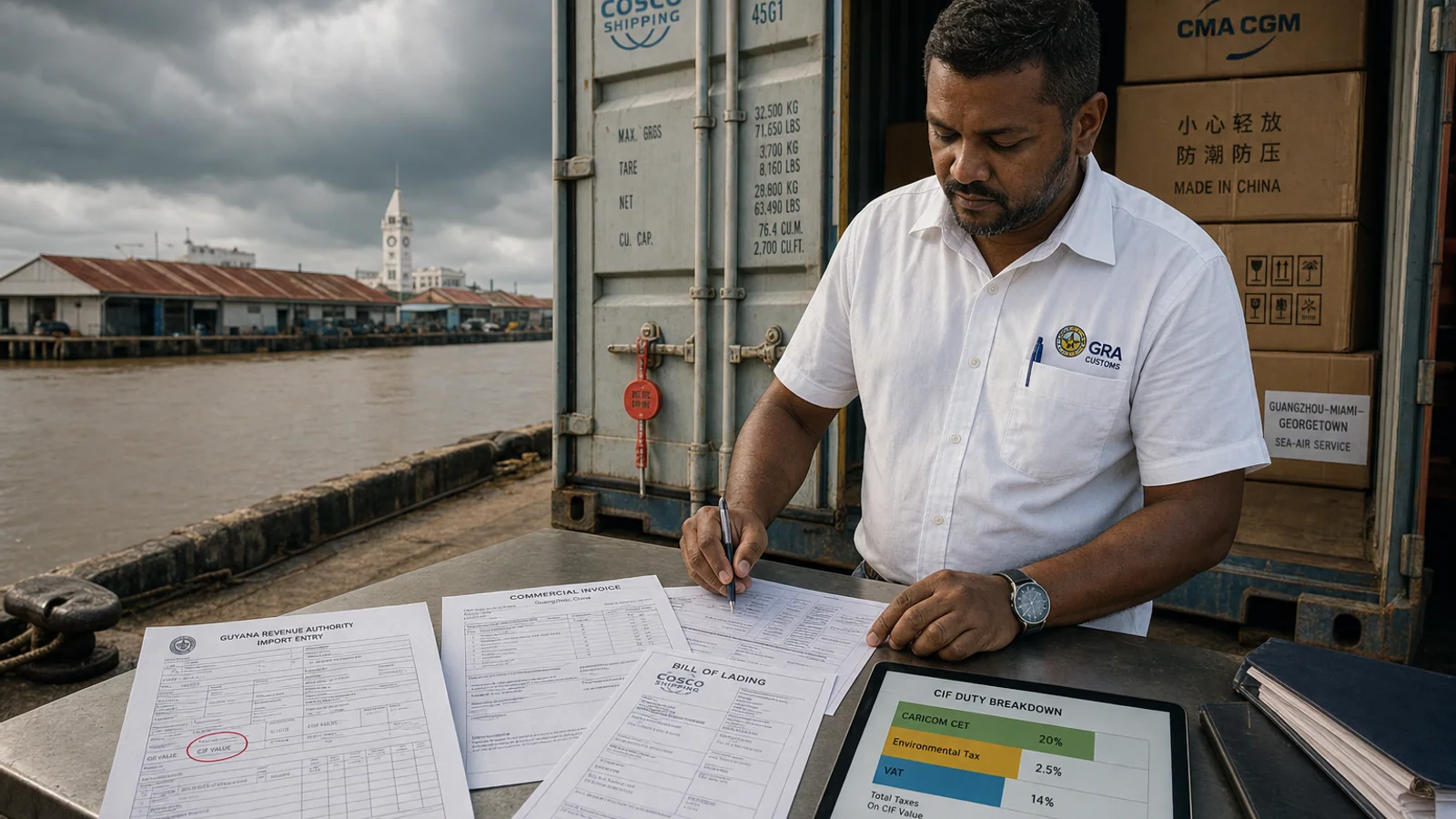
Quick answer Guyana charges four things on a China import: CARICOM Common External Tariff duty of 0%–40%, Environmental Tax on certain containers, Excise Tax on vehicles, alcohol and fuel, and 14% VAT. The Guyana Revenue Authority applies all of them to the CIF value. Sea-air freight from China to Georgetown runs 17–26 days.
- Guyana taxes the CIF value — your freight and insurance are part of the taxable base, not just the Chinese factory invoice.
- VAT in Guyana is 14% and it is charged on CIF plus duty plus Environmental and Excise Tax, so it compounds on top of the tariff.
- Chinese goods receive no tariff preference in Guyana; CET bands of 0%, 5%, 20% and 40% apply by HS code.
- Walio sea-air from China to Georgetown moves in 17–26 days, from $5.48/kg at 5,000+ kg, port to airport, priced in seconds.
This guide breaks down every charge the Guyana Revenue Authority assesses on Chinese cargo, with the formula and worked numbers. If you search in Spanish for impuestos importación China Guyana, the same rules apply — the tax base is CIF in both languages.
See your price in seconds
Real carrier rates, no signup, no follow-up calls.
China to Guyana import taxes: what do you actually pay on arrival?
Quick answer Four charges hit a China to Guyana import: CARICOM Common External Tariff duty of 0% to 40%, Environmental Tax on certain imported containers, Excise Tax on vehicles, alcohol, tobacco and fuel, and 14% VAT. The Guyana Revenue Authority assesses every one of them on the CIF value of the shipment.
The Guyana Revenue Authority (GRA) applies the taxes in a fixed sequence. First the CET duty, then Environmental Tax, then Excise Tax where it applies, and finally 14% VAT on CIF plus duty plus the other two taxes. The order matters, because each layer enlarges the base for the next one.
Guyana has no free trade agreement with China. Goods of Chinese origin therefore pay the full CET rate that CARICOM publishes for third countries. A Certificate of Origin from a Chinese chamber of commerce does not reduce your duty — it proves where the goods were made and keeps GRA from disputing origin later.
| Tax | Legal base | Rate or band | Applies to |
|---|---|---|---|
| Customs duty (CET) | CARICOM Common External Tariff, Customs Act | 0%, 5%, 20%, 40% | All goods from outside CARICOM, by HS code |
| Environmental Tax | Customs (Amendment) legislation | Per-unit rate on containers | Imported non-returnable beverage containers |
| Excise Tax | Excise Tax Act | Varies by product and engine size | Vehicles, alcohol, tobacco, petroleum products |
| VAT | Value-Added Tax Act | 14% | CIF + duty + Environmental + Excise |
Duty and taxes are government charges. They never appear inside a Walio freight quote, and no forwarder can discount them. Walio prices the transport; GRA assesses the tax.
What is CIF value and why does Guyana tax it instead of FOB?
Quick answer CIF value is the cost of the goods plus international insurance plus freight to Guyana. The Guyana Revenue Authority uses CIF as the taxable base, so your sea-air freight and insurance are taxed as well. GRA officers can reject an undervalued Chinese invoice and reassess the shipment using reference values.
CIF stands for Cost, Insurance and Freight. It is larger than FOB Shenzhen, which covers only the goods delivered onto the vessel, and far larger than EXW factory, which excludes inland Chinese trucking too. Because Guyana taxes CIF, the freight you pay becomes part of your duty base.
That has a practical consequence. A low-value, high-volume consignment flown at premium rates can carry a tax bill out of proportion to the goods. Cheaper, well-chosen transport reduces both the freight invoice and the duty assessed on it.
GRA valuation officers compare declared values against reference data. Alibaba, 1688 and Temu invoices that look far below market attract scrutiny, and officers can request bank transfer records, payment receipts and supplier correspondence before releasing the cargo.
The importer carries the undervaluation risk, not the supplier
If a Chinese supplier issues a low-value invoice "to help with customs", GRA penalizes the importer of record in Georgetown. Expect reassessment, penalties, detention and storage charges. Ask your supplier for an invoice that separates goods, freight and insurance on separate lines so your CIF is provable item by item.
How is import tax calculated in Guyana step by step?
Quick answer Guyana stacks the taxes in a fixed order. Start with CIF, apply the CET duty rate, add Environmental Tax and any Excise Tax, then charge 14% VAT on the running total. A CIF US$20,000 shipment at 20% duty pays US$4,000 duty, then VAT of US$3,360 on US$24,000.
The formula is one line: VAT = (CIF + CET duty + Environmental Tax + Excise Tax) × 14%. Note the sequence — VAT is charged after duty, never before.
Worked example: 1,000 kg of LED lighting from Shenzhen
Assume goods invoiced at US$9,000 FOB Shenzhen, sea-air freight on 1,000 chargeable kg, and insurance at 1% of value plus freight. Duty for lighting fixtures typically falls in the 20% band.
| Line | Basis | Amount (US$) |
|---|---|---|
| Goods (FOB Shenzhen) | Supplier invoice | 9,000 |
| Sea-air freight | 1,000 kg | 6,000 |
| Insurance | 1% of goods + freight | 150 |
| CIF value | Taxable base | 15,150 |
| CET duty | 20% of CIF | 3,030 |
| Environmental Tax | Not applicable | 0 |
| Excise Tax | Not applicable | 0 |
| VAT | 14% of 18,180 | 2,545 |
| Total tax to GRA | Duty + VAT | 5,575 |
Freight in the table is illustrative arithmetic, not a quote. Your real rate depends on the origin port, the destination airport and the chargeable weight, and the calculator on this page returns it instantly.
Second example: a 0% duty item
Solar panels and many industrial machines sit in the 0% CET band. On a CIF of US$30,000, duty is nil — but VAT of 14% still applies to the full CIF, producing US$4,200 payable before release. A 0% tariff never means a tax-free import.
VAT-registered Guyanese businesses can usually recover import VAT as input tax on their returns. Private individuals and unregistered buyers cannot, so for them the 14% is a permanent cost. Confirm your position with a licensed tax adviser.
See your price in seconds
Real carrier rates, no signup, no follow-up calls.
What are the CARICOM CET rates for Chinese goods in Guyana?
Quick answer The CARICOM Common External Tariff is the shared tariff schedule Guyana applies to goods from outside the region, with main bands of 0%, 5%, 20% and 40%. Machinery, industrial inputs and most solar equipment sit low. Furniture, textiles, finished electronics and motorcycles sit at the upper end.
Guyana is a CARICOM member, so its external tariff is set regionally rather than nationally. Anything arriving from Shanghai, Ningbo or Shenzhen is a third-country import and pays the published band for its HS code.
| Product from China | HS chapter | CET band | Excise | VAT | Indicative total on CIF |
|---|---|---|---|---|---|
| Solar panels | 85 | 0% | No | 14% | 14% |
| Industrial machinery | 84 | 0–5% | No | 14% | 14–20% |
| Auto parts | 87 | 5–20% | No | 14% | 20–37% |
| Consumer electronics | 85 | 20% | No | 14% | 37% |
| Textiles and apparel | 61–62 | 20% | No | 14% | 37% |
| Furniture | 94 | 20% | No | 14% | 37% |
| Motorcycles | 87 | 20–40% | Yes | 14% | 37%+ |
Rates are the published CARICOM bands as of 2026 and are shown for planning. Your exact rate depends on the national tariff line GRA assigns.
HS classification follows a global logic: the first six digits are standard worldwide, and the remaining national digits are Guyanese. GRA classifies your goods, not your Chinese supplier, and a supplier's declared code is only a starting point.
Confirm the HS code with a licensed Guyanese customs broker before the cargo leaves China. Reclassification after arrival at Georgetown means a revised SAD, a new assessment and storage days you pay for. CARICOM also publishes conditional duty exemption lists for approved sectors — ask whether your goods qualify before you book.
Environmental Tax, Excise Tax and the exemptions importers miss
Quick answer Environmental Tax applies to imported beverage containers at a published per-unit rate. Excise Tax is separate and hits vehicles, alcohol, tobacco and petroleum products, with vehicle rates driven by engine size and age. GO-Invest concessions, manufacturing incentives and remigrant allowances can cut or waive duty for qualifying importers.
Environmental Tax applies per unit to non-returnable metal, plastic and glass containers entering Guyana. A mixed consolidation from Guangzhou carrying bottled drinks, canned goods or cosmetics in glass can trigger it on thousands of units, so count containers before you buy.
Excise Tax works differently. For vehicles, GRA assesses it using engine capacity bands and vehicle age, which is why a four-year-old 1,500 cc Chinese sedan, a used 3,000 cc SUV and an electric vehicle all land at different effective rates. Motorcycles follow their own schedule.
Concessions exist and are frequently missed. GO-Invest negotiates investment agreements that waive or reduce duty on qualifying capital equipment, and sector programs cover manufacturing, agriculture and mining inputs. Returning Guyanese nationals may qualify under the remigrant scheme, which requires proof of residence abroad, passport history and an approved GRA application.
Approvals must exist before the cargo lands
GRA grants concessions against an approval issued before arrival. Filing the application after the vessel berths or the flight lands rarely succeeds, and the cargo accrues storage while you wait. Duty classification and exemption eligibility are questions for a licensed Guyanese customs broker, not for your freight forwarder.
How much does sea-air cargo from China to Guyana cost?
Quick answer Walio sea-air freight from China to Guyana starts from $7.52/kg at 300–499 kg, $6.62/kg at 500–999 kg, $5.94/kg at 1,000–4,999 kg and $5.48/kg at 5,000 kg and above, port to airport. Transit is 17–26 days. Origin and destination handling are added per shipment in the calculator.
Sea-air is a multimodal service: ocean from Dalian, Fuzhou, Guangzhou, Ningbo, Qingdao, Shanghai, Shenzhen, Xiamen or Xingang to Los Angeles in 12–18 days, truck from Los Angeles to Miami in 3–5 days, then air from Miami to Georgetown (GEO) in 2–3 days.
China to Georgetown by sea-air, port to airport. Full air freight is faster and far dearer; pure ocean via Caribbean transshipment is slower.
Port to airport means the shipper delivers the cargo to the origin port and the consignee collects it at Georgetown airport. Chargeable weight is the greater of actual weight and volume × 167 kg per m³, with a 300 kg minimum billed weight — a 180 kg shipment is billed as 300 kg.
 Shenzhen(CNSZX)
 Georgetown(GEO)
Always read the rates as "from" figures. The exact price depends on the origin port and destination airport, and origin and destination handling is added per shipment rather than folded into the per-kg number. Door pickup in China and door delivery in Guyana are quoted on request through the calculator.
For regional benchmarking, compare this lane with our Sea-Air China to Colombia Calculator: Rates in Seconds and the Sea-Air China to Peru Calculator: 2026 Rates.
See your price in seconds
Real carrier rates, no signup, no follow-up calls.
FCL, LCL, air or sea-air: which option lands cheapest in Georgetown?
Quick answer Sea-air reaches Georgetown in 17–26 days, sitting between full air freight and pure ocean on both cost and speed. FCL suits 25 m³ and up, LCL suits roughly 3–15 m³, and sea-air suits urgent cargo from 300 kg upward. Remember that higher freight raises your CIF and therefore your duty.
| Mode | Transit to Georgetown | Priced by | Effect on CIF | Best for |
|---|---|---|---|---|
| FCL 20' | 40–55 days | Per container | Low | 25–30 m³, dense cargo |
| FCL 40'/40HC | 40–55 days | Per container | Lowest per m³ | 55–68 m³ of volume cargo |
| LCL | 45–60 days | Per m³ | Low | 3–15 m³ consolidations |
| Sea-air | 17–26 days | Per chargeable kg | Medium | Urgent cargo from 300 kg |
| Air freight | 5–9 days | Per chargeable kg | Highest | Samples, spares, deadlines |
The LCL-to-FCL crossover usually sits around 10–15 m³. Above that, cost per cubic metre in a 20' box normally beats consolidated LCL, and you also avoid CFS deconsolidation handling at destination.
Ocean routing into Guyana adds its own realities. Most services transship through Caribbean hubs such as Kingston or Caucedo, and draft limits on the Demerara River cap vessel size at Georgetown, which lengthens schedules and reduces direct sailings.
Choose sea-air
Your buyer deadline sits inside a month, the cargo weighs 300 kg or more, and full air freight would wipe out the margin. Sea-air also smooths peak-season air capacity squeezes out of South China.
Choose FCL
You have 25 m³ or more, the goods are not time critical, and you want the lowest possible freight line on your CIF. Lower freight means lower duty and lower VAT in Georgetown.
Which Incoterm should a Guyanese importer use?
| Incoterm 2020 | Freight paid by | Insurance by | Guyanese duty and VAT | Risk transfers |
|---|---|---|---|---|
| EXW | Buyer | Buyer | Buyer | At the Chinese factory |
| FOB | Buyer | Buyer | Buyer | On board at origin port |
| CIF | Seller | Seller | Buyer | On board at origin port |
| DDP | Seller | Seller | Seller | At the buyer's door |
FOB is the practical default for most Guyanese importers, because you control the carrier and see the real freight cost that enters your CIF. DDP looks easy, but it puts import liability on a Chinese seller who cannot register for VAT in Guyana — which blocks input VAT recovery for your business.
Speed-versus-cost trade-offs look similar on other Latin American lanes; see the Sea-Air vs Air China–Chile Calculator: 17-26 Days 2026 and the Sea-Air China to Mexico Calculator: 16-25 Days (2026) for comparable routings.
See your price in seconds
Real carrier rates, no signup, no follow-up calls.
What documents does Guyana customs require for Chinese goods?
Quick answer Guyana customs needs a commercial invoice, packing list, Bill of Lading or Air Waybill, Certificate of Origin, your TIN, and the SAD declaration lodged electronically in ASYCUDA World. Restricted goods add permits from GNBS, the Ministry of Health or the Ministry of Agriculture before the Guyana Revenue Authority releases cargo.
ASYCUDA World is the UNCTAD customs platform GRA uses to receive declarations, assess tax and issue releases. The SAD — Single Administrative Document — is the declaration form itself, filed electronically by a licensed broker on your behalf.
- Commercial invoice — issued by the Chinese supplier, showing goods, freight and insurance separately
- Packing list — supplier issued, with carton counts, weights and dimensions
- Bill of Lading or Air Waybill — issued by the carrier, NVOCC or forwarder
- Certificate of Origin — issued by a Chinese chamber of commerce or CCPIT
- TIN — your Guyanese Taxpayer Identification Number, required before any SAD is lodged
- Permits — GNBS, Ministry of Health or Ministry of Agriculture approvals for regulated goods
On a sea-air file you will see two transport documents: an ocean Bill of Lading for the China–Los Angeles leg and an Air Waybill for the Miami–Georgetown flight. GRA works from the AWB covering the final import leg, but keep both on file for valuation support.
| Document | Issued by | Required for | If missing |
|---|---|---|---|
| Commercial invoice | Chinese supplier | Every import | No valuation, no assessment |
| Packing list | Chinese supplier | Every import | Physical exam likely |
| AWB / Bill of Lading | Carrier or NVOCC | Cargo release | Cargo not releasable |
| Certificate of Origin | CCPIT / chamber | Origin proof | Origin query, delay |
| GNBS permit | GNBS | Electrical goods, tyres | Detention at GEO |
| Health permit | Ministry of Health | Food, drugs, cosmetics | Refusal or re-export |
Documentation discipline on another sea-air lane follows the same logic — see the Sea-Air China to Mexico Calculator: 2026 Rates for a comparable file structure.
How do you clear customs in Georgetown without delays?
Quick answer Clearance follows a fixed order: your broker lodges the SAD in ASYCUDA World, GRA assesses duty, Environmental Tax, Excise and 14% VAT, you pay, then the airline or terminal releases the cargo. Most clean files close in two to five working days. Undervaluation and wrong HS codes cause the longest holds.
- Register for a TIN with GRA and appoint a licensed customs broker.
- Send the broker a pre-alert with invoice, packing list, AWB and Certificate of Origin.
- Broker classifies the goods and lodges the SAD in ASYCUDA World.
- GRA assesses duty, Environmental Tax, Excise and 14% VAT.
- Pay the assessment, then collect the release and gate out the cargo.
Guyanese brokers normally charge a fee per declaration plus disbursements such as terminal handling, examination and delivery. Ask for the structure in writing before you file; disbursements are passed through, not marked up by reputable brokers.
What about small parcels from Alibaba, AliExpress and Temu?
Guyana does not operate a broad de minimis exemption. Courier parcels are normally assessed on CIF value like any other import, and courier clearance simply uses a simplified declaration rather than a different tax formula. Confirm current treatment with GRA or your broker before you order.
Air cargo free time at Georgetown is short, and storage accrues daily once it expires. Have funds ready to pay the assessment the same day GRA issues it. The five costliest mistakes are undervalued invoices, wrong HS classification, a missing Certificate of Origin, no import permit for regulated goods, and late payment that converts free time into storage and demurrage.
Importers researching impuestos importación China Guyana often underestimate one thing: freight is taxable. Choosing the right mode lowers your CIF, your duty and your VAT together. Enter your route in the calculator above and see your price in seconds — no signup, no follow-up calls.
Guyana charges CARICOM Common External Tariff duty of 0% to 40% depending on the HS code, plus 14% VAT calculated on CIF value plus duty. Vehicles, alcohol, tobacco and fuel also carry Excise Tax, and certain beverage containers carry Environmental Tax. A typical 20% duty item ends up with a combined tax load near 37% of CIF.
The Guyana Revenue Authority starts from the CIF value — goods plus insurance plus freight — then applies the CET duty rate, adds any Environmental or Excise Tax, and charges 14% VAT on that total. On a CIF of US$20,000 at 20% duty, you pay US$4,000 duty and US$3,360 VAT. Freight is taxed, so cheaper shipping lowers your tax bill too.
Guyana does not run a broad de minimis exemption, so courier parcels from Alibaba, AliExpress or Temu are normally assessed on CIF value like any other import. Small shipments are still declared and can attract duty and 14% VAT. Confirm the current threshold and treatment with the Guyana Revenue Authority or a licensed customs broker before you order.
You need a commercial invoice, packing list, Bill of Lading or Air Waybill, Certificate of Origin, your TIN and a SAD declaration filed in ASYCUDA World. Regulated goods also need permits from GNBS, the Ministry of Health or the Ministry of Agriculture. Missing one document is the most common reason cargo sits at Georgetown accruing storage.
Sea-air takes 17 to 26 days door-relevant transit: 12 to 18 days by ocean from the Chinese port to Los Angeles, 3 to 5 days by truck to Miami, then 2 to 3 days by air to Georgetown. The exact figure depends on which Chinese port you ship from. The calculator prices and times your exact routing in seconds.