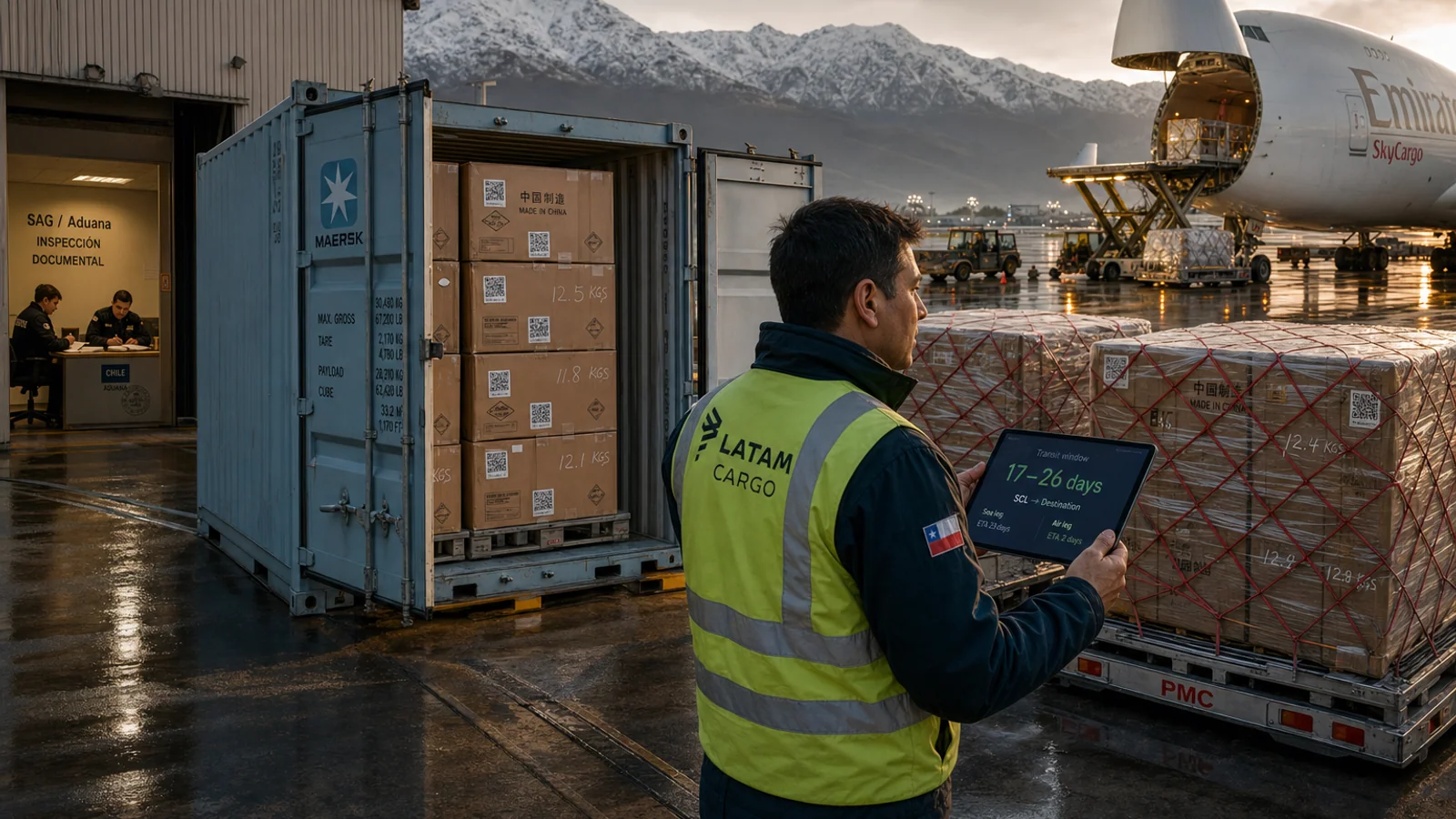
Quick Answer: Sea-air from China to Chile takes 17–26 days and starts from $5.46/kg at 5,000+ chargeable kg, port to airport. Direct air lands in Santiago in about 3–7 days but costs several times more per kilo. Sea-air sails to Los Angeles, trucks to Miami, then flies to SCL.
- Sea-air China to Chile runs 17–26 days total: 12–18 days ocean to Los Angeles, 3–5 days truck to Miami, 2–3 days air to Santiago (SCL).
- Sea-air freight starts from $7.49/kg at 300–499 kg and from $5.46/kg at 5,000+ kg, port to airport, on the cheapest port and airport pairing.
- Minimum billed weight is 300 kg, and chargeable weight is the greater of actual kilos or volume × 167 kg per m³.
- Direct air wins on urgency and on dense, high-value cargo; sea-air wins when you can trade one to two extra weeks for a much lower cost per kilo.
Chilean importers face the same question on every purchase order from Shenzhen or Ningbo: pay for speed, or pay less and wait. This guide compares both services on transit, cost per kilo, cargo type and customs, then prices your exact shipment in the calculator.
Sea-air vs air China Chile: what is the real difference?
Quick Answer: Sea-air moves your cargo by ocean to Los Angeles, by truck to Miami, then by air to Santiago, in 17–26 days from $5.46/kg at volume. Direct air flies China to SCL in about 3–7 days at a far higher rate per kilo. Both are priced per chargeable kilo.
Sea-air is a multimodal service that buys ocean economics for the long Pacific leg and air speed for the final leg into Santiago. You are not choosing between two freight products. You are choosing where on the speed curve you want to sit.
Direct air from China to SCL usually takes 3–7 days from export cut-off to airport release, including Chinese export clearance and a transhipment stop in the Americas or Europe. Sea-air takes 17–26 days. The difference is roughly 10 to 18 days.
Because both services bill per chargeable kilo, the comparison is clean. Same weight, same cube, very different rate. That makes the decision a straight math problem rather than a judgment call.
Capacity matters too. During peak season and the weeks around Chinese New Year, direct air space tightens and rates spike. Sea-air releases that pressure because the heavy lifting happens on a vessel, where space is far easier to secure than belly capacity.
Documentation differs as well. Sea-air starts on a Bill of Lading or Sea Waybill for the ocean leg and finishes on an Air Waybill (AWB) into Santiago. Direct air travels on a single AWB from origin to SCL.
Sea-air (17–26 days)
Best when your sales calendar can absorb two to three extra weeks. You pay a fraction of the air rate per kilo and still beat a pure ocean booking by weeks. Replenishment stock, apparel, e-commerce SKUs and spare parts for inventory all fit this profile. Space is more predictable in peak season, and the rate drops as your weight tier rises — from $5.46/kg at 5,000+ chargeable kg, port to airport.
Direct air (about 3–7 days)
Best when a week of delay costs more than the freight itself. A production line waiting on a bearing, a tender sample due in Santiago, perishables, or medical and lab items all justify the premium. Direct air also makes sense for small, dense, high-value units where freight is a tiny share of landed cost. You trade money for certainty, and in Q4 you also compete for scarce space.
How does sea-air from China to Chile actually work?
Quick Answer: You deliver cargo to a Chinese port — Shanghai, Ningbo, Shenzhen, Qingdao, Xiamen, Guangzhou, Dalian, Fuzhou or Xingang. The ocean leg reaches Los Angeles in 12–18 days, a truck runs it to Miami in 3–5 days, and it flies Miami to Santiago in 2–3 days. The consignee collects at SCL.
- Delivery to the Chinese port. Your supplier or trucker delivers the cargo into the terminal before the port cut-off.
- Ocean leg to Los Angeles. Transit runs 12–18 days depending on the origin port and the service string.
- Deconsolidation in Los Angeles. The cargo is stripped, checked and prepared for the road leg.
- Truck Los Angeles to Miami. A fixed 3–5 day overland run across the southern corridor.
- Air Miami to Santiago. Two to three days on the AWB into SCL, where the consignee collects after customs release.
| Origin port | Ocean to Los Angeles | Truck LA–Miami | Air Miami–SCL | Total transit |
|---|---|---|---|---|
| Shanghai | 12–16 days | 3–5 days | 2–3 days | 17–24 days |
| Ningbo | 12–16 days | 3–5 days | 2–3 days | 17–24 days |
| Shenzhen | 13–17 days | 3–5 days | 2–3 days | 18–25 days |
| Guangzhou | 13–17 days | 3–5 days | 2–3 days | 18–25 days |
| Xiamen | 13–17 days | 3–5 days | 2–3 days | 18–25 days |
| Fuzhou | 14–18 days | 3–5 days | 2–3 days | 19–26 days |
| Qingdao | 13–17 days | 3–5 days | 2–3 days | 18–25 days |
| Dalian | 14–18 days | 3–5 days | 2–3 days | 19–26 days |
| Xingang | 14–18 days | 3–5 days | 2–3 days | 19–26 days |
 Shanghai(CNSHA)
 Santiago(SCL)Shenzhen(CNSZX)Santiago(SCL)
Port cut-off is not the vessel ETD. Terminals close container receiving days before sailing, and documentation cut-off is earlier still. Miss it and your cargo rolls to the next vessel, which costs you a full week on a weekly service. Book the trucker in China against the cut-off, not the sailing date.
Plan for two handlings. The cargo is deconsolidated and re-palletized before the air leg, so pack for it: shrink-wrapped, clearly labeled, stable pallets built under airline height limits. Soft cartons and over-tall pallets get rebuilt at your cost and your timeline.
The quoted service is port to airport. The shipper delivers to the Chinese port, and the consignee collects at SCL after clearance. Door pickup in China and door delivery anywhere in Chile are quoted on request — submit the addresses in the calculator and the request is priced for you.
Importers supplying more than one South American market usually compare lanes side by side. See the Sea-Air China to Peru Calculator: 2026 Rates and the Sea-Air China to Argentina Calculator: 17-26 Days (2026) for the equivalent numbers into Lima and Buenos Aires.
What does sea-air China to Chile cost per kilo in 2026?
Quick Answer: Sea-air freight starts from $7.49/kg for 300–499 kg, from $6.59/kg for 500–999 kg, from $5.91/kg for 1,000–4,999 kg and from $5.46/kg for 5,000+ kg, port to airport, on the cheapest port and airport pairing. Origin and destination handling is added per shipment in the calculator.
| Chargeable weight | Sea-air rate per kg | Service scope |
|---|---|---|
| 300–499 kg | from $7.49/kg | Port to airport |
| 500–999 kg | from $6.59/kg | Port to airport |
| 1,000–4,999 kg | from $5.91/kg | Port to airport |
| 5,000+ kg | from $5.46/kg | Port to airport |
These are "from" rates on the cheapest port and airport pairing on the lane. Your exact rate depends on which Chinese port you load at and which destination airport you use. The calculator prices that combination instantly.
Chargeable weight decides the bill. It is the greater of the actual kilos or the volume multiplied by 167 kg per m³. So 4 m³ of light goods bills as 668 kg, not its scale weight. Measure your cartons before you compare quotes.
A 120 kg shipment is still charged as 300 kg. Consolidating two purchase orders into one booking usually lowers your cost per kilo, and crossing a tier line helps too — 500 kg bills at a lower rate per kilo than 499 kg, so the heavier shipment can cost less in total.
What the per-kg rate covers: the ocean leg, the overland leg and the air leg, port to airport. What it does not cover: origin and destination handling, itemized per shipment in the calculator and never folded into the per-kg figure. Chilean duties and IVA are government charges, not freight.
Walio compares carrier rates across the ocean leg — Maersk, MSC, CMA CGM and Hapag-Lloyd among them — and prices the air leg against live airline rates. Pricing parallel lanes? Check the Sea-Air China to Mexico Calculator: 2026 Rates and the Sea-Air China to Colombia Calculator: Rates in Seconds.
Enter your port, airport, weight and cube in the calculator on this page and the price appears in seconds. No signup, no form that waits for an email, no follow-up calls.
Which cargo should fly direct and which should go sea-air?
Quick Answer: Direct air suits cargo where one week of delay costs more than the freight: launch stock, spare parts that stop a production line, perishables and small, dense, high-value units. Sea-air suits replenishment orders, e-commerce restocks, apparel, accessories, machinery components and anything where 17–26 days still beats the sales calendar.
Run the decision in money. Multiply the per-kg gap by your chargeable weight, then compare it against your holding cost, your margin per unit and the cost of a stockout over the extra 10 to 18 days. If the gap is larger than the risk, sea-air wins.
Cargo profiles that favor sea-air:
- Apparel, footwear and accessories on a seasonal replenishment cycle
- Household goods, beauty products and e-commerce SKUs restocking a warehouse
- Spare parts going into inventory rather than onto a stopped machine
- LED lighting, electrical goods and light machinery components
Cargo profiles that favor direct air:
- Perishables and temperature-sensitive goods
- Medical devices, lab consumables and reagents
- Samples due for a tender or certification deadline in Santiago
- Replacement parts for downed production equipment
- High-value electronics with heavy insurance exposure
Pro tip
Density beats weight. Any cargo lighter than 167 kg per m³ pays volumetric on both sea-air and direct air, so a badly packed pallet can erase the entire sea-air saving. Ask your supplier to reduce carton void space, stack to a uniform pallet footprint and keep the build under airline height limits before you book.
Restricted and special cargo needs airline approval on the final leg. Lithium batteries, aerosols, magnets, paints and anything classed as dangerous goods must be declared, packed to UN standards and accepted by the carrier. Submit the details through the calculator and a Walio specialist follows up with the options.
There is also the pure ocean alternative. If your shipment fills 10–15 m³ or more and no deadline is pressing, LCL or FCL into San Antonio or Valparaíso costs much less than sea-air — but adds weeks. The same trade-off plays out on shorter corridors; see the Sea-Air China to Guatemala Calculator: 2026 Rates for how it works into Puerto Quetzal.
What do Chilean customs require on arrival at SCL?
Quick Answer: The Servicio Nacional de Aduanas clears cargo at Santiago airport against a Declaración de Ingreso filed by your customs broker. Chile's general ad valorem duty is 6%, and IVA is 19% on the CIF value plus duty. The China–Chile Free Trade Agreement removes duty on most goods with a valid certificate of origin.
Your broker files the Declaración de Ingreso against a complete document set. Missing or inconsistent paperwork is the single most common cause of delay at SCL.
- Factura Comercial — commercial invoice with values, Incoterm and full goods description
- Packing list — carton count, weights and dimensions matching the AWB
- Air Waybill (AWB) — for the Miami–Santiago leg
- Certificado de Origen — under the China–Chile FTA, issued correctly at origin
- RUT — the Chilean importer's tax identification number
The FTA benefit disappears without the correct certificate of origin presented on time. Per the China–Chile Free Trade Agreement, most Chinese-origin goods enter at zero duty, but the paperwork, not the origin, triggers the benefit. Chasing a corrected certificate after arrival is the most expensive mistake on this lane.
HS classification drives everything else: the duty rate, FTA eligibility and whether you need a permit from SAG, ISP or SEC. Confirm the code with a licensed customs broker before the goods leave China, not after they land.
Free time in the Santiago airport bonded warehouse is short. Prepare the Declaración de Ingreso before the flight arrives, or storage charges start accruing within days. Air cargo moves fast, and so does the warehouse clock.
Two mistakes that stall clearance at SCL
First, consignee details on the AWB must match the RUT and the commercial invoice exactly — a different legal name or address holds the file. Second, never undervalue an invoice to reduce duty; Aduanas can reassess the value, apply penalties and detain the cargo. Duties and taxes in Chile are government charges and are never part of a Walio freight price. For duty, tax or classification questions, work with a licensed customs broker.
Ready to compare the two options with real numbers? Enter your Chinese port, your destination airport, your weight and your cube in the calculator above. You get the price on screen in seconds — no signup, no forms that wait for an email, no follow-up calls. If your cargo needs a specialist, the calculator takes the request and a Walio specialist follows up.
Sea-air takes 17–26 days in total, depending on the origin port. The route runs 12–18 days by ocean from ports like Shanghai, Ningbo or Shenzhen to Los Angeles, 3–5 days by truck to Miami, then 2–3 days by air into Santiago (SCL).
Yes, sea-air costs clearly less per kilo than direct air on this lane. Walio's sea-air rates start from $7.49/kg at 300–499 kg and from $5.46/kg at 5,000+ chargeable kg, port to airport, while direct air carries a much higher rate for a 3–7 day transit. The calculator on this page prices your exact port, airport and weight in seconds.
The minimum billed weight is 300 kg. A lighter shipment is still charged as 300 kg, so consolidating two purchase orders into one booking usually lowers your cost per kilo. Chargeable weight is the greater of the actual weight or volume × 167 kg per m³.
Chile applies a general ad valorem duty of 6% plus 19% IVA on the CIF value, but the China–Chile Free Trade Agreement removes the duty on most Chinese-origin goods when you present a valid certificate of origin. Duties and taxes are government charges, not part of a freight price — confirm your HS code with a licensed customs broker.
Some can move, but the air leg into Santiago requires airline approval, correct UN packing and a dangerous goods declaration. Submit the details through the calculator and a Walio specialist follows up with the options for your cargo.