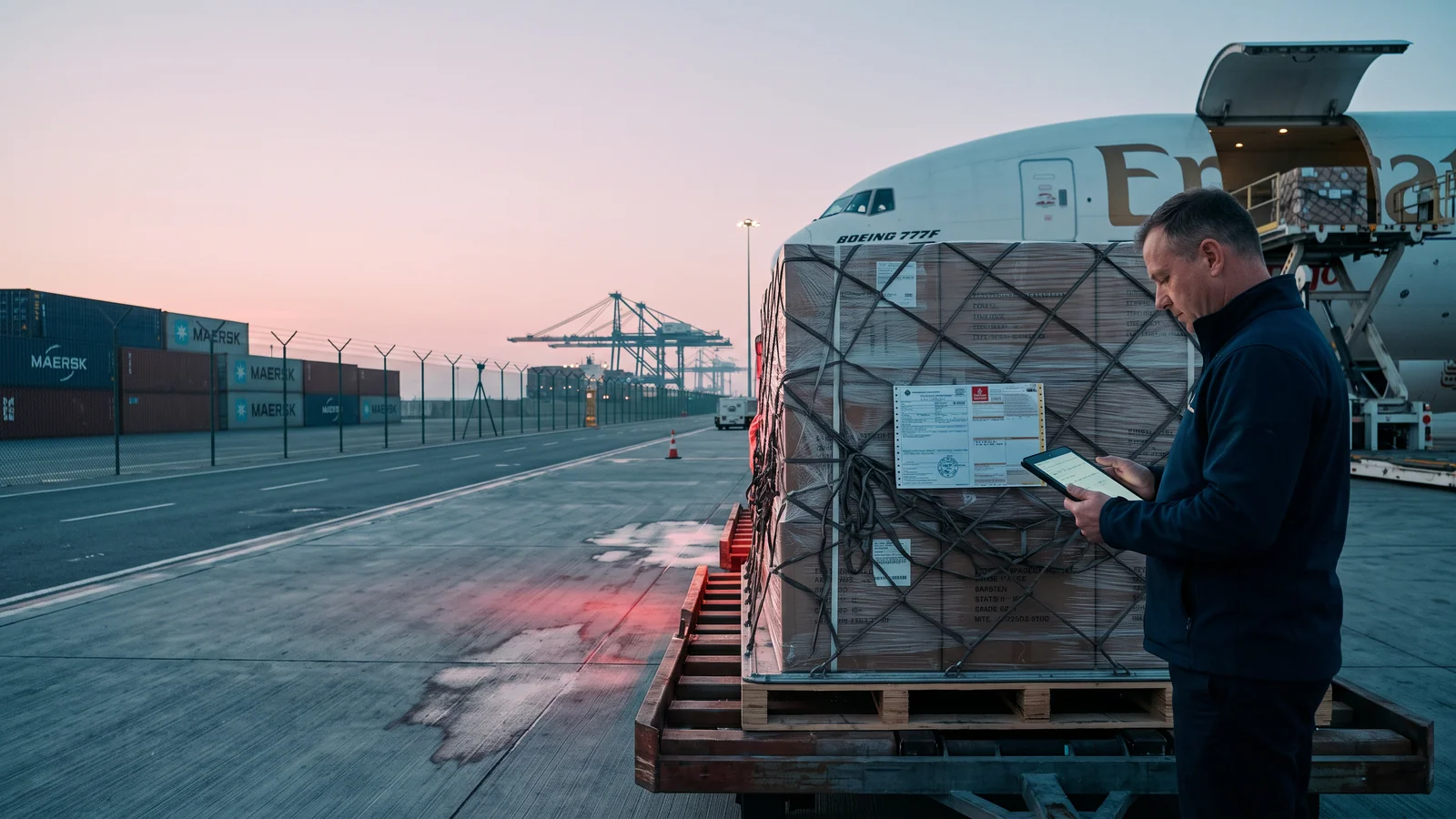
Quick Answer: Sea-air cargo from China to Argentina takes 17-26 days port to airport: 12-18 days ocean to Los Angeles, 3-5 days truck to Miami, then 2-3 days air to Buenos Aires (EZE), Mendoza or Rosario. Rates start from $5.90/kg at 5,000+ kg. Minimum billed weight is 300 kg.
- Sea-air China to Argentina runs 17-26 days port to airport, against 40-55 days for straight ocean freight to Buenos Aires.
- The route is ocean to Los Angeles (12-18 days), truck to Miami (3-5 days), then air to EZE, MDZ or ROS (2-3 days).
- Walio sea-air freight starts from $7.93/kg at 300-499 kg and from $5.90/kg at 5,000+ kg, cheapest port and airport on the lane.
- Minimum billed weight is 300 kg, and chargeable weight is the greater of actual kilos or volume x 167 kg per m3.
Argentine importers use sea-air when ocean freight arrives too late and full air freight costs too much. This guide breaks the 17-26 day window into legs you can put on a restock calendar.
How long does sea-air cargo from China to Argentina take?
Quick Answer: Sea-air cargo from China to Argentina takes 17-26 days port to airport. The clock splits into three legs: 12-18 days ocean from the Chinese port to Los Angeles, 3-5 days by truck to Miami, and 2-3 days by air into Buenos Aires, Mendoza or Rosario.
The service moves your cargo three ways under one booking. Ocean carriers such as Maersk, MSC, CMA CGM and Hapag-Lloyd handle the Pacific crossing, a line-haul truck covers Los Angeles to Miami, and an airline lifts the freight south. This is a multimodal service billed on one chargeable weight, so you get a single rate instead of three separate invoices to reconcile.
The 9-day spread in the window comes almost entirely from the origin port. Shanghai, Ningbo, Shenzhen and Guangzhou sail fastest to Los Angeles. Dalian, Xingang, Qingdao, Fuzhou and Xiamen usually add transshipment time or a slower string, which pushes the ocean leg toward 18 days.
Against 40-55 days for straight ocean freight from China to Buenos Aires. Sea-air removes roughly a month of inventory sitting on the water.
The quoted window is port to airport, not door to door. You deliver the cargo to the Chinese port of loading, and your consignee collects it at EZE, MDZ or ROS after clearance. New to the mode? Read What Is Sea-Air Shipping and When Should You Use It? before you book your first shipment.
 Shanghai(CNSHA)
 Buenos Aires(EZE)Qingdao(CNTAO)Rosario(ROS)
What is the day-by-day door-to-door timeline?
Quick Answer: Plan 3-6 days from factory to port cut-off, 12-18 days sailing to Los Angeles, 2-3 days deconsolidation and transfer at the CFS, 3-5 days trucking to Miami, 2-3 days flying to Argentina, then 2-5 days for customs clearance and delivery inside Argentina.
Here is the full chain, stage by stage, with the party who actually controls each one.
| Stage | Typical duration | Who controls it |
|---|---|---|
| Factory to port of loading | 3-6 days | Supplier / origin trucker |
| Port cut-off to vessel ETD | 2-4 days | Ocean carrier |
| Ocean leg to Los Angeles | 12-18 days | Ocean carrier |
| Discharge, drayage and CFS deconsolidation | 2-3 days | LA terminal and CFS |
| Truck Los Angeles to Miami | 3-5 days | Line-haul carrier |
| Miami airline cut-off and tender | 1 day | Airline / handling agent |
| Flight Miami to EZE, MDZ or ROS | 2-3 days | Airline |
| Argentine clearance and last mile | 2-5 business days | Importer and despachante de aduana |
The port cut-off is not the sailing date. Cargo usually has to be in the terminal 2-4 days before vessel ETD. Miss it by two hours and your shipment waits for the next sailing, which can be a full week, not a day.
The second hard deadline is in Miami. Cargo must be tendered with the Air Waybill (AWB) before flight close. Miss that window and the freight rolls to the next available lift, which in peak weeks can mean 2-3 days on the ground.
Pro tip
Ask your supplier for the packing list and commercial invoice the day the cargo leaves the factory, not the day the vessel sails. Your despachante can pre-classify the goods while the box is still on the Pacific, which is where most of the 2-5 clearance days get saved.
Door pickup in China and door delivery in Argentina are quoted on request. Enter the request in the calculator and a Walio specialist prices the legs around the port-to-airport rate.
Sea-air vs ocean freight to Argentina: which is faster and cheaper?
Quick Answer: Sea-air reaches Argentina in 17-26 days; full ocean freight from China to Buenos Aires typically runs 40-55 days with a transshipment. Sea-air costs more per kilo but cuts roughly a month of transit. Ocean FCL wins on dense, high-volume cargo where the arrival date is flexible.
| Factor | Sea-air | Ocean FCL |
|---|---|---|
| Transit, port to port/airport | 17-26 days | 40-55 days |
| Billing basis | Per chargeable kg | Per container (20', 40', 40HC) |
| Minimum | 300 kg | 1 container |
| Transshipments | 0 on the ocean leg | 1-2 (Cartagena, Santos, Balboa) |
| Capital tied up in transit | ~3 weeks | ~7-8 weeks |
Most China-Buenos Aires ocean services transship at Cartagena, Santos or Balboa. One missed connection adds 7-14 days, and that risk sits outside your control once the box is gated in.
When sea-air wins
Choose sea-air when a stockout costs more than the freight premium. Seasonal launches, replenishment of a fast-moving SKU, spare parts, electronics and anything priced against a moving peso all justify paying per kilo to land a month earlier. It also wins when your volume sits well below a 20 ft container and LCL plus transshipment would take two months.
When ocean FCL wins
Choose ocean FCL when the cargo is dense, heavy and the arrival date is flexible. Tiles, hardware, machinery, packaging and raw materials rarely earn back a per-kilo premium. If you can forecast 8-10 weeks out and your warehouse can hold the buffer, a 40HC moves far more value per freight dollar than any air leg.
Watch the density test. Sea-air bills on chargeable weight, so light, bulky cargo loses its advantage fast. The same economics apply on neighboring lanes — see the Sea-Air China to Peru Calculator: 2026 Rates and the Sea-Air China to Bahamas Calculator: 16-25 Days (2026) for how the model prices other South American and Caribbean destinations.
How much does sea-air China to Argentina cost in 2026?
Quick Answer: Walio sea-air freight from China to Argentina starts from $7.93/kg for 300-499 kg, from $7.03/kg for 500-999 kg, from $6.35/kg for 1,000-4,999 kg and from $5.90/kg for 5,000+ kg, cheapest port and airport on the lane. Minimum billed weight is 300 kg.
| Chargeable weight band | Sea-air freight, China to Argentina |
|---|---|
| 300-499 kg | from $7.93/kg |
| 500-999 kg | from $7.03/kg |
| 1,000-4,999 kg | from $6.35/kg |
| 5,000+ kg | from $5.90/kg |
These are "from" rates on the cheapest port and airport pairing on the lane, as of Walio's live rate table on October 5, 2026. Your exact rate depends on which of the nine Chinese ports you load at and whether you fly into EZE, MDZ or ROS.
Chargeable weight decides what you pay. It is the greater of the actual kilos or volume x 167 kg per cubic meter. A 2 m3 shipment weighing 200 kg bills as 334 kg, not 200 kg.
The 300 kg floor matters for small importers. A 120 kg shipment is still billed as 300 kg, so consolidating two or three supplier orders into one booking usually lowers your landed cost per unit.
- Rates are port to airport: you deliver to the Chinese port, your consignee collects at the Argentine airport.
- Origin and destination handling charges are added per shipment in the calculator, never folded into the per-kg rate.
- Door pickup in China and door delivery in Argentina are quoted on request through the calculator.
- Argentine duties, VAT and perception taxes are the country's published rates, not Walio charges.
Comparing lanes before you commit production? The Sea-Air China to Mexico Calculator: 2026 Rates and the Sea-Air China to Guatemala Calculator: 2026 Rates show how the same weight bands price out on shorter routes.
What delays sea-air shipments to Buenos Aires, and how do you avoid them?
Quick Answer: Most delays happen off the vessel: missed port cut-offs in China, CFS deconsolidation backlogs in Los Angeles, airline capacity limits out of Miami, and Argentine import licensing. Clean documents and an accurate HS classification keep the cargo moving through AFIP and out of the airport bonded warehouse.
Have this paperwork complete before the vessel sails, not after it arrives.
- Factura Comercial — values, Incoterm (FOB, CIF, EXW or DAP) and full product descriptions.
- Packing list — pieces, gross and net weights, and dimensions for the chargeable weight calculation.
- Certificado de Origen — only where a tariff preference applies.
- Bill of Lading (B/L) for the ocean leg and Air Waybill (AWB) for the air leg.
- CUIT and importer registry status — plus any SIRA-type declaration your product requires.
A licensed despachante de aduana files the clearance with Aduana. That is not optional for commercial imports, and the broker needs your HS classification agreed in advance.
A wrong HS code is the most expensive delay on this lane
HS/HTS classification drives both the duty rate and whether a licence is required. A wrong code triggers inspection and days of bonded storage at EZE, where the cargo accrues warehouse charges the whole time. Confirm the code with your customs broker before the goods ship, and treat duty and tax rates as Argentina's published rates, not as a Walio charge.
Peak season tightens both ends of the route. The weeks before Lunar New Year and late Q3 squeeze ocean space to Los Angeles and air capacity out of Miami at the same time. Book 2-3 weeks ahead in those windows.
Finally, screen the cargo for the air leg. Lithium batteries, aerosols, magnets and other dangerous goods need declaration and approval before tender, or the airline will simply refuse the shipment at the Miami cut-off.
Sea-air cargo takes 17-26 days from a Chinese port to Buenos Aires Ezeiza (EZE), port to airport. The route runs 12-18 days by ocean to Los Angeles, 3-5 days by truck to Miami, and 2-3 days by air to EZE. Add 2-5 business days for Argentine customs clearance and local delivery.
Yes. Sea-air lands in 17-26 days while full ocean freight from China to Buenos Aires typically takes 40-55 days, usually with a transshipment. Sea-air costs more per kilo but removes roughly a month of inventory sitting on the water.
The minimum billed weight is 300 kg. A shipment lighter than that is still charged as 300 kg, so small orders are usually worth consolidating. Chargeable weight is the greater of the actual weight and the volume multiplied by 167 kg per cubic meter.
Walio sea-air freight starts from $7.93/kg for 300-499 kg and drops to from $5.90/kg at 5,000 kg and above, on the cheapest port and airport pairing on the lane. Origin and destination handling charges are added per shipment. The calculator on this page prices your exact port, airport and weight in seconds.
Buenos Aires Ezeiza (EZE), Mendoza (MDZ) and Rosario (ROS) all receive the air leg from Miami. EZE has the most frequencies and the widest customs broker coverage, while MDZ and ROS can save inland trucking if your warehouse is in Cuyo or Santa Fe.
Pick your Chinese port, your Argentine airport and your weight, and the calculator does the rest. Enter your route in the calculator above and see your price in seconds — no signup, no follow-up calls.