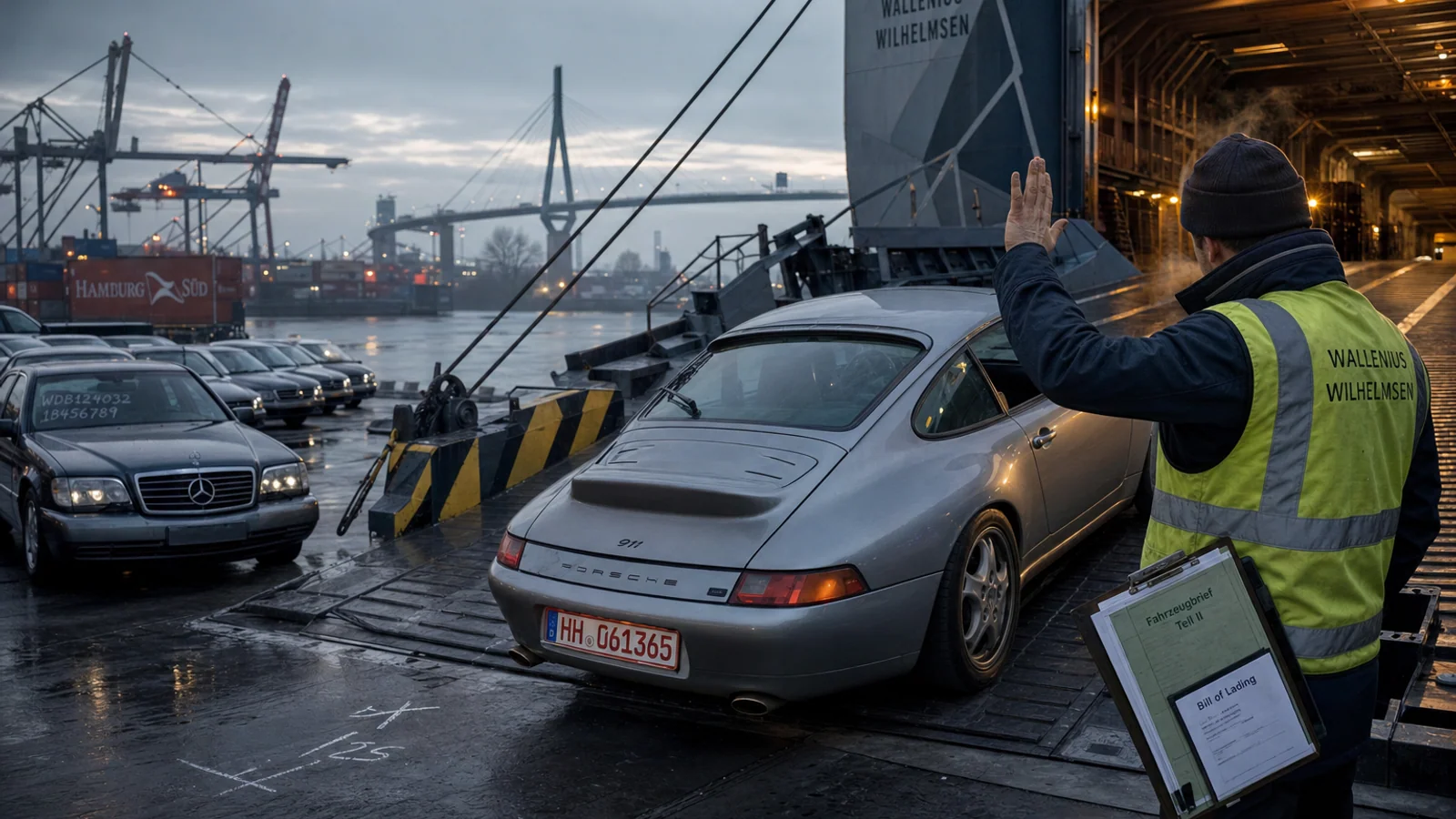
Quick answer A car shipped from Germany to the USA clears CBP under HTS 8703 at 2.5% duty, with pickups taxed at 25% and motorcycles at 10%. Ocean transit from Bremerhaven or Hamburg runs 12–18 days to East Coast ports. Enter the vehicle and route in the calculator and a specialist sends your exact price within 1 business day.
- CBP duty is 2.5% for passenger cars, 25% for pickup trucks (the "chicken tax") and 10% for motorcycles, calculated on the vehicle's declared value.
- Vehicles 25 years or older are exempt from EPA and DOT conformity rules, which is why a 2000 BMW M5 imports far more cheaply than a 2021 one.
- RoRo from Bremerhaven or Hamburg is usually the cheapest way to move one car; a 20 ft container protects the vehicle and lets you ship parts with it.
- Landed cost is freight + insurance + duty + HMF/MPF + customs broker + bond + inland delivery + state sales or use tax at your DMV.
This page walks through every line of the landed cost, the legal pathways by vehicle age, and the paperwork CBP, the EPA and NHTSA expect. Readers searching for a calculadora importar carro de alemania a usa can send the vehicle details straight to a Walio specialist from the form on this page.
Get your quote for this car
Send the vehicle and route. A specialist confirms vessel space and the all-in rate with the carrier and replies within 1 business day.
How much does it cost to import a car from Germany to the USA?
Quick answer Total landed cost has eight moving parts: inland transport to the German port, ocean freight, marine insurance, CBP duty, HMF and MPF, customs broker and bond, US inland delivery, and state sales or use tax. The vehicle's size, value, age and your delivery ZIP code change every line. The calculator prices your exact car and route.
No honest quote on this lane is a single number. The freight piece depends on vessel space, vehicle dimensions and the sailing you catch. The government pieces depend on what you paid for the car.
Three variables move the total more than anything else. Declared value drives duty, Section 232 tariff, HMF, MPF and insurance at the same time, so a €12,000 BMW E30 and a €90,000 Porsche on the same vessel land at very different costs. Age bracket is the second: under 25 years old means EPA and DOT conformity work through a Registered Importer or an Independent Commercial Importer, and that work can cost more than the ocean freight itself.
Destination is the third. A car collected at the Baltimore terminal costs far less to finish than the same car trucked to Denver or Dallas after discharge. Walio does not publish a fixed rate for the Germany–USA car lane because vessel space and vehicle dimensions set the price. The calculator takes the request and a specialist confirms with the carrier.
What line items belong in a complete landed-cost estimate?
| Cost line | Who charges it | What drives the amount |
|---|---|---|
| German inland trucking | Transport company / forwarder | Distance to Bremerhaven or Hamburg, runner vs non-runner |
| Export clearance (Ausfuhranmeldung) | German customs agent | Flat file fee per vehicle |
| Terminal handling at origin | Terminal / carrier | RoRo lane meters or container size |
| Ocean freight + BAF | Carrier (Maersk, Hapag-Lloyd, MSC, CMA CGM) | Dimensions, service, fuel surcharge, season |
| Marine cargo insurance | Underwriter | Percentage of declared value |
| US destination terminal handling | Terminal / carrier | Port of discharge, mode |
| CBP duty | US government | 2.5% / 25% / 10% of declared value by HTS code |
| Section 232 automobile tariff | US government | 25% on covered imported automobiles |
| HMF | US government | 0.125% of value at ocean ports |
| MPF | US government | Percentage of value with a statutory floor and ceiling |
| Customs broker + single-entry bond | Licensed customs broker | Entry complexity, bond amount tied to value and duty |
| CBP or EPA exam | Terminal / exam site | Charged only if your unit is pulled |
| US drayage and inland delivery | Auto transport carrier | Miles from port to your ZIP code, open vs enclosed |
| Title, registration, state sales or use tax | Your state DMV | Vehicle value and your state's rate |
Forwarders hide four of these more often than any others: origin terminal handling at Bremerhaven, BAF on the ocean leg, US destination terminal handling, and exam fees. Ask for them in writing before you book, whoever you book with.
Is it cheaper to import from Germany or buy locally?
Import from Germany
The German market is deep in exactly the specs the US never got: diesel wagons, manual-transmission sport sedans, Euro-only trims and right-hand-drive-free classics with service books. You pay the purchase price plus freight, insurance, duty, broker and inland transport, and you wait six to ten weeks door to door. You also inherit the paperwork burden: EPA 3520-1, DOT HS-7, ISF and the Fahrzeugbrief.
Buy the same model in the US
A US dealer or private seller gives you a titled, registered, FMVSS-compliant car this week, with a local service history and no customs exposure. For a common model that the US market already sells, the import almost never wins once duty, the Section 232 tariff and freight land on top. Local buying also keeps warranty and recall support straightforward.
| Factor | Import from Germany | Buy in the USA |
|---|---|---|
| Added import costs | Freight, insurance, duty, HMF, MPF, broker, bond, inland | None |
| Time to possession | 6–10 weeks door to door | 1–7 days |
| Spec availability | Euro-only trims, diesel wagons, manual gearboxes | US-market trims only |
| Compliance work under 25 years | RI + ICI required | Already FMVSS and EPA compliant |
| Break-even logic | Wins when the spec does not exist in the US | Wins on any common model |
Price your German import
Vehicle details, pickup city, US delivery ZIP. Written quote from a specialist within 1 business day.
Import car from Germany to USA calculator: how do you get a price?
Quick answer Enter the pickup address in Germany, the destination ZIP in the United States, the vehicle year, make, model and declared value, then choose RoRo or container. The calculator sends the request straight to a Walio specialist, who confirms vessel space and the all-in rate with the carrier and returns your exact price within 1 business day.
Every field on the form changes the booking. Running or non-running matters first: a non-runner cannot travel RoRo and has to be winched into a container. Dimensions matter for container cube, and declared value sets both the insurance premium and the duty base.
- Pickup address in Germany and the German port you prefer — Bremerhaven or Hamburg
- US delivery ZIP code, or the port if you plan to collect the car yourself
- Year, make, model, VIN and declared value from the Kaufvertrag or dealer invoice
- Runner or non-runner, plus any modification that changes height or width
- RoRo, shared container or exclusive container, and whether parts travel with the car
The returned quote covers German inland trucking, export clearance, ocean freight, terminal charges at both ends, and optional marine insurance and US customs brokerage. It never covers government charges. CBP duty, the Section 232 tariff, HMF, MPF, state sales or use tax and DMV fees are paid by the importer, not by the carrier.
The same calculator prices the US leg on its own. If you already have ocean freight arranged, request port-to-door auto transport from Baltimore, Newark, Charleston, Houston or Long Beach to any state. No signup, no sales call, and a specialist answers compliance questions in chat.
Send your vehicle details
A Walio specialist confirms space with the carrier and returns a written all-in rate within 1 business day.
What duty does CBP charge on a European vehicle?
Quick answer CBP charges 2.5% duty on passenger cars under HTS 8703, 25% on pickup trucks under the long-standing "chicken tax," and 10% on motorcycles. Since 2025, a Section 232 tariff of 25% applies to imported automobiles. Duty is calculated on the declared transaction value, not on US retail value.
| Vehicle type | HTS heading | Base CBP duty | Section 232 automobile tariff |
|---|---|---|---|
| Passenger car (sedan, coupe, wagon, SUV) | 8703 | 2.5% | 25% where covered |
| Pickup / light truck | 8704 | 25% | 25% where covered |
| Motorcycle | 8711 | 10% | Not applicable |
| Vehicle parts shipped with the car | 8708 | Varies by part | Parts tariff where covered |
Section 232 is a national-security tariff on imported automobiles and auto parts. It changed the math for anyone importing a modern German car in 2025 and 2026. Its scope and exclusions can change, so confirm current treatment with a licensed customs broker before you wire money for the car.
Value comes from the commercial invoice or purchase contract, converted at the CBP exchange rate on the date of export. Keep the Kaufvertrag or dealer invoice and the bank transfer receipt. Understating value is fraud, not a saving, and CBP values vehicles against market data.
Two more federal fees apply at ocean ports. The Harbor Maintenance Fee is 0.125% of declared value. The Merchandise Processing Fee is a percentage of value with a statutory minimum and maximum per entry. A one-time import uses a single-entry customs bond; dealers and repeat importers post a continuous bond instead.
Returning US residents
A US citizen returning home with a personally owned, personally used vehicle may qualify for different treatment than a commercial purchase. Eligibility depends on time abroad, ownership period and how the car was used. That is exactly the question a licensed customs broker should answer in writing before the vessel loads.
Which German cars can you legally import into the United States?
Quick answer Vehicles manufactured 25 or more years ago are exempt from EPA emissions and DOT safety conformity rules and import on form HS-7 box 1 and EPA 3520-1 code E. Newer cars need a Registered Importer, an Independent Commercial Importer, or a Show or Display exemption from NHTSA for a rare approved model.
The 25-year exemption runs on the actual month and year of manufacture, not the model year. A car built in March 2001 becomes eligible in March 2026, even if it was sold as a 2002 model. The build date appears on the German registration documents and on the VIN plate.
Per NHTSA and the EPA, a vehicle manufactured 25 or more years ago enters without FMVSS or emissions conformity work. One month short of the date and the whole compliance pathway changes.
A Registered Importer (RI) is a NHTSA-licensed company that modifies a non-conforming vehicle to meet FMVSS and certifies the result. An Independent Commercial Importer (ICI) is the EPA-side equivalent for emissions conformity. Most modern German cars need both, and the vehicle must appear on NHTSA's list of models deemed capable of conversion.
Show or Display is a separate NHTSA exemption for historically or technologically significant vehicles on an approved list. Road use is capped at 2,500 miles per year, and the car still has to satisfy EPA emissions requirements unless it is 21 years or older for emissions purposes.
| Pathway | Who qualifies | Key requirements | Realistic timeline |
|---|---|---|---|
| 25 years or older | Any vehicle by build date | HS-7 box 1, EPA 3520-1 code E, title, invoice | Days after arrival |
| Under 25 with RI + ICI | Models on NHTSA's eligible list | FMVSS conversion, EPA emissions conversion, bond to NHTSA | Weeks to months after arrival |
| Show or Display | Approved significant models only | NHTSA petition approval, 2,500 mile annual cap, EPA compliance | Petition can take months |
| Temporary import (racing, testing, display) | Non-road or time-limited use | HS-7 declaration box, export or destroy at deadline | Fixed term, no street registration |
Verify eligibility before you pay
A car bought in Germany without an eligibility check can be refused entry by CBP, exported at your cost, or destroyed. Confirm the build month, the HS-7 declaration box and the EPA code before you transfer funds — not after the vessel sails.
What documents do you need to import a German car?
Quick answer You need the Zulassungsbescheinigung Teil II (Fahrzeugbrief), the purchase invoice or Kaufvertrag, EPA form 3520-1, DOT form HS-7, CBP form 7501 entry summary, the ocean Bill of Lading, and an ISF 10+2 filing transmitted at least 24 hours before the vessel loads in Germany.
| Document | Who issues it | When it is due | If missing or late |
|---|---|---|---|
| Zulassungsbescheinigung Teil II (Fahrzeugbrief) | German registration authority | Original at port of export, 72 hours before loading | Vehicle is not loaded |
| Kaufvertrag / dealer invoice | Seller | At export filing and at US entry | CBP cannot value the entry |
| EPA form 3520-1 | Importer or broker | At US entry | EPA hold at the port |
| DOT form HS-7 | Importer or broker | At US entry | NHTSA hold at the port |
| CBP form 7501 entry summary | Licensed customs broker | Within the statutory window after arrival | Liquidated damages, storage |
| Ocean Bill of Lading | Carrier or NVOCC | Issued after loading | No release at destination terminal |
| ISF 10+2 | Importer or broker | 24 hours before vessel loading in Germany | Penalties and delayed release |
| Ausfuhranmeldung / ABD | German customs | Before departure | No VAT refund proof |
The Fahrzeugbrief is the German title, and CBP requires the original ownership document at the port of export 72 hours before loading. Scans do not satisfy the requirement. Ship it by tracked courier to your forwarder the moment the sale closes.
ISF 10+2 is filed by the importer or the broker before the vessel loads. Late or missing filings carry penalties and can hold the car at the US port. Your customs broker files the 7501 entry summary, posts the bond, coordinates any CBP or EPA exam, and releases the unit for pickup.
Run a lien and VIN check first
A German vehicle with an outstanding finance lien cannot be legally exported. Check the VIN for liens, recalls and accident history before payment, and confirm the seller holds the original Teil II. Buyers lose vehicles at the port over this more often than over any customs rule.
RoRo vs shared container vs exclusive container from Hamburg
Quick answer RoRo is usually the cheapest option for a single running car: it drives on and off the vessel, with no loading labor. A shared 40 ft container splits the cost between two to four vehicles. An exclusive 20 ft container holds one car plus spare parts and gives the best protection for high-value or non-running vehicles.
| Mode | Relative cost per car | Damage risk | Parts inside? | Recommended insurance |
|---|---|---|---|---|
| RoRo | Lowest for one running car | Moderate — handled by terminal drivers | No | All-risk on declared value |
| Shared 40 ft container | Low per vehicle (2–4 cars) | Low | Limited, space permitting | All-risk on declared value |
| Exclusive 20 ft container | Higher — one car, one box | Lowest | Yes, crated parts | All-risk, agreed value for collectors |
| Exclusive 40 ft container | Highest per single car | Lowest | Yes, generous space | All-risk, agreed value |
Nothing loose can travel inside a RoRo vehicle. The car sails unlocked with the keys held at the terminal, so personal effects, spare wheels and parts are not permitted. RoRo also needs the car to drive on under its own power and steer and brake normally.
Choose RoRo
Pick RoRo for a standard, running, street-legal car with no modifications and nothing to ship alongside it. Bremerhaven and Hamburg both run frequent RoRo services to US East Coast ports, so sailings are easy to catch. For the full mechanics of how vehicles are loaded, lashed and discharged, read What Is RoRo Shipping and How Does It Work?
Choose a container
Pick a container for classics, restored cars, matching-numbers engines, lowered or widened vehicles, and any non-runner. A container also lets you send a parts crate, spare wheels or panels with the car. One car fills a 20 ft box comfortably, which is why a shared 40 ft load almost always costs less per vehicle.
Marine cargo insurance is quoted as a percentage of declared value, and carrier liability alone will never cover a collector car. For anything rare, ask for an agreed-value policy and photograph the vehicle at loading, including the odometer and all four corners.
Compare RoRo and container for your car
Send the vehicle details once and a specialist prices both options with the carrier.
How long does shipping from Germany to a US port take?
Quick answer Ocean transit from Bremerhaven or Hamburg runs 12–18 days to Baltimore, Newark or Charleston, 18–25 days to Houston, and 25–35 days to Long Beach via the Panama Canal. Add 7–14 days for booking, port cut-off and loading in Germany, plus 3–7 days for CBP clearance and release.
 Bremerhaven(DEBRV)
 Baltimore(USBAL)Hamburg(DEHAM)Newark(USEWR)Hamburg(DEHAM)Long Beach(USLGB)
| Arrival port | Transit from Hamburg / Bremerhaven | Sailing frequency | Dominant service |
|---|---|---|---|
| Baltimore | 12–16 days | Weekly | RoRo and container |
| Newark / NY-NJ | 13–18 days | Multiple weekly | Container, some RoRo |
| Charleston | 14–18 days | Weekly | Container and RoRo |
| Houston | 18–25 days | Weekly | Container, limited RoRo |
| Long Beach | 25–35 days | Weekly via Panama Canal | Container |
Port cut-off is not the same as vessel ETD. The car must be at the German terminal several days before the ship sails, and missing cut-off means waiting for the next sailing — often a full week on RoRo services.
Pick the port that serves your region, not the cheapest freight line on paper. Northeast buyers use Newark/NY-NJ, Mid-Atlantic uses Baltimore, the Southeast uses Charleston or Savannah, Texas and the central states use Houston, California and the Southwest use Long Beach, and the Midwest moves inland by rail or truck from Baltimore. Nine hundred miles of US inland transport can erase the freight savings from a cheaper discharge port.
A realistic door-to-door timeline: purchase and export paperwork 1–2 weeks, German inland transport 2–5 days, ocean 12–35 days, CBP clearance 3–7 days, US inland delivery 2–8 days.
Can you recover the 19% German VAT when you export?
Quick answer Yes. A vehicle exported outside the EU qualifies for VAT-free treatment, so a German dealer either sells net of the 19% MwSt or refunds it once you prove export with the stamped customs document and the Bill of Lading. Private sellers do not charge VAT, so there is nothing to recover.
There are two routes with a dealer. Either you buy net of VAT against a deposit, or you pay the gross price and claim the refund after you supply export proof. The dealer needs the Ausfuhranmeldung (ABD), the stamped exit confirmation and the ocean Bill of Lading showing a US destination.
To drive the car to the port legally you use an Ausfuhrkennzeichen — the German export license plate. It is valid for a limited period and requires its own short-term insurance confirmation (Versicherungsbestätigung). Most buyers skip the drive entirely and have the car trucked to Bremerhaven or Hamburg on a transporter.
A used car sold differenzbesteuert (margin scheme) carries no recoverable VAT at all, and that wording is common on older classics. Read the invoice before you budget a refund, and confirm the VAT treatment in writing with the dealer or a German tax adviser.
What happens after the car lands: title, DMV and state tax
Quick answer After CBP releases the vehicle, you collect it from the terminal or book inland transport, then title and register it at your state DMV. Most states charge sales or use tax on the purchase price, require a VIN inspection, and ask for the stamped CBP 7501, the Fahrzeugbrief and the Bill of Lading.
- CBP releases the entry and the terminal issues a pickup authorization.
- Collect at the terminal or book drayage and US auto transport to your address.
- Complete your state's VIN verification or inspection.
- File the title application with the stamped 7501, Fahrzeugbrief and Bill of Lading.
- Pay state sales or use tax, register the vehicle and collect plates.
- Bind US auto insurance before the car moves on public roads.
State sales or use tax is often the largest single post-arrival cost, charged on the vehicle value at your state's rate. Credits and exemptions vary widely, so confirm treatment with your DMV or a tax adviser rather than assuming.
European cars also need practical conversion work: headlight aiming to US patterns, amber side markers on some models, speedometer and tire labeling expectations, and an emissions test in states that require one for the vehicle's age bracket.
The six mistakes that inflate cost
Buying before checking the 25-year build date. Skipping the lien check. Missing the 72-hour original title deadline at the port of export. Skipping the ISF 10+2 filing. Undervaluing the car on the invoice. Letting the vehicle sit past free time at the US terminal and racking up demurrage and storage.
Quick glossary. CIF: cost, insurance and freight to destination port. FOB: seller delivers on board at origin. HTS 8703: tariff heading for passenger vehicles. Landed cost: everything paid before the car reaches your driveway. Customs bond: the guarantee that duties get paid. ISF 10+2: the advance security filing before loading. Demurrage: charges for leaving cargo at the terminal past free time. Drayage: the short move from port to yard or truck.
Request your Germany–USA car quote
Vehicle, pickup city and US ZIP code. A specialist confirms carrier space and sends the exact price within 1 business day.
The cost depends on the vehicle's declared value, its age, whether you choose RoRo or a container, and your final delivery address in the United States. The fixed government pieces are 2.5% duty on cars, HMF at 0.125% of value, MPF, plus the 25% Section 232 automobile tariff where it applies. Enter the car and route in the calculator on this page and a Walio specialist sends your exact price within 1 business day.
The 25-year rule exempts any vehicle manufactured 25 or more years ago from EPA emissions and DOT/FMVSS safety conformity requirements. Eligibility runs on the actual month and year of manufacture, not the model year, so a car built in June 2001 becomes importable in June 2026. Younger cars need a Registered Importer, an Independent Commercial Importer, or a NHTSA Show or Display exemption.
You need the Zulassungsbescheinigung Teil II (Fahrzeugbrief), the purchase invoice or Kaufvertrag, EPA form 3520-1, DOT form HS-7, CBP form 7501, the ocean Bill of Lading and an ISF 10+2 filing. The original German title must be presented at the port of export at least 72 hours before loading. A licensed customs broker files the entry and posts your customs bond.
Ocean transit from Bremerhaven or Hamburg takes 12–18 days to Baltimore, Newark or Charleston, 18–25 days to Houston, and 25–35 days to Long Beach. Add roughly two weeks for booking, export paperwork and port cut-off in Germany, plus 3–7 days for CBP clearance and inland delivery in the United States.
Yes, if you buy from a VAT-registered German dealer under the regular tax scheme. The dealer either invoices net of the 19% MwSt or refunds it once you provide the stamped customs export confirmation and the ocean Bill of Lading. Cars sold under the margin scheme (differenzbesteuert) and private sales carry no recoverable VAT.
Importing a BMW, Porsche, Mercedes or Audi from Germany is a sequence of checkable steps: confirm the build date, confirm the duty treatment with a licensed customs broker, lock the sailing, file the ISF, and plan the inland leg. Anyone looking for a calculadora importar carro de alemania a usa can skip the guesswork here. Enter the vehicle and your route in the calculator above — no signup, no sales calls, and a Walio specialist confirms space with the carrier and sends your exact, all-in price within 1 business day.