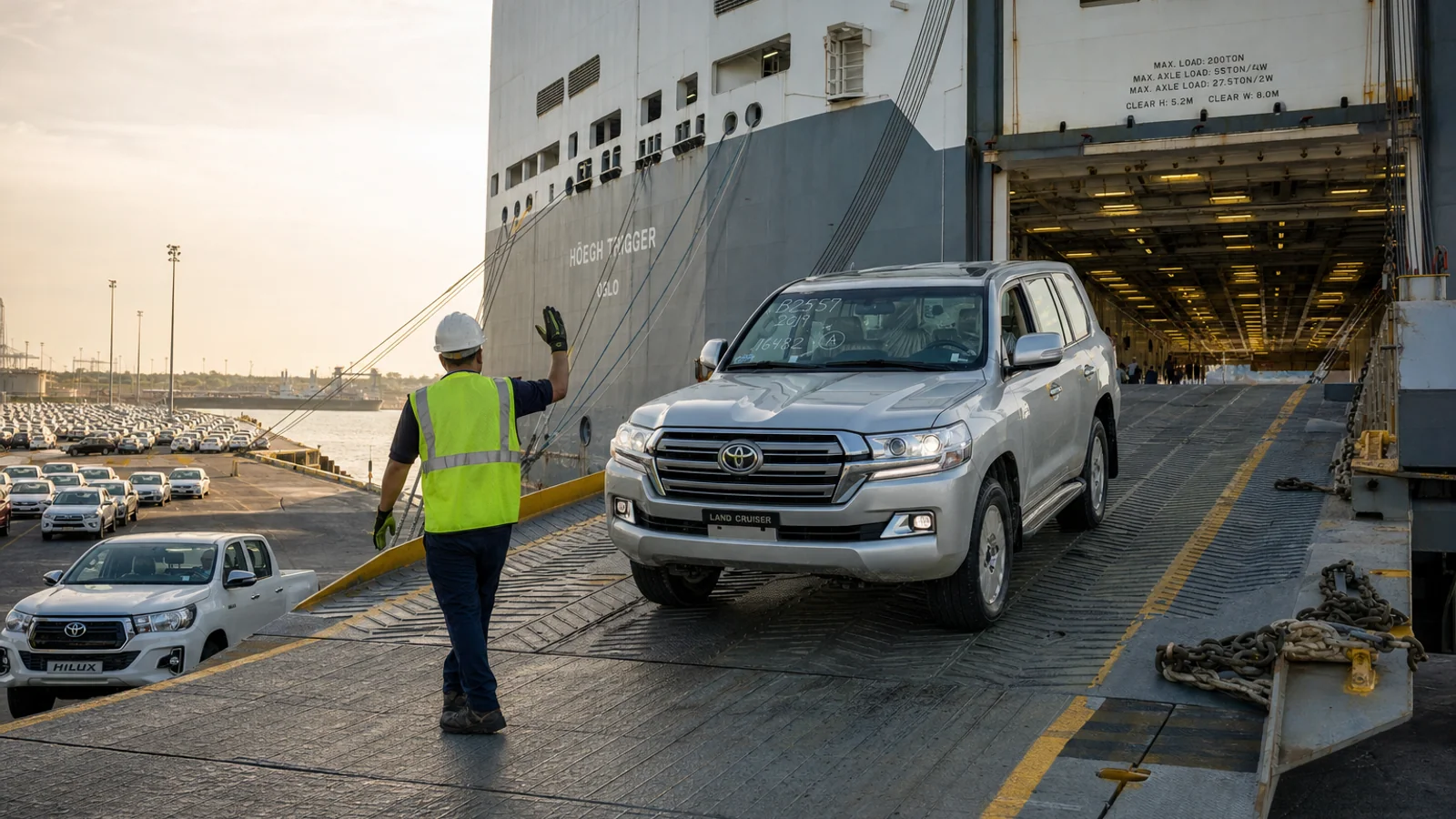
Quick answer RoRo shipping means roll-on/roll-off: your car, truck or excavator is driven up a stern ramp onto a vessel, lashed to the deck, and driven off at the destination port. No container, no packing. Container shipping seals the same vehicle inside a 20 ft or 40 ft box instead, with more protection and more flexibility.
- RoRo stands for roll-on/roll-off: the cargo moves on its own wheels or on a mafi roll trailer, never inside a box.
- RoRo requires a running, driveable vehicle and allows no personal belongings inside — US Customs and the carrier both enforce this.
- A container protects the vehicle from weather and theft, serves any port with a crane, and accepts non-running cars.
- Walio prices one vehicle in its own 20 ft container port to port from $1,920 to Colombia up to $4,059 to Venezuela; RoRo and oversized machinery are quoted on request through the same calculator.
First-time vehicle shippers usually compare two methods: RoRo and a container. This guide explains how each one works, what it costs, what paperwork US Customs demands, and which one fits your lane.
See your price in seconds
Real carrier rates, no signup, no follow-up calls.
What is RoRo shipping?
Quick answer RoRo shipping is roll-on/roll-off ocean freight. The vehicle is driven up a ramp onto a dedicated vessel, parked on a car deck, and lashed down with straps and chocks. Nothing is packed, crated or containerized. At the destination port a licensed driver rolls it off and parks it in the yard for customs release.
The acronym says everything. Roll-on/roll-off cargo travels on wheels instead of being lifted by a crane. A sedan, a dump truck and a combine harvester all board the same way: a port driver takes the wheel and drives the unit aboard through a stern or side ramp.
The opposite method is LoLo, short for lift-on/lift-off. On a LoLo service, a ship-to-shore crane lifts containers, flat racks or crated cargo onto the vessel. Containerized car shipping is a LoLo service, because the box holding your car is craned aboard like any other container.
RoRo capacity is measured in CEU, or car equivalent units. One CEU equals the deck footprint of a standard sedan, roughly 4 by 1.7 meters. Container ships are measured in TEU instead, so the two fleets are never compared on the same scale.
RoRo is a port-to-port service by its nature. You deliver the vehicle to the terminal gate and the consignee collects it from the yard at destination. Who uses it:
- Dealers and remarketers moving ten, fifty or two hundred units on one sailing
- Construction and mining fleets shipping high and heavy units that no container accepts
- Agricultural importers bringing in tractors, sprayers and harvesters
- Families relocating a single car on a lane that already has regular RoRo service
Ask for the vessel's deck clearance before you book, not after. A lifted pickup with a light bar measures 2.2 m tall and will not fit a fixed car deck rated at 1.8 m. The carrier then moves it to the main deck at a higher rate, or rejects it at the gate.
How does RoRo shipping work step by step?
Quick answer RoRo works in seven steps: book space, file the US export declaration, deliver the vehicle to the terminal before the cut-off, surrender the keys and title paperwork, let stevedores drive it aboard and lash it, sail, then present the bill of lading at destination to release it from the yard.
- Book the sailing. You reserve space with a carrier, an NVOCC or a freight forwarder for a named vessel and voyage number.
- File the export declaration. The forwarder files the Electronic Export Information in AES and receives an ITN number. Per CBP, the vehicle title must sit with Customs at the port of export 72 hours before loading.
- Deliver to the terminal. Drop the vehicle before the port cut-off, which falls 24 to 72 hours ahead of vessel ETD. Miss it and you roll to the next sailing — on a monthly lane, that is four weeks, not one day.
- Gate-in inspection. The terminal verifies the VIN, runs a damage survey and issues a gate receipt. That receipt is your proof of condition if you file a claim later.
- Load and lash. Stevedores drive the unit aboard, chock the wheels and secure it with chains and web straps. You leave one key at the terminal and nothing else inside.
- Sail. The transit clock starts at vessel ETD, not at the day you dropped the car.
- Discharge and release. The vehicle is driven off into the yard. Free time is short, customs clearance runs against the bill of lading, and storage charges start quickly.
Port cut-off is not the sailing date
First-time shippers plan around the ETD and arrive two days late. The cut-off is the real deadline. Add the trucking time from your city to the gateway port and build in a buffer of at least three business days.
What are the types of RoRo vessels?
Quick answer Five vessel types carry RoRo cargo. PCC and PCTC ships are floating parking garages for cars and high and heavy units. ConRo ships mix containers above with vehicle decks below. RoPax carries passengers and vehicles on short sea routes. RoLo combines ramps with crane-loaded holds for mixed cargo.
A PCTC — Pure Car and Truck Carrier — is the workhorse of deep-sea vehicle trades. It carries 5,000 to 8,000 CEU on liftable and hoistable decks, so deck heights adjust to the cargo. Stern ramps are rated from 100 up to 320 tonnes.
A PCC (Pure Car Carrier) is the older, simpler design with fixed low decks for cars only. A lifted pickup, a cargo van or a shuttle bus often will not clear. ConRo ships carry containers on top and vehicle decks below, and they dominate Caribbean and Latin America services out of PortMiami and Port Everglades.
RoPax vessels are ferries that carry passengers with cars and trailers on short sea routes. RoLo ships keep ramp access but add crane-worked holds for break-bulk pieces.
"High and heavy" means anything taller or heavier than a car deck tolerates: excavators, graders, tractors, buses, and static cargo bolted to a mafi roll trailer. Those units load on the strengthened main deck or a hoistable deck set to extra height.
| Vessel type | Capacity (CEU) | Ramp capacity (tonnes) | Deck configuration | Typical cargo |
|---|---|---|---|---|
| PCC | 2,000–6,000 | 50–150 | Fixed low decks | Cars, small SUVs |
| PCTC | 5,000–8,000 | 100–320 | Liftable + hoistable decks | Cars, trucks, high and heavy |
| ConRo | 1,000–2,500 | 100–300 | Container slots above, car decks below | Containers, vehicles, rolling plant |
| RoPax | 100–1,000 | 30–100 | Passenger decks over vehicle deck | Cars, trailers, passengers |
| RoLo | 500–2,000 | 50–150 | Ramp access plus crane holds | Mixed vehicles and break-bulk |
| LoLo container ship | 0 (no ramp) | Crane only | Cellular container holds | Containers, flat racks |
What can and cannot ship by RoRo?
Quick answer RoRo accepts anything that rolls: cars, SUVs, pickups, buses, trailers, excavators, tractors, forklifts and boats on trailers. Static cargo can ride on a mafi roll trailer. RoRo refuses non-running vehicles on most lanes, loose personal belongings inside the cabin, hazardous goods, and anything taller than the deck clearance.
Running and driveable is the default rule, because a stevedore has to drive the unit aboard. Some terminals accept non-runners with advance approval and a winch or towing surcharge. Many simply decline them, which pushes the vehicle into a container instead.
Personal effects are the single most common mistake. No boxes, tools, spare parts or suitcases may travel inside a RoRo vehicle. Carriers prohibit it, CBP flags it on export, and marine insurance will not cover loss or theft of items that should not be there. If you also need to move household goods, read What Is Personal Effects Shipping? and plan that cargo separately.
- Fuel at a quarter tank or less, with no fuel or oil leaks
- No propane tanks, loose batteries, aerosols or other dangerous goods
- No roof boxes, camper shells or racks that breach deck clearance
- RVs, motorhomes, semi-trucks and heavy machinery never fit a shipping container — they move RoRo or on a flat rack
For those oversized units Walio does not publish a rate. Enter the shipment in the calculator on this page and a specialist returns a quote for the RoRo or flat rack option.
Hidden items can hold the whole vessel
A terminal that finds undeclared cargo inside a car can refuse the unit at the gate or discharge it before loading. You then pay storage, a re-handling fee, and you wait for the next sailing.
RoRo vs container car shipping: which is better?
Quick answer Container shipping wins on protection, port coverage, non-running vehicles and the ability to pack personal effects alongside the car. RoRo wins on simplicity and on oversized units that no container accepts. On Latin America lanes, container service reaches far more ports, which is why most US to Latin America vehicle moves ship in a 20 ft container.
One standard car fills a 20 ft container with room for little else. A 40 ft high cube holds two to three cars with racking, or one car plus a family's household goods. RoRo charges by the unit or by measured volume, so a second car costs a second full fee.
RoRo cargo sits on enclosed but ventilated decks, and several different drivers handle each unit during loading and discharge. More hands on the wheel means more opportunity for scuffs and mirror damage. A sealed container keeps the vehicle untouched from the loading warehouse to the consignee's gate.
Choose RoRo
Your unit is oversized, self-propelled and heavy — a bus, a wheel loader, a tractor or a semi-truck. The lane has regular RoRo calls, and you accept a port-to-port service with no personal items inside.
Choose a container
You ship a car, SUV, pickup or motorcycle to Latin America or the Caribbean. The vehicle may not run, you want weather and theft protection, or you want household goods loaded alongside under one bill of lading.
If neither ocean option moves fast enough, there is a third route worth pricing: What Is Sea-Air Shipping and When Should You Use It? explains the hybrid that cuts ocean transit roughly in half for urgent cargo.
| Method | Cost basis | Cargo type | Personal items | Weather protection | Non-running OK | Port requirement |
|---|---|---|---|---|---|---|
| RoRo | Per unit or per m³ | Wheeled, self-propelled | No | Partial (ventilated deck) | Rarely, with surcharge | Ramp + car deck terminal |
| 20 ft container | Per container | 1 car, SUV or pickup | Yes, with inventory | Full (sealed box) | Yes | Any container terminal |
| 40 ft HC container | Per container | 2–3 cars or car + goods | Yes, with inventory | Full (sealed box) | Yes | Any container terminal |
| Flat rack | Per unit, out-of-gauge | Tall or wide machinery | No | None (open) | Yes | Heavy-lift crane |
| Break-bulk | Per freight tonne | Project and outsized cargo | No | None to partial | Yes | Multi-purpose berth |
See your price in seconds
Real carrier rates, no signup, no follow-up calls.
How much does it cost to ship a car by RoRo?
Quick answer RoRo is priced per unit or per cubic meter of the vehicle's footprint, not per container. Walio quotes RoRo and oversized machinery on request. For container vehicle shipping, Walio's port-to-port price for one vehicle in its own 20 ft container runs from $1,920 to Colombia up to $4,059 to Venezuela, in seconds.
RoRo carriers measure length x width x height and bill either per cubic meter or at a flat per-unit rate for standard cars. On top of the ocean rate sit terminal handling at both ends, wharfage, and a bunker adjustment factor (BAF) that moves with fuel prices. Walio does not publish a RoRo rate because every unit measures differently — the calculator takes the request and a specialist returns the number.
Container vehicle shipping is different: the box is a fixed unit, so the price is instant. These are Walio's lowest port-to-port prices for one vehicle in its own 20 ft container, as of our quoting system checked since September 28, 2026:
| Destination country | Price (USD, port to port) | Destination country | Price (USD, port to port) |
|---|---|---|---|
| Colombia | $1,920 | Mexico | $2,420 |
| Guatemala | $1,970 | Uruguay | $2,540 |
| Panama | $1,980 | Dominican Republic | $2,545 |
| Honduras | $2,020 | Costa Rica | $2,620 |
| Argentina | $2,086 | Brazil | $2,670 |
| Chile | $2,220 | Jamaica | $2,970 |
| Ecuador | $2,220 | El Salvador | $3,002 |
| Peru | $2,220 | Venezuela | $4,059 |
Cost drivers apply to both methods: vehicle dimensions and weight, your origin gateway, sailing frequency on the lane, peak season surcharges, and whether the unit runs. Port to port excludes destination terminal handling, customs clearance, import duties and inland delivery. Duties are set by the destination country — DIAN in Colombia, SUNAT in Peru, SAT in Mexico — and a licensed customs broker confirms the rate for your HS code.
Port to port, one vehicle in its own 20 ft container to Colombia. The same calculator prices Venezuela at $4,059 and routes RoRo, machinery and RV requests to a specialist.
See your price in seconds
Real carrier rates, no signup, no follow-up calls.
How long does RoRo shipping take by trade lane?
Quick answer Transit depends on the lane and the sailing frequency. US East Coast to Northern Europe RoRo typically runs about two weeks port to port. US Gulf to the Caribbean and Central America is far shorter. Book two to four weeks ahead, because RoRo sailings on many lanes are monthly, not weekly.
Your gateway depends on where you are. Florida ships through PortMiami or Port Everglades. Texas and the central states use Port Houston or Galveston. California and the Southwest load at Los Angeles/Long Beach. The Northeast uses NY/NJ and Baltimore, the Southeast uses Savannah or Brunswick, the Midwest railheads through Chicago, and the Pacific Northwest loads at Tacoma. The gateway changes both the price and the transit time, which is why the calculator prices your exact origin.
| Origin port | Destination port | Transit (days) | Sailing frequency | Service available |
|---|---|---|---|---|
| Miami, FL | Cartagena, Colombia | 4–6 | Weekly | Container + ConRo |
| Miami, FL | Caucedo, Dominican Rep. | 3–5 | Weekly | Container + ConRo |
| Miami, FL | Kingston, Jamaica | 3–5 | Weekly | Container + ConRo |
| Houston, TX | Veracruz, Mexico | 4–6 | Weekly | Container + RoRo |
| Houston, TX | Puerto Cortés, Honduras | 4–6 | Weekly | Container |
| Savannah, GA | Puerto Quetzal, Guatemala | 8–12 | Weekly | Container |
| Long Beach, CA | Callao, Peru | 12–16 | Weekly | Container + RoRo |
| Long Beach, CA | Manzanillo, Mexico | 5–7 | Weekly | Container + RoRo |
| NY/NJ | Santos, Brazil | 14–18 | Weekly | Container + RoRo |
| Baltimore, MD | Bremerhaven, Germany | 12–16 | Every 1–3 weeks | RoRo (PCTC) |
 Miami(USMIA)
 Cartagena(COCTG)Houston(USHOU)
 Veracruz(MXVER)Baltimore(USBAL)
 Bremerhaven(DEBRV)
Book RoRo space two to four weeks ahead, and longer during peak season. Container space on most US to Latin America lanes books far faster. At destination, free time in the RoRo yard is short, so arrange customs clearance before the vessel berths or storage charges start.
What documents does a RoRo shipment require?
Quick answer Every US RoRo export needs the original title or a certified copy, a bill of sale or commercial invoice, the AES filing with its ITN number, a signed power of attorney for the forwarder, and the bill of lading. CBP must hold the title at the port of export 72 hours before the vessel loads.
- Certificate of Title (original or certified copy), or a Manufacturer's Statement of Origin for a new unit
- Lien release letter from the lender if the vehicle is financed
- AES / EEI filing producing the ITN; the 72-hour CBP title rule is non-negotiable
- Bill of Lading naming the consignee — originals versus telex release decides how the car is handed over
- Commercial documents at destination: Factura Comercial, Certificado de Origen, and the importer's tax ID (RUT in Colombia, RFC with SAT in Mexico, NIT in Guatemala)
Destination authorities each run their own vehicle import rules: DIAN in Colombia, SUNAT in Peru, ANAM in Panama, Receita Federal in Brazil. A licensed customs broker in the destination country confirms duty rates, VIN verification and emissions requirements before you ship.
Marine insurance is optional but strongly advised. All-risk cover protects against handling damage; total-loss-only covers the vessel casualty scenario and nothing else. Your gate-in damage survey is the document that supports a claim, so never leave the terminal without a copy.
Household goods need their own file
If a family's belongings move with the vehicle, they need a separate inventory, a used-goods declaration and US Customs Form 3299. Those goods cannot ride inside a RoRo unit — they ship LCL or in the same container. See What Is Personal Effects Shipping? for the full checklist.
How do you prepare and book a RoRo vehicle shipment?
Quick answer Prepare the vehicle first: wash it so the inspector sees existing damage, drop fuel to a quarter tank or less, fix leaks, charge the battery, disable the alarm, and strip every personal item. Then price the shipment in the calculator on this page, compare RoRo and container options, and book online.
- Fuel at or below a quarter tank, no fuel, oil or coolant leaks
- Working brakes and parking brake, inflated tires, a charged battery that starts first time
- Alarm and immobilizer disabled; one key handed to the terminal
- Clean interior and undercarriage — several Latin America and Oceania markets run agricultural inspections on arrival
- Remove toll transponders, GPS trackers, roof boxes and loose trim
Photograph the vehicle from all four corners on gate-in day, including the roof and the odometer. Keep the terminal damage survey with those photos. Together they are the evidence that settles a claim quickly.
Check the destination country's import rules before you book, not after. Several Latin American markets restrict vehicle imports by model year or emissions standard, and a car that clears in Panama may be refused elsewhere.
Price both methods before you commit. Walio compares real carrier rates — including Maersk, MSC, CMA CGM and Hapag-Lloyd — and quotes container vehicle shipping instantly. RoRo, machinery and RV requests go through the same calculator and a specialist returns the rate.
Now that you know what RoRo shipping is, what it refuses, and where container service beats it, the last step is the number. Enter your route in the calculator above and see your price in seconds — no signup, no follow-up calls.
See your price in seconds
Real carrier rates, no signup, no follow-up calls.
RoRo means roll-on/roll-off: your vehicle is driven onto the ship up a ramp and driven off at the other end, with no container and no packing. The ship is a floating parking garage with decks, ramps and lashing points. If it rolls on wheels, it can ship RoRo.
Sometimes, but not always. RoRo can cost less for a single standard car on a high-volume lane with frequent sailings, while a 20 ft container often wins on Latin America routes because RoRo service is thinner and container space is plentiful. Walio's calculator compares the options for your exact route in seconds.
No on both counts in most cases. RoRo terminals require a running, driveable vehicle because stevedores drive it aboard, and loose personal items inside the cabin are prohibited by carriers and flagged by customs. A container accepts non-running vehicles and allows household goods loaded alongside with the proper inventory.
Roughly two weeks port to port from the US East Coast to Northern Europe, plus terminal time on both ends. Sailing frequency matters more than vessel speed: if your lane sails every three or four weeks, waiting for space adds more days than the ocean crossing itself.
RoRo is quoted on request because rates depend on the vehicle's measured volume, the lane and the sailing. For container vehicle shipping, Walio's port-to-port price for one vehicle in its own 20 ft container runs from $1,920 to Colombia up to $4,059 to Venezuela. Enter your route in the calculator to see your number.