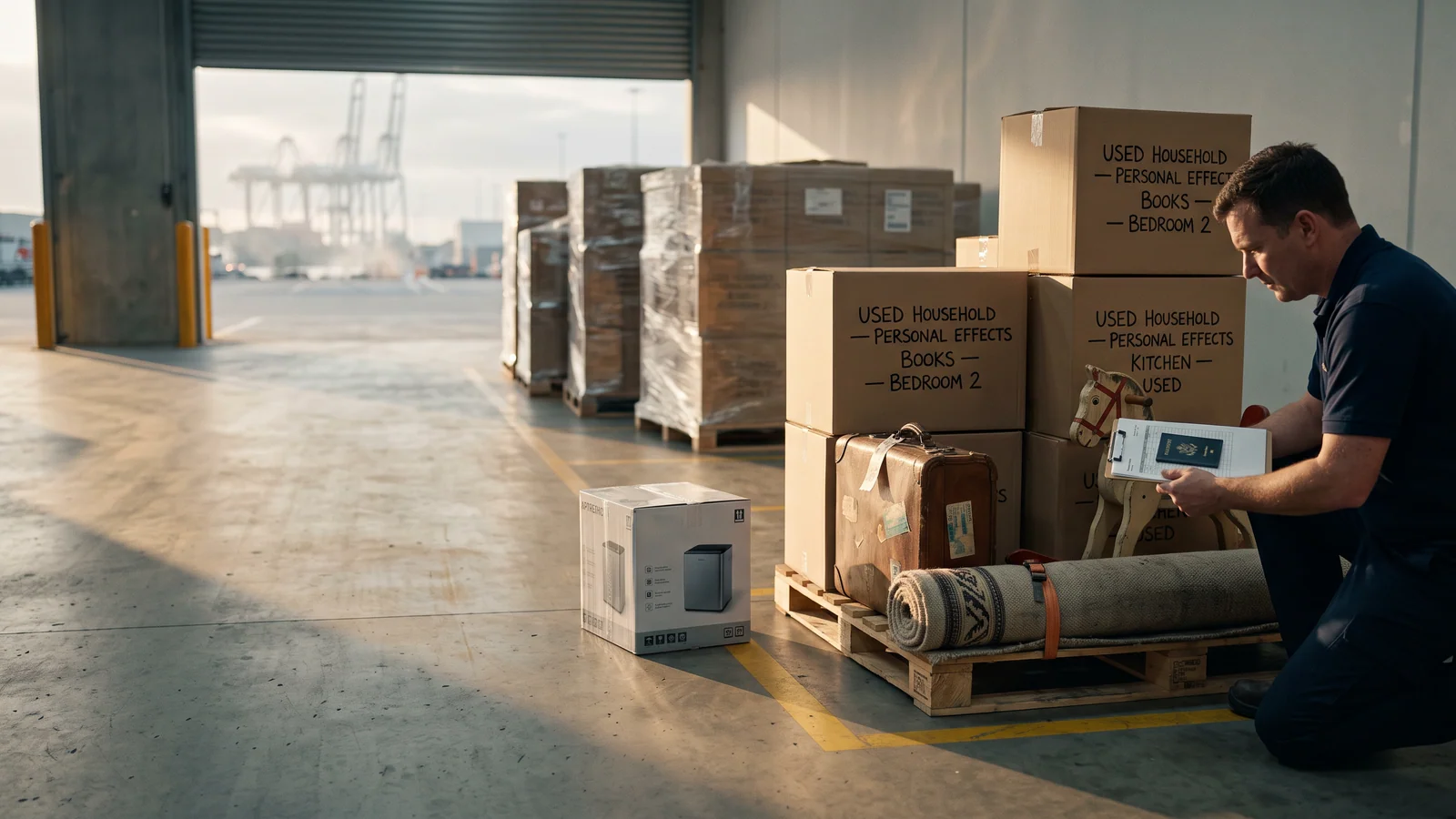
Quick Answer: Personal effects shipping moves your own used belongings abroad — clothes, books, kitchenware, furniture — under a customs category separate from commercial cargo. Most Latin American countries grant duty relief if you prove residency and the goods are used, owned over six months, and listed on a valued inventory. Walio prices port-to-port moves from $1,048 to Nicaragua.
- Personal effects are used, owned belongings shipped for your own use — not merchandise for sale, which is why customs treats them differently.
- Most Latin American customs authorities require a valued packing inventory, passport, visa or residency proof, and a used-goods declaration (Menaje de Casa) to grant duty relief.
- Small loads ship LCL by the cubic meter; above roughly 10–15 m³ a 20 ft container usually costs less per m³.
- Walio port-to-port moves start at $1,048 to Nicaragua and run to $4,770 to Curaçao, priced in seconds in the calculator on this page.
This guide explains the category, the paperwork and the costs in the order a first-time mover meets them. Read it once, then price your exact load in the calculator on this page.
What are personal effects in shipping?
Quick Answer: Personal effects are used items you already own and will keep using — clothing, books, linens, kitchenware, tools, furniture and appliances. Customs separates them from commercial cargo because they are not for sale. That classification, not the box they travel in, decides your paperwork, your duty treatment and your declared value.
The question what are personal effects in shipping has a legal answer, not a packing answer. The category covers goods bought for your own use, owned before the move, and carried abroad to keep using. Nothing in the shipment may be destined for resale or commercial distribution.
That single test is what makes personal effects shipping cheaper to clear than an import of merchandise. Customs officers read your inventory looking for signs that you are a trader rather than a mover.
What customs normally accepts
- Clothing, shoes, bedding, towels and linens in family quantities
- Books, documents, photo albums and artwork you already own
- Kitchenware, small appliances, hand tools and garden tools
- Hobby equipment — bicycles, instruments, camping and dive gear
- Personal electronics in reasonable quantity: one laptop per family member, not twelve
What breaks the exemption
- New goods still sealed in retail packaging with price tags attached
- Commercial quantities of a single item — 40 identical phone cases, 30 pairs of new sneakers
- Firearms, ammunition and replica weapons
- Alcohol in quantity, perishable food, live plants and seeds
- Aerosols, paints, solvents and any flammable liquid
Declared value is the replacement value of used goods, not the price you paid new. A five-year-old sofa is worth what a similar used sofa costs today. Customs challenges inflated lists because they look like insurance fraud, and lowball lists because they look like duty evasion.
Pro tip
Photograph each open box before you tape it, with the box number visible. If customs opens box 14 and questions the contents, you have a dated image that matches line 14 of your inventory. This one habit resolves most inspection disputes in a day instead of a week.
Personal effects vs household goods: what's the difference?
Quick Answer: Household goods is the broad customs term for everything leaving your home, including furniture and appliances. Personal effects usually means the smaller, portable items you carry or ship in boxes. Most Latin American authorities file both under one used-goods declaration, but carriers, insurers and air shippers price and document them differently.
The personal effects vs household goods distinction matters most at the pricing stage. Household goods are bulky and volume-driven: furniture, mattresses, washing machines, rugs. They travel by ocean freight almost without exception, priced per cubic meter or by the container.
Personal effects are portable. Many movers send ten or fifteen boxes by air or courier a week before the furniture sails, so they land with clothes, laptops and school documents already in hand.
| Attribute | Personal effects | Household goods |
|---|---|---|
| Typical items | Clothes, books, kitchen items, documents | Furniture, mattresses, appliances, rugs |
| Usual transport mode | Air, courier or LCL ocean | LCL or FCL ocean |
| Pricing basis | Chargeable weight (air) or m³ (ocean) | Cubic meters (m³) |
| Typical volume | 1–5 m³ | 8–60 m³ |
| Latin America customs filing | Menaje de Casa | Menaje de Casa |
| USA inbound form | CBP Form 3299 | CBP Form 3299 |
| Insurance valuation | Per box, declared sum | Per item for high-value pieces |
On inbound US moves, CBP accepts both under Form 3299, the declaration for free entry of unaccompanied articles. Across Latin America, DIAN, SUNAT, ANAM and their peers file both under the Menaje de Casa used-goods declaration. Country rules still differ sharply — our guide to moving to Panama in 2026, with documents, customs and costs walks through one country's version in full.
Insurance follows the same split. Boxes are covered as a declared sum across a valued inventory. A piano, a dining set or a painting needs its own line and its own value.
How does personal effects shipping actually work, step by step?
Quick Answer: The process runs in six steps: inventory your items, choose LCL or a full container, book and get collection or drop-off, load and seal, sail with a Bill of Lading in your name, then clear customs with your residency proof and release the cargo. Transit is ocean time plus clearance, not just sailing days.
- Build a valued packing inventory. Number every box. List contents and replacement values in English and Spanish. This document becomes your customs filing, so write it once and write it properly.
- Choose LCL or FCL. LCL shares a container and prices per m³. One 20 ft container holds roughly a one to two bedroom home — about 28–30 m³ of usable space.
- Pick your lane and gateway. Florida ships via PortMiami, Texas and the central states via Port Houston, California via LA/Long Beach, the Northeast via NY/NJ, the Southeast via Savannah, the Midwest by rail through Chicago, the Pacific Northwest via Seattle. Ontario moves via Toronto, Quebec and the Atlantic provinces via Montreal, Western Canada via Vancouver.
- Load at the CFS. LCL cargo goes to a container freight station for consolidation. Port cut-off falls days before vessel ETD, so a missed cut-off means the next sailing, not a later truck.
- Collect your documents. The carrier issues a Bill of Lading (B/L) or Sea Waybill naming you as consignee.
- Clear and deliver. At arrival the container is deconsolidated at a destination CFS, customs reviews the file, the exemption is applied or duties are assessed, then drayage and last mile bring the load to your door.
 Miami(USMIA)
 Cartagena(COCTG)Houston(USHOU)
 Manzanillo(PAMIT)New York(USNYC)
 Santos(BRSSZ)
Never let the B/L be consigned to someone else
Some forwarders consign the Bill of Lading to their own destination agent "for convenience". You then need that agent's release to collect your own belongings, and their invoice sets the terms. Insist that the B/L names you or your appointed customs broker as consignee, and check the draft before the vessel sails.
Destination charges, door-to-door delivery and air options are quoted on request through the calculator. If ocean is too slow and full air freight is too expensive, read our explainer on sea-air shipping and when to use it before you commit to a mode.
What does personal effects customs clearance require?
Quick Answer: Customs grants duty relief on used personal effects when you prove three things: you are moving residency, you owned the goods before the move, and the inventory matches the container. Required papers usually include passport, visa or residency card, a valued inventory, the Bill of Lading and a used-goods declaration filed through a licensed customs broker.
Personal effects customs clearance fails on paperwork far more often than on the goods themselves. The core document set barely changes across the region.
- Passport with entry stamp
- Visa, residency card or long-stay permit
- Valued packing inventory, numbered by box
- Original Bill of Lading or Sea Waybill
- Used-goods declaration — usually Menaje de Casa
- Local tax identification number
| Country | Authority | Used-goods declaration | Tax ID required |
|---|---|---|---|
| Colombia | DIAN | Menaje Doméstico | NIT / RUT |
| Panama | ANAM | Menaje de Casa | RUC |
| Mexico | SAT / ANAM | Menaje de Casa | RFC / CURP |
| Peru | SUNAT | Menaje de Casa | RUC / DNI |
| Dominican Republic | DGA | Menaje de Casa | RNC / Cédula |
| Brazil | Receita Federal | Bagagem Desacompanhada | CPF |
| USA (inbound) | CBP | Form 3299 | SSN / passport |
| Canada (inbound) | CBSA | Form B4 / BSF186 | SIN / passport |
Timing windows are strict. Several countries require the goods to arrive within a set period around your own entry date, and most allow the exemption only once per person. Europe applies the same logic with different forms — see our 2026 guide to moving to Spain, documents and customs for a non-Latin-America comparison.
What happens if the exemption does not apply?
Customs then treats the shipment as a normal import and applies published national rates to the CIF value — cost, insurance and freight combined. Worked example: goods valued at $8,000 with $2,000 freight and insurance give a CIF value of $10,000. At a 10% duty rate that is $1,000 duty, making $11,000. A 19% VAT (IVA) on $11,000 adds $2,090, for $3,090 in total charges.
Rates vary by HS code and by country, and they change. Duty, tax and residency questions belong to a licensed customs broker or tax adviser, not to a shipping platform.
How much does personal effects shipping cost — and how fast can you get a price?
Quick Answer: Walio port-to-port moves of boxes and some furniture start at $1,048 to Nicaragua, $1,869 to Colombia and $1,907 to the Dominican Republic, rising to $4,770 to Curaçao. Volume, origin gateway and destination port drive the number. The calculator on this page prices your exact shipment in seconds, with no signup.
Our lowest verified port-to-port price for a consolidated load of boxes and some furniture, from our quoting system as of September 2026.
| Destination | Port-to-port, from (USD) |
|---|---|
| Nicaragua | $1,048 |
| Colombia | $1,869 |
| Dominican Republic | $1,907 |
| Peru | $1,996 |
| Panama | $2,056 |
| Ecuador | $2,142 |
| Costa Rica | $2,212 |
| Guatemala | $2,472 |
| Brazil | $3,350 |
| Mexico | $3,360 |
| Jamaica | $3,553 |
| Curaçao | $4,770 |
Volume is the main lever. Below roughly 10 m³, LCL almost always wins. Between 10 and 15 m³ the crossover arrives, and a dedicated 20 ft container starts costing less per cubic meter than consolidated space.
LCL for a studio or one bedroom
You pay by the cubic meter and share the box with other shippers. Expect extra days for consolidation at origin and deconsolidation at the destination CFS. Best for five to ten boxes plus a few pieces of furniture.
FCL for a two bedroom and up
You get the whole container, sealed at your door and opened at destination. Fewer handling points means less damage risk. A 20 ft holds roughly a one to two bedroom home; a 40 ft handles a family house.
What the port-to-port price does not include
Port-to-port means exactly that: origin port to destination port. Destination charges, customs clearance, duties and taxes, door delivery and air shipments are quoted on request through the calculator.
- THC and DTHC — terminal handling at origin and destination
- BAF and CAF — bunker (fuel) and currency adjustment factors
- Peak season surcharge — common on Asia and holiday-period sailings
- Demurrage and detention — charged daily once free time expires, usually after 5–7 days at the terminal
A personal move is effectively a DAP or port-to-port arrangement under Incoterms 2020, not DDP. Duties and import taxes stay with you as the importer. Walio compares real carrier rates from lines such as Maersk, MSC, CMA CGM and Hapag-Lloyd, so the number on screen comes from live pricing.
Frequently asked questions
Household goods is the wider customs term covering furniture, appliances and everything else leaving your home, while personal effects usually means the portable items you pack in boxes — clothes, books, kitchenware. Most Latin American customs authorities file both under the same used-goods declaration, often called Menaje de Casa. The practical difference shows up in pricing: boxes by weight or cubic meter, furniture almost always by cubic meter on ocean freight.
No, not in most cases, if you qualify for the country's used-goods exemption and file it correctly. Customs normally requires proof of residency or a long-stay visa, a valued inventory, and goods you owned before the move. If you do not qualify, the country's published duty and VAT rates apply to the CIF value, so confirm your situation with a licensed customs broker.
Ocean transit is only part of the answer — you also need loading time at a container freight station, the port cut-off before vessel departure, and customs clearance at arrival. Clearance can add days or weeks depending on the authority and how clean your inventory is. The Walio calculator shows transit estimates for your exact origin gateway and destination port.
Yes. Small loads move as LCL, where your boxes and furniture share a container with other shippers and you pay by the cubic meter. Above roughly 10 to 15 cubic meters a dedicated 20 ft container usually costs less per cubic meter, which is why the calculator compares both for your volume.
Firearms, ammunition, alcohol in quantity, perishable food, live plants, aerosols, paints and flammable liquids are refused or restricted on nearly every lane. New goods still in retail packaging and commercial quantities of one item also break the exemption, because customs reads them as merchandise. Check your destination country's restricted list before you pack.
You now know what customs calls your belongings, which papers unlock the exemption, and what moves the price. The last step is the number. Enter your route in the calculator above and see your price in seconds — no signup, no follow-up calls.