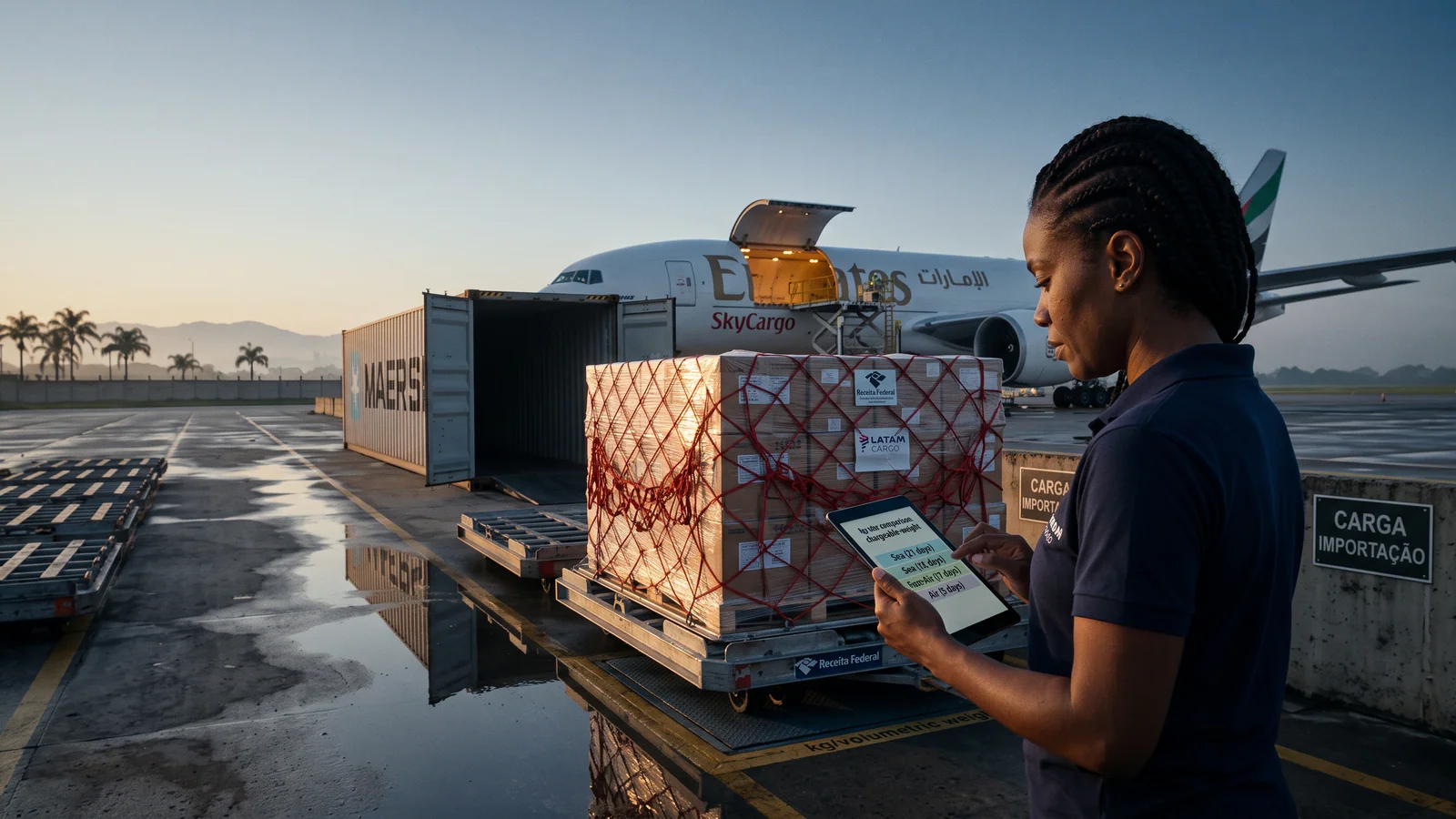
Quick Answer: Sea-air cargo from China to Brazil moves by ocean to Los Angeles, by truck to Miami, then by air to São Paulo or ten other Brazilian airports. Total transit is 16-25 days. Walio's sea-air rates start from $6.64/kg for 300-499 kg and from $4.60/kg at 5,000+ kg, port to airport.
- Sea-air from China to Brazil takes 16-25 days total: 12-18 days ocean to Los Angeles, 3-5 days truck to Miami, 1-2 days air into Brazil.
- Walio sea-air rates start from $6.64/kg (300-499 kg) and drop to from $4.60/kg at 5,000 kg and above, port of origin to Brazilian airport.
- Minimum billed weight is 300 kg; chargeable weight is the greater of actual weight or volume x 167 kg per cubic meter.
- Brazilian import taxes (II, IPI, PIS/COFINS-Importação, ICMS, Siscomex fee) are separate from freight; AFRMM does not apply to air-arriving cargo.
This guide gives Brazilian importers the transit math, the cost-per-kilo bands and the tax layers for the China-Brazil lane in 2026. Every number you need to book is priced live in the calculator on this page.
What is sea-air cargo from China to Brazil and how does it work?
Quick Answer: Sea-air cargo is a combined multimodal service: containers sail from China to a transshipment hub, then the cargo flies to the final destination. On Walio's China-Brazil lane the hub chain is Los Angeles by ocean, Miami by truck, then air into eleven Brazilian airports. Total transit runs 16-25 days.
Sea-air freight uses the ocean for the long, cheap leg and an aircraft for the short, fast leg. You book once, you get one transport price per chargeable kilo, and one operator controls both legs. That single-booking structure is what separates sea-air from stitching together your own ocean and air bookings.
What is the actual routing on Walio's lane?
The cargo loads at Dalian, Fuzhou, Guangzhou, Ningbo, Qingdao, Shanghai, Shenzhen, Xiamen or Xingang. It sails the trans-Pacific to Los Angeles in 12-18 days, which is the shortest deep-sea crossing available out of China. Trucking then moves it Los Angeles to Miami in 3-5 days. The final leg flies Miami to Brazil in 1-2 days.
Total China-to-Brazil sea-air transit on Walio's lane, versus 35-50 days for pure ocean into Santos. The spread inside that band comes almost entirely from which Chinese port you load at.
Which Brazilian airports does the service reach?
Eleven airports take the final leg: Belo Horizonte (CNF), Campinas/Viracopos (VCP), Curitiba (CWB), Florianópolis (FLN), Manaus (MAO), Navegantes (NVT), Porto Alegre (POA), Rio de Janeiro (GIG), São José dos Campos (SJK), São Paulo/Guarulhos (GRU) and Vitória (VIX).
Classic sea-air corridors use Dubai, Singapore, Colombo or Incheon as the transshipment hub, which works well for Europe but adds days to any Brazil routing. The Pacific-Americas chain is faster into Brazil because Los Angeles is the closest major hub to Chinese load ports, and Miami is the densest air gateway into South America.
The service is port to airport: your supplier delivers the cargo to the Chinese port, and you collect at the Brazilian airport after clearance. Door pickup in China and door delivery in Brazil are quoted on request through the calculator. If you are moving household goods instead of commercial cargo, our Guatemala Moving Guide 2026: Complete Document Guide shows how a personal-effects shipment is documented differently.
How long does it take to ship cargo from China to Brazil by sea, sea-air and air?
Quick Answer: Pure ocean from China to Santos runs 35-50 days port to port. Sea-air runs 16-25 days port to airport, depending on the Chinese origin port. Air freight is quoted at 5-8 days but rarely lands that fast, because almost no direct China-Brazil freighters fly without a hub stop.
The sea-air math is simple: 12-18 days ocean, plus 3-5 days trucking, plus 1-2 days flying. Shanghai, Ningbo and Shenzhen sit at the fast end because they have the most frequent direct trans-Pacific strings to Los Angeles. Dalian and Xingang sit at the slow end, since northern sailings usually add a coastal call before crossing.
Why does air freight take longer than the quoted 5-8 days?
China-Brazil has thin direct freighter capacity and almost no passenger belly space on a single-aircraft routing. Most air cargo transits a Middle East, European or North American hub, and each connection adds queuing time on the ground. Plan for 3-6 extra days over the marketing transit, more in Q4 when hub terminals back up.
Why does ocean slip past the carrier's schedule?
Asia-South America strings have absorbed Red Sea diversions around the Cape of Good Hope, which pulls tonnage out of the network. Santos berth congestion then adds waiting time at anchor. Carriers like Maersk, MSC, CMA CGM and Hapag-Lloyd publish a transit that assumes no omitted call, and omitted calls are common in peak season.
Chinese origin | Ocean to Santos (days) | Sea-air to GRU / VCP (days) | Ocean sailings per week |
|---|---|---|---|
Shanghai | 35-45 | 16-20 | 4-6 |
Ningbo | 35-45 | 16-20 | 4-6 |
Shenzhen / Yantian | 33-42 | 17-21 | 3-5 |
Guangzhou / Nansha | 34-44 | 17-21 | 2-4 |
Xiamen | 35-45 | 18-22 | 2-3 |
Fuzhou | 36-46 | 18-22 | 1-2 |
Qingdao | 38-48 | 18-23 | 2-4 |
Dalian / Xingang | 40-50 | 20-25 | 1-3 |
Other Brazilian gateways shift the ocean number. Paranaguá and Itajaí/Navegantes typically add 2-4 days after Santos, Suape often calls earlier on a northbound rotation, and Manaus adds 10-14 days because it needs feeder transshipment up the Amazon. By air, VCP and GRU are the primary entries, with GIG, CNF, CWB, FLN, NVT, POA, SJK, VIX and MAO served on the same 1-2 day final leg.
How much customs dwell time should you add?
Transit is not delivery. Add Brazilian clearance time on top: 2-10 days depending on the parametrização channel your DUIMP draws. Canal verde clears automatically, amarelo triggers document review, vermelho adds physical inspection, and cinza opens a customs value investigation.
How much does sea-air cargo from China to Brazil cost per kilo in 2026?
Quick Answer: Walio sea-air rates start from $6.64/kg for 300-499 kg, from $5.74/kg for 500-999 kg, from $5.06/kg for 1,000-4,999 kg and from $4.60/kg at 5,000 kg and above. These are port-to-airport rates on the cheapest port-airport pairing. Origin and destination handling is added per shipment.
Chargeable weight band | Walio sea-air rate (USD/kg) | Scope |
|---|---|---|
300-499 kg | from $6.64 | Port to airport |
500-999 kg | from $5.74 | Port to airport |
1,000-4,999 kg | from $5.06 | Port to airport |
5,000 kg and above | from $4.60 | Port to airport |
Every figure above is a "from" rate on the cheapest port-airport pairing in the rate table dated September 30, 2026. A Dalian to Manaus booking will not price like a Shanghai to Viracopos booking. The calculator on this page returns the exact rate for your pairing.
What is the minimum billed weight?
The lane bills a 300 kg minimum chargeable weight. A 180 kg shipment is still charged as 300 kg, so small orders pay for air they do not use. Importers with several suppliers in the same province should consolidate into one booking before shipping.
How is chargeable weight calculated?
Chargeable weight is the greater of actual gross weight and volumetric weight. On this service, volumetric weight is volume in cubic meters x 167 kg. So 4 CBM weighing 400 kg actual bills as 668 kg, and the rate band shifts from 300-499 kg to 500-999 kg.
Pro tip
Check the band edges before you confirm packing. A 950 kg chargeable shipment sits in the 500-999 kg band, but adding 50 kg pushes it into the 1,000-4,999 kg band at a lower rate per kilo. Denser cartons and tighter pallet stacking can also cut volumetric weight below actual weight, which stops you paying for air.
What moves the per-kilo number?
Origin port — trans-Pacific frequency and inland positioning differ sharply between Shanghai and Xingang.
Destination airport — GRU and VCP carry more frequency than MAO, SJK or VIX, which changes the final-leg cost.
Density — anything under 167 kg per CBM pays on volume, not on scale weight.
Commodity and DG content — lithium batteries, aerosols and magnets need dangerous-goods handling on the air leg.
Season — pre-Chinese New Year and Q4 peak both tighten space.
Origin and destination handling charges are itemized per shipment in the calculator. They are never folded into the per-kilo rate, so what you see on screen is what the shipment costs. Door pickup in China and door delivery in Brazil are quoted on request in the same flow.
Is sea freight or air freight cheaper for shipping from China to Brazil?
Quick Answer: Ocean is cheapest per kilo and slowest; air is fastest and most expensive; sea-air sits between them at 16-25 days. The break-even depends on cargo value and density. High-value, dense cargo under roughly 3,000 kg usually justifies sea-air; bulky low-value goods stay on the water.
Run four numbers before you pick a mode: freight cost per kilo, cargo value per kilo, density in kg per CBM, and the carrying cost of capital over the extra ocean weeks. The rule of thumb is blunt: when 30 extra days of tied-up capital costs more than the freight gap, sea-air wins.
How does the decision framework work in practice?
Cargo worth under about USD 10 per kilo almost never justifies paying air-side rates. Cargo worth USD 50 or more per kilo usually does, because the inventory sitting on the water represents real working capital plus stockout risk. Density decides the rest: a pallet at 90 kg per CBM pays volumetric weight and loses its cost advantage fast.
Mode | Transit (port to port/airport) | Priced on | Minimum size | Best-fit cargo |
|---|---|---|---|---|
Ocean FCL | 35-50 days | Per container (20GP, 40GP, 40HQ) | ~15 CBM upward | Furniture, machinery, bulk stock |
Ocean LCL | 40-55 days | Per CBM or per ton | 1 CBM | Low-value replenishment |
Sea-air | 16-25 days | Per chargeable kg | 300 kg billed minimum | Electronics, components, fashion drops |
Air freight | 5-8 quoted, 8-14 real | Per chargeable kg | 45 kg upward | Urgent, high-value, samples |
Express courier | 4-7 days | Per kg, door to door | No minimum | Documents, small parcels |
When does LCL beat FCL?
LCL wins below roughly 10 CBM. Between 10 and 15 CBM a 20 ft container usually costs less per cubic meter than consolidation, and it removes CFS deconsolidation delays at destination. Above 15 CBM, FCL is nearly always cheaper and always faster through the terminal.
Ocean FCL from Shenzhen to Santos
You book a 40HQ, wait 33-42 days at sea, then clear at Santos. Freight per kilo is the lowest available, but you pay AFRMM at 8% on the ocean freight, plus terminal handling and drayage from the port to your warehouse. You also finance two extra months of inventory. This is the right answer for furniture, tiles, steel parts and anything where landed cost per unit beats speed.
Sea-air from Shenzhen to Guarulhos
The same goods sail to Los Angeles, truck to Miami and fly into GRU in 17-21 days. You pay from $5.06/kg in the 1,000-4,999 kg band, you skip AFRMM entirely because the cargo arrives by air, and you clear at an airport terminal rather than a congested seaport. This is the right answer for consumer electronics, medical devices, spare parts and seasonal apparel.
Scenario | Chargeable weight (sea-air) | Applicable Walio band | Sea-air transit | Ocean transit |
|---|---|---|---|---|
300 kg electronics, 1.4 CBM | 300 kg (actual governs) | from $6.64/kg | 17-21 days | 35-45 days |
3 CBM apparel, 380 kg actual | 501 kg (volume x 167) | from $5.74/kg | 16-20 days | 40-55 days (LCL) |
1 x 40HQ furniture, 62 CBM | Not suited to sea-air | Price as FCL | n/a | 35-45 days |
Note the customs difference in that table. Air-arriving cargo skips AFRMM, so the landed-cost gap between sea-air and ocean is narrower than the freight quotes suggest on their own.
What taxes do you pay when importing from China into Brazil?
Quick Answer: Brazilian imports pay Imposto de Importação (II), IPI, PIS/COFINS-Importação, state ICMS and the Siscomex fee. AFRMM, the 8% merchant marine charge, applies to ocean freight only, not to cargo arriving by air. Rates depend on the NCM code, so confirm classification with a licensed despachante aduaneiro.
II (Imposto de Importação) — charged on the customs value, which is goods plus freight plus insurance.
IPI — federal excise, charged on customs value plus II.
PIS/COFINS-Importação — as of 2026 the standard combined rate is 11.75% (2.1% + 9.65%) on the customs value, with higher rates for specific NCMs.
ICMS — state tax on a grossed-up base, commonly 17-18% depending on the state of clearance.
Siscomex fee — a fixed federal charge per declaration, filed through the Portal Único.
AFRMM — 8% on ocean freight into Brazilian seaports, per the published merchant marine rule; it does not apply to air-arriving cargo.
A worked landed-cost example
Take a CIF customs value of USD 20,000 with II at 16% and IPI at 5%, clearing in São Paulo at 18% ICMS. II is USD 3,200. IPI is 5% of USD 23,200, so USD 1,160. PIS/COFINS at 11.75% of the customs value is USD 2,350.
ICMS uses a grossed-up base. Add the customs value and the three federal taxes to reach USD 26,710, divide by 0.82, and the base becomes USD 32,573. ICMS at 18% is USD 5,863. Total tax is roughly USD 12,573, or about 63% on top of the CIF value before broker fees and storage.
Category (illustrative NCM) | Typical II | Typical IPI | PIS/COFINS | ICMS SP / SC / ES | AFRMM applies? |
|---|---|---|---|---|---|
Cotton T-shirts (6109.10.00) | 35% | 0% | 11.75% | 18% / 17% / 17% | Ocean only |
Networking equipment (8517.62) | 12-16% | 0-15% | 11.75% | 18% / 17% / 17% | Ocean only |
Machine parts (8479.90) | 12-14% | 0-5% | 11.75% | 18% / 17% / 17% | Ocean only |
Furniture (9403.60.00) | 18% | 0-5% | 11.75% | 18% / 17% / 17% | Ocean only |
Toys (9503.00) | 20-35% | 0% | 11.75% | 18% / 17% / 17% | Ocean only |
Rates follow the NCM, not the product name
Two similar products can sit in different NCM headings with a 20-point tariff gap. ICMS also varies by state, and the incentive regimes in Santa Catarina and Espírito Santo change the arithmetic substantially. Confirm every classification with a licensed despachante aduaneiro and every tax position with a Brazilian tax adviser. A freight quote is not tax advice.
What documents and licences do I need to import goods from China into Brazil?
Quick Answer: You need active RADAR habilitation, a Portal Único Siscomex registration, a correct NCM classification and a DUIMP filing. Shipment documents are the commercial invoice, packing list, Air Waybill or Bill of Lading and, for tariff preference or origin proof, a Certificate of Origin. Some goods need an Import Licence before shipping.
What is RADAR habilitation?
RADAR, formally Habilitação no Siscomex, is the Receita Federal authorization that lets a CNPJ import. It comes in tiers: Expresso for small volumes, Limitada with a semester value cap, and Ilimitada for high-volume importers. An expired or blocked RADAR stops your cargo at the airport while storage charges accrue daily.
What is DUIMP and how does it differ from the old DI?
DUIMP is the single import declaration filed in the Portal Único Siscomex, replacing the legacy DI workflow. After submission, the system runs parametrização and assigns your cargo to canal verde, amarelo, vermelho or cinza. Canal verde clears without human review; cinza means a customs value investigation and can hold cargo for weeks.
Commercial invoice (Factura Comercial) with NCM, Incoterm 2020 and unit values
Packing list with gross weight, net weight and dimensions per carton
Air Waybill for the air leg and ocean Bill of Lading for the first leg
Certificate of Origin where origin proof or preference applies
Importer's CNPJ and Inscrição Estadual
Import Licence (LI) issued before shipment where the NCM requires one
Which agencies must approve your goods?
Brazil's anuentes review specific categories before release. Inmetro certifies electricals, toys and safety-critical products. ANVISA handles cosmetics, food, supplements and medical devices. MAPA covers agricultural and animal-origin goods, and ANATEL certifies radio-frequency equipment, including anything with Wi-Fi or Bluetooth.
Where an LI is required, it must be issued before the goods leave China. A post-shipment LI triggers penalties under the import control rules and can delay release for weeks. Importers comparing documentation across the region will find a useful contrast in our guide to Moving to Colombia in 2026: Complete Guide to Documents & Regulations.
Which Chinese ports and Brazilian airports does the sea-air service cover?
Quick Answer: Walio's sea-air lane loads at Dalian, Fuzhou, Guangzhou, Ningbo, Qingdao, Shanghai, Shenzhen, Xiamen and Xingang, and delivers to eleven Brazilian airports including São Paulo (GRU), Campinas (VCP), Rio de Janeiro (GIG), Manaus (MAO) and Porto Alegre (POA). Rates and transit change with the pairing you choose.
Factory region | Load port | Typical cargo |
|---|---|---|
Guangdong (Shenzhen, Dongguan, Foshan) | Shenzhen or Guangzhou | Electronics, lighting, appliances |
Zhejiang and Jiangsu (Yiwu, Suzhou) | Ningbo or Shanghai | Consumer goods, textiles, components |
Fujian (Quanzhou, Jinjiang) | Xiamen or Fuzhou | Footwear, sportswear, stone |
Shandong (Qingdao, Linyi) | Qingdao | Machinery, tires, chemicals |
Northeast and Hebei/Tianjin | Dalian or Xingang | Auto parts, steel products |
 Shanghai(CNSHA)
 São Paulo(GRU)Shenzhen(CNSZX)Campinas(VCP)
Which Brazilian airport should you clear at?
GRU and VCP both serve São Paulo state, but Viracopos was built as a cargo airport and usually posts shorter terminal dwell times than Guarulhos. CWB, NVT and FLN serve the South, CNF covers Minas Gerais, POA the far South, VIX Espírito Santo, and GIG the Rio market. MAO serves the Manaus Free Trade Zone, which runs on its own rules.
Manaus cargo requires SUFRAMA registration on top of RADAR, plus a Zona Franca-specific declaration. Published "from" rates reflect the cheapest port-airport pairing only, so price your exact combination in the calculator rather than assuming the lowest band applies to your lane.
What surcharges, seasons and restrictions should importers plan for?
Quick Answer: Chinese New Year, Golden Week and Q4 peak season compress capacity and push rates up through GRI and PSS cycles. Lithium batteries, aerosols and magnets need dangerous-goods handling on the air leg. Demurrage, detention and airport storage in Brazil start when free time ends, not when you collect.
When should you book?
Book 3-4 weeks ahead of Chinese New Year and Golden Week, since factories ship everything at once and space disappears. Carriers announce General Rate Increases on the 1st and the 15th of the month. Peak Season Surcharges typically run August through November on Asia outbound.
Red Sea disruption keeps Asia-Europe tonnage on the Cape of Good Hope routing, which absorbs vessel capacity network-wide. That tightens trans-Pacific space even though the China-Los Angeles leg never touches Suez.
Storage in Brazil escalates by percentage, not by the day rate
Airport armazenagem is charged as a percentage of CIF value and steps up weekly, so a high-value shipment can accrue serious cost during a canal vermelho inspection. On the ocean leg, demurrage and detention start the moment free time expires. File the DUIMP early and have funds ready for tax payment before arrival.
What cannot fly, and what cannot enter?
Lithium batteries under UN3480 and UN3481 need a DG declaration, correct packing and a specialist booking request.
Aerosols, flammable powders and unshielded magnets also require dangerous-goods handling on the air leg.
Brazil restricts used and remanufactured goods in most categories without prior authorization.
Goods lacking Inmetro, ANATEL or ANVISA approval are held or returned at the importer's cost.
Buy all-risk cargo insurance on the declared CIF value. Carrier liability under the Montreal Convention is weight-based and sits far below the value of most electronics shipments. Readers moving personal effects rather than commercial stock should read our Moving to El Salvador: Complete Requirements Guide 2026 for how used-goods rules work on a household move.
How do you book sea-air cargo from China to Brazil step by step?
Quick Answer: Get your chargeable weight, pick your Chinese port and Brazilian airport, price it in the calculator and book online. Then your supplier delivers to the port, the ocean leg runs to Los Angeles, trucking moves it to Miami, and the air leg lands in Brazil for clearance under your DUIMP.
Confirm RADAR and NCM before booking. A blocked CNPJ or a wrong classification stops cargo at the airport while storage accrues.
Calculate chargeable weight. Compare actual gross weight against volume x 167 kg, then check the result against the 300 kg minimum billed weight.
Price the exact pairing in the calculator. Compare weight breaks while you are there, because moving 950 kg to 1,000 kg lowers the per-kilo rate.
Deliver to the origin port. Your supplier hands over the cargo with the commercial invoice, packing list and any Certificate of Origin; Walio issues the transport documents for both legs.
Appoint a despachante aduaneiro. They file the DUIMP, pay II, IPI, PIS/COFINS and ICMS, and release the cargo at GRU, VCP or your chosen airport.
Pro tip
Send your despachante the draft invoice and packing list while the cargo is still on the water. Pre-registering the DUIMP data means you file on the day of arrival instead of three days later, which is usually the difference between one storage period and two.
Shipping personal belongings instead of commercial cargo changes the entire document set. Our guides to Requirements for Moving to Costa Rica: Complete Guide 2026 and Moving to Venezuela: Your Complete Requirements Guide 2026 cover inventories, used-goods declarations and household-goods clearance.
Sea-air cargo is a combined service where your goods sail from China to a transshipment hub and then fly to the destination. On Walio's lane, containers move from ports like Shanghai, Ningbo or Shenzhen to Los Angeles in 12-18 days, truck to Miami in 3-5 days, then fly into GRU, VCP or nine other Brazilian airports in 1-2 days. Total transit is 16-25 days, port to airport.
Walio sea-air rates start from $6.64/kg for 300-499 kg, from $5.74/kg for 500-999 kg, from $5.06/kg for 1,000-4,999 kg and from $4.60/kg for 5,000 kg and above, port to airport on the cheapest pairing. The exact rate depends on your Chinese port and Brazilian airport, and origin and destination handling is added per shipment. Enter your details in the calculator on this page for your real number in seconds.
Chargeable weight is the greater of your shipment's actual weight and its volumetric weight. For Walio's sea-air service the conversion is volume x 167 kg per cubic meter, so 4 CBM at 400 kg actual bills as 668 kg. The minimum billed weight on this lane is 300 kg, so lighter shipments are still charged as 300 kg.
No. AFRMM is the 8% merchant marine renewal charge levied on ocean freight into Brazilian seaports, so cargo that arrives at a Brazilian airport does not pay it. That makes the landed-cost gap between sea-air and pure ocean smaller than the freight quotes alone suggest.
Sea freight is cheaper per kilo, but it takes 35-50 days port to port versus 5-8 quoted days for air, which usually runs longer because of hub connections. Sea-air sits between the two at 16-25 days with a per-kg rate well below air. For high-value or dense cargo above 300 kg, sea-air often delivers the lowest total cost once inventory carrying cost is counted.
You now have the transit bands, the weight breaks and the tax layers for sea air cargo China to Brazil. The only number left is the one for your exact shipment. Enter your Chinese port, your Brazilian airport and your chargeable weight in the calculator above and see your price in seconds — no signup, no follow-up calls.