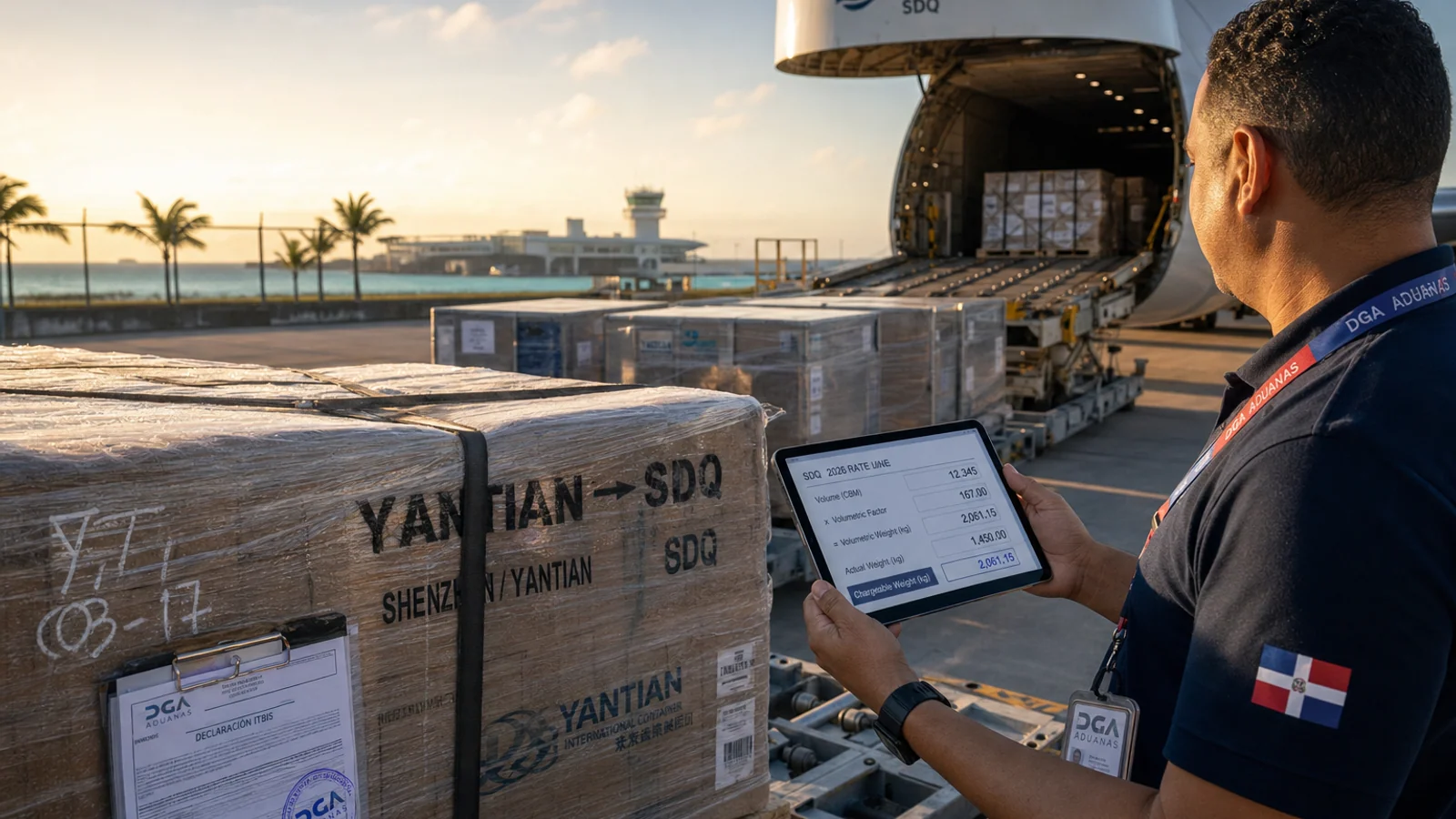
Quick answer Sea-air cargo from China to the Dominican Republic ships for 1,000–4,999 chargeable kg from $4.48/kg, and 5,000+ kg from $4.02/kg, port to airport, on Walio's October 13, 2026 rate table. Transit runs 16–25 days: ocean to Los Angeles, truck to Miami, air to Santo Domingo (SDQ). The calculator prices your exact port and weight.
- Sea-air moves China → Dominican Republic in 16–25 days total: 12–18 days ocean to Los Angeles, 3–5 days truck to Miami, 1–2 days air to SDQ.
- Walio sea-air rates start at $6.06/kg for 300–499 kg, $5.15/kg for 500–999 kg, $4.48/kg for 1,000–4,999 kg and $4.02/kg for 5,000+ kg, port to airport.
- Minimum billed weight is 300 kg, and chargeable weight is the greater of actual weight or volume × 167 kg per cubic meter.
- Dominican import tax is calculated on CIF value: arancel (duty) + 18% ITBIS + ISC where it applies + the customs service charge — none of it is part of the freight rate.
Dominican importers who search for a calculadora marítimo aéreo china república dominicana want one thing: a real number for a real shipment, today. This page gives you the rate bands, the chargeable-weight math and the tax base, then hands you the calculator that prices your exact port and weight.
See your price in seconds
Real carrier rates, no signup, no follow-up calls.
What is a sea-air calculator and how does it work?
Quick answer A sea-air calculator is an online tool that prices a multimodal shipment — ocean for the long leg, air for the final leg — in one number. You enter origin port, destination airport, weight and dimensions. It reads live carrier rates and returns a price in seconds, with no forms and no sales call.
Sea-air is one service, not three bookings. Walio sells the full movement as a single multimodal routing: ocean from your Chinese port to Los Angeles, truck from Los Angeles to Miami, then air from Miami to Santo Domingo's Las Américas airport (SDQ).
The price is built per chargeable kilogram, not per container. That matters because most restock orders land in the awkward middle — too heavy for courier, too small for a full container, and too urgent for a 40-plus-day ocean transit to Caucedo.
 Shenzhen(CNSZX)
 Los Angeles(USLAX)Los Angeles(USLAX)Miami(USMIA)Miami(MIA)
 Santo Domingo(SDQ)
Scope is port to airport. The shipper delivers the cargo to the Chinese port of loading, and the consignee collects it at SDQ after clearing with the Dirección General de Aduanas (DGA). Door pickup at your supplier's factory and door delivery in Santiago or Punta Cana are quoted on request inside the same calculator.
Origin and destination handling charges are added per shipment, as their own lines. Walio never folds them into the per-kilo figure, because a per-kg rate that hides handling is not a real comparison.
The rates you see come from a live carrier rate table — the October 13, 2026 version is what loads on screen. That is the difference between a calculator and a lead form: one gives you a price, the other gives you an email three days later.
Sea-air calculator China to Dominican Republic: how do you use it?
Quick answer Pick your Chinese origin port, select Santo Domingo (SDQ) as destination, then enter gross weight and the dimensions of every pallet or carton. The tool computes chargeable weight, applies the right weight band, adds handling, and shows the total. The whole process takes under a minute and needs no signup.
People typing calculadora marítimo aéreo china república dominicana usually have a packing list in hand and a supplier waiting on a decision. Five steps turn that packing list into a bookable price.
- Choose the origin port. Walio prices sea-air from Dalian, Fuzhou, Guangzhou, Ningbo, Qingdao, Shanghai, Shenzhen, Xiamen and Xingang.
- Enter every piece. Put dimensions in centimeters and weight in kilograms. The calculator converts to CBM and compares actual weight against volumetric weight for you.
- Read the weight band. Rates step down at 300, 500, 1,000 and 5,000 chargeable kg, so 480 kg is worth consolidating up to 500 kg before you ship.
- Add handling and any door service. Origin and destination handling appear as separate lines, and you can request factory pickup or delivery to Santiago at the same time.
- Book online. Oversized, stackable-only or dangerous-goods cargo routes the request to a Walio specialist through the same calculator.
Four inputs decide the number: gross weight in kilograms, volume in cubic meters, the origin port, and the Incoterm you agreed with the supplier. Most Chinese factory orders sell FOB, which means the supplier covers export clearance and delivery to the port and your cost starts there.
Ask your supplier for the post-packing carton list, not the pre-production estimate. Shrink wrap, pallet height and carton overhang all get measured at the airport scale, and a 6 cm pallet base can push a shipment into a higher volumetric figure.
See your price in seconds
Real carrier rates, no signup, no follow-up calls.
How much does it cost to ship cargo from China to the Dominican Republic?
Quick answer Sea-air freight from China to Santo Domingo starts at $6.06/kg for 300–499 chargeable kg, $5.15/kg for 500–999 kg, $4.48/kg for 1,000–4,999 kg and $4.02/kg for 5,000+ kg, port to airport. Rates are from Walio's October 13, 2026 table; the exact figure depends on your port and airport.
| Chargeable weight band | Rate (USD per kg) | Scope | Transit |
|---|---|---|---|
| 300–499 kg | from $6.06 | Port to airport | 16–25 days |
| 500–999 kg | from $5.15 | Port to airport | 16–25 days |
| 1,000–4,999 kg | from $4.48 | Port to airport | 16–25 days |
| 5,000+ kg | from $4.02 | Port to airport | 16–25 days |
Read every figure as a "from" rate. It reflects the cheapest port and airport combination on the lane, and your actual rate moves with the Chinese port you load at. The calculator resolves that in one click instead of a two-day quote cycle.
The minimum billed weight is 300 kg. A 180 kg shipment still bills as 300 kg, so small sample orders and single-pallet restocks usually belong on international courier instead.
Two cost groups sit outside the per-kg freight. First, origin and destination handling, priced per shipment and shown as itemized lines. Second, Dominican duty, ITBIS and customs service charges, which you pay to the DGA at import — never to a freight carrier.
Compare like for like
If a competitor's per-kilo number looks lower, check what it includes. An all-in Walio total shows freight, origin handling and destination handling separately. A single low per-kg figure with handling buried downstream is how a cheap quote becomes an expensive invoice at SDQ.
See your price in seconds
Real carrier rates, no signup, no follow-up calls.
How do you calculate chargeable weight and CBM for this lane?
Quick answer Chargeable weight is the greater of actual gross weight and volume × 167 kg per cubic meter. CBM equals length × width × height in meters. Pure air freight uses volume ÷ 6000 per kilogram; ocean LCL bills whichever is greater of CBM or metric tons, where 1 CBM is treated as 1,000 kg.
Start with CBM. A standard export pallet measuring 120 cm × 100 cm × 110 cm equals 1.20 × 1.00 × 1.10, or 1.32 CBM. Ten identical pallets give you 13.2 CBM.
Now apply the sea-air rule. 13.2 CBM × 167 kg = 2,204 kg chargeable, which falls inside the 1,000–4,999 kg band from $4.48/kg. If those ten pallets actually weigh 2,600 kg gross, the higher figure wins and you bill on 2,600 kg.
The sea-air volumetric divisor. Multiply your total CBM by 167 and compare it against gross weight — whichever is larger is what you pay for.
Pure air freight uses a different divisor. Length × width × height in centimeters ÷ 6000 gives kilograms, so that same 120 × 100 × 110 cm pallet produces 220 kg volumetric on a straight air waybill.
Ocean LCL uses the weight-or-measure rule: 1 CBM is treated as 1,000 kg, and the carrier bills whichever is greater. Dense cargo such as tiles, hardware or ceramic bills on weight, while light cargo such as apparel, foam or plastic housewares bills on volume.
| Mode | Volumetric rule | Worked example (1.32 CBM pallet) | Billing basis |
|---|---|---|---|
| Sea-air | CBM × 167 kg | 220 kg volumetric | Greater of actual or volumetric |
| Pure air | cm³ ÷ 6000 | 220 kg volumetric | Greater of actual or volumetric |
| Ocean LCL | 1 CBM = 1,000 kg | 1.32 CBM or 1.32 tons | Weight or measure, whichever is greater |
| Ocean FCL | None | n/a | Per container, within payload limits |
How long does a shipment from China to the Dominican Republic take?
Quick answer Sea-air runs 16–25 days port to airport: 12–18 days ocean from the Chinese port to Los Angeles, 3–5 days by truck from Los Angeles to Miami, and 1–2 days by air from Miami to Santo Domingo (SDQ). Full ocean service to Caucedo or Haina takes far longer and usually transships.
The ocean leg drives the variance. South China ports sit at the short end of the 12–18 day window, while North China ports sit at the long end because of the extra coastal steaming and the typical port rotation.
| Origin port | Region served | Ocean leg to LA | LA → Miami | Miami → SDQ | Total |
|---|---|---|---|---|---|
| Shenzhen | Guangdong, Dongguan, Foshan | 12–18 (short end) | 3–5 days | 1–2 days | 16–25 days |
| Guangzhou | Pearl River Delta | 12–18 (short end) | 3–5 days | 1–2 days | 16–25 days |
| Xiamen / Fuzhou | Fujian | 12–18 (mid) | 3–5 days | 1–2 days | 16–25 days |
| Ningbo / Shanghai | Zhejiang, Jiangsu, Yiwu | 12–18 (mid) | 3–5 days | 1–2 days | 16–25 days |
| Qingdao / Xingang | Shandong, Hebei, Beijing | 12–18 (long end) | 3–5 days | 1–2 days | 16–25 days |
| Dalian | Liaoning, northeast China | 12–18 (long end) | 3–5 days | 1–2 days | 16–25 days |
Straight ocean service to the Dominican Republic works differently. Very few vessels run China to Caucedo direct, so your box transships at Panama, Cartagena or Kingston, and each connection adds a week or more of waiting for the feeder.
Port cut-off is not vessel ETD
Cargo must be inside the terminal days before the ship sails, and documentation cut-off usually lands earlier still. Miss it and you wait for the next weekly sailing — which turns a 16–25 day plan into a 23–32 day one, with your supplier's invoice already due.
Sea-air vs ocean FCL, LCL, air and courier: which wins?
Quick answer Sea-air sits between ocean and air: faster than LCL, far cheaper than pure air, with a 300 kg minimum. FCL wins above roughly 25–28 CBM, LCL wins on non-urgent cargo under 10–15 CBM, courier wins under about 100 kg, and pure air wins only when days matter more than money.
| Mode | Cost basis | Transit | Ideal volume | Best use case | Main risk |
|---|---|---|---|---|---|
| Sea-air | From $4.02–$6.06/kg by band | 16–25 days | 300–5,000+ kg | Urgent restock, electronics, apparel | 300 kg minimum billing |
| Ocean FCL | Per container, priced in calculator | Longest, usually transships | 25–28+ CBM | Furniture, tiles, bulk retail stock | Demurrage and detention at Caucedo |
| Ocean LCL | Per CBM or ton, priced in calculator | Long, plus CFS deconsolidation | 2–15 CBM | Low-value, non-urgent cargo | Desconsolidación and storage fees |
| Pure air | Per chargeable kg, multiple of sea-air | Fastest | Under 1,000 kg | Deadline-critical, high-value goods | Cost per kilo |
| Courier express | Per piece, door to door | Days | Under ~100 kg | Samples, small parcels | US$200 de minimis limits |
When does sea-air beat full ocean freight?
- You need goods on the shelf within a month but cannot absorb full air freight pricing per kilogram.
- Your shipment runs 2–25 CBM — too much for courier, not enough to justify a 40-foot container.
- You are recovering from a Chinese New Year or Golden Week production delay and the sailing you booked has already left.
When should you stay on ocean?
- Low-value, high-volume cargo where freight per CBM decides your retail margin.
- Furniture, ceramics, construction materials and anything that fills a container before it hits the payload limit.
- Planned replenishment with 50+ days of lead time already written into the purchase order.
| Container | Internal dimensions (approx.) | Capacity | Max payload | Practical usable volume |
|---|---|---|---|---|
| 20' standard | 5.90 × 2.35 × 2.39 m | ~33 CBM | ~28,000 kg | 25–28 CBM |
| 40' standard | 12.03 × 2.35 × 2.39 m | ~67 CBM | ~26,500 kg | 54–58 CBM |
| 40' high cube | 12.03 × 2.35 × 2.69 m | ~76 CBM | ~26,500 kg | 60–65 CBM |
See your price in seconds
Real carrier rates, no signup, no follow-up calls.
Which Chinese ports and Dominican gateways does the lane use?
Quick answer Walio prices sea-air from nine Chinese ports — Dalian, Fuzhou, Guangzhou, Ningbo, Qingdao, Shanghai, Shenzhen, Xiamen and Xingang — into Santo Domingo's Las Américas airport (SDQ). Your factory's location decides the origin port and changes both transit time and the per-kilogram rate.
Supplier geography picks the port for you. Guangdong factories in Shenzhen, Guangzhou, Dongguan and Foshan load at Shenzhen or Guangzhou. Yiwu market cargo trucks a few hours to Ningbo or Shanghai.
| Supplier region | Usual loading port | Typical cargo |
|---|---|---|
| Guangdong (Shenzhen, Dongguan, Foshan) | Shenzhen or Guangzhou | Electronics, LED, small appliances |
| Zhejiang (Yiwu, Wenzhou) and Jiangsu | Ningbo or Shanghai | Housewares, accessories, seasonal goods |
| Fujian (Quanzhou, Jinjiang) | Xiamen or Fuzhou | Footwear, apparel, sports goods |
| Shandong, Hebei, Beijing area | Qingdao or Xingang | Hardware, auto parts, machinery |
| Liaoning and the northeast | Dalian | Industrial components, steel products |
On the Dominican side, sea-air terminates at AILA–SDQ in Santo Domingo, where your consignee clears with the DGA and collects the cargo. Full ocean imports arrive somewhere else entirely: Caucedo (DP World), Haina, Puerto Plata or Manzanillo, each with its own handling and storage schedule.
Inland delivery is a separate line. Moving cargo from SDQ or from the port to Santiago, La Vega, San Pedro de Macorís or Punta Cana is priced in the calculator, not bundled into the freight rate.
What taxes do you pay importing from China into the Dominican Republic?
Quick answer Dominican import tax is calculated on CIF value — cost of goods, insurance and freight. On that base the DGA applies the arancel (duty) for your HS code, then 18% ITBIS, then the Selective Consumption Tax (ISC) on listed goods such as alcohol, tobacco and some vehicles, plus the customs service charge.
The order of calculation matters more than most importers expect:
- CIF value — commercial invoice value plus insurance plus freight.
- Arancel — the duty rate tied to your HS code in the Dominican tariff schedule.
- ITBIS at 18% — applied to CIF plus duty, per the published Dominican rate.
- ISC — the Selective Consumption Tax, only on listed products such as alcohol, tobacco and certain vehicles.
- Customs service charge — the DGA's administrative fee on the declaration.
Because the base is CIF, freight is taxed twice over: once as a cost you pay, and again as part of the value the DGA taxes. Cheaper freight lowers your landed cost and your tax bill at the same time.
The US$200 de minimis applies to low-value express shipments. Commercial sea-air and ocean cargo does not qualify, so plan for a full declaration every time.
- Factura Comercial from the Chinese supplier, with HS codes and unit values
- Packing list with carton count, weights and dimensions
- House Air Waybill (HAWB) for sea-air, or Bill of Lading for ocean
- Certificado de Origen where a trade preference applies
- Your RNC (Registro Nacional del Contribuyente) as the importer of record
HS classification is not a guess
Your HS code sets the duty rate, and a wrong code triggers reclassification, fines and delay at Caucedo or SDQ. A licensed Dominican customs broker (agente aduanal) should confirm your classification and the final tax figure. Walio is a shipping platform, not a tax adviser — duty and ITBIS amounts are never part of a freight rate.
Which charges sit outside the freight rate?
Quick answer A freight rate covers movement, not clearance. Outside it sit origin and destination handling, THC and DTHC, desconsolidación, storage at Caucedo or SDQ, customs broker fees, inland trucking, duty and ITBIS, plus surcharges such as BAF, GRI and peak season fees that move with the market.
| Charge | Inside the sea-air freight rate? | Who it goes to | When it applies |
|---|---|---|---|
| Ocean + truck + air legs | Yes | Carriers, via Walio | Every shipment |
| Origin handling | No — separate line in the calculator | Origin terminal / agent | Every shipment |
| Destination handling | No — separate line in the calculator | SDQ terminal / agent | Every shipment |
| THC / DTHC | No | Ocean terminal | Ocean FCL and LCL |
| Desconsolidación / CFS | No | CFS operator | Ocean LCL |
| Storage at SDQ or Caucedo | No | Terminal | After free time expires |
| Customs broker fee | No | Agente aduanal | Every commercial import |
| Arancel, ITBIS, ISC | No | DGA | At clearance, on CIF value |
| BAF, GRI, peak season | Market-driven surcharges | Carriers | High season, fuel swings |
| Inland delivery in RD | No — quoted on request | Local trucker | Delivery beyond SDQ |
Ocean imports carry the heaviest tail of extra charges. Free time at the terminal is limited, and once it expires you pay demurrage on the box inside the terminal and detention once it leaves. Slow document preparation is the single most common reason Dominican importers pay storage.
FOB with your own freight
Your supplier delivers to the Chinese port and handles export clearance. You control the carrier, the routing and the rate, and you see every charge itemized before booking. Most experienced Dominican importers buy FOB because it keeps freight visible and keeps the CIF base honest.
CIF or DDP from the supplier
CIF means the supplier includes freight and insurance to destination, usually at a margin you cannot see. DDP moves import liability and Dominican tax exposure onto the seller, which sounds convenient but hides who filed what with the DGA. If anything goes wrong at clearance, you are the one standing at SDQ.
Cargo insurance is quoted on commercial invoice value plus freight plus a margin. On a multimodal routing with two transfers — vessel to truck in Los Angeles, truck to aircraft in Miami — it is worth having.
See your price in seconds
Real carrier rates, no signup, no follow-up calls.
Price your shipment now
The quickest way to settle a sourcing decision is to price it. A calculadora marítimo aéreo china república dominicana only helps if it returns a number you can act on, and Walio compares real carrier rates — the same carriers that move Pacific volume, including Maersk, MSC, CMA CGM and Hapag-Lloyd — instead of routing you to a sales queue.
- Enter your Chinese port, SDQ, gross weight and carton dimensions.
- Check which weight band you land in, and whether consolidating a few boxes moves you down a tier.
- Compare sea-air against the ocean LCL and full air options Walio also prices on the same screen.
- Book online, or send an oversized or dangerous-goods request to a specialist through the same form.
Enter your route in the calculator above and see your price in seconds — no signup, no follow-up calls.
Container pricing depends on size, origin port and sailing week, so Walio prices your exact 20', 40' or 40HC move in the calculator instead of publishing one figure. For 300 kg to 5,000+ kg of cargo, sea-air is often the better math: rates start from $4.48/kg in the 1,000–4,999 kg band and from $4.02/kg above 5,000 kg, port to airport. Enter your port and weight to compare both in seconds.
Ocean freight is cheaper per kilogram, air freight is faster, and sea-air sits between them at rates from $6.06/kg for 300–499 kg down to $4.02/kg above 5,000 kg. Ocean wins on low-value, high-volume cargo with long lead times. Sea-air wins when you need 16–25 day transit without paying full air pricing.
Sea-air takes 16–25 days in total: 12–18 days ocean from the Chinese port to Los Angeles, 3–5 days trucking to Miami, and 1–2 days flying to Santo Domingo (SDQ). Full ocean service to Caucedo or Haina takes considerably longer because it usually transships through Panama, Cartagena or Kingston.
The DGA calculates tax on CIF value — goods plus insurance plus freight. It applies the arancel for your HS code, then 18% ITBIS, then the Selective Consumption Tax on listed products, plus the customs service charge. A licensed Dominican customs broker should confirm your HS classification and the final amount before you ship.
A standard 20' container holds roughly 33 CBM of internal volume, with about 25–28 CBM usable once pallets are loaded. LCL bills whichever is greater of CBM or metric tons, treating 1 CBM as 1,000 kg. Sea-air uses a different rule: chargeable weight is the greater of actual weight or volume × 167 kg per cubic meter.