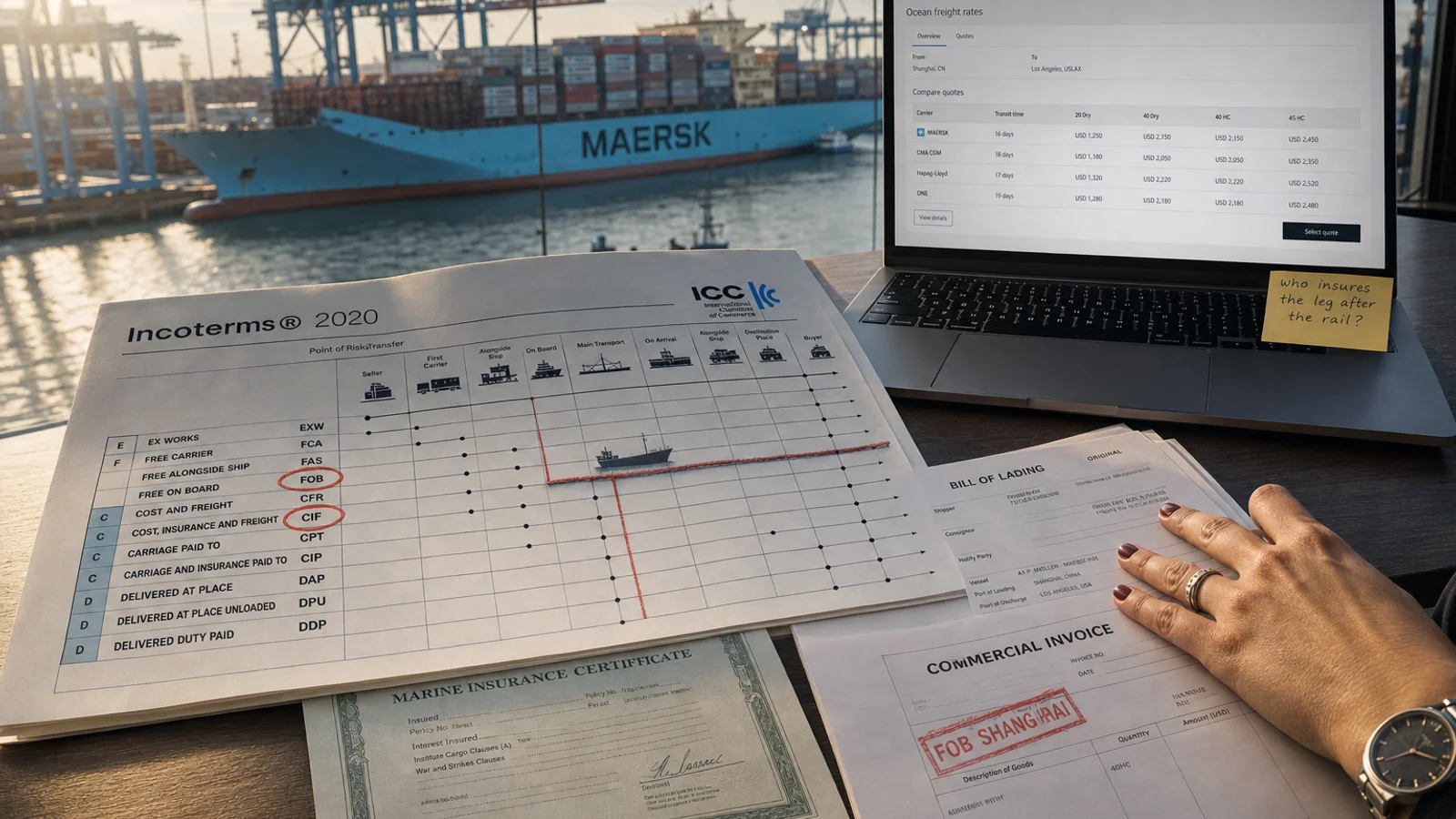
Quick answer Incoterms are 11 standardized trade rules published by the International Chamber of Commerce that define where the seller's responsibility ends and the buyer's begins. The current edition is Incoterms 2020. Each rule assigns who pays freight, who carries risk, who insures the cargo and who clears export and import customs.
- Incoterms 2020 contains 11 rules: EXW, FCA, CPT, CIP, DAP, DPU, DDP (any transport mode) and FAS, FOB, CFR, CIF (sea and inland waterway only).
- Cost transfer and risk transfer are different points — under CIF the seller pays freight to the destination port but risk passes when the goods are loaded on the vessel at origin.
- Incoterms do not transfer ownership, set payment terms, choose governing law or cover contract breach — your sales contract has to do that.
- Walio's cheapest port-to-port container rates in our system range from $756 to Colombia up to $3,066 to Venezuela, and the calculator prices your exact lane in seconds.
Spanish-speaking suppliers and buyers search qué son los incoterms for the same reason you are reading this page: one wrong three-letter code can hand you a bill you never budgeted. This guide explains all 11 rules, the risk-versus-cost trap and which Incoterm fits your shipment.
See your price in seconds
Real carrier rates, no signup, no follow-up calls.
What are Incoterms and what do they do in international trade?
Quick answer Incoterms are International Commercial Terms, a set of 11 three-letter rules published by the International Chamber of Commerce. They tell a seller and a buyer who arranges transport, who pays each cost, where risk passes and who handles export and import customs. They apply to the sale of goods, not services.
The International Chamber of Commerce (ICC) in Paris created the first set in 1936 and revises it roughly every decade. Each rule is a shorthand for a package of obligations both parties already agreed to. Anyone asking qué son los incoterms is really asking one question: at which point does the other side stop paying and stop being responsible?
The five jobs an Incoterm performs
- Delivery point — the exact place the seller fulfills its obligation, from a factory gate to a buyer's warehouse.
- Cost allocation — who pays inland haulage, export clearance, terminal handling, ocean freight and destination charges.
- Risk transfer — the moment loss or damage stops being the seller's problem and becomes the buyer's.
- Insurance duty — only CIP and CIF make cargo insurance mandatory; the other nine rules leave it optional.
- Customs responsibility — who files the export declaration at origin and who clears the import at destination.
A rule is incomplete without a named place. "FOB" alone means nothing. "FOB PortMiami, Incoterms 2020" is a usable term because it names the rule, the place and the version.
Incoterms govern the seller-buyer relationship only. They do not govern the contract between the shipper and the carrier — that contract is the Bill of Lading (B/L), the Sea Waybill or the Air Waybill (AWB). A freight forwarder, NVOCC or customs broker executes the rule, books the vessel and files the paperwork, but none of them change who owes what under your sales contract.
Seven rules work with any transport mode and four are reserved for sea and inland waterway transport. The ICC has maintained the set since 1936 and the 2020 edition is current as of 2026.
See your price in seconds
Real carrier rates, no signup, no follow-up calls.
Who publishes Incoterms and how did they evolve from 1936 to 2020?
Quick answer The International Chamber of Commerce in Paris publishes Incoterms and has done so since 1936. Revisions landed in 1953, 1967, 1976, 1980, 1990, 2000, 2010 and 2020. Incoterms 2020 is the current edition. Older editions stay valid if the contract names them explicitly, which is why the version must always be written down.
Every revision followed a change in how cargo actually moves. The 1980 edition responded to containerization and introduced a term for cargo handed to a carrier before vessel loading. The 2010 edition cut the list from 13 rules to 11 and recognized multimodal transport as the norm rather than the exception.
Incoterms 2020 made four changes that matter in day-to-day contracts. DAT (Delivered at Terminal) became DPU (Delivered at Place Unloaded), which widened the delivery place beyond terminals. CIP insurance moved up to Institute Cargo Clauses A, an all-risks level, while CIF stayed at the far narrower Clauses C. FCA gained an option letting the parties instruct the carrier to issue an on-board Bill of Lading, which solves a long-standing problem with letters of credit. The 2020 text also spells out security-related clearance costs instead of leaving them floating.
| Change | Incoterms 2010 | Incoterms 2020 |
|---|---|---|
| Rule removed | DAT (Delivered at Terminal) | No longer exists |
| Rule created | — | DPU (Delivered at Place Unloaded) |
| CIP insurance level | Institute Cargo Clauses C | Institute Cargo Clauses A |
| CIF insurance level | Institute Cargo Clauses C | Institute Cargo Clauses C (unchanged) |
| FCA bill of lading | No on-board B/L option | Optional on-board B/L for letters of credit |
| Security costs | Mentioned briefly | Allocated explicitly in A4/A7 and B4/B7 |
| Number of rules | 11 | 11 |
Always write the year. A contract that says only "CIF Cartagena" invites an argument about which edition applies — and under Incoterms 2010 the CIP insurance floor was lower. Write "CIF Cartagena, Incoterms 2020" and the ambiguity disappears.
What are the 11 Incoterms 2020 and what does each one mean?
Quick answer Incoterms 2020 has 11 rules in two families. Seven work with any transport mode: EXW, FCA, CPT, CIP, DAP, DPU and DDP. Four apply only to sea and inland waterway: FAS, FOB, CFR and CIF. They also sort into groups E, F, C and D by how far the seller's obligation reaches.
- EXW — Ex Works. Seller makes the goods available at its own premises. Buyer does everything else.
- FCA — Free Carrier. Seller delivers to a carrier named by the buyer, cleared for export.
- CPT — Carriage Paid To. Seller pays carriage to the named destination; risk passes at first carrier.
- CIP — Carriage and Insurance Paid To. CPT plus mandatory all-risks insurance (Clauses A).
- DAP — Delivered at Place. Seller delivers ready for unloading at the named place, import duties unpaid.
- DPU — Delivered at Place Unloaded. Seller delivers and unloads at the named place.
- DDP — Delivered Duty Paid. Seller delivers cleared for import with duties and taxes paid.
- FAS — Free Alongside Ship. Seller places goods alongside the vessel at the origin port.
- FOB — Free on Board. Seller loads goods on board the vessel at the origin port.
- CFR — Cost and Freight. FOB plus ocean freight paid to the destination port.
- CIF — Cost, Insurance and Freight. CFR plus minimum insurance (Clauses C).
The four groups follow a simple logic. E is departure (EXW). F means main carriage unpaid by the seller (FCA, FAS, FOB). C means main carriage paid by the seller (CPT, CIP, CFR, CIF). D means arrival (DAP, DPU, DDP). Obligation grows as you move from E to D.
| Rule | Name (EN / ES) | Mode | Delivery point | Risk passes | Freight | Insurance | Export clearance | Import clearance |
|---|---|---|---|---|---|---|---|---|
| EXW | Ex Works / En Fábrica | Any | Seller's premises | At seller's premises | Buyer | Optional | Buyer | Buyer |
| FCA | Free Carrier / Franco Transportista | Any | Named place or carrier | On handover to carrier | Buyer | Optional | Seller | Buyer |
| CPT | Carriage Paid To / Transporte Pagado Hasta | Any | First carrier | At first carrier | Seller | Optional | Seller | Buyer |
| CIP | Carriage and Insurance Paid To / Transporte y Seguro Pagados Hasta | Any | First carrier | At first carrier | Seller | Seller (Clauses A) | Seller | Buyer |
| DAP | Delivered at Place / Entregada en Lugar | Any | Named destination | At destination, not unloaded | Seller | Optional | Seller | Buyer |
| DPU | Delivered at Place Unloaded / Entregada en Lugar Descargada | Any | Named destination, unloaded | After unloading | Seller | Optional | Seller | Buyer |
| DDP | Delivered Duty Paid / Entregada Derechos Pagados | Any | Named destination | At destination | Seller | Optional | Seller | Seller |
| FAS | Free Alongside Ship / Franco al Costado del Buque | Sea only | Quay at origin port | Alongside vessel | Buyer | Optional | Seller | Buyer |
| FOB | Free on Board / Franco a Bordo | Sea only | On board at origin port | On board vessel | Buyer | Optional | Seller | Buyer |
| CFR | Cost and Freight / Coste y Flete | Sea only | On board at origin port | On board vessel | Seller | Optional | Seller | Buyer |
| CIF | Cost, Insurance and Freight / Coste, Seguro y Flete | Sea only | On board at origin port | On board vessel | Seller | Seller (Clauses C) | Seller | Buyer |
Two details get missed constantly. DPU is the only rule that obliges the seller to unload at destination. And a container handed over at a CFS or an inland depot is delivered before it ever reaches a ship, so FCA fits that reality while FOB does not.
See your price in seconds
Real carrier rates, no signup, no follow-up calls.
Where does risk pass versus where do costs pass?
Quick answer Risk transfer is the moment the buyer starts bearing loss or damage. Cost transfer is the moment the buyer starts paying. Under the C rules they split: the seller pays main carriage to the destination port, but risk passes at origin when the goods are loaded or handed to the carrier. That gap causes most disputes.
Take a CIF Callao shipment from Port Houston. The seller books the vessel, pays ocean freight and buys minimum insurance. Risk, however, passes the instant the container is loaded on board in Houston. If the box is damaged mid-ocean, the buyer in Peru bears the loss and files the claim, even though the buyer never spoke to the carrier.
CPT works the same way with a worse optical illusion. The seller pays carriage to an inland point such as Bogotá, but risk passes at the first carrier — often a trucker leaving a warehouse in Miami. Thousands of kilometers of transit sit on the buyer's risk account while the seller's invoice still says "carriage paid."
How each ICC rule is structured: A1–A10 and B1–B10
Every rule in the ICC publication uses the same ten-article skeleton, with the A articles covering the seller and the B articles the buyer.
- A1/B1 — general obligations, including the goods, the invoice and conforming documents.
- A2/B2 — delivery and taking delivery.
- A3/B3 — transfer of risk.
- A4/B4 — carriage.
- A5/B5 — insurance.
- A6/B6 — delivery and transport documents.
- A7/B7 — export and import clearance, including security formalities.
- A8/B8 — checking, packaging and marking.
- A9/B9 — allocation of costs.
- A10/B10 — notices between the parties.
Read A3 and A9 side by side and the split jumps out immediately. Insurance deserves the same scrutiny: CIP requires Institute Cargo Clauses A, an all-risks standard, while CIF requires only Clauses C, which covers a short list of named perils. Buyers of high-value cargo under CIF routinely buy their own top-up policy.
The most expensive assumption in trade
Do not assume the party who pays the freight also carries the risk. Under CFR, CIF, CPT and CIP the seller pays main carriage while the buyer carries risk from origin. If you buy CIF and the vessel suffers a general average event, the claim is yours.
What is the difference between FOB and CIF?
Quick answer Under FOB the seller delivers the goods on board the vessel at the origin port and risk passes there; the buyer books and pays ocean freight. Under CIF the seller also pays ocean freight and minimum insurance to the destination port, but risk still passes on board at origin. Both apply to sea freight only.
FOB — buyer controls the carrier
The importer nominates the shipping line, negotiates the rate and sees every charge. That control matters at destination ports like Cartagena, Callao, Manzanillo and Caucedo, where destination terminal handling and documentation fees vary sharply by carrier. The importer also controls free time before demurrage and detention start.
CIF — seller controls the carrier
The exporter books the vessel and bundles freight into one price. Convenient for a first-time importer, but the freight line is invisible and often marked up. The buyer still carries risk from the moment the box is loaded at origin, and the insurance is only Clauses C unless the contract says otherwise.
| Point | FOB | CIF |
|---|---|---|
| Delivery point | On board at origin port | On board at origin port |
| Risk passes | On board at origin | On board at origin |
| Ocean freight paid by | Buyer | Seller |
| Insurance | Optional, buyer decides | Mandatory, Clauses C minimum |
| Transport document | Buyer's B/L contract | Seller's B/L contract |
| Best for | Importers with a forwarder | First-time buyers wanting one price |
| Common error | Using it for containers | Assuming seller carries ocean risk |
Under a strict ICC reading, CIF is not the right rule for containerized cargo — CIP is the multimodal equivalent, and it brings Clauses A insurance with it. For the full breakdown of how these two terms change your landed cost, read FOB vs CIF: What's the Difference in Shipping?.
See your price in seconds
Real carrier rates, no signup, no follow-up calls.
Who pays freight and insurance under each Incoterm?
Quick answer The seller pays main carriage under the C and D rules — CPT, CIP, CFR, CIF, DAP, DPU and DDP. The buyer pays it under EXW, FCA, FAS and FOB. Only CIP and CIF make insurance mandatory. Every other rule leaves insurance optional, which means uninsured cargo unless someone buys a policy.
A shipment is not one cost. It is a stack of eight or nine, and the Incoterm slices the stack at a specific line. The table below runs the same export — one 40 ft high cube of general cargo from a Texas warehouse to a buyer's door in Latin America — through five rules.
| Cost line | EXW | FCA | FOB | CIF | DDP |
|---|---|---|---|---|---|
| Loading at seller's warehouse | Buyer | Seller | Seller | Seller | Seller |
| Inland haulage to port | Buyer | Buyer | Seller | Seller | Seller |
| Export clearance / EEI filing | Buyer | Seller | Seller | Seller | Seller |
| Origin terminal handling (THC) | Buyer | Buyer | Seller | Seller | Seller |
| Ocean freight, BAF, CAF | Buyer | Buyer | Buyer | Seller | Seller |
| Cargo insurance | Optional | Optional | Optional | Seller (Clauses C) | Optional |
| Destination THC / deconsolidation | Buyer | Buyer | Buyer | Buyer | Seller |
| Import clearance and duties | Buyer | Buyer | Buyer | Buyer | Seller |
| Drayage and last mile | Buyer | Buyer | Buyer | Buyer | Seller |
Only one line in that table has a published Walio number: the ocean freight line. Our lowest port-to-port container rate to Colombia in our system is $756, and the rest of the stack depends on your port, your broker and your tariff classification. The calculator prices the freight line for your exact lane.
Three charges ambush first-time importers. Destination THC is billed by the terminal regardless of who booked the vessel. Deconsolidation at the CFS applies to every LCL shipment. And demurrage and detention start the day free time expires, usually between five and seven days depending on the carrier and port.
EXW and DDP sit at the two extremes and both carry real exposure. Under EXW a foreign buyer must somehow file the US export declaration without a presence in the country. Under DDP the seller becomes the importer of record abroad, which can mean local tax registration and full liability to the destination customs authority.
What do Incoterms not cover?
Quick answer Incoterms do not transfer ownership of the goods, set the price or payment method, choose the governing law, define remedies for breach, or cover force majeure and sanctions. They also say nothing about product liability or intellectual property. Those belong in the sales contract, and a lawyer should draft them.
This is the gap most articles about qué son los incoterms skip entirely. An Incoterm is a delivery and cost rule, not a complete contract.
- Title transfer — ownership passes when your contract or the applicable law says it does, not when risk passes.
- Payment terms — letters of credit, advance payment and open account live in the contract.
- Governing law and jurisdiction — the Incoterm picks neither a court nor a legal system.
- Breach and remedies — late delivery, defective goods and penalties are contract matters.
- Sanctions, prohibited goods and force majeure — outside the scope of the ICC rules entirely.
Incoterms are also voluntary. No statute forces them on you. They bind the parties only when the contract incorporates them by rule, place and version — that is why "DAP Bogotá, Incoterms 2020" works and "delivered Bogotá" does not.
The chosen rule still reaches into customs. A CIF value and an FOB value produce different duty bases, and authorities including DIAN in Colombia, SUNAT in Peru, SAT in Mexico, ANAM in Panama and Receita Federal in Brazil apply their own valuation methods to reach the dutiable value. The Incoterm must appear on the Factura Comercial, on the packing list and on the import declaration.
Valuation is not a DIY exercise
Walio is a shipping platform, not legal or tax counsel. For duty rates, HS classification, customs valuation and import tax exposure, use a licensed customs broker in the destination country or a qualified tax adviser before you sign the contract.
Which Incoterm should you choose for your shipment?
Quick answer Choose by control, experience and transport mode. New exporters usually start with FCA or CFR. Experienced importers prefer FOB or FCA so they control the carrier and destination charges. E-commerce sellers lean on DAP or DDP. Container shipments should use FCA, CPT or CIP rather than the maritime-only rules.
| Profile | Recommended rule | Why |
|---|---|---|
| First-time exporter | FCA or CFR | Keeps export clearance at home, limits foreign liability |
| Experienced importer | FOB or FCA | Controls carrier, transit time and destination charges |
| E-commerce seller | DAP or DDP | Buyer expects a landed price with no surprises |
| FCL shipper | FCA, CPT or CIP | Container is delivered before vessel loading |
| LCL shipper | FCA or CIP | Accounts for CFS handover and deconsolidation |
| Project or oversized cargo | DAP or CIP | Flat rack and RoRo need coordinated delivery control |
| Bulk commodity, sea | FAS or FOB | Vessel loading is the natural delivery point |
One rule of thumb settles most negotiations: whoever understands the destination market better should handle import clearance. A US exporter without a Colombian NIT should not sell DDP Bogotá. A Peruvian importer with a broker at Callao should not buy CIF.
For LCL, volume drives the decision before the Incoterm does. Under roughly 10–15 m³, consolidated ocean freight usually beats a full container on cost per cubic meter. Above that threshold a 20 ft box often wins. Either way, the term must say who absorbs CFS and deconsolidation fees at destination.
Pro tip for US exporters
Avoid EXW. A foreign buyer cannot easily file the US export declaration or an ISF "10+2" filing, and a failed filing stops the container. FCA at your warehouse gives the buyer the same commercial result while keeping the export formalities with the party that can legally complete them.
See your price in seconds
Real carrier rates, no signup, no follow-up calls.
How much does the freight behind your Incoterm cost?
Quick answer Your Incoterm decides who pays, not how much. Ocean freight depends on lane, container size, volume and season. Walio's lowest port-to-port container rates in our system run from $756 to Colombia and $810 to Guatemala up to $3,066 to Venezuela. The calculator on this page prices your exact route in seconds.
Checked in our quoting system since September 28, 2026, the lowest port-to-port rates for a 20 ft or 40 ft high cube of general cargo include Colombia $756, Guatemala $810, Panama $821, Honduras $864, Peru $1,080, Brazil $1,566, Mexico $1,577, Jamaica $1,890 and Venezuela $3,066. Walio compares carriers including Maersk, MSC, CMA CGM and Hapag-Lloyd on the same screen.
Port to port means ocean freight only. Destination terminal handling, drayage, customs clearance, duties and last mile sit outside that number — and your Incoterm decides which party absorbs each one.
 Miami(USMIA)
 Cartagena(COCTG)Houston(USHOU)
 Puerto Quetzal(GTPRQ)
Your origin region decides your gateway, and the gateway moves both price and transit. Florida ships through PortMiami. Texas and the central states ship through Port Houston. California and the Southwest use LA/Long Beach. The Northeast uses NY/NJ, the Southeast uses Savannah, the Midwest rails through Chicago and the Pacific Northwest uses Seattle. Ontario moves through Toronto, Quebec and the Atlantic provinces through Montreal, and Western Canada through Vancouver.
Beyond the lane, cost moves with container size (20', 40', 40HC, 45'), FCL versus LCL, bunker and currency surcharges (BAF and CAF), peak season surcharges and how much free time you get before demurrage and detention begin.
Air cargo, door-to-door service, RoRo and destination charges are quoted on request through the calculator. RVs, semi-trucks and heavy machinery do not fit in a container — they move on a flat rack or a RoRo vessel, and a Walio specialist follows up after the calculator takes the request.
See your price in seconds
Real carrier rates, no signup, no follow-up calls.
No, Incoterms are voluntary rules and no law forces you to use them. They become binding only when your sales contract names the rule, the place and the version, such as 'CIP Callao, Incoterms 2020'. Without that reference, courts fall back on the contract language and the applicable national law.
There are 11 Incoterms in the 2020 edition. Seven work with any transport mode — EXW, FCA, CPT, CIP, DAP, DPU and DDP — and four apply only to sea and inland waterway transport: FAS, FOB, CFR and CIF. DPU replaced the old DAT rule from Incoterms 2010.
The seller pays main carriage under CPT, CIP, CFR, CIF, DAP, DPU and DDP, while the buyer pays it under EXW, FCA, FAS and FOB. Insurance is mandatory only under CIP, which requires Institute Cargo Clauses A, and CIF, which requires the lower Clauses C. Every other rule leaves insurance to whoever decides to buy it.
Under FOB the buyer books and pays ocean freight, and risk passes once the goods are loaded on board at the origin port. Under CIF the seller pays freight and minimum insurance to the destination port, but risk still passes on board at origin. Both rules apply only to sea and inland waterway transport.
No, not under a strict reading of the ICC rules. Containers are handed over at a terminal or CFS before they are loaded on the vessel, so FCA, CPT or CIP fits the real delivery point. Using FOB for containers leaves a gap where risk sits with the seller after it loses physical control.
Now you know qué son los incoterms, which of the 11 rules fits your cargo and who absorbs each line of the cost stack. The missing piece is the freight number behind the term. Enter your route in the calculator above and see your price in seconds — no signup, no follow-up calls.