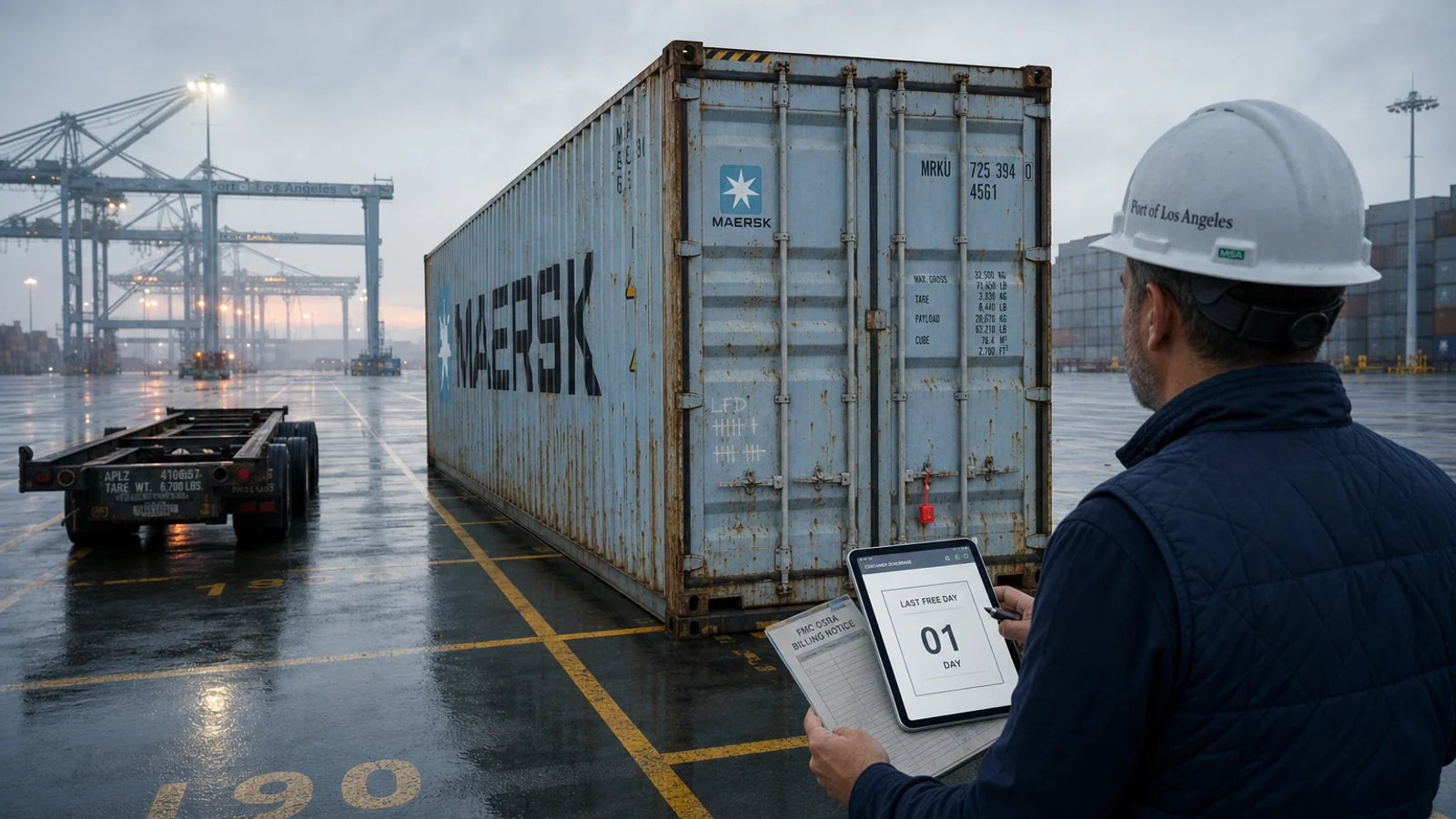
Quick answer Demurrage is the daily charge a carrier bills when your container stays inside the terminal past its free time — usually 4 to 5 free days at US ports. Detention is the separate charge for keeping the container outside the terminal too long. The consignee normally pays both, unless the Incoterm says otherwise.
- Demurrage runs while the container sits inside the terminal; detention runs while you hold it outside the gate.
- Most US ocean carriers give 4–5 calendar free days for demurrage and 3–5 days of detention after pickup.
- Rates are tiered: a low first tier, then a higher rate after a few days, and a higher one again after that.
- Under FMC rules from OSRA 2022, a demurrage invoice must show 13 specific data elements or it is not legally enforceable.
Demurrage is the single most avoidable cost in container import, and it is almost always caused by paperwork rather than trucking. This guide explains the clock, the math, the FMC rules and the dispute process — and the calculator on this page prices your ocean freight before any of it starts.
See your price in seconds
Real carrier rates, no signup, no follow-up calls.
What Is Demurrage in Shipping?
Quick answer Demurrage is the daily fee an ocean carrier or terminal charges when a loaded import container stays inside the port past the agreed free time. The word comes from the French demeurer, to delay. In plain terms: the box is blocking terminal space, so the clock starts and you pay for every extra day.
Think of demurrage as rent on terminal space you did not vacate on time. The terminal planned for your container to leave within a few days. When it does not, the carrier charges you daily until it does.
The charge applies only while the container is inside the terminal gate. That covers import containers waiting for pickup and export containers delivered to the port far too early, before their vessel's cut-off.
The ocean carrier bills demurrage, not your trucker. If you booked through an NVOCC or a freight forwarder, the carrier bills the NVOCC and the NVOCC rebills you under its own tariff. In bulk and charter shipping, the same word means something related but distinct: compensation paid to the shipowner when loading or discharge takes longer than the laytime agreed in the charter party.
Carriers do not all use the same label. The same cost can appear on an invoice as demurrage, storage, per diem or simply DEM, depending on the carrier's published tariff language.
At most US terminals, demurrage accrues on calendar days, not business days. A container discharged on a Thursday before a three-day weekend can burn most of its free time before a single truck gate opens. Count your last free day on a calendar, not on a workweek.
What Is the Difference Between Demurrage and Detention?
Quick answer Demurrage is charged while the container sits inside the terminal. Detention is charged after you pull it out and keep it too long before returning the empty. One clock runs behind the gate, the other outside it. Terminal storage and chassis per diem are two more charges, billed by different parties.
The one-line test every importer should memorize: inside the gate is demurrage, outside the gate is detention. A single import container can generate both on the same shipment — demurrage for sitting at the terminal, then detention for sitting at your warehouse.
Two other charges get confused with these. Terminal storage comes from the marine terminal operator under its own schedule, while demurrage comes from the carrier. You can receive both invoices for the same container on the same days.
| Charge | Where it applies | Who bills it | When the clock runs | Who pays |
|---|---|---|---|---|
| Demurrage | Inside the terminal | Ocean carrier / NVOCC | Day after availability until gate-out | Consignee |
| Detention (per diem) | Outside the terminal | Ocean carrier / NVOCC | Gate-out until empty return | Consignee |
| Terminal storage | Inside the terminal | Marine terminal operator | Day after free storage ends | Consignee or trucker |
| Chassis per diem | Outside the terminal | Chassis pool provider | Chassis-out until chassis return | Trucker or consignee |
Chassis per diem is the one that surprises people. It keeps running after the container is returned if the chassis stays out, and it comes from a pool operator with no connection to your ocean carrier.
Watch for the billing error too. Carriers sometimes label detention as demurrage on the invoice. That mislabel matters, because the free-time rules and the start date are different for each charge.
See your price in seconds
Real carrier rates, no signup, no follow-up calls.
What Is Free Time, and When Does the Clock Start?
Quick answer Free time is the number of days you can keep a container without paying demurrage or detention. For imports at US ports it typically starts the day after the container is discharged and available, and ends when the container exits the gate. Most carriers give 4 to 5 calendar days.
Demurrage free time and detention free time are two separate allowances. Demurrage free time counts from the date the container is discharged and made available. Detention free time counts from the moment the box leaves the gate on a truck or rail car.
Your last free day (LFD) is the date to track. You will find it in three places: the carrier's online tracking page, the arrival notice your forwarder sends, and the terminal's own website.
The clock stops when the container physically crosses the out-gate — not when you book a truck appointment. A confirmed appointment for next Tuesday does nothing for Monday's demurrage.
Several holds let the clock keep running while you can do nothing about it:
- CBP exam hold (VACIS, tailgate or intensive at a CES)
- Freight hold for unpaid ocean charges
- Line release pending from the carrier
- Missing or late ISF "10+2" filing
- USDA, FDA or other partner-agency hold
- Terminal hold for an unpaid prior invoice on an unrelated container
Free time is negotiable. Importers with volume routinely write 7, 10 or 14 free days into the service contract, especially for cargo railed inland via Chicago, where transit alone consumes days.
A CBP exam does not pause the clock automatically
Per CBP practice, an exam hold stops you from picking up the container, but the carrier's demurrage meter keeps running unless you request a waiver. Save the hold notice and the release timestamp — that evidence is what gets the days credited back later.
How Is Demurrage Calculated? A Worked Example
Quick answer Demurrage equals chargeable days multiplied by the tiered daily rate per container. Chargeable days are calendar days past the last free day, counted until gate-out. Rates step up in tiers, so day 10 can cost three times what day 6 costs. Multiply by container count for the invoice total.
The formula is simple:
(days past the last free day) × (the tier rate for each day) × (number of containers)
Here is the arithmetic with illustrative tier rates — check your own carrier's tariff for the real figures. A 40 ft container is discharged Monday and made available the same day. The carrier grants 5 free days, so the LFD falls on day 5. You collect the box on day 9.
- Chargeable days: day 6, 7, 8 and 9 — four days.
- Tier 1 (days 6–7): $120 and $180.
- Tier 2 (days 8–9): $240 and $240.
- Total: $780 for one container.
Now multiply. The same four-day delay on three containers is $2,340. On ten containers it is $7,800 — for a delay nobody treated as an emergency.
Reefers and hazardous cargo usually sit in a higher tier, and reefers add a plug-in or energy charge billed per day alongside demurrage. A refrigerated container stuck on a CBP hold is the most expensive box on the terminal.
A compliant invoice line shows the B/L number, the container number, the container availability date, the last free day, the days billed, the rate applied for each tier, and the total.
Four chargeable days on three 40 ft containers at tiered rates of $120, $180, $240 and $240 produces a $2,340 invoice. The freight was booked months earlier; the demurrage was decided in four days.
How Much Does Demurrage Cost Per Day?
Quick answer Demurrage is billed per container per day on a tiered scale, so cost depends on the port, the carrier tariff, the container type and how many days you run over. Rates are set by the carrier's published tariff, not by Walio. Your freight price, however, you can see instantly.
Every major carrier uses the same shape of tariff. A modest first tier covers the first two or three chargeable days. A steeper second tier follows. After roughly a week, a punitive third tier kicks in that is designed to make the container leave.
| Port | Typical import free days | Tier 1 (days) | Tier 2 (days) | Tier 3 (days) |
|---|---|---|---|---|
| Los Angeles / Long Beach | 4 | 1–4 | 5–9 | 10+ |
| New York / New Jersey | 5 | 1–3 | 4–7 | 8+ |
| Rotterdam | 5–7 | 1–5 | 6–10 | 11+ |
| Shanghai | 5–7 | 1–5 | 6–10 | 11+ |
| Singapore | 5 | 1–5 | 6–10 | 11+ |
| Jebel Ali | 5–10 | 1–5 | 6–10 | 11+ |
Dollar rates change by carrier, container size and season, so verify yours in two public places: the carrier's published tariff and the terminal's storage schedule. Under FMC rules, both must be publicly available. Congestion periods push the upper tiers higher.
Freight is a different question, and that one has an instant answer. Walio prices ocean freight port to port from real carrier rates — 20 ft general cargo from $756 to Colombia, $810 to Guatemala, $1,080 to Peru and $1,566 to Brazil, with the full range across our Latin America lanes running from $756 to Colombia up to $3,066 to Venezuela.
 Miami(USMIA)
 Cartagena(COCTG)Houston(USHOU)
 Puerto Quetzal(GTPRQ)
Destination charges, door-to-door delivery and air cargo are quoted on request through the calculator. Demurrage is never included in a freight quote, because it depends entirely on how fast you pick up.
See your price in seconds
Real carrier rates, no signup, no follow-up calls.
Who Has to Pay Demurrage Charges?
Quick answer The consignee named on the bill of lading usually pays demurrage, because they control pickup. The carrier bills whoever holds the cargo release, which can be the importer, the NVOCC or the freight forwarder. The Incoterm decides who ultimately absorbs the cost between buyer and seller.
The bill of lading is a contract of carriage. It binds the shipper, the consignee and the notify party. When an NVOCC issues a house B/L, the NVOCC is the carrier's customer, pays the carrier, then rebills its own client under its tariff.
| Incoterm 2020 | Who arranges main carriage | Who absorbs destination demurrage |
|---|---|---|
| EXW | Buyer | Buyer |
| FOB | Buyer | Buyer |
| CFR | Seller | Buyer |
| CIF | Seller | Buyer |
| DAP | Seller | Seller |
| DDP | Seller | Seller |
DDP moves destination demurrage onto the seller, along with import clearance and duty liability. That is exactly why exporters price DDP higher than CIF — they are absorbing a risk they cannot control from abroad.
Charter-party demurrage works differently. There, the charterer owes the shipowner an agreed daily rate when loading or discharge exceeds the laytime, measured from the notice of readiness and documented in the statement of facts. Finish early and the charterer may earn despatch, a rebate. Container demurrage has no equivalent reward.
One practical reality overrides all of it: the carrier will not release your container until the invoice is paid. You pay first, then recover from the seller or the responsible party afterward.
What Causes Demurrage Charges Most Often?
Quick answer Most demurrage comes from paperwork, not from trucking. Customs holds, a missing or late ISF filing, unpaid freight blocking the line release, and no customs bond are the top causes at US ports. Chassis shortages, appointment scarcity and port congestion add the rest.
Ranked by frequency at US gateways, the documentary causes dominate:
- CBP exam or agency hold
- Incorrect HS/HTS classification delaying the entry
- Late ISF "10+2" filing — due 24 hours before loading abroad
- No active continuous bond, or a single-entry bond filed late
- Unpaid ocean freight blocking the line release
- Original B/L not surrendered and no telex release issued
Before a truck can move, the chain must clear: B/L surrender or telex release, arrival notice issued, customs entry filed and accepted, then line release and terminal release both showing green. One red flag stops everything.
Operational causes fill the rest: no terminal appointment slots, chassis pool shortages, driver capacity, weekend gate closures, and warehouses that cannot receive the load.
Vessel ETD is not your clock
Importers plan around the vessel's ETD and get caught by an early arrival. Demurrage starts from container availability at destination, which can land days before your forecast. Track the actual ATA and the discharge date, not the sailing schedule. Peak-season bunching before Lunar New Year and hurricane-season diversions at Gulf and Caribbean ports both shift arrivals hard.
How Can I Avoid Demurrage Fees on My Container?
Quick answer Clear customs before the vessel arrives, pre-book a terminal appointment for the first free day, and confirm your continuous bond and ISF are filed. Watch the last free day daily on the carrier's tracking. If the clock has already started, request a hold-related waiver immediately with written evidence.
Pre-arrival work is where demurrage is won:
- ISF filed 24 hours before loading at origin
- HS codes confirmed with your licensed customs broker
- Continuous bond active and sufficient
- Ocean freight paid before arrival notice
- Telex release requested at least a week before ETA
Operationally, book the trucking appointment the moment the vessel berths. Use a drop-and-pick trucker so the chassis and box come back fast, which cuts detention. For LCL, pre-clear at the inland CFS where deconsolidation happens.
If the invoice already exists, dispute it in order:
- Request the invoice's 13 required FMC data elements in writing.
- Gather evidence: hold notices, appointment screenshots, gate records, release timestamps.
- File the dispute inside the carrier's stated window, with the B/L and container numbers.
- Escalate to the FMC if the invoice is non-compliant or unanswered.
Carriers routinely waive demurrage for five reasons: a CBP exam hold, a terminal gate closure, no appointments available, equipment or chassis unavailability, and their own documentation error. Screenshot the appointment system showing zero slots — that single image wins more waivers than any email argument.
What Do FMC and OSRA 2022 Rules Say About Demurrage?
Quick answer The Ocean Shipping Reform Act of 2022 and the FMC's Demurrage and Detention Billing Rule require carriers and marine terminals to issue invoices containing 13 specific data elements within 30 days. If the invoice is missing a required element, the billed party is not obligated to pay it.
The FMC's Interpretive Rule sets the governing principle: demurrage exists to incentivize cargo movement, not to generate revenue. Charges that accrue while pickup was genuinely impossible are open to challenge.
Required invoice elements include the container number, the B/L number, the port of discharge, the container availability date, the last free day, the allowed free time in days, the start and end dates of the billing period, the applicable rate, and the dispute contact and process.
Per the FMC Demurrage and Detention Billing Rule, an invoice missing any required element is not enforceable, and it must be issued within 30 days of the last day charges accrued.
The rule also limits who can be billed: the party that contracted with the carrier for carriage, or the consignee — not a motor carrier who never had a choice in the matter. The billed party then has a defined window to request fee mitigation, a refund or a waiver.
For a formal charge complaint at the FMC, work with a licensed customs broker or a trade attorney. Walio is a shipping platform, not legal counsel.
See your price in seconds
Real carrier rates, no signup, no follow-up calls.
Demurrage means the daily charge a carrier bills when your container stays inside the port terminal past its free time. It compensates the terminal and carrier for occupied space and pushes importers to pick up cargo quickly. The same word is used in bulk shipping for a vessel that exceeds its agreed laytime.
Demurrage applies while the container is still inside the terminal, and detention applies after you take it out and hold it too long before returning the empty. Both are billed per container per day by the ocean carrier. One container can generate both charges on the same import.
The consignee on the bill of lading normally pays demurrage, because the consignee controls when the container leaves the terminal. The carrier bills the party that contracted the carriage, which may be an NVOCC or forwarder who then rebills the importer. Under DDP, the seller absorbs the cost instead.
Most US import containers get 4 to 5 calendar free days, counted from the day after the container is discharged and made available. Detention free time is separate and usually runs 3 to 5 days from gate-out. Shippers with service contracts can negotiate 7, 10 or 14 days.
Yes. Carriers regularly waive demurrage caused by CBP exam holds, terminal closures, no available appointments or their own documentation errors. Under FMC rules, you can also refuse an invoice that is missing any of the 13 required data elements or that arrives more than 30 days after the charges stop accruing.
Demurrage is decided in days, but your freight cost is decided before the booking. Walio compares real carrier rates — Maersk, MSC, CMA CGM, Hapag-Lloyd and more — for FCL, LCL, air and door-to-door moves across the Americas. Enter your route in the calculator above and see your price in seconds — no signup, no follow-up calls.