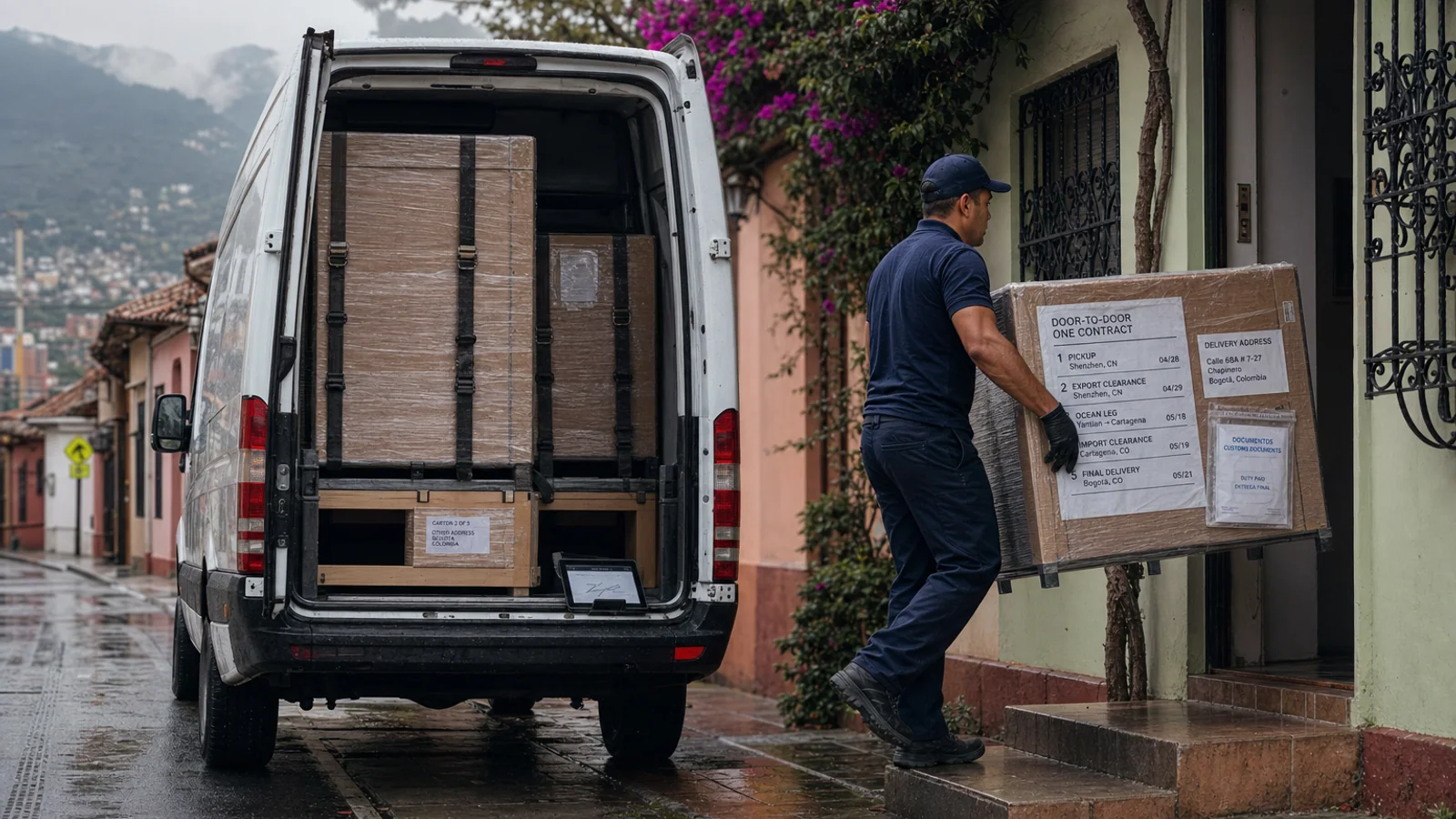
Quick answer Door-to-door shipping is a single contract that covers pickup at your address, export customs, the main ocean, air or road leg, import customs and final delivery to the destination address. Duties and taxes are only included under DDP terms. Port-to-port moves to Latin America start at $1,048 to Nicaragua.
- Door-to-door means one provider and one contract from your sidewalk to the receiver's sidewalk — not inside the home, up the stairs, or unpacked.
- Door-to-door is a service scope, not an Incoterm: only DDP includes duties and import taxes; DAP stops at delivery with taxes unpaid.
- Demurrage, customs inspections, port storage and duties are the four charges most often excluded from a door-to-door quote.
- Walio's port-to-port household goods moves run from $1,048 (Nicaragua) to $4,770 (Curaçao); door-to-door add-ons are quoted on request through the calculator.
Spanish-speaking shippers search envío puerta a puerta qué es for one reason: they want to know where the service really starts and stops. This guide answers that, line by line, for families moving household goods and for online buyers importing from the USA.
See your price in seconds
Real carrier rates, no signup, no follow-up calls.
What is door-to-door shipping, exactly?
Quick answer Door-to-door shipping is a transport service where one provider handles every leg between the sender's address and the receiver's address: pickup, inland transport, export clearance, the main international leg, import clearance and final delivery. You sign one contract, track one reference number, and hold one party responsible for the whole chain.
The defining feature is single responsibility across the entire chain. A freight forwarder or NVOCC books the ocean carrier, hires the drayage trucker, instructs the customs broker and schedules the last-mile delivery. You deal with one file and one invoice.
Door-to-door is a service scope, not a shipping mode. FCL, LCL, air cargo, courier and trucking can all be sold door to door. The mode decides the transit time and the price; the scope decides who arranges each leg.
Readers asking envío puerta a puerta qué es usually want the legal definition of "door." In practice, the door is the curb or driveway at the address, not a bedroom on the second floor. The driver delivers to the property line unless you buy inside delivery.
Three documents follow the cargo from end to end:
- Bill of Lading (B/L) for ocean, or Air Waybill (AWB) for air — the contract of carriage and title document.
- Commercial invoice (Factura Comercial) — declared value, which drives duties and taxes.
- Packing list — piece count, weights and dimensions that must match the cargo exactly.
Ask your provider for the B/L release terms before booking. An original B/L sent by courier can delay delivery by a week; an express release or Sea Waybill clears the cargo without paper chasing.
What does door-to-door service actually include?
Quick answer A door-to-door service normally includes pickup at origin, loading, export documentation and clearance, the main ocean, air or road leg, terminal handling at both ends, import customs filing, drayage from the port and delivery to the destination address. Insurance, packing materials and duties are usually quoted separately.
| Service element | Normally included | Where it is billed |
|---|---|---|
| Pickup at origin address | Yes | Origin |
| Inland haul to port, CFS or airport | Yes | Origin |
| Export filing (AES/EEI, B/L, manifest) | Yes | Origin |
| Terminal handling charge (THC) | Yes | Origin |
| Ocean or air freight | Yes | Main leg |
| Destination THC (DTHC) | Often separate | Destination |
| CFS deconsolidation (LCL) | Often separate | Destination |
| Import customs entry by licensed broker | Yes | Destination |
| Duties, IVA, import taxes | No (only under DDP) | Destination |
| Drayage and last-mile delivery | Yes | Destination |
| Inside delivery, stairs, unpacking | No | Destination |
| Cargo insurance | No — optional add-on | Origin |
Household goods carry extra paperwork. You need a dated inventory, a used-goods declaration, and CBP Form 3299 for personal effects entering the USA. Most Latin American customs authorities require a Menaje de Casa filing, usually notarized and legalized at the consulate before the cargo sails.
Online buyers get a simpler version. Courier door-to-door bundles the clearance into the rate when the shipment falls under the destination's low-value threshold. Above that threshold, a formal entry starts and the broker fee and duties appear as separate charges.
How does door-to-door shipping work step by step?
Quick answer Door-to-door shipping runs in six steps: booking and pickup at the origin address, inland transport to the port or airport, export customs clearance, the main international leg, import customs clearance at destination, then last-mile delivery to the receiver's address. Each handoff has a cut-off date and a document that must match the cargo.
- Booking and documents. You confirm volume, addresses and dates. You submit the commercial invoice or the household goods inventory.
- Pickup and inland haul. A truck collects at your address and delivers to the container yard or the CFS warehouse for consolidation.
- Export filing. Per US Census Bureau rules, an EEI filing in AES is required for most export shipments valued above $2,500 per Schedule B line. On US-bound imports, CBP requires the ISF "10+2" filed 24 hours before vessel loading.
- Main leg. The cargo sails or flies. Walio compares carriers such as Maersk, MSC, CMA CGM and Hapag-Lloyd on the same lane.
- Import clearance. A licensed customs broker files the entry with DIAN in Colombia, SAT in Mexico, SUNAT in Peru, ANAM in Panama, Receita Federal in Brazil or CBSA in Canada.
- Deconsolidation and delivery. LCL cargo is stripped at the destination CFS, then trucked to the address on a scheduled appointment with proof of delivery.
CBP requires the Importer Security Filing at least 24 hours before the container is loaded onto the vessel at the foreign port. Late filings carry liquidated damages of up to $5,000 per violation.
What is NOT included in a door-to-door shipment?
Quick answer Door-to-door quotes usually exclude import duties and taxes, customs inspection fees, demurrage and detention, port storage, prohibited or restricted goods handling, interior delivery, unpacking and debris removal. Under DAP terms the receiver pays duties on arrival. Read the exclusions line of any quote before you compare two prices.
Four charges surprise first-time shippers more than any others:
- Duties and IVA. Customs collects these from the importer of record before release.
- Exam fees. X-ray, VACIS or intensive exams are billed to the cargo, plus the trucking to and from the exam site.
- Demurrage and detention. Free time at destination is typically a handful of calendar days, then charges accrue daily per container.
- Port and CFS storage. Separate from demurrage, and it starts the moment free time ends.
On household moves, the physical extras add up. Inside delivery, stair carries, long walks from the truck, furniture disassembly, unpacking and debris removal are nearly always billed separately. So are failed delivery appointments and waiting time beyond the free truck hours.
Restricted items break household shipments
Alcohol, firearms, ammunition, perishables, loose lithium batteries and aerosols are restricted or banned on most consolidated services. Packing new, boxed goods into a used-household shipment is the fastest way to lose a duty-free Menaje de Casa exemption and trigger a full inspection.
Does door-to-door include customs duties and taxes?
Quick answer Only under DDP. Delivered Duty Paid means the seller or shipper pays import duties, IVA and clearance costs, so the receiver pays nothing on arrival. Most door-to-door quotes are sold on DAP terms: everything is delivered to the address, but the receiver settles duties and taxes with customs first.
| Incoterm 2020 | Who pays transport | Who clears customs | Who pays duty + IVA | Equals door-to-door? |
|---|---|---|---|---|
| EXW | Buyer | Buyer (both ends) | Buyer | No |
| FCA | Buyer | Seller exports, buyer imports | Buyer | No |
| CPT | Seller to named place | Seller exports, buyer imports | Buyer | Partly |
| CIF | Seller to destination port | Seller exports, buyer imports | Buyer | No — stops at the port |
| DAP | Seller to the address | Seller exports, buyer imports | Buyer | Yes, taxes unpaid |
| DDP | Seller to the address | Seller (both ends) | Seller | Yes, taxes paid |
DDP moves the importer-of-record role onto the seller. That means the seller takes on the local tax ID, the entry liability and any penalty. Many sellers refuse DDP into Latin America because a foreign company often cannot be the importer of record without local registration such as a RUT or NIT.
Household goods can avoid duty entirely. Returning residents and new residents in most countries qualify for a duty-free Menaje de Casa allowance, subject to residency proof and a notarized inventory with dates and values.
A worked duty example
Published rates vary by HS code. As an example, Colombia applies IVA at 19%, Mexico at 16%, Peru IGV at 18%, Chile IVA at 19% and the Dominican Republic ITBIS at 18%. Assume a CIF value of $5,000 into Colombia at a 10% tariff.
- Duty: $5,000 × 10% = $500
- Taxable base: $5,000 + $500 = $5,500
- IVA: $5,500 × 19% = $1,045
- Total payable to customs: $1,545 on top of the freight
That is arithmetic, not advice. Confirm the tariff line with a licensed customs broker or a tax adviser, because the HS/HTS classification decides the rate.
See your price in seconds
Real carrier rates, no signup, no follow-up calls.
Door-to-door vs port-to-port: which do you need?
Quick answer Door-to-door covers every leg and both customs clearances. Port-to-port covers only the ocean leg between terminals, leaving you to arrange trucking, clearance and delivery at both ends. Door-to-port and port-to-door split the difference. Port-to-port is cheaper on paper but adds charges you must source yourself.
| Scope | Door to Door | Door to Port | Port to Door | Port to Port |
|---|---|---|---|---|
| Pickup at origin address | Yes | Yes | No | No |
| Inland transport at origin | Yes | Yes | No | No |
| Export customs clearance | Yes | Yes | No | No |
| Main ocean or air leg | Yes | Yes | Yes | Yes |
| Import customs clearance | Yes | No | Yes | No |
| Final delivery to address | Yes | No | Yes | No |
| Single responsible party | Yes | Partial | Partial | No |
Choose port-to-port when
You already have a customs broker and a trucker in the destination country, or a relative receives the container and handles clearance. You accept the demurrage risk and you want the lowest headline freight number.
Choose door-to-door when
You are moving abroad for the first time, buying online, or you have no broker at destination. One party owns the schedule, the paperwork and the delivery appointment, which removes the handoff gaps where cargo sits and accrues storage.
Port-to-port hides real work: drayage, chassis, a signed power of attorney for your broker, and a customs bond — single entry or continuous for US imports. Walio's published household goods prices are port-to-port. Door-to-door legs and destination charges are quoted on request through the calculator.
How does door-to-door differ by transport mode?
Quick answer Door-to-door works on every mode. Courier suits boxes under about 70 kg with clearance bundled in. LCL suits 2 to 12 m³ of household goods. FCL wins above roughly 10 to 15 m³ or when you ship a car. Air cargo moves urgent, high-value freight in days instead of weeks.
| Mode | Typical transit | Relative cost | Ideal size | Best for |
|---|---|---|---|---|
| Ocean FCL (20', 40', 40HC, 45') | 2–5 weeks port to port | Low per m³ | Over 10–15 m³ | Full home moves, cars, pallets |
| Ocean LCL | 3–6 weeks door to door | Medium per m³ | 2–12 m³ | 1–2 bedroom moves, boxes |
| Air cargo (AWB) | 3–8 days | High | 50–500 kg | Urgent, high-value, samples |
| Trucking LTL / FTL | 1–7 days | Low to medium | Any pallet count | USA, Canada, Mexico, Colombia |
| Courier express | 2–6 days | Highest per kg | Under ~70 kg | Parcels, online purchases |
The crossover point matters. LCL beats FCL on cost per cubic meter until roughly 10 to 15 m³. Past that, a 20-foot container is cheaper per unit of space and moves faster because it skips CFS deconsolidation. One car fills a 20-foot container with room for boxes packed around it.
Air cargo prices on chargeable weight: the higher of actual weight or volumetric weight. Courier shipments price the same way, which is why a light, bulky box costs more than the scale suggests.
How long does a door-to-door shipment take?
Quick answer Transit time depends on the mode and the gateway. Ocean door-to-door adds roughly one to three weeks to the port-to-port sailing for pickup, clearance and last mile. Air cargo delivers in days. Customs exams, holidays and inland distance are the three variables that move the date most.
Think in three time blocks: origin pickup and consolidation, the main leg, then destination clearance and delivery. LCL adds days at both ends because the cargo waits for a consolidation and is sorted again at the destination CFS.
 Miami(USMIA)
 Cartagena(COCTG)Houston(USHOU)
 Veracruz(MXVER)Savannah(USSAV)
 Caucedo(DOCAU)
Your gateway depends on your region. Florida ships through PortMiami. Texas and the central states route via Port Houston. California and the Southwest use LA/Long Beach. The Northeast uses NY/NJ, the Southeast uses Savannah, the Midwest railes through Chicago, and the Pacific Northwest uses Seattle. In Canada, Ontario moves through Toronto, Quebec and the Atlantic provinces through Montreal, and Western Canada through Vancouver.
Destination ports shape the last leg too: Cartagena and Buenaventura in Colombia, Callao in Peru, Veracruz and Manzanillo in Mexico, Santos in Brazil, Puerto Cortés in Honduras, Acajutla in El Salvador, Caucedo in the Dominican Republic and Kingston in Jamaica.
Plan your pickup against the port cut-off, not the vessel ETD. Documentation and gate cut-offs usually fall two to four days before sailing. Missing cut-off by two hours costs a full week on weekly services.
What does door-to-door shipping cost and how do you price it?
Quick answer Price depends on volume or chargeable weight, mode, distance to the gateway, destination port, the last-mile leg and the service level. Walio's port-to-port household goods moves to Latin America run from $1,048 to Nicaragua up to $4,770 to Curaçao. Door-to-door legs and destination charges are quoted on request.
| Destination | Port-to-port, from (USD) |
|---|---|
| Nicaragua | $1,048 |
| Colombia | $1,869 |
| Dominican Republic | $1,907 |
| Peru | $1,996 |
| Panama | $2,056 |
| Costa Rica | $2,212 |
| Guatemala | $2,472 |
| Chile | $2,863 |
| Mexico | $3,360 |
| Jamaica | $3,553 |
| Curaçao | $4,770 |
These are lowest published prices for boxes and some furniture, consolidated, as checked in our quoting system since September 28, 2026. They are port to port, not door to door.
Port-to-port household goods to Nicaragua. The same service to Curaçao starts at $4,770. Distance, port fees and service frequency explain most of that spread.
Check every quote for these surcharges: THC and DTHC, BAF (bunker adjustment), CAF (currency adjustment), peak season surcharge, documentation and B/L release. An itemized quote lets you compare line by line. An all-in number can hide who pays destination charges.
RoRo sailings, air cargo, a motorcycle in a shared container, door-to-door legs and destination charges are quoted on request. RVs, motorhomes, semi-trucks and heavy machinery do not fit a container; they move on a flat rack or a RoRo vessel, and a specialist prices them after the calculator takes your details.
See your price in seconds
Real carrier rates, no signup, no follow-up calls.
How do you choose a door-to-door provider?
Quick answer Ask six questions: is the quote itemized, who is the importer of record, which Incoterm applies, how much free time you get at destination, what the exclusions line says, and whether a licensed customs broker is included. A provider who cannot answer in writing is quoting you a number, not a service.
- Get the exclusions in writing and the Incoterm printed on the quote.
- Confirm free time in days at destination, before demurrage starts.
- Verify credentials: an FMC-licensed NVOCC or OTI for US ocean exports, and a licensed broker at destination.
- Ask whether cargo insurance is offered and how claims are filed.
- For household goods, insist on an inventory requirement and a written destination-charge disclosure.
Online buyers should settle one question before clicking buy: did the seller ship DDP or DAP? That single letter decides whether you pay IVA on arrival.
Quick glossary
B/L bill of lading · AWB air waybill · THC/DTHC terminal handling at origin/destination · BAF fuel surcharge · CFS container freight station · drayage short port trucking · demurrage container sitting at the terminal · detention container held outside the terminal · deconsolidation splitting an LCL container · NVOCC non-vessel operating common carrier · HS code tariff classification · ISF importer security filing.
Now you have the full answer to envío puerta a puerta qué es: one contract, two addresses, and a clear list of what sits outside the price. Enter your route and volume in the calculator above and see your price in seconds — no signup, no follow-up calls.
See your price in seconds
Real carrier rates, no signup, no follow-up calls.
No, not unless the shipment moves under DDP (Delivered Duty Paid) terms. Most door-to-door quotes are sold DAP, meaning the carrier delivers to the address but the receiver pays import duties and IVA to customs before release. Always check which Incoterm appears on your quote.
Door-to-door covers pickup, both customs clearances and final delivery under one contract. Port-to-port covers only the ocean leg between two terminals, so you arrange trucking, your own customs broker and delivery yourself. Port-to-port looks cheaper but leaves several charges unquoted.
No, standard door-to-door delivery is curbside at the destination address. Inside delivery, stair carries, furniture reassembly, unpacking and debris removal are separate services that must be added to the quote before the truck arrives.
Walio's port-to-port rates for boxes and furniture start at $1,048 to Nicaragua and run up to $4,770 to Curaçao, with Colombia at $1,869 and Mexico at $3,360. Door-to-door pickup and delivery legs, plus destination charges, are quoted on request through the calculator on this page.
Yes, cars, SUVs, pickups and motorcycles ship door to door inside containers, and one car fills a 20-foot container with room for boxes around it. RoRo sailings, shared containers and oversized vehicles are quoted on request after the calculator takes your details.