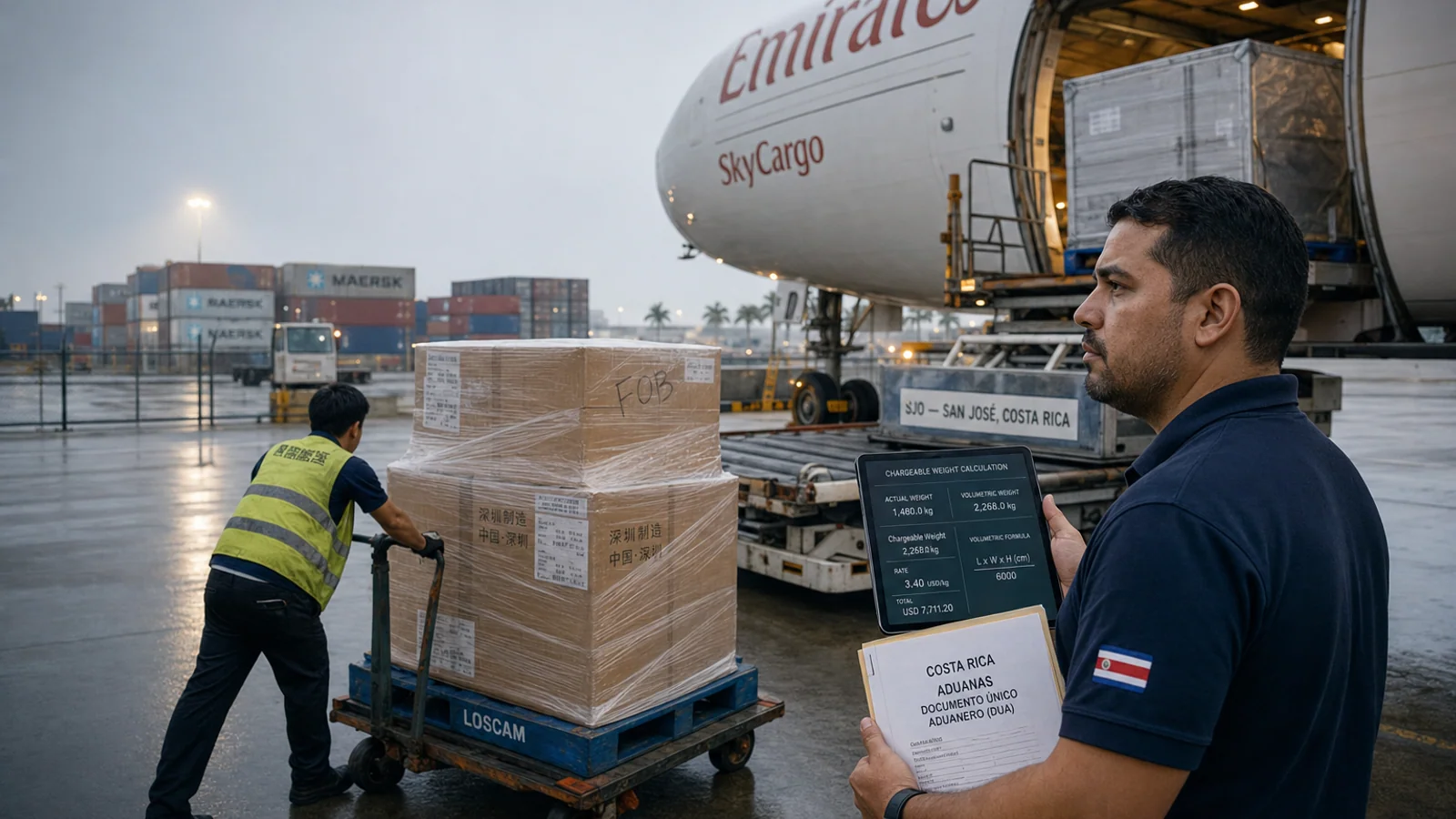
Quick answer Sea-air freight from China to San José (SJO) starts at $5.45 per chargeable kilo for 300–499 kg and drops to $3.40/kg at 5,000 kg and up, port to airport. Transit runs 16–25 days: ocean to Los Angeles, truck to Miami, then air to SJO. The calculator prices your exact port and weight.
- Sea-air China to Costa Rica is billed per chargeable kilo: from $5.45/kg at 300–499 kg, from $4.53/kg at 500–999 kg, from $3.86/kg at 1,000–4,999 kg and from $3.40/kg at 5,000 kg or more.
- Chargeable weight is the greater of actual weight and volume × 167 kg per cubic meter; shipments under 300 kg are billed as 300 kg.
- The routing is multimodal: ocean from ports like Shanghai, Ningbo, Shenzhen or Qingdao to Los Angeles (12–18 days), truck to Miami (3–5 days), air to San José (1–2 days).
- Costa Rican import taxes are separate from freight: DAI by HS code, the 1% Ley 6946 charge, 13% VAT and, on some goods, Selective Consumption Tax — all calculated on the CIF value.
Costa Rican importers type calculadora marítimo aéreo china costa rica into Google because they want one number, not a quote request. This guide gives you the rate logic, the transit math and the tax base, then hands you the calculator.
See your price in seconds
Real carrier rates, no signup, no follow-up calls.
What does the sea-air China to Costa Rica calculator show?
Quick answer The calculator returns a sea-air price per chargeable kilo for your exact Chinese port, destination airport and weight. Rates start at $5.45/kg for 300–499 kg and reach $3.40/kg from 5,000 kg, port to airport. Origin and destination handling appear as separate line items, never buried in the per-kilo figure.
A sea-air freight calculator prices the ocean leg, the road leg and the air leg as one multimodal movement and returns a single cost per kilo. That is the whole point of the service: ocean economics for most of the distance, air speed for the last stretch into Central America.
Walio's rate table for this lane is live, dated October 16, 2026, and quoted in US dollars. The bands below reflect the cheapest port and airport pairing on the lane, so always read them as "from".
| Chargeable weight band | Sea-air rate (from) | Billing unit | Scope |
|---|---|---|---|
| 300–499 kg | $5.45/kg | Per chargeable kilo | Port to airport |
| 500–999 kg | $4.53/kg | Per chargeable kilo | Port to airport |
| 1,000–4,999 kg | $3.86/kg | Per chargeable kilo | Port to airport |
| 5,000 kg and up | $3.40/kg | Per chargeable kilo | Port to airport |
| Under 300 kg | Billed as 300 kg | Minimum billed weight | Port to airport |
The scope is port to airport. You deliver the cargo to the Chinese loading port, and your consignee collects it at Juan Santamaría International Airport (SJO). Door pickup at a factory in Yiwu or Dongguan and door delivery in Heredia or Alajuela are quoted inside the calculator, not folded into the per-kilo rate.
Handling charges at origin and destination are added per shipment. Walio shows them as their own line, because a per-kilo rate that hides handling is not a real price. You see every component before you book.
There is no signup, no form that waits for an email and no sales call. You enter the shipment, read the number, compare options and book online.
See your price in seconds
Real carrier rates, no signup, no follow-up calls.
How is chargeable weight calculated for sea-air from China?
Quick answer Chargeable weight is the greater of actual gross weight and volumetric weight. For sea-air, volumetric weight equals cubic meters × 167 kg. Pure air freight from China uses length × width × height in centimeters divided by 6,000. Shipments under 300 kg are billed at the 300 kg minimum.
Chargeable weight (peso cobrable) is the figure the carrier actually bills. Volumetric weight (peso volumétrico) converts the space your cargo occupies into kilos, because an aircraft and a consolidation box both run out of room before they run out of payload.
Worked example: 12 cartons of housewares
Take 12 cartons measuring 60 × 40 × 50 cm each. One carton is 0.12 m³, so the shipment is 1.44 m³. Multiply 1.44 × 167 and you get 240 kg of volumetric weight.
If the actual gross weight is 180 kg, the greater figure is 240 kg. Both numbers sit under the minimum, so you are billed on 300 kg at the 300–499 kg band, from $5.45/kg.
Worked example: 9 m³ of dense hardware
Now take 9 m³ of tools and fittings weighing 1,900 kg. Volumetric weight is 9 × 167 = 1,503 kg. Actual weight wins, so you bill on 1,900 kg and land in the 1,000–4,999 kg band, from $3.86/kg.
Straight air freight uses a different divisor. Airlines take length × width × height in centimeters and divide by 6,000, which equals a density factor of 167 kg per cubic meter — the same ratio expressed another way. The practical difference is that sea-air prices on total cubic meters, not carton by carton, so you need your packing list totals, not a guess.
Dense cargo wins on sea-air. Hardware, tools, fasteners, spare parts, ceramic tile and small motors usually bill on actual weight. Light bulky goods — plastic housewares, foam, empty containers, inflatables — bill on volume and often belong on full ocean LCL instead. Ask your supplier to compress carton dimensions before you book; 5 cm off each carton height can move you into a cheaper band.
How long does sea-air take from China to Costa Rica?
Quick answer Sea-air runs 16–25 days port to airport, depending on the origin port. The ocean leg to Los Angeles takes 12–18 days, the truck to Miami 3–5 days, and the Miami–San José flight 1–2 days. Full ocean service to Caldera or Moín takes far longer; straight air is faster but costs more per kilo.
The routing is deliberate. Ocean carriers such as Maersk, MSC, CMA CGM and Hapag-Lloyd run high-frequency transpacific services into Los Angeles, which is the fastest reliable ocean gateway from Asia. From there, cargo moves overland to Miami, the main air hub for Central America, and flies south.
 Shanghai(CNSHA)
 Los Angeles(USLAX)Los Angeles(USLAX)Miami(USMIA)Miami(MIA)
 San José(SJO)
Walio loads sea-air from nine Chinese ports: Dalian, Fuzhou, Guangzhou, Ningbo, Qingdao, Shanghai, Shenzhen, Xiamen and Xingang. Total door-of-port to airport transit lands between 16 and 25 days, and the spread comes almost entirely from the ocean leg and the sailing frequency at your port.
| Leg | Mode | Transit | Document |
|---|---|---|---|
| China port → Los Angeles | Ocean | 12–18 days | Ocean bill of lading |
| Los Angeles → Miami | Truck | 3–5 days | Trucking / transfer manifest |
| Miami → San José (SJO) | Air | 1–2 days | Air waybill (AWB) |
| Full lane, port to airport | Multimodal | 16–25 days | B/L + AWB |
Port cut-off versus vessel ETD
Your supplier must hit the port cut-off, not the sailing date. Cut-off for cargo receipt and documentation usually falls two to four days before the vessel's ETD. Miss it by a few hours and the booking rolls to the next sailing, which on many transpacific strings means a full week lost.
Chinese New Year and peak season
Two windows break schedules every year. Chinese New Year shuts factories for one to three weeks and creates a production rush before it and a space crunch after it. The pre-Christmas peak from roughly August to October tightens both ocean space and belly capacity out of Miami.
In those windows, book earlier rather than cheaper. Rolled bookings cost more in lost sales than the freight ever saves. If you are comparing neighboring origins, our Sea-Air Hong Kong to Costa Rica Calculator: 2026 Rates covers the same routing logic from Hong Kong.
How it compares to the alternatives
Full ocean FCL or LCL from China discharges at Puerto Caldera on the Pacific or Moín (APM Terminals) on the Caribbean, typically 30–45 days with transshipment. Straight air lands at Juan Santamaría (SJO) in roughly a week but prices at air levels. Sea-air sits between them on both counts.
Sea-air vs LCL, FCL and courier: which should you use?
Quick answer Sea-air wins when you need speed near air service but refuse air prices: 16–25 days at a per-kilo rate that falls to $3.40/kg from 5,000 kg. LCL fits non-urgent cargo under about 10–15 m³. FCL takes over above that. Courier only makes sense for samples and very small parcels.
| Mode | Transit (China → Costa Rica) | Billed by | Ideal size | Delivery point | Best use |
|---|---|---|---|---|---|
| Sea-air | 16–25 days | Chargeable kilo (167 kg/m³) | 300 kg – 5,000+ kg | SJO airport | Restocking, dense goods, deadlines |
| Ocean LCL | 30–45 days | Cubic meter (m³) | 1–15 m³ | Caldera / Moín CFS | Non-urgent mixed cargo |
| Ocean FCL 20' | 30–45 days | Per container | Up to ~28 m³ | Caldera / Moín | Full-volume orders, one supplier |
| Ocean FCL 40' / 40HC | 30–45 days | Per container | ~58–68 m³ | Caldera / Moín | Bulky, high-volume programs |
| Straight air | 7–12 days | Chargeable kilo (÷6,000) | 50–1,000 kg | SJO airport | Emergencies, high-value small cargo |
| Courier | 4–8 days | Parcel weight | Under ~70 kg | Door | Samples, documents, spare part singles |
The 10–15 m³ rule
Above roughly 10–15 m³, cost per cubic meter usually favors a 20 ft container over LCL consolidation. LCL carries per-shipment fees — CFS handling, deconsolidation, documentation — that do not shrink as volume grows, so the effective price per m³ climbs toward the FCL equivalent.
A 20 ft container absorbs around 28 m³ of real cargo once you allow for pallet footprints and dunnage. That is why LCL loses its edge long before you fill a container: the container price divided by 15 m³ often already beats the LCL rate.
Break-even logic for a Costa Rican SME
Think in two variables: density and deadline. If your cargo bills above roughly 167 kg per cubic meter, sea-air prices on weight and stays competitive. If it bills on volume and you can wait five to seven weeks, ocean LCL or FCL into Caldera wins on pure freight cost.
By cargo type, the rule of thumb holds well. Fast-moving SKUs you cannot run out of, seasonal goods with a fixed sell-through window, spare parts that stop a production line and machinery components all justify sea-air. Slow-turning inventory and bulky low-value goods belong on the water.
See your price in seconds
Real carrier rates, no signup, no follow-up calls.
How much does it cost to bring goods from China to Costa Rica?
Quick answer Freight is only part of the landed cost. Sea-air starts at $5.45/kg for 300–499 kg and $3.40/kg from 5,000 kg, port to airport. On top sit origin and destination handling, Costa Rican customs clearance, the customs broker fee and last-mile delivery, plus DAI, the 1% Ley 6946 charge and 13% VAT.
Split your landed cost into three blocks and it stops being confusing. Block one is international freight. Block two is local handling and clearance. Block three is taxes payable to the state.
Block one: international freight
The sea-air per-kilo rate covers the ocean leg to Los Angeles, the road leg to Miami and the flight to San José. It does not cover origin handling in China, destination handling at SJO, customs clearance or delivery. Those sit as separate per-shipment lines in the calculator, which is how a transparent quote should read.
Block two: handling and clearance
On full ocean alternatives you meet a longer surcharge list: THC at origin and DTHC at destination, BAF for bunker fuel, CAF for currency adjustment, ISPS security fees and peak season surcharges. After the free time expires you also risk demurrage on the container at the terminal and detention once it leaves.
At destination you pay the licensed customs broker (agente aduanero), any warehouse storage while the file clears, and last-mile trucking. Delivery inside the Greater Metropolitan Area — San José, Heredia, Alajuela, Cartago — costs less than Guanacaste, Limón or rural routes, where distance and backhaul drive the price up.
The same lane costs from $5.45/kg at 300–499 kg. Consolidating four monthly orders into one 5,000 kg shipment moves you down three weight bands. Plan purchase orders around the bands instead of shipping dribbles every few weeks.
Block three: taxes
Duties and taxes are not freight charges and they are not Walio prices. They are published by the Costa Rican state and calculated on the CIF value. The next section breaks them down.
See your price in seconds
Real carrier rates, no signup, no follow-up calls.
What taxes do you pay when importing from China to Costa Rica?
Quick answer Costa Rica taxes imports on the CIF value: cost of goods, insurance and freight. The published charges are the DAI set by HS code, the 1% Ley 6946 contribution, 13% VAT and, on selected goods, the Selective Consumption Tax. Rates vary by product, so confirm classification with a licensed customs broker.
CIF value is the invoice value of the goods plus insurance plus freight to the point of import. It is the base for every charge that follows, which is why understating freight does not reduce exposure — customs values the full CIF base and can reconstruct it.
| Charge | Calculation base | Published rate | Collected by |
|---|---|---|---|
| DAI (import duty) | CIF value | Varies by HS code | Customs authority |
| Ley 6946 contribution | CIF value | 1% | Customs authority |
| Selective Consumption Tax | CIF + DAI (selected goods only) | Varies by product | Customs authority |
| VAT (IVA) | Accumulated base | 13% | Customs authority |
| Customs broker fee | Per DUA / shipment | Agreed with the broker | Agente aduanero |
The order of calculation matters. You start with CIF, apply the DAI set by your product's HS/HTS classification, add the 1% Ley 6946 contribution, add Selective Consumption Tax where it applies, then apply 13% VAT on the accumulated base. Each layer sits on top of the previous one.
HS classification drives everything. Two products that look identical on a shelf can carry very different DAI rates depending on material, use or motor rating. Getting the tariff heading right before you buy protects your margin far more than squeezing the freight quote.
Clearance happens through a DUA (single customs declaration) filed in the TICA system by a licensed agente aduanero. Only a licensed broker can file it, and the broker is also the person who signs off on your classification.
Duty rates are set by the state, not by Walio
Walio prices freight and handling. DAI, Ley 6946, Selective Consumption Tax and VAT are published by the Costa Rican authorities and depend on your product's classification and any applicable trade agreement. Confirm your product's treatment with a licensed customs broker or tax adviser before you commit to a purchase order. We are a shipping platform, not legal or tax counsel.
Which Incoterm should you use on a China to Costa Rica purchase?
Quick answer FOB at a Chinese port is the cleanest fit for sea-air, because the port-to-airport rate starts where FOB ends. EXW pushes inland pickup and export clearance onto you. CIF hands control of the ocean leg to the supplier. DDP moves import liability and Costa Rican tax exposure onto the seller.
| Incoterm 2020 | Seller delivers at | Who pays main freight | Who clears import | Fit with sea-air |
|---|---|---|---|---|
| EXW | Factory door | Buyer | Buyer | Workable, add inland + export clearance |
| FCA | Named point / terminal | Buyer | Buyer | Good |
| FOB | On board at origin port | Buyer | Buyer | Best match |
| CIF | Origin port, freight prepaid | Seller | Buyer | Poor, seller controls routing |
| DAP | Named place in Costa Rica | Seller | Buyer | Limited |
| DDP | Named place, duties paid | Seller | Seller | Not recommended |
FOB Shanghai, FOB Ningbo or FOB Shenzhen matches the port-to-airport scope exactly. The supplier's responsibility ends at the loading port, and the Walio rate picks up there. No overlap, no gap, no mystery charges in the middle.
The CIF trap
CIF looks cheaper on the supplier's quotation because the ocean freight is bundled in. The cost usually reappears at destination as inflated handling, release and documentation fees charged by an agent you did not choose. You also lose control of the carrier, the routing and the schedule, which matters when a vessel rolls.
The DDP caution
DDP shifts import clearance and duty payment to the seller, which in practice makes a foreign supplier responsible for your Costa Rican declaration. You lose visibility on the declared value and the HS code used in the DUA, and any later audit still involves your business. Keep import liability where you can defend it.
Ask every supplier for three things on the same email: FOB price at the nearest port, carton dimensions in centimeters, and gross weight per carton. With those you can run the sea-air number and the LCL number in the calculator and compare true landed cost instead of comparing two quotes written on different terms.
What documents and customs steps does the shipment need?
Quick answer Every China to Costa Rica import needs a commercial invoice, packing list, the transport document and the DUA filed in TICA by a licensed customs broker. Sea-air moves on an ocean bill of lading for the first leg and an air waybill for the Miami–San José flight, so both documents must match the invoice exactly.
- Factura Comercial — commercial invoice with a precise product description, unit values, Incoterm and currency.
- Packing list — carton count, dimensions in centimeters and gross weight per carton; this is what drives chargeable weight and your rate band.
- Bill of Lading (B/L) — covers the ocean leg from China to Los Angeles.
- Air Waybill (AWB) — covers the Miami to San José flight.
- Certificado de Origen — required where a trade preference applies to the goods.
- Importer registration — cédula jurídica or cédula física registered as an importer in Costa Rica.
The AWB and the B/L must show identical description, weight and value. A mismatch between documents stalls release, and cargo sitting in a bonded warehouse accrues storage charges daily. Fix the paperwork before the shipment flies, not after it lands.
Regulated goods need approval before arrival, not after. Food, cosmetics, supplements, medical devices, agricultural inputs and electronics with radio modules typically require registration or a permit from the Ministry of Health or the SFE. Your customs broker will tell you which register applies to your HS heading.
Vague invoice descriptions cause delays
"Spare parts", "accessories" or "goods" on a commercial invoice invites reclassification, inspection and storage charges. Write what the item is, what it is made of and what it is used for: "stainless steel hose clamps, 50 mm, for irrigation systems". A specific description protects the HS code your broker declared and keeps the DUA moving. If you are relocating to Costa Rica while setting up the business, read our Requirements for Moving to Costa Rica: Complete Guide 2026 for the personal-effects side of the paperwork.
How do you use the sea-air China to Costa Rica calculator?
Quick answer Enter the Chinese loading port, the destination airport, your gross weight and total cubic meters. The calculator applies the chargeable weight rule, finds your weight band and returns the sea-air price in seconds, with handling listed separately. No signup, no waiting for an email, no sales call.
- Pick your origin port from Dalian, Fuzhou, Guangzhou, Ningbo, Qingdao, Shanghai, Shenzhen, Xiamen or Xingang.
- Pick San José (SJO) as the destination airport.
- Enter gross weight and either carton dimensions or total cubic meters.
- Review the chargeable weight the tool applies — the greater of actual weight and m³ × 167 kg.
- Compare sea-air against the other modes shown, then book online without a quote request.
Three scenarios for Costa Rican SMEs
Small importer, 400 kg. A 400 kg restock of dense hardware from FOB Shenzhen sits in the 300–499 kg band, from $5.45/kg, port to airport. Transit lands in the 16–25 day window. The same order shipped LCL would wait a further three to four weeks at Caldera.
Mid-size order, 1,200 kg. At 1,200 kg chargeable, you drop into the 1,000–4,999 kg band, from $3.86/kg. That is roughly the volume where many Costa Rican retailers stop paying straight air and switch permanently.
Consolidated shipment, 5,500 kg. Combining three suppliers into one 5,500 kg movement from FOB Ningbo reaches the top band, from $3.40/kg. Consolidation is the single biggest lever on this lane, bigger than any negotiation on a single booking.
What to have ready before you run it
- Carton count and carton dimensions in centimeters.
- Gross weight per carton and total gross weight.
- The FOB port your supplier quotes from.
- A clear product description for the invoice and the HS heading your broker expects.
Oversized, dangerous or project cargo still gets priced. Submit the request through the calculator and a Walio specialist follows up, or open the chat on the page. Lithium batteries, aerosols and anything classed as dangerous goods need a declaration before the air leg accepts them.
See your price in seconds
Real carrier rates, no signup, no follow-up calls.
If you have been searching for a calculadora marítimo aéreo china costa rica that gives a number instead of a contact form, this is it. Enter your route in the calculator above and see your price in seconds — no signup, no follow-up calls.
Sea-air freight starts at $5.45 per chargeable kilo for 300–499 kg, $4.53/kg for 500–999 kg, $3.86/kg for 1,000–4,999 kg and $3.40/kg from 5,000 kg, port to airport on the cheapest port and airport pairing. Origin and destination handling are added per shipment. The calculator on this page prices your exact port, airport and weight in seconds.
Sea-air takes 16 to 25 days port to airport, depending on the loading port. The ocean leg to Los Angeles runs 12–18 days, the truck to Miami 3–5 days and the flight from Miami to San José 1–2 days. Chinese New Year and peak season can add time, so book earlier in those windows.
Multiply length by width by height in centimeters and divide by 6,000 to get volumetric weight in kilos for straight air freight. For sea-air, the density factor is 167 kg per cubic meter, so 2 m³ equals 334 kg volumetric. You are billed on whichever is greater, actual or volumetric weight.
Costa Rica charges the DAI set by your product's HS code, a 1% Ley 6946 contribution, 13% VAT and, on selected goods, the Selective Consumption Tax. All of them are calculated on the CIF value, which is the goods plus insurance plus freight. Rates depend on classification, so confirm them with a licensed customs broker.
Yes. The minimum billed weight is 300 kg, so a 120 kg shipment is still charged as 300 kg. If your order is much lighter than that, compare courier service in the calculator before committing to sea-air.