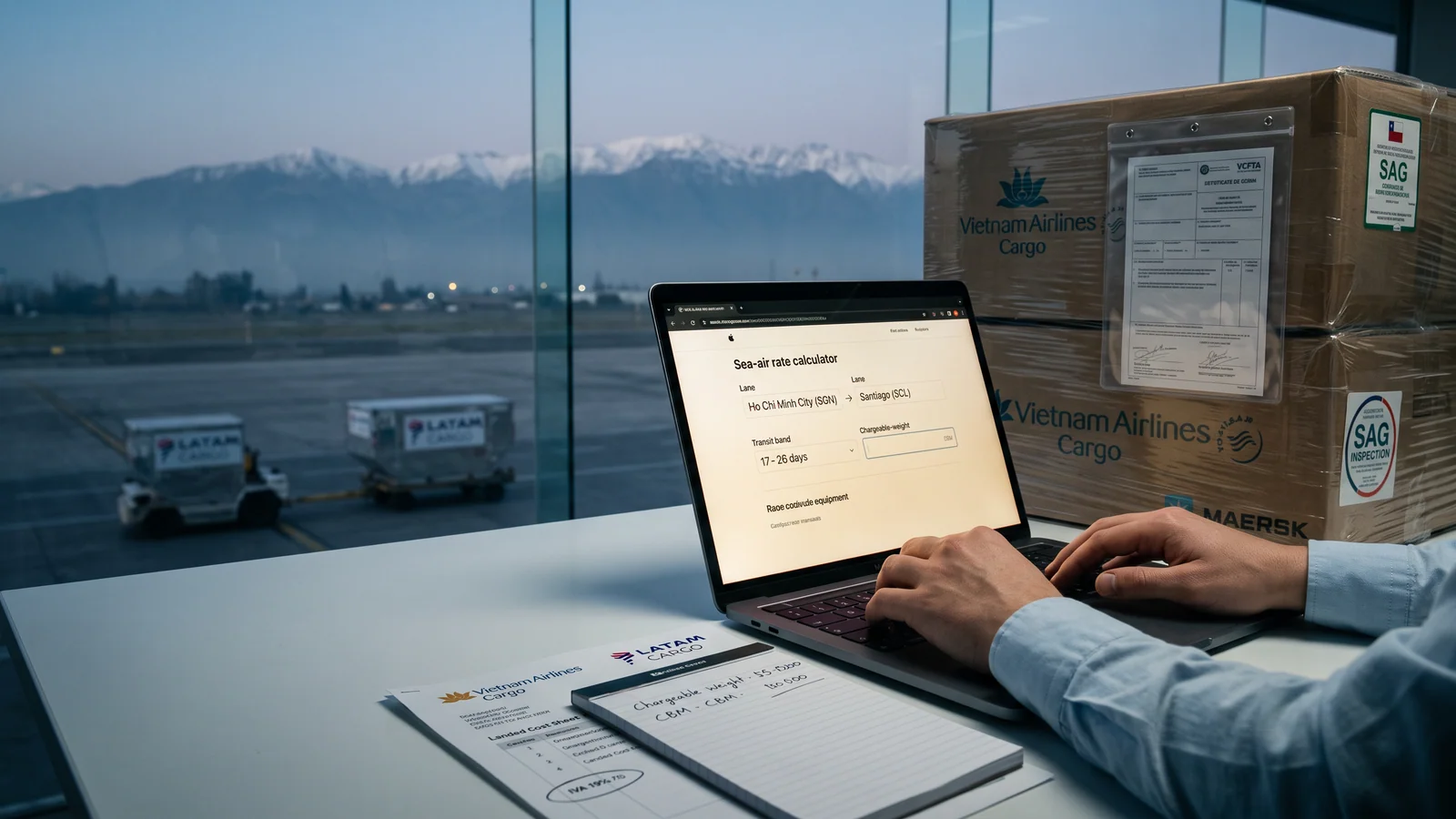
Quick Answer: Sea-air to Santiago runs 17–26 days door to airport: ocean to Los Angeles, truck to Miami, then air to SCL. Walio's published sea-air rate starts from $7.49/kg at 300–499 kg and from $5.46/kg at 5,000+ kg on listed Asian port-airport pairs. The calculator prices your exact shipment in seconds.
- Sea-air total transit to Santiago is 17–26 days: 12–18 days ocean to Los Angeles, 3–5 days truck to Miami, 2–3 days air to SCL.
- Walio's published sea-air rate per chargeable kilo starts from $7.49/kg (300–499 kg), $6.59/kg (500–999 kg), $5.91/kg (1,000–4,999 kg) and $5.46/kg (5,000+ kg) on the cheapest listed port-airport pair.
- Minimum billed weight is 300 kg, and chargeable weight is the greater of actual weight or volume × 167 kg per m³.
- Chile charges 6% ad valorem plus 19% IVA on the CIF value, and the Chile–Vietnam FTA (VCFTA) can drop the duty to 0% with a valid Form VC certificate of origin.
Chilean importers buying in Vietnam face the same squeeze every season: full ocean takes five to seven weeks, and pure air destroys the margin. Sea-air sits in the middle, and the calculator on this page prices it instantly.
Vietnam to Chile Sea-Air Calculator: How Do You Get a Price?
Quick Answer: A sea-air freight calculator turns four inputs into a live price: origin gateway, destination airport, gross weight and box dimensions. Walio's calculator reads real carrier rates, applies the 300 kg minimum and the 167 kg per m³ rule, then shows freight plus handling on screen in seconds. No signup, no follow-up calls.
Sea-air is one multimodal service, not three shipments. The ocean leg crosses the Pacific to Los Angeles, a truck runs the cargo to Miami, and an aircraft flies it to Santiago. A calculadora marítimo aérea vietnam chile prices all three legs as a single number per chargeable kilo.
Which inputs does the calculator need?
Origin port or gateway where your supplier delivers the cargo
Destination airport — Santiago (SCL) on this lane
Number of pieces, pallets or cartons
Gross weight in kilograms, pallet included
Length × width × height in centimeters per piece, measured packed
What does the calculator return?
You see the freight rate per chargeable kilo for your weight band, origin and destination handling added per shipment, and the transit window for that port-airport pairing. Nothing waits in an inbox. The number appears while you are still reading the page.
Vietnamese cargo reaches the sea-air network through a listed Asian gateway. Boxes leaving Ho Chi Minh City through Cat Lai or Cai Mep, plus freight from Hai Phong and Da Nang, usually feeder or truck to that gateway first. The calculator prices that routing for you instead of leaving you to stitch quotes together.
Pro tip
Quote the shipment before you confirm the purchase order quantity. Moving from 280 kg to 320 kg crosses the 300 kg minimum and changes your cost per unit more than most suppliers' volume discounts.
Importers who also feed an Andean distribution center should compare entry points. Our Sea-Air Vietnam to Colombia Calculator: Rates 2026 guide covers the same multimodal structure into Bogotá, which is useful when Santiago is not the only stock location.
How Much Does Sea-Air Cargo From Vietnam to Chile Cost?
Quick Answer: Walio's published sea-air rate per chargeable kilo starts from $7.49/kg for 300–499 kg, $6.59/kg for 500–999 kg, $5.91/kg for 1,000–4,999 kg and $5.46/kg for 5,000+ kg on the cheapest listed port-airport pair. Origin and destination handling is added per shipment. The exact rate depends on your port and airport.
Chargeable weight band | Rate from (USD/kg) | Service scope | Billing note |
|---|---|---|---|
300–499 kg | $7.49 | Port to airport (SCL) | 300 kg minimum applies |
500–999 kg | $6.59 | Port to airport (SCL) | Band break at 500 kg |
1,000–4,999 kg | $5.91 | Port to airport (SCL) | Band break at 1,000 kg |
5,000+ kg | $5.46 | Port to airport (SCL) | Best published rate |
Read the scope before you compare anything. These rates are port to airport: the shipper delivers the cargo to the origin port, and the consignee collects it at Santiago airport. Rates shown are "from" figures on the cheapest listed port-airport pair, as of October 1, 2026.
Why does the 300 kg minimum matter so much?
Minimum billed weight is 300 kg. A 180 kg shipment still bills as 300 kg, so the effective cost per real kilo nearly doubles. Small orders usually belong in courier instead, and the calculator will show you that comparison.
Anything lighter pays the 300 kg minimum, which is why consolidating two small Vietnamese orders into one booking almost always wins.
What is not in the per-kilo rate?
Origin and destination handling is charged per shipment and itemized separately. We never fold it into the per-kilo figure, because that hides the real cost of a light shipment. Door pickup in Asia and door delivery in Santiago, Valparaíso or Antofagasta are quoted on request inside the calculator.
How Long Does a Shipment From Vietnam to Chile Take?
Quick Answer: Sea-air lands in Santiago in 17–26 days: 12–18 days ocean to Los Angeles, 3–5 days truck to Miami, 2–3 days air to SCL. Straight ocean from Vietnam to San Antonio or Valparaíso typically runs five to seven weeks with transshipment. Pure air cargo takes three to six days.
 Shanghai(CNSHA)
 Los Angeles(USLAX)Los Angeles(USLAX)Miami(USMIA)Miami(MIA)
 Santiago(SCL)
Full ocean is the slow comparison. There are no direct vessel services between Vietnam and Chile, so boxes transship at Busan, Shanghai, Singapore, Manzanillo or Callao. Each transshipment adds 7 to 14 days of hub dwell time that no schedule quotes honestly.
Which port and airport pairs serve this lane?
Origin | Destination | Typical hub | Transit (days) | Weekly departures |
|---|---|---|---|---|
Cat Lai (Ho Chi Minh) | San Antonio | Busan or Manzanillo | 38–50 | 2–3 |
Cai Mep | San Antonio | Manzanillo (deep-water call) | 35–45 | 1–2 |
Cai Mep | Valparaíso | Busan or Shanghai | 38–48 | 1–2 |
Hai Phong | San Antonio | Feeder to Shanghai/Busan | 42–55 | 1–2 |
Da Nang | Valparaíso | Feeder to Cai Mep or Singapore | 45–57 | 1 |
Cat Lai | Iquique (ZOFRI) | Callao or Manzanillo | 42–55 | 1 |
Cat Lai | Antofagasta | Callao | 45–58 | 1 |
SGN (air) | SCL | One or two connections | 3–6 | Daily |
HAN (air) | SCL | One or two connections | 4–7 | Daily |
Listed Asian port (sea-air) | SCL via LAX + MIA | Los Angeles, Miami | 17–26 | Weekly |
Port cut-off is not the same as vessel ETD. Cargo must be gated in two to four days before the ship sails, and documentation cut-off often falls earlier. Missing cut-off costs you a full week on a weekly service, which erases any saving you negotiated with the supplier.
Frequency also differs by origin. Cai Mep handles deep-water vessels and gets more direct hub calls. Hai Phong normally feeders to Shanghai or Busan first, which lengthens both the transit and the risk window.
How Do You Calculate Chargeable Weight and CBM?
Quick Answer: Chargeable weight is the greater of actual weight and volumetric weight. For sea-air, volume × 167 kg per m³. For pure air, L×W×H in cm ÷ 6000. For ocean LCL, 1 CBM equals 1,000 kg under the weight-or-measure rule. A 20 ft container holds roughly 28–30 CBM of packed cargo.
Start with CBM. Multiply length × width × height in meters for one piece, then multiply by the number of pieces. That single figure drives every mode on this lane.
Worked example: 20 cartons of 60 × 40 × 50 cm
Step | Calculation | Result |
|---|---|---|
Volume per carton | 0.60 × 0.40 × 0.50 m | 0.12 CBM |
Total volume | 0.12 × 20 cartons | 2.4 CBM |
Actual gross weight | Weighed with pallet | 300 kg |
Sea-air chargeable weight | 2.4 × 167 kg/m³ | 401 kg |
Pure air chargeable weight | (60×40×50) ÷ 6000 × 20 | 400 kg |
Ocean LCL billing | 2.4 CBM vs 0.3 ton (W/M) | 2.4 revenue tons |
One shipment, three billable figures. The scale says 300 kg, but sea-air bills 401 kg because the cargo is light for its volume. LCL ignores the weight entirely and charges on the 2.4 CBM.
How much fits in a container?
20 ft: about 33 CBM empty, roughly 28 CBM of real packed cargo
40 ft: about 58 CBM packed
40 ft high cube: about 68 CBM packed
Standard pallet footprint: 1.20 × 1.00 m, usually stacked to 1.60–1.80 m for air legs
The warehouse measures what it sees
Pallet overhang, shrink wrap, corner protectors and slip sheets all count in the measured dimensions. Declare the packed pallet, not the product carton, or the consolidation warehouse will remeasure and rebill the difference.
Air, Sea-Air, LCL, FCL or Courier: Which Wins on This Lane?
Quick Answer: Under 70 kg, courier usually wins on total cost and speed. From 300 kg to roughly 5 CBM, sea-air beats pure air on price and beats LCL by three to five weeks. Above 12–15 CBM, FCL usually drops below LCL per cubic meter. Density decides the rest.
Mode | Cost driver | Transit to Chile | Ideal size | Transport document | Best use case |
|---|---|---|---|---|---|
Courier | Chargeable kg, door to door | 4–8 days | Under 70 kg | Courier AWB | Samples, urgent spares |
Pure air | Chargeable kg (÷6000) | 3–6 days | 70–500 kg | Air Waybill | Stopped production line |
Sea-air | Chargeable kg (167 kg/m³) | 17–26 days | 300 kg – 5 CBM | B/L + AWB | Seasonal restock |
Ocean LCL | CBM / W M rule | 38–55 days | 2–12 CBM | Sea Waybill or B/L | Planned stock, low urgency |
Ocean FCL | Per container | 35–50 days | Above 12–15 CBM | Bill of Lading | Furniture, ceramics, volume |
Where exactly are the break-even points?
Below ~70 kg: courier, because the 300 kg minimum kills sea-air
300 kg to ~5 CBM: sea-air, the sweet spot on this lane
2–12 CBM with no deadline: LCL
Above 12–15 CBM: FCL usually beats LCL per cubic meter
Density decides the rest. Cargo lighter than 167 kg per m³ is volume-billed, so bulky low-density goods punish both air and sea-air. Plastic housewares, foam inserts and empty packaging are the classic traps.
Sea-air fits this importer
A Santiago footwear brand restocks 40 cartons of sneakers ahead of the winter sell-through. The cargo is dense enough to bill near actual weight, and arriving 17–26 days after gate-in protects the selling window. Pure air would have cost multiples of the sea-air rate for the same boxes.
FCL fits this importer
A furniture wholesaler buys 34 CBM of rattan chairs from Binh Duong. The cargo is extremely light per cubic meter, so any chargeable-weight mode is punished. A 40 ft box to San Antonio carries the lot at the lowest cost per unit, and the five-week transit is planned into the season.
Buyers running both a Chilean and a Colombian warehouse should price both entry points before committing. The Vietnam to Colombia sea-air rate guide shows how the same cargo behaves on an Andean lane with a different landed-cost structure.
What Taxes Do You Pay Importing From Vietnam to Chile?
Quick Answer: Chile applies 6% ad valorem duty plus 19% IVA on the CIF value — goods, freight and insurance combined. The Chile–Vietnam Free Trade Agreement (VCFTA) can reduce the duty to 0% when you present a valid Form VC certificate of origin. IVA still applies on every import.
CIF value is product value plus international freight plus insurance. That is the base the Servicio Nacional de Aduanas uses for both duty and IVA. These are published government rates, not Walio prices.
Worked example: 500 kg actual, 6 CBM
Chargeable weight is 6 × 167 = 1,002 kg, so the shipment falls in the 1,000–4,999 kg band at from $5.91 per chargeable kilo. Freight is therefore about $5,921 before the per-shipment handling the calculator itemizes separately.
Line | Basis | Amount (USD) |
|---|---|---|
Goods value (FOB) | Supplier invoice | 30,000 |
Sea-air freight | 1,002 kg × $5.91 from | 5,921 |
Cargo insurance | Illustrative 0.35% of value | 105 |
CIF base | Goods + freight + insurance | 36,026 |
Ad valorem 6% | CIF × 0.06 | 2,162 |
Ad valorem with Form VC | VCFTA preference | 0 |
IVA 19% | (CIF + duty) × 0.19 | 7,256 |
Same shipment by air / LCL / FCL | Priced live by port pair | See calculator |
The duty line disappears with a valid certificate. The IVA line never does, although IVA-registered companies normally recover it as crédito fiscal through their tax filing.
How does the VCFTA preference actually work?
Your supplier obtains Form VC from the Vietnamese issuing authority before shipment
The goods must meet the agreement's origin rules for their HS heading
The direct consignment rule allows transshipment at Busan, Shanghai or Los Angeles, provided the cargo stays under customs control and you keep the documents
Imports above USD 1,000 FOB require a licensed despachador de aduana to file the DIN
Classification is not a guess
Duty rate, permits and VCFTA eligibility all follow the HS code. Walio is a shipping platform, not a tax or legal adviser. A licensed Chilean customs broker should confirm your classification and the preference claim before the goods sail.
Which Documents and Permits Does Chile Require?
Quick Answer: Every Vietnam to Chile import needs a commercial invoice, packing list, Bill of Lading or Air Waybill, and a DIN filed by a licensed customs broker. ISPM-15 heat-treated pallets are mandatory. SAG, SEC or ISP approval applies to food, electrical goods and health products before release.
Document | Issued by | When needed | What goes wrong without it |
|---|---|---|---|
Factura Comercial | Vietnamese supplier | Every shipment | No customs value, no DIN |
Packing list | Supplier | Every shipment | Rebilled CBM, inspection delay |
Bill of Lading | Carrier or NVOCC | Ocean leg | No cargo release |
Air Waybill | Airline | Miami–SCL leg | No airport collection |
Form VC (certificate of origin) | Vietnamese authority | VCFTA preference | Full 6% duty applies |
DIN | Despachador de aduana | Above USD 1,000 FOB | Cargo stays in bond |
ISPM-15 stamped pallets | Treatment provider | Any wood packing | Fumigation or return at your cost |
SAG / SEC / ISP approval | Chilean agency | Food, electrical, health goods | Hold at San Antonio or SCL |
Sea-air uses two transport documents, and importers forget this constantly. An ocean Bill of Lading covers the Pacific leg, and a separate Air Waybill covers Miami to Santiago. Your broker needs both to file cleanly.
Consignee data must match your registration exactly. RUT, legal name and address have to mirror what Chilean customs holds. One transposed digit on the RUT sends the file back and burns storage days at the airport.
Which Incoterm and Which Surcharges Change Your Quote?
Quick Answer: Incoterms decide who pays what. EXW puts Vietnamese inland trucking and export clearance on you. FOB Ho Chi Minh is the normal buy for Chilean importers. CIF San Antonio hides the seller's margin inside the freight. DDP Santiago moves import liability and Chilean tax registration onto the seller.
Incoterm 2020 | Who books freight | Who pays origin charges | Risk transfers at | Fit for Chilean importers |
|---|---|---|---|---|
EXW Binh Duong | Buyer | Buyer | Supplier's factory | Only with a strong origin agent |
FCA Cat Lai | Buyer | Seller to terminal | Named terminal | Good for consolidated cargo |
FOB Ho Chi Minh | Buyer | Seller | On board vessel | The standard choice |
CIF San Antonio | Seller | Seller | On board vessel | Convenient, usually pricier |
DDP Santiago | Seller | Seller | Delivery address | Rare; seller takes tax liability |
Which surcharges appear on each side?
Origin: THC, export customs clearance, Vietnamese local charges, documentation fee, LSS on some services
Destination: DTHC, almacenaje at SCL or the port, deconsolidation at the CFS, drayage and the broker fee
Variable: BAF, CAF and peak season surcharge, which move with fuel, currency and demand
Free time is short on the air leg. Storage clocks at Santiago airport start within days of arrival, not weeks. Send your broker the invoice, packing list and Form VC while the cargo is still airborne.
Pro tip
CIF quotes from Vietnamese suppliers often carry a freight markup you never see. Buy FOB, price the move yourself in the calculator, and you get an itemized number you can audit line by line.
Which Mistakes Inflate Your Vietnam–Chile Quote?
Quick Answer: Wrong dimensions are the costliest error: the warehouse remeasures and rebills at 167 kg per m³. Tet shuts Vietnamese factories and forwarders for one to two weeks, and pre-Tet space disappears. Booking three to four weeks ahead protects both your rate and your sailing.
Measure the packed carton. Not the product box, not the drawing. Declare gross weight with the pallet included.
Plan around Tet. Late January to mid-February stops factories, trucking and customs brokers in Vietnam for one to two weeks.
Respect peak season. August to October tightens space and lifts rates across Asian gateways.
Never split below 300 kg. Two 200 kg shipments bill as 600 kg; one 400 kg booking bills as 400 kg.
Confirm Form VC before departure. Retroactive issuance is slow and sometimes refused outright.
Demand the real packing list. Guessed CBM is the single biggest reason a quote changes after booking.
The remeasure trap
If your supplier declares 2.0 CBM and the gateway warehouse measures 2.6 CBM, your chargeable weight jumps from 334 kg to 435 kg. The invoice follows the measurement, not the booking. Photograph the stacked pallets before collection.
Walio compares real carrier rates from the lines that actually serve these lanes, including Maersk, MSC, CMA CGM and Hapag-Lloyd on the ocean leg. You see the number, you compare the modes, and you book online. That is what a calculadora marítimo aérea vietnam chile should do.
Frequently Asked Questions
Container cost depends on the origin port, the container size, the sailing and the week you book, so there is no single figure. Walio prices 20 ft, 40 ft and 40 ft high cube ocean freight to San Antonio and Valparaíso from live carrier rates in the calculator on this page. Enter your port pair and you see the all-in number in seconds.
Straight ocean from Vietnam to San Antonio or Valparaíso typically takes five to seven weeks, because almost every service transships at Busan, Shanghai, Singapore, Manzanillo or Callao. Sea-air is far faster at 17–26 days: 12–18 days ocean to Los Angeles, 3–5 days by truck to Miami, then 2–3 days by air to Santiago.
Multiply length × width × height in centimeters and divide by 6000 for pure air cargo. For sea-air, the rule is volume in cubic meters × 167 kg per m³, and you pay on whichever is higher, actual or volumetric. A 2.4 CBM shipment therefore bills at 401 kg even if it weighs 300 kg on the scale.
Chile charges 6% ad valorem duty plus 19% IVA calculated on the CIF value, which is goods plus freight plus insurance. The Chile–Vietnam Free Trade Agreement can bring the duty to 0% if you present a valid Form VC certificate of origin. IVA applies either way, and a licensed customs broker should confirm your HS code.
A 20 ft container holds about 33 CBM of empty space but roughly 28 CBM of real packed cargo once pallets and stacking limits are counted. A 40 ft holds about 58 CBM and a 40 ft high cube about 68 CBM. Below 12–15 CBM, LCL or sea-air usually costs less per cubic meter.
Stop waiting on supplier quotes and forwarder emails. Enter your origin port, Santiago as the destination airport, your gross weight and your box dimensions in the calculator above, and see your sea-air price in seconds — no signup, no follow-up calls.