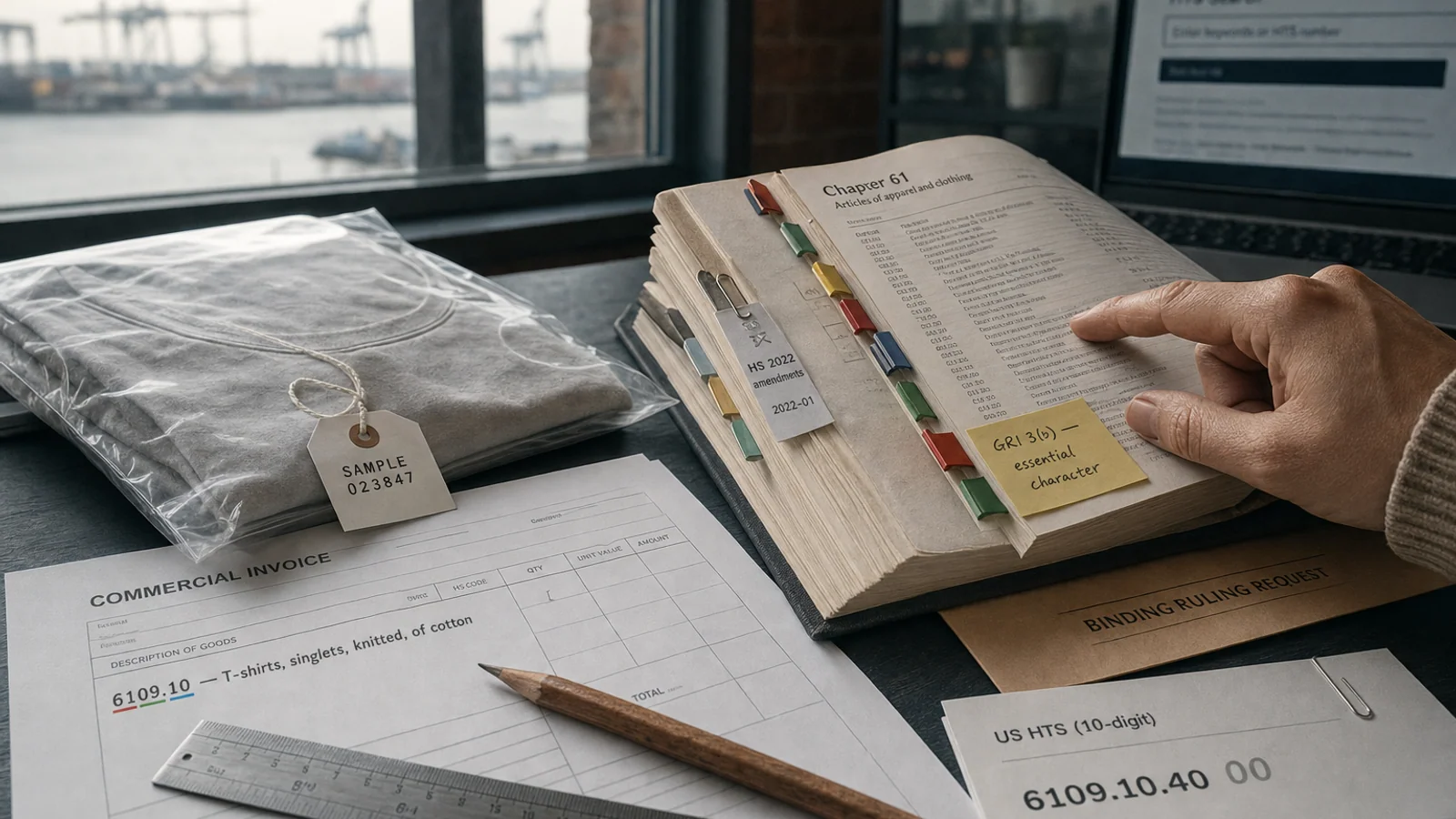
Quick answer An HS code is a six-digit product number from the World Customs Organization's Harmonized System, used by over 200 countries and economies covering about 98% of world trade. Customs uses it to set duties, taxes and restrictions. Countries add two to seven more digits for national tariff lines.
- The first six digits of an HS code are identical worldwide; everything after digit six is national and changes at the border.
- The United States uses 10-digit HTS numbers for imports and 10-digit Schedule B numbers for exports; China uses 13 digits.
- The World Customs Organization revises the Harmonized System every five years — HS 2022 is current and HS 2028 is in development.
- The importer of record, not the carrier or forwarder, is legally responsible for the classification declared to customs.
Classification is the one part of international shipping you cannot outsource your liability for. This guide breaks the code down digit by digit, shows you the free official lookup tools, and explains the rules customs officers actually apply.
See your price in seconds
Real carrier rates, no signup, no follow-up calls.
What is an HS code and why do I need one to ship internationally?
Quick answer An HS code is a six-digit number that identifies a product in the Harmonized System, a classification standard maintained by the World Customs Organization. Over 200 countries and economies use it, covering roughly 98% of world trade. Customs reads the code to assign duty rates, taxes, licensing rules and trade statistics.
The Harmonized System is a nomenclature of roughly 5,000 commodity groups, in force since January 1988. The World Customs Organization (WCO) in Brussels writes it, maintains it and publishes the explanatory notes that interpret it. Every member administration applies the same six digits to the same goods.
The code is what turns a product description into a legal customs category. "Cotton t-shirt" is marketing language. 6109.10 is a classification a customs officer can act on, with a duty rate attached to it.
Per the WCO, more than 200 countries, customs unions and economies classify goods with the Harmonized System, covering about 98% of international merchandise trade.
Plenty rides on those six digits. The code drives your duty rate, the base for VAT or IVA at destination, import licensing, quotas, sanitary and phytosanitary permits, and whether you qualify for a free trade agreement preference.
- CBP (United States) and CBSA (Canada) require a tariff number on every entry.
- DIAN (Colombia) calls it the posición arancelaria on the import declaration.
- SAT (Mexico) uses the TIGIE fraction, SUNAT (Peru) the partida arancelaria.
- ANAM (Panama) and Receita Federal (Brazil, via NCM) ask for it on every declaration.
A shipment without a correct code does not move, no matter how good the freight rate is. Classification errors strand containers that were booked, loaded and sailed on time.
See your price in seconds
Real carrier rates, no signup, no follow-up calls.
How many digits are in an HS code and what does each digit mean?
Quick answer An HS code has six internationally standard digits: two for the chapter, two for the heading, two for the subheading. Countries then add two to seven national digits for their own tariff lines. Digits one through six are identical in Bogotá, Houston and Shanghai; the rest are local.
Work through a real example. Roasted coffee beans, not decaffeinated, ship under 0901.21.
- 09 — the chapter: coffee, tea, maté and spices.
- 0901 — the heading: coffee, whether or not roasted or decaffeinated.
- 0901.21 — the subheading: coffee, roasted, not decaffeinated. This six-digit root is the same in every HS member country.
- 0901.21.00.35 — the US HTS extension, which separates the goods further for US duty and statistical reporting.
A non-food example works the same way. A passenger car with a spark-ignition engine between 1,500 and 3,000 cc classifies under 8703.23: chapter 87 (vehicles other than railway), heading 8703 (motor cars for transport of persons), subheading 8703.23 (engine displacement band).
The full Harmonized System runs to 21 sections and 99 chapters. Chapter 77 is reserved for future use. Chapters 98 and 99 are set aside for national purposes — the US uses chapter 98 for returned goods and chapter 99 for temporary rates, including Section 301 duties.
| Jurisdiction | Code for roasted coffee | Digits | Where the digits diverge |
|---|---|---|---|
| International (WCO) | 0901.21 | 6 | — |
| United States (HTS) | 0901.21.00.35 | 10 | Digit 7 |
| European Union (CN) | 0901.21.00 | 8 | Digit 7 |
| Canada (Customs Tariff) | 0901.21.00.10 | 10 | Digit 7 |
The pattern holds across products. Get the first six right and the rest is a local lookup, not a new decision.
What is the difference between an HS code and an HTS code?
Quick answer An HS code is the six-digit international root; an HTS code is the 10-digit United States import number built on top of it. Schedule B is the 10-digit US export number. The EU uses 8-digit CN codes and 10-digit TARIC codes. All of them share the same first six digits.
The HTS is the Harmonized Tariff Schedule of the United States. The US International Trade Commission publishes it; CBP enforces it on imports. Every US import entry carries a 10-digit HTS number.
Schedule B is the 10-digit export classification published by the US Census Bureau. You file it in the Automated Export System when an export shipment exceeds $2,500 per Schedule B number, or when a license is required.
Exporters may generally use the HTS number in AES instead of Schedule B, but not always — some Schedule B lines have no matching HTS line, because export statistics track different detail than import tariffs. When in doubt, use Schedule B for exports.
| Code | Digits | Region | Issuing authority | Used for |
|---|---|---|---|---|
| HS code | 6 | Global | World Customs Organization | Both |
| HTS code | 10 | United States | USITC / CBP | Imports |
| Schedule B | 10 | United States | US Census Bureau | Exports |
| CN code | 8 | European Union | European Commission | Exports, statistics |
| TARIC code | 10 | European Union | European Commission | Imports |
| Commodity code (UK) | 10 | United Kingdom | HMRC | Imports |
Country length varies widely once you pass digit six. Here is what the major markets require as of 2026.
| Country / region | Digits required | Official lookup tool |
|---|---|---|
| United States | 10 | USITC HTS Search / Census Schedule B |
| European Union | 8 or 10 | TARIC Consultation |
| United Kingdom | 10 | UK Trade Tariff |
| Canada | 10 | Canada Tariff Finder |
| China | 13 | GACC tariff database |
| India | 8 | ITC-HS / ICEGATE |
| Japan | 9 | Japan Customs Tariff Schedule |
| Australia | 10 | ABF Working Tariff |
Putting a US HTS number on a Brazilian or Colombian import declaration does not work — only the first six digits travel across borders.
See your price in seconds
Real carrier rates, no signup, no follow-up calls.
How do I find the HS code for my product for free?
Quick answer Start with the official tariff database of the destination country, search by material and function rather than brand name, then confirm the six-digit root in the WCO nomenclature. US importers use the USITC HTS search; exporters use the Census Schedule B tool. Both are free and public.
- Write a technical description. Material composition, function, state (raw, semi-finished, finished), packaging, and whether it ships as a set.
- Find the chapter by material or industry, then read the section and chapter notes before you read the headings. Legal notes override intuition every time.
- Use the free official tools: USITC HTS search, Census Schedule B Search Engine, EU TARIC consultation, Canada Tariff Finder, Colombia's DIAN arancel, Mexico's SAT TIGIE.
- Cross-check CBP CROSS for rulings on products like yours. A prior ruling is the closest thing to a free second opinion.
- Document your reasoning in writing and keep it in the shipment file for five years, the standard US recordkeeping period.
Never copy a code straight off a supplier's commercial invoice. Suppliers classify for their own export tariff, not your destination tariff, and their six-digit root may be wrong for how your product is finished or packaged. Verify it against the destination country's published schedule before you file.
What are the 6 General Rules of Interpretation?
Quick answer The General Rules of Interpretation, or GRI, are six legally binding rules that decide classification when a product could fit more than one heading. They apply in strict order: you may only move to GRI 2 after GRI 1 fails. GRI 6 extends the same logic down to the subheading level.
- GRI 1 — classification follows the terms of the headings and the section or chapter notes. This resolves most cases.
- GRI 2(a) — incomplete or unassembled goods keep the finished classification. A knocked-down bicycle in a box is still a bicycle.
- GRI 2(b) — mixtures and composite goods extend to materials combined with other materials.
- GRI 3 — the tiebreakers: (a) most specific description, (b) essential character, (c) last in numerical order. This is how a gift basket or a tool kit gets classified.
- GRI 4 — genuinely novel goods classify with their closest kin.
- GRI 5 — cases, containers and packing materials usually follow the goods inside them.
- GRI 6 — applies rules 1 through 5 at subheading level, comparing only subheadings at the same dash level.
The order is mandatory
Jumping straight to "essential character" under GRI 3(b) is the most common classification error. You may only reach GRI 3 after the headings and legal notes under GRI 1 fail to resolve the goods. Customs will apply the rules in sequence even if you did not.
What happens if you use the wrong HS code?
Quick answer The wrong HS code triggers held cargo, amended entries, back duties with interest and penalties. Under US law, CBP can assess penalties up to the domestic value of the goods for fraud, two to four times the lost duty for gross negligence, and up to twice the lost duty for negligence.
Those tiers come from 19 U.S.C. § 1592. The Customs Modernization Act added the "reasonable care" standard, which means the importer must show a documented, defensible classification process — not a guess.
The operational cost often exceeds the penalty. While the entry is corrected, the container sits at the terminal. Demurrage and detention keep running, and free time does not pause for a classification dispute.
Latin American authorities enforce the same way under their own schedules. DIAN can impose fines and, in serious cases, seizure for an incorrect posición arancelaria. SUNAT in Peru and ANAM in Panama apply their own sanction tables.
Underpaying duty creates liability. Overpaying is a silent loss — the wrong code can also cost you a free trade agreement preference you were entitled to, because rules of origin are written as tariff shifts at chapter, heading or subheading level.
The importer of record owns the classification
Legal responsibility sits with the importer of record, even when the supplier, forwarder or broker provided the number. If you find an error before CBP does, a prior disclosure under 19 U.S.C. § 1592(c)(4) can sharply reduce the penalty exposure. Talk to a licensed customs broker before filing one.
How do you get a binding ruling to confirm a classification?
Quick answer A binding ruling is a written decision from a customs authority that legally fixes the classification of your product. CBP issues rulings free of charge through the eRulings portal, normally within 30 days for electronic requests. The EU equivalent is Binding Tariff Information, valid for three years.
To file with CBP, submit the eRulings Template with a complete product description, spec sheets or samples, the intended use, and your proposed classification with the reasoning behind it. Search CROSS first — an existing ruling on a near-identical product may answer the question at no cost and no wait.
- United States: CBP eRulings portal, searchable in CROSS.
- European Union: Binding Tariff Information via the EU Customs Trader Portal, valid three years.
- Canada: CBSA National Customs Rulings, plus advance rulings under USMCA.
- Mexico: advance rulings available through SAT under USMCA provisions.
A ruling protects you prospectively, not retroactively. It does not erase past entries filed under a wrong code.
Hire a licensed customs broker for multi-component machinery, chemical mixtures, textiles with blended fibers, and anything with antidumping exposure. Those four categories generate the most reclassifications. A binding ruling is the only answer customs cannot argue with later.
Where do HS codes appear on your shipping paperwork?
Quick answer The HS or national tariff code appears on the commercial invoice, the packing list, the customs declaration, the certificate of origin and the export filing. It does not legally belong on the Bill of Lading, but carriers increasingly ask for it to support advance manifest and ISF data.
| Document | Code required? | Digits | Filed with |
|---|---|---|---|
| Commercial invoice (Factura Comercial) | Yes, per line | 6–10 | Customs at destination |
| Packing list | Recommended | 6 | Customs, carrier |
| ISF "10+2" | Yes | 6 minimum | CBP, 24h before loading |
| AES / EEI export filing | Yes | 10 (Schedule B) | US Census Bureau |
| Certificate of Origin | Yes | 6 | Customs, FTA claims |
| Bill of Lading | Not legally required | 6 if requested | Carrier / NVOCC |
The Bill of Lading is a transport document — a contract of carriage and title document — not a customs document. Our guide to what a Bill of Lading is and why you need one explains where that line sits and why consignee details on the B/L still have to match the invoice.
One product, one code, on every document. Mismatched codes between the invoice and the declaration are a classic inspection trigger at PortMiami, Cartagena and Santos alike.
How does your HS code affect what you pay to ship and import?
Quick answer The HS code sets your duty rate and tax base at destination, not your freight cost. Freight is driven by mode, volume, weight, lane and gateway. Walio's calculator on this page prices your exact shipment in seconds from real carrier rates, with charges itemized and no sales call.
Freight and surcharges
Driven by mode, cubic meters or chargeable weight, lane and gateway. Includes THC, BAF, drayage and last mile. Walio compares real rates from carriers like Maersk, MSC, CMA CGM and Hapag-Lloyd and itemizes every charge on screen.
Duties and taxes
Driven by your HS code and the declared customs value. Published as percentages by each customs authority. A worked example: customs value $20,000 × 10% duty = $2,000, then destination IVA applies to value plus freight plus duty.
Mode choice moves the freight number more than anything else. LCL usually beats FCL below roughly 10–15 m³, and above that a 20 ft container is normally cheaper per cubic meter. For air, chargeable weight decides.
Your origin decides your gateway. Florida ships via PortMiami, Texas and the central states via Port Houston, California via LA/Long Beach, the Northeast via NY/NJ, the Southeast via Savannah, the Midwest by rail through Chicago, the Pacific Northwest via Seattle. Ontario routes via Toronto, Quebec and the Atlantic provinces via Montreal, Western Canada via Vancouver.
 Miami(USMIA)
 Cartagena(COCTG)
Watch the port cut-off, not the vessel ETD. Documentation cut-off typically falls two to three days before sailing, and a late classification correction can miss it.
Incoterms 2020 decide who carries the duty. DDP puts duty and import liability on the seller. DAP leaves it with the buyer. FOB and CIF split responsibility at the origin port. For duty and tax rulings, consult a licensed customs broker or tax adviser.
See your price in seconds
Real carrier rates, no signup, no follow-up calls.
How often does the Harmonized System change?
Quick answer The WCO revises the Harmonized System every five years. HS 2022 is the edition in force as of 2026, and it introduced 351 sets of amendments. HS 2028 is in development. Re-verify your codes before each cycle, because headings get split, merged or deleted.
| Edition | Effective | Amendment sets | Main product areas affected |
|---|---|---|---|
| HS 2017 | 1 Jan 2017 | 233 | Fish, forestry, chemicals, LED lamps |
| HS 2022 | 1 Jan 2022 | 351 | E-waste, drones, smartphones, novel tobacco, 3D printers |
| HS 2028 | 1 Jan 2028 (planned) | In development | Environmental goods, dual-use items, digital products |
A code that was correct in 2021 may not exist in HS 2022. Review your product catalog against the current edition before each annual tariff update.
You now know what an HS code is, how the six digits break down, and where the national extensions begin. Classification sets your duty. Freight is a separate number, and you can see it right now. Enter your route in the calculator above and see your price in seconds — no signup, no follow-up calls.
An HS code is a six-digit number that tells customs exactly what your product is. The World Customs Organization maintains the system, and more than 200 countries and economies use the same first six digits, covering about 98% of world trade. Customs uses the code to set your duty rate, taxes and any import restrictions.
An HS code is the six-digit international root, while an HTS code is the 10-digit United States import number built on that root. The first six digits are always the same; the last four are US-specific tariff detail published by the USITC and enforced by CBP. For US exports, you use a 10-digit Schedule B number instead.
Use the official tariff database of the destination country — the USITC HTS search for US imports, the Census Schedule B tool for US exports, TARIC for the EU, the Canada Tariff Finder, DIAN for Colombia or SAT's TIGIE for Mexico. All are free and public. Search by material and function, read the chapter notes, then cross-check similar products in the CBP CROSS ruling database.
Your cargo can be held, your entry amended, and back duties charged with interest and penalties. Under US law CBP can assess up to twice the lost duty for negligence and up to the domestic value of the goods for fraud. Demurrage and detention keep accruing at the port while the classification is corrected.
The importer of record is legally responsible, even when a supplier, forwarder or customs broker supplied the number. US law requires importers to exercise reasonable care in classification. If you are unsure, request a binding ruling from CBP through the eRulings portal or work with a licensed customs broker.
The World Customs Organization revises the Harmonized System every five years. HS 2022 is the edition currently in force and introduced 351 sets of amendments, including new lines for e-waste, drones and novel tobacco products. HS 2028 is already in development, so codes should be re-verified before each cycle.