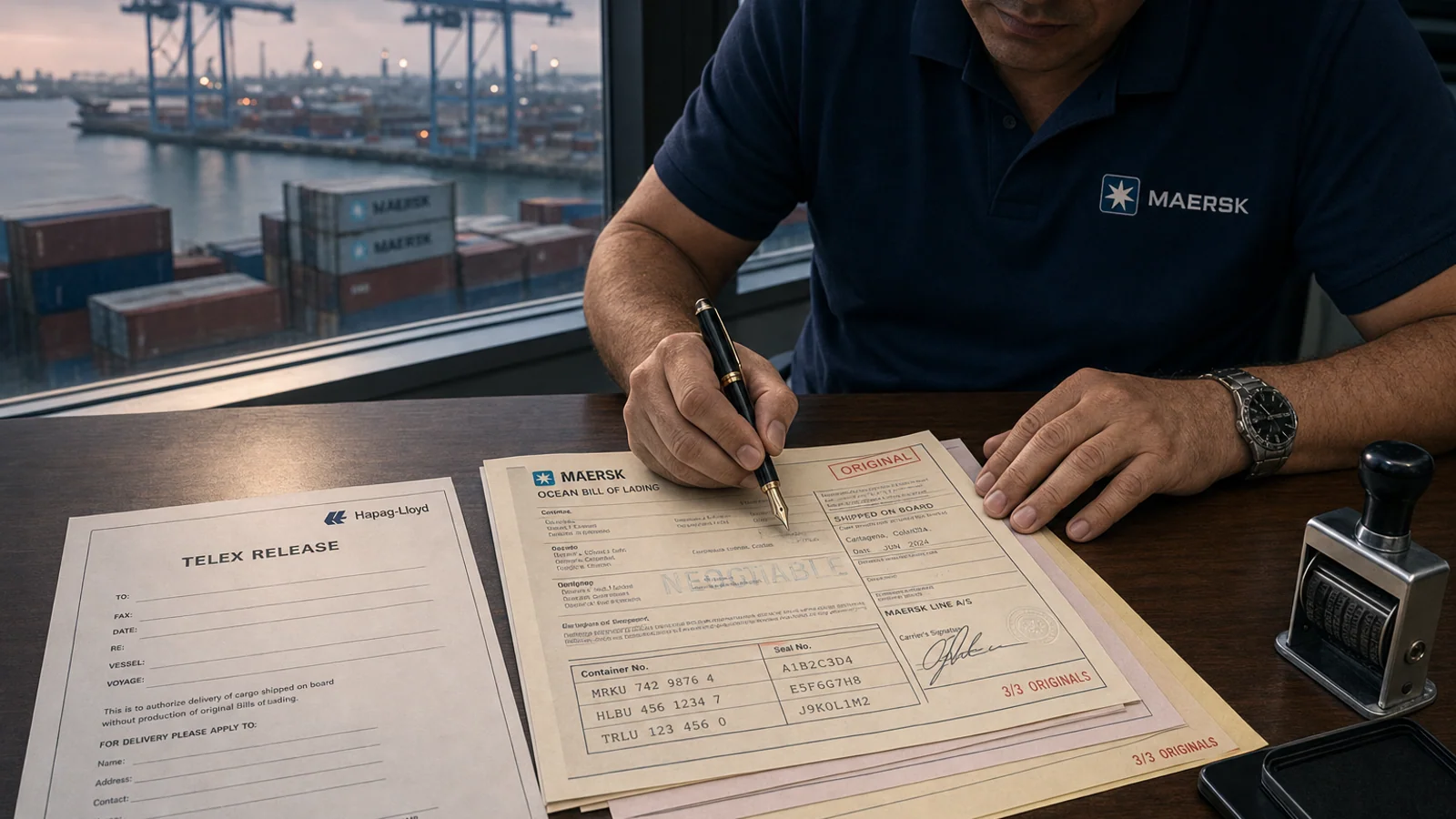
Quick answer A bill of lading (B/L) is the transport document a carrier issues to a shipper that does three jobs at once: it receipts the cargo, evidences the contract of carriage, and acts as a document of title. Without a correctly released B/L, the consignee cannot collect the container at destination.
- A bill of lading performs three legal functions: receipt of goods, evidence of the contract of carriage, and document of title.
- An order (negotiable) B/L transfers ownership by endorsement; a straight B/L names one consignee and cannot be traded.
- Telex or express release replaces couriering three originals and typically frees cargo the same business day once the carrier confirms.
- Walio prices port-to-port 20 ft and 40 ft HC containers from $756 to Colombia and $3,066 to Venezuela, and the B/L is issued by the carrier after sailing.
This guide walks through every box on the document, every B/L type, and what to do when one is lost or wrong. It is written for first-time importers and exporters on the USA and Canada to Latin America lanes.
See your price in seconds
Real carrier rates, no signup, no follow-up calls.
What is a bill of lading and why do I need one?
Quick answer A bill of lading is the document a carrier or its agent issues to the shipper once cargo is loaded. It proves the carrier received the goods, states the terms of carriage, and controls who may claim the container at destination. No valid B/L, no cargo release — customs and the terminal both demand it.
So, what is a bill of lading in plain terms? It is a transport document issued by the ocean carrier, an NVOCC or a freight forwarder to the shipper, naming the cargo, the voyage and the party entitled to collect it.
A packing slip or commercial invoice cannot replace it. The terminal releases the container against the B/L and the delivery order that follows it, never against your invoice. The invoice proves value to customs; the B/L proves entitlement to the goods.
You will see several abbreviations for the same family of documents: B/L, BOL, OBL (original bill of lading), MBL (master) and HBL (house). They differ in who issues them, not in what they fundamentally do.
The timing is predictable. Your cargo gates in before the port cut-off, which falls a day or two ahead of vessel ETD. The box loads, the vessel sails, and the carrier then issues the B/L with the on board date.
Customs authorities build their import filings around B/L data. CBP in the United States, DIAN in Colombia, SUNAT in Peru, SAT in Mexico and ANAM in Panama all reference the B/L number, container number and manifest details when matching your declaration to the vessel manifest.
Ask your forwarder for the draft B/L the same day the container gates in. Reviewing the draft before the documentation cut-off is free; correcting a filed manifest is not.
What are the three functions of a bill of lading?
Quick answer A bill of lading works as a receipt, a contract and a title document. As a receipt it records quantity, marks and apparent condition. As evidence of the contract of carriage it binds carrier and shipper to liability terms. As a document of title it lets the holder claim or transfer ownership of the goods in transit.
Receipt of goods
The carrier confirms it took custody of a stated number of packages in apparent good order. On containerized cargo you will see "said to contain" and "shipper's load, stow and count", because the carrier never opened the box.
A clean B/L carries no adverse remark about the condition of the goods. A claused or "foul" B/L notes damage, such as torn cartons or stained drums. Banks reject claused documents under letters of credit, because the buyer is paying for sound cargo.
Evidence of the contract of carriage
The reverse of a carrier B/L holds the terms and conditions: liability limits, jurisdiction, free time at destination, and demurrage and detention clauses. Those printed terms govern your claim if a container arrives short or damaged.
Document of title
Whoever lawfully holds the original can claim the cargo. That single feature is why sellers keep originals until payment clears, and why banks hold them as security in documented trade.
Watch the difference between "received for shipment" and "shipped on board". Letters of credit under UCP 600 almost always demand an on board notation with a date. The clean on board B/L is what triggers bank negotiation and payment.
Carriers normally issue a set of three signed originals. Presenting any one of them releases the cargo, which is why the other two become void on first presentation.
What information is required on a bill of lading?
Quick answer Every bill of lading must name the shipper, consignee, notify party and carrier, describe the cargo, and identify the voyage. Required fields include container and seal numbers, package count, gross weight, measurement in cubic meters, port of loading, port of discharge, freight terms and the on board date.
Carrier forms follow a standard layout. Read the draft box by box, in this order.
| Box on the B/L | What goes in it | Common error |
|---|---|---|
| Shipper | Legal name, address, tax ID | Trade name instead of legal name |
| Consignee | Legal name plus RUT, NIT, RFC or RUC | Missing or wrong tax ID |
| Notify party | Customs broker contact | Left blank |
| Vessel / voyage | Vessel name and voyage number | Outdated after a vessel change |
| Port of loading | Miami, Houston, Savannah, NY/NJ | Terminal named instead of port |
| Port of discharge | Cartagena, Callao, Veracruz, Santos | Transshipment port used |
| Marks and numbers | Container number, seal number | Digit typo in seal |
| Description of goods | Plain description plus HS code | Too vague, e.g. "machine parts" |
| Packages | Count and package type | Pallets counted as cartons |
| Gross weight | Kilograms | Net weight entered instead |
| Measurement | Cubic meters (m³) | Rounded wrongly on LCL |
| Freight terms | Prepaid or collect | Conflicts with the Incoterm |
| Number of originals | Usually three | Changed after issue |
| Place and date of issue | On board date | Date earlier than sailing |
The notify party matters more than new shippers expect. Naming the destination customs broker as notify party means arrival notices land directly with the person filing your entry, which shortens clearance.
Your cargo description must match the Factura Comercial and the HS classification. Mismatches between the B/L, the invoice and the declaration invite customs queries at DIAN, SUNAT or Receita Federal.
The freight terms box maps to your Incoterms 2020 choice. FOB and FCA sales usually show freight collect. CIF, CFR, DAP and DDP sales usually show freight prepaid, because the seller bought the ocean leg.
What types of bills of lading exist and when is each used?
Quick answer The main types are straight (non-negotiable), order (negotiable), bearer, master, house, switch, through, combined transport and charter party bills of lading. Straight B/Ls suit shipments already paid for. Order B/Ls suit letters of credit and open accounts where the seller keeps control until payment clears.
| Type | Consignee field | Transfer method | Risk to seller | Typical payment terms |
|---|---|---|---|---|
| Straight B/L | Named company | None, not negotiable | High if unpaid | Prepaid or intercompany |
| Order B/L | "To order of shipper" | Endorsement on reverse | Low | Letter of credit, open account |
| Bearer B/L | Blank | Physical delivery | Very high if lost | Rare, specialized trades |
An order B/L reading "to order of shipper" stays under the seller's control until the seller signs the reverse. "To order of bank" puts the issuing bank in control under a letter of credit, and the bank endorses only after the buyer pays or accepts the draft.
A switch B/L replaces an original set with a second set, often to hide the real supplier in a triangular trade. A through B/L or combined transport B/L covers more than one leg, which matters on transshipment hubs such as Cartagena, Caucedo and Kingston.
A charter party B/L refers back to a charter agreement the bank never sees. Banks routinely refuse it under UCP 600 unless the credit expressly permits it.
On LCL consolidations, two documents exist for the same cargo. The consolidator issues the house B/L to you, and the ocean carrier issues the master B/L to the consolidator.
See your price in seconds
Real carrier rates, no signup, no follow-up calls.
Master bill of lading vs house bill: what's the difference?
Quick answer A master bill of lading is issued by the ocean carrier to the NVOCC or freight forwarder. A house bill of lading is issued by that forwarder to the actual shipper. On a master B/L the forwarder is the shipper; on the house B/L your company is. Both describe the same cargo.
A house bill of lading is the document your freight forwarder or NVOCC issues to you, in its own name, covering your specific consignment inside a larger movement.
| Feature | Master B/L (MBL) | House B/L (HBL) |
|---|---|---|
| Issued by | Ocean carrier | NVOCC or forwarder |
| Shipper named | Forwarder or NVOCC | Your company |
| Consignee named | Destination agent | Your buyer |
| Held by | Forwarder | Shipper, buyer or bank |
| Used for | Carrier contract | LCL and forwarder FCL |
| Chase for release | Carrier agent | Destination agent |
When you get only an MBL
Direct FCL bookings with a carrier such as Maersk, MSC, CMA CGM or Hapag-Lloyd produce one document. Your company is the shipper on the carrier's own B/L, and you deal with the carrier's destination office for release.
When you get an HBL plus an MBL
LCL shipments to Buenaventura or Callao nearly always generate both. Your cargo shares a container with other shippers, so the consolidator contracts with the carrier and issues you a house document for your pallets alone.
On US imports, the ISF "10+2" filing to CBP must be transmitted before loading abroad. The filing carries the lowest-level B/L number, which is the house B/L number when an HBL exists, and the MBL must be linked so CBP can match the manifest.
A released house B/L is not enough
If the master B/L is still unreleased at the terminal, your cargo stays put even with a clean house release. Both levels must be free, and free time keeps running while you wait.
Original vs telex release: how is cargo actually released?
Quick answer A telex release is a carrier message confirming the shipper surrendered all original bills of lading at origin, letting the consignee collect cargo without presenting paper. Originals must be couriered and physically presented. Express release means no originals were ever printed. Choose by how much payment risk you carry.
Three release methods exist, and you pick one at booking. A surrendered B/L means the originals were handed back to the carrier at origin. Express release means the carrier printed no originals at all, which suits intercompany moves.
- The buyer pays, or the bank confirms payment under the credit.
- The shipper surrenders all three originals at the carrier's origin office.
- The carrier messages its destination agent confirming surrender.
- The agent issues the delivery order to the consignee or broker.
- The terminal releases the container against that delivery order, not the B/L itself.
Timing is the practical argument. Couriering three originals from Miami to Lima or Santos takes several days and can miss vessel arrival. A telex release usually clears the same business day once the carrier confirms surrender.
Originals still earn their keep. Use them for letter of credit shipments, first-time buyers, and open-account sales where you carry real non-payment risk.
Free time starts at discharge, not at release
Demurrage accrues on the container inside the terminal and detention accrues once it leaves. A release delayed by couriered originals burns free time you already paid for. Confirm the release method before the vessel sails.
Bill of lading vs sea waybill, air waybill and invoice?
Quick answer A bill of lading can transfer ownership; a sea waybill cannot. A sea waybill is a non-negotiable receipt released to the named consignee with no paper to present. An air waybill is always non-negotiable. The commercial invoice proves value and the packing list proves contents — neither releases cargo.
| Document | Negotiable | Transfers title | Release process | Best use |
|---|---|---|---|---|
| Bill of lading | Yes, if "to order" | Yes | Original or telex | Letters of credit |
| Sea waybill | No | No | ID of named consignee | Prepaid, intercompany |
| Air waybill | No | No | ID plus arrival notice | All air cargo |
| Delivery order | No | No | Issued after B/L release | Terminal pickup |
A sea waybill is the smarter choice on short transits where paper cannot keep up. Miami to Caucedo or Kingston runs in a few days, so originals in a courier bag arrive after the vessel does.
Supporting documents each prove a different thing. Keep them consistent.
- Commercial invoice (Factura Comercial): value, Incoterm and parties.
- Packing list: contents, package count and weights.
- Certificado de Origen: origin for preferential duty under trade agreements.
- US Customs Form 3299: household goods and personal effects, with a used-goods declaration and full inventory.
If you are still choosing a mode, the documentation follows the decision. Read Air Freight vs Ocean Freight: Which One Wins? before you commit, because an air waybill never gives you title security. For split routings that combine a sea leg and an air leg, each leg carries its own document — What Is Sea Air Shipping and When Does It Win? explains how that paperwork chains together.
Vehicles moving without a container get their own version. A RoRo B/L names the VIN, make, model and running condition instead of package counts — see What Is RoRo Shipping and How Does It Work? for how that booking runs.
What happens if the bill of lading is lost or wrong?
Quick answer If an original bill of lading is lost, the carrier will normally release cargo only against a letter of indemnity, often bank-backed, plus a formal declaration. Errors are fixed by a B/L amendment before or shortly after sailing. Late corrections trigger carrier amendment fees and can delay customs clearance.
Corrections are free before the documentation cut-off. Once the carrier files the manifest with customs, every change becomes a paid amendment, and some ports also charge a manifest correction fee.
- Wrong consignee tax ID: RUT in Colombia, NIT, RFC in Mexico, RUC in Peru.
- Gross weight that disagrees with the VGM filing.
- Container or seal number typed one digit off.
- Cargo description too vague for the HS code declared.
- Port of discharge set to the transshipment hub instead of the final port.
A letter of indemnity is a written promise to cover the carrier if the real holder later appears and claims the cargo. Banks counter-sign these reluctantly, because the exposure can last for years.
Liability sits in international and national law. Ocean carriage usually runs under the Hague-Visby Rules, with US COGSA applying to US trades, while the Hamburg and Rotterdam Rules apply in a narrower set of states. Domestic US trucking runs under the Carmack Amendment and the NMFTA uniform straight bill of lading.
Manifest corrections at DIAN, SUNAT or Receita Federal can carry their own penalties under local rules. Ask a licensed customs broker in the destination country before filing anything disputed.
Scan everything before it leaves your office
Keep PDF copies of all three originals, the surrender receipt and the telex confirmation. If a courier loses the set, those scans speed the indemnity process and prove what the carrier issued.
What does the shipment cost and how do I price it now?
Quick answer The bill of lading is free paperwork attached to a freight rate. Walio's port-to-port container prices start at $756 for Colombia and run to $3,066 for Venezuela, with Guatemala at $810 and Panama at $821. Documentation, release type and destination charges sit outside that base ocean rate.
Walio's published port-to-port prices for a 20 ft or 40 ft HC container of general cargo run as follows: Colombia $756, Guatemala $810, Panama $821, Honduras $864, Argentina $972, Chile $1,080, Ecuador $1,080, Peru $1,080, Uruguay $1,426, Dominican Republic $1,431, Brazil $1,566, Costa Rica $1,577, Mexico $1,577, Jamaica $1,890, El Salvador $2,249 and Venezuela $3,066.
The lowest published container price in Walio's Latin America lane set. The carrier issues the bill of lading after sailing at no separate charge on the base ocean rate.
 Miami(USMIA)
 Cartagena(COCTG)
Your origin gateway moves the number. Florida ships through PortMiami, Texas and the central states through Port Houston, California and the Southwest through LA/Long Beach, the Northeast through NY/NJ, the Southeast through Savannah, the Midwest by rail via Chicago, and the Pacific Northwest through Seattle. From Canada, Ontario routes via Toronto, Quebec and the Atlantic provinces via Montreal, and Western Canada via Vancouver.
The base ocean rate excludes several real charges. Expect THC and DTHC, BAF, peak season surcharge, drayage, CFS deconsolidation on LCL, and duties and taxes at destination, which the importer pays unless you sold DDP.
RoRo, air cargo, door-to-door moves and oversized pieces on flat rack are quoted on request. Submit the shipment in the calculator and a Walio specialist follows up with the number.
See your price in seconds
Real carrier rates, no signup, no follow-up calls.
How do I fill out a bill of lading step by step?
Quick answer Start with the shipper and consignee legal names and tax IDs, add the notify party, then describe the cargo exactly as the commercial invoice does. Enter container and seal numbers, package count, gross weight and measurement. Pick freight terms, choose straight or order, confirm release type, then approve the draft before cut-off.
- Enter shipper legal name, address and tax ID.
- Enter the consignee exactly as registered with destination customs.
- Add the notify party, normally the destination customs broker.
- Copy the cargo description and HS code from the Factura Comercial.
- Enter container number, seal number, packages, gross weight in kg and m³.
- Select freight prepaid or collect to match your Incoterm.
- Choose straight or "to order" based on payment risk.
- Confirm release type: originals, telex or express.
- Approve the draft before the documentation cut-off.
Domestic US trucking uses a different form. On an LTL uniform straight bill or VICS BOL, you add the PRO number, the NMFC code and freight class, accessorials such as liftgate or inside delivery, the driver's signature, and any OS&D notation for shortage or damage at delivery.
Are electronic bills of lading accepted?
Yes, and adoption is growing. The DCSA publishes eBL standards, the UNCITRAL MLETR gives electronic records legal equivalence, and the UK Electronic Trade Documents Act 2023 put that into force. Major carriers signed the FIT Alliance pledge to move toward full eBL use.
| Feature | Paper B/L | Electronic B/L (eBL) |
|---|---|---|
| Transfer time | 2-7 days by courier | Minutes |
| Courier cost | Yes, per set | None |
| Legal basis | Hague-Visby, COGSA | MLETR, UK ETDA 2023 |
| Fraud risk | Forgery, loss in transit | Platform-controlled |
| Platforms | None | WAVE BL, Bolero, essDOCS, CargoX |
Confirm acceptance with your bank first. A letter of credit shipment only works on an eBL if the issuing bank and the buyer's jurisdiction both recognize it.
Your bill of lading is paperwork wrapped around a freight rate, and the rate is the part you control. Enter your route in the calculator above and see your price in seconds — no signup, no follow-up calls.
See your price in seconds
Real carrier rates, no signup, no follow-up calls.
The carrier, its agent, or an NVOCC issues the bill of lading to the shipper after the cargo is loaded. Carriers normally issue three signed originals, and the shipper holds them until payment is settled, then couriers them to the consignee or surrenders them for a telex release. The consignee or its customs broker presents the original or the telex confirmation to get the delivery order.
A straight bill of lading names one consignee and cannot be transferred, while an order bill of lading is negotiable and passes by endorsement. Straight B/Ls work when the goods are already paid for or moving between related companies. Order B/Ls protect sellers under letters of credit because the buyer only gets title once the bank endorses the document.
A bill of lading is a document of title that can transfer ownership; a sea waybill is not and cannot. With a sea waybill the carrier releases cargo to the named consignee on proof of identity, with no originals to courier. Use a sea waybill for prepaid or intercompany shipments, and a bill of lading when you need payment security.
If an original is lost, the carrier usually releases cargo only against a letter of indemnity, often backed by a bank guarantee. Mistakes are corrected with a B/L amendment, which is free before the documentation cut-off but carries a carrier fee once the manifest is filed. Fix tax ID, weight and container number errors before sailing to avoid customs delays.
Yes, in jurisdictions that have adopted MLETR-based law, including the UK under the Electronic Trade Documents Act 2023, an electronic bill of lading carries the same legal force as paper. Major carriers and platforms such as WAVE BL, Bolero, essDOCS and CargoX issue eBLs under DCSA standards. Confirm with your bank and your counterparty's jurisdiction before choosing an eBL for a letter of credit shipment.