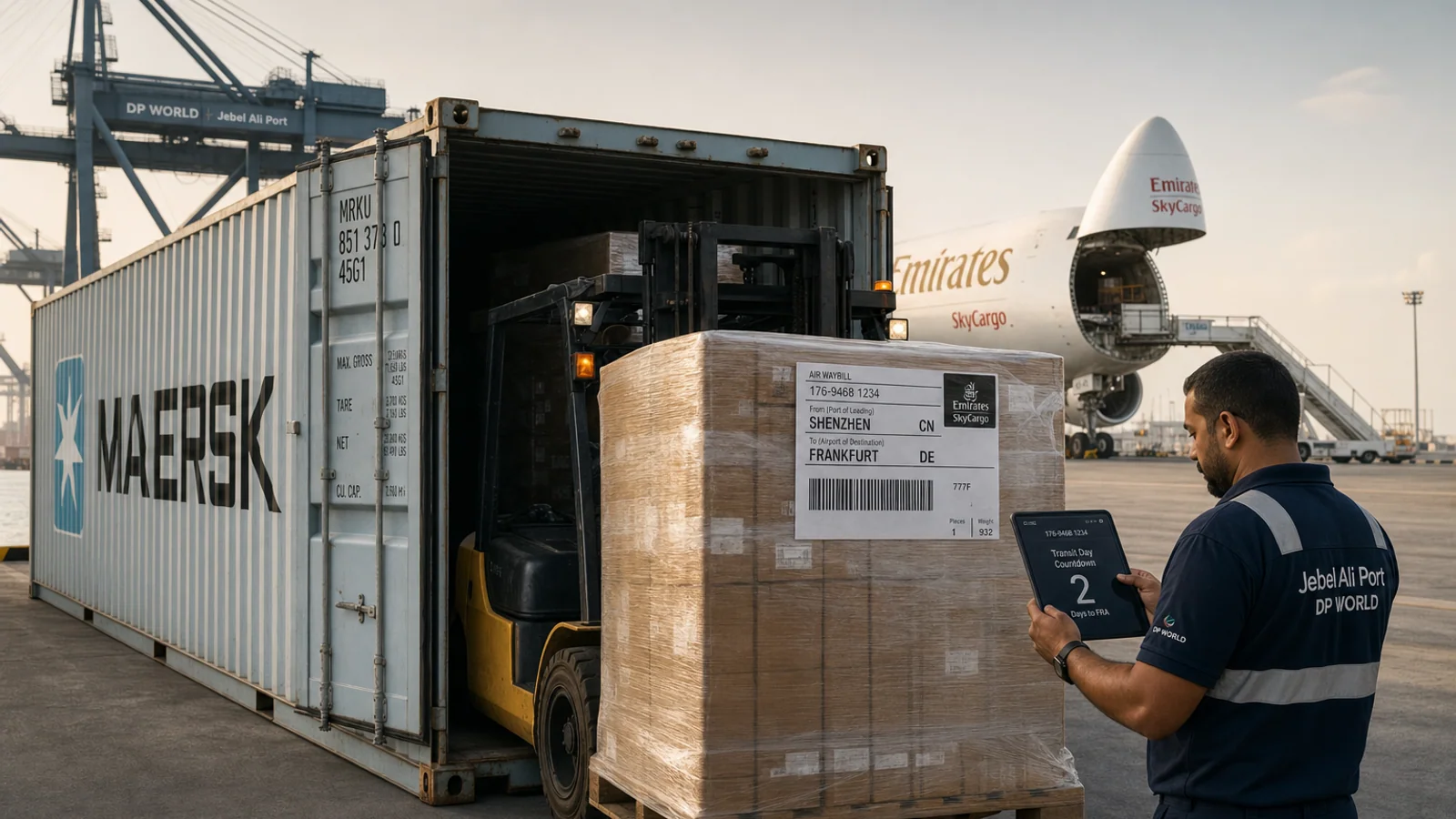
Quick answer Sea air shipping moves cargo by ocean vessel to a transshipment hub, then by aircraft to the final airport, typically landing in 18-25 days from Asia. That sits roughly half the transit of pure ocean freight and well above air freight cost efficiency. It wins when cargo is too urgent for a vessel and too heavy for a plane.
- Sea air shipping combines one ocean leg and one air leg through a transshipment hub such as Dubai, Singapore, Colombo, Busan or Los Angeles.
- Typical Asia to Europe sea-air transit runs 18-25 days, against 32-40 days by pure ocean and 4-7 days by pure air.
- The handover at the hub involves deconsolidation at a CFS, re-palletizing to aircraft dimensions and a bonded transfer from port to airport.
- Sea-air usually moves on a separate Bill of Lading plus Air Waybill, so insurance and liability must be written to cover both legs.
This guide explains how the two legs connect, which hubs serve which lanes, and the exact transit ranges importers should plan around. Then you can price your own shipment on this page.
See your price in seconds
Real carrier rates, no signup, no follow-up calls.
What is sea air shipping and how does it work?
Quick answer Sea air shipping is a multimodal service that carries cargo by ocean vessel to an intermediate hub, then by aircraft to the destination airport. One booking, two modes, one freight forwarder coordinating the handover. It targets the gap between slow ocean freight and expensive air freight on long Asia-to-West trade lanes.
The definition matters because people confuse three terms. Sea-air freight joins a vessel leg and an air leg at a transshipment hub under a single forwarder booking. The forwarder owns the handover, books the flight and keeps the cargo moving under customs control at the hub.
Air-sea reverses the order. Cargo flies to a hub first, then sails to the final port. It exists, but it is rare. The economics only work when origin ocean capacity is unavailable or an inland factory sits far from any port.
Multimodal transport means two or more modes under one transport arrangement. Intermodal is different: the same loading unit, usually a container, moves untouched from mode to mode. Sea-air is almost never intermodal, because the cargo leaves the ocean container at the hub and gets rebuilt onto aircraft pallets.
That rebuild step is the part shippers underestimate. Cartons are stripped, stacked to aircraft height, shrink-wrapped, re-weighed and screened for air security. Packaging that survived ocean stowage sometimes fails forklift handling at the hub. For the foundational overview of the service and its use cases, read What Is Sea-Air Shipping and When Should You Use It?.
Ask your forwarder for the hub name before you accept the rate. Two quotes with the same transit range can route through different hubs, and a hub with a one-hour bonded truck run beats one with a four-hour run on reliability every time.
How does sea air shipping work step by step?
Quick answer Cargo is booked as LCL or FCL at origin, sails to a transshipment hub, is deconsolidated at a container freight station, re-palletized to aircraft height and weight limits, cleared for bonded transfer by truck to the airport, then flown to the destination airport for customs release and last mile delivery.
- Booking and origin handling. You book space against a cargo cut-off, not the vessel ETD. The cut-off usually falls two to four days before departure. Miss it and your cargo rolls to the next sailing, which breaks the whole timeline.
- Export clearance and Bill of Lading. The origin customs declaration is filed and the carrier issues a Bill of Lading covering the ocean leg to the hub, not to the final destination.
- Ocean leg to the hub. Sailing time runs 10-16 days from Shanghai, Ningbo, Shenzhen, Ho Chi Minh City or Nhava Sheva, depending on the hub and the service string.
- Deconsolidation at the hub CFS. Containers are stripped at a container freight station. Cartons are re-palletized to a working aircraft pallet height near 160 cm and re-weighed so chargeable weight can be confirmed.
- Bonded drayage to the airport. The freight moves under customs control from port to airport. In Jebel Ali or Singapore that run is often 30-60 minutes. The Air Waybill is issued at this point.
- Flight and destination clearance. The aircraft leg lands at the destination airport, where entry is filed with the relevant authority: CBP in the USA, DIAN in Colombia, SUNAT in Peru, Receita Federal in Brazil, SAT in Mexico. Last mile delivery follows release.
The risk point sits at stage four and five. If the vessel berths late or the flight is full, cargo waits at the hub. Plan for 2-5 days of buffer at the transshipment hub and quote your buyer a range, never a fixed arrival date.
Hub storage is not always free
Free time at the hub CFS is limited and bonded storage is billed by the day once it expires. If your flight slips because of peak season capacity, those days land on your invoice. Confirm the free time in writing before booking.
How long does sea-air shipping take from China to Europe?
Quick answer China to Europe by sea-air runs about 18-25 days door to airport via Dubai or Singapore, against 32-40 days by pure ocean and 4-7 days by pure air. The ocean leg to the hub takes 10-16 days, hub handling 2-4 days, and the flight plus customs 2-4 days.
| Lane | Hub | Ocean leg (days) | Hub handling (days) | Air leg + clearance (days) | Total sea-air (days) | Pure ocean (days) |
|---|---|---|---|---|---|---|
| Shanghai → Europe | Dubai / Jebel Ali | 12-15 | 2-3 | 3-4 | 18-22 | 32-40 |
| Shenzhen → Los Angeles | Singapore | 10-14 | 2-4 | 3-5 | 17-23 | 26-34 |
| Ningbo → Lima or Santiago | Busan | 12-16 | 3-4 | 4-6 | 20-28 | 35-45 |
| Ho Chi Minh City → Europe | Singapore | 8-12 | 2-4 | 3-4 | 16-22 | 30-38 |
| Nhava Sheva → Europe | Colombo | 5-8 | 2-4 | 3-4 | 12-18 | 24-32 |
| Shanghai → Bogotá or São Paulo | Los Angeles | 14-18 | 2-4 | 4-6 | 22-30 | 38-50 |
| Shenzhen → East Africa | Dubai / Jebel Ali | 12-15 | 2-3 | 3-5 | 18-24 | 30-40 |
Read the table as days saved, not as a promise. Shanghai to Europe via Dubai saves roughly 14 to 18 days against a direct vessel, which is usually the difference between hitting a retail season and missing it.
Transit varies for three reasons. Vessel schedule reliability on the first leg is the biggest swing factor. Flight capacity at the hub is the second, and it tightens hard in Q3 and Q4 when peak season backlog builds. Public holidays at the hub are the third and cost you a weekend.
For lane-specific numbers, see Sea-Air Cargo China to USA Calculator: 18-Day Transit 2026, Sea-Air China to Peru Calculator: 2026 Rates and Sea-Air China to Argentina Calculator: 17-26 Days (2026).
 Shanghai(CNSHA)
 Dubai(AEJEA)Shenzhen(CNSZX)
 Singapore(SGSIN)
See your price in seconds
Real carrier rates, no signup, no follow-up calls.
What are the main sea-air transshipment hubs in the world?
Quick answer Dubai and Jebel Ali dominate sea-air for Asia to Europe, Africa and the Middle East. Singapore and Colombo serve South and Southeast Asian origins. Busan handles North Asia. Los Angeles and Vancouver feed North America and Latin America. Istanbul has grown as a European gateway with wide-body capacity.
| Hub | Origins served | Typical destinations | Port → airport | Hub days | Main limitation |
|---|---|---|---|---|---|
| Dubai (Jebel Ali / DWC) | China, Vietnam, India | Europe, Africa, Middle East | Short bonded run | 2-3 | Bonded storage cost after free time |
| Singapore (PSA / Changi) | South and Southeast Asia, South China | Europe, North America, Oceania | Under 1 hour | 2-4 | Higher handling rates |
| Colombo | India, Bangladesh, Pakistan | Europe, East and West Africa | Under 1 hour | 2-4 | Thinner wide-body capacity |
| Busan | North China, Korea, Japan | Americas, Latin America | Inland transfer to ICN | 3-4 | Longer domestic leg to the airport |
| Los Angeles / Long Beach | All of Asia | Latin America, US interior | Short drayage | 2-4 | Port congestion in peak season |
| Vancouver | North Asia | Canada, US Midwest, Latin America | Short drayage | 2-4 | Fewer onward cargo flights |
| Istanbul | Asia via Mediterranean | Europe, CIS, North Africa | Medium bonded run | 2-4 | Longer ocean leg to reach it |
Dubai owns most Asia-Europe sea-air volume for a structural reason. Jebel Ali to Dubai World Central is a short bonded truck run, so the handover costs hours instead of a day. Singapore competes on flight frequency and Changi's cargo handling depth.
Colombo is the natural hub for Indian subcontinent origins because the ocean leg is only five to eight days. From there, cargo feeds Europe and both African coasts. Busan serves North Asia but carries an inland transfer to the airport, which adds a day.
For Latin America, the hub picture flips west. Los Angeles/Long Beach and Vancouver act as sea-air hubs into Latin America, flying onward to Bogotá, Lima, Santiago, São Paulo and Mexico City. That routing often beats an all-water service through the Panama Canal by two weeks.
Name the limitations before you commit. Bonded storage is billed daily. Belly capacity on some onward routes is thin. And weekend handling gaps at several hubs can park your freight until Monday.
Sea air shipping vs ocean freight vs air freight vs rail
Quick answer Sea-air sits between the extremes on every axis: slower than air, faster than ocean, cheaper per kilo than air, dearer than ocean, and far lower in CO2 than a full air routing. Rail from China to Europe competes on time but does not serve the Americas or Africa.
| Mode | Asia → Europe transit | Relative cost per kg | CO2 per tonne-km | Schedule reliability | Capacity limit | Ideal cargo |
|---|---|---|---|---|---|---|
| Sea-air | 18-25 days | Medium | Medium | Medium | Aircraft pallet dimensions | Mid-value, deadline-driven goods |
| Ocean FCL/LCL | 32-40 days | Lowest | Lowest | Medium | Effectively unlimited | Bulk, heavy, low-value goods |
| Air freight | 4-7 days | Highest | Highest | High | Weight and volume limited | High-value, urgent, light goods |
| Rail (China-Europe) | 18-25 days | Medium-low | Low | Medium | Container slots on fixed corridors | Europe-bound containerized cargo |
The emissions math is the strongest argument people skip. Air freight burns roughly 20-30 times the CO2 per tonne-km of ocean freight, so flying only the final leg cuts your footprint sharply against a full air booking while still hitting the deadline.
Rail is a real competitor on one lane only. China to Europe by rail runs 18-25 days and prices below air. There is no equivalent corridor serving the USA, Canada or Latin America, which is why sea-air carries those markets.
Reliability deserves a caveat. Sea-air inherits ocean schedule risk on leg one and air capacity risk on leg two. Quote a range to your customer, never a date.
Know the surcharges per mode. Ocean carries THC and DTHC, BAF and a peak season surcharge. Air carries a fuel surcharge and a security surcharge per kilo. Sea-air carries both sets, plus hub handling, which is why an itemized quote beats a vague all-in number.
See your price in seconds
Real carrier rates, no signup, no follow-up calls.
When should I use sea air shipping instead of ocean freight?
Quick answer Use sea-air when the cargo is too urgent for a 35-day vessel and too heavy or too low-value for a full air booking. Classic fits are apparel season changeovers, spare parts replenishment, consumer electronics launches, medical devices and inventory recovery after a missed ocean cut-off.
The ideal profile is narrow and worth memorizing. Moderate value density, roughly 300 kg to 5,000 kg per shipment and 1-15 CBM, deadline-driven but not life-critical. Below that weight, courier often wins. Above it, the air leg gets punishing.
Volumetric weight is the hard limit. Air freight charges on dimensional weight at a 1:6,000 divisor, so a light, bulky carton pays for air it does not weigh. Run the math before you fall in love with the transit time.
- Apparel and footwear brands that missed the Chinese New Year vessel window but cannot absorb full air freight
- Automotive and machinery spare parts replenishing a line that is about to stop
- Consumer electronics tied to a launch date with firm retail shelf commitments
- Seasonal e-commerce inventory that must land before a promotional week
- Recovery shipments after a rolled container or a missed origin cut-off
Some cargo does not suit sea-air at all. Dangerous goods with air restrictions, lithium batteries beyond state-of-charge rules, perishables with short shelf life, and oversized or flat-rack cargo all fail at the air leg. Vehicles and rolling stock belong on a different mode entirely.
Disruption is the other trigger. Red Sea diversions, canal delays and port congestion all stretch ocean transit without warning. Sea-air becomes the pressure valve when the vessel schedule stops being credible.
Split the shipment. Send the deadline-critical SKUs by sea-air and the rest by ocean FCL on the same purchase order. You protect the launch date and keep the blended landed cost far below a full air booking.
What documents, Incoterms and insurance does sea-air need?
Quick answer Sea-air usually runs on two contracts: a Bill of Lading to the hub and an Air Waybill from the hub onward. Some forwarders issue a through multimodal B/L. Incoterms 2020 choice decides who carries risk at the hub, and insurance must be written to cover both legs without a gap.
The document structure drives the claim. With a separate B/L plus AWB, liability changes hands at the hub, and a damaged pallet can fall between two carriers. A through multimodal Bill of Lading keeps one contracting carrier responsible end to end, which simplifies recovery.
Incoterms 2020 decide where your risk ends. Under FCA, risk passes at origin handover. Under CIF, it passes at the origin port with insurance arranged to the named port. Under DAP or DDP, the seller stays liable through both legs, and DDP also puts destination clearance and duty on the seller.
- Commercial invoice (Factura Comercial for Latin American destinations)
- Packing list with dimensions and weight per carton
- Bill of Lading for the ocean leg, Air Waybill for the air leg
- Certificate of Origin (Certificado de Origen) where a trade agreement applies
- HS/HTS classification for every line item, agreed with your customs broker in advance
Bonded transit at the hub is a legal status, not a formality. Cargo moves from port to airport under customs control and must not be treated as an import into the hub country. Get that wrong and you pay duty twice.
For US-bound cargo, CBP requires an Importer Security Filing, the ISF "10+2", on the ocean leg if the container enters the USA. Entry also needs a customs bond. A continuous bond generally pays for itself above roughly five entries a year. For duty and classification questions, work with a licensed customs broker.
Insure both legs, including hub handling
All-risk cover must name the ocean leg, the air leg and the handling at the transshipment hub. Re-palletizing is where damage most often occurs, and a policy written for "marine transit" alone can leave that step uncovered.
What does sea air shipping cost and how do you price it?
Quick answer Sea-air is priced per chargeable kilo, built from the ocean leg to the hub, hub handling and bonded transfer, and the air leg to destination. Weight, volume, lane, hub choice and season drive the number. The calculator on this page prices your exact shipment in seconds.
Air carriers charge on the greater of actual or volumetric weight, calculated as length × width × height in centimeters divided by 6,000. That single rule decides whether sea-air makes financial sense for your cargo.
Cost drivers in order: chargeable weight, lane and hub, flight availability on your dates, fuel and security surcharges, then any hub storage days you incur. Change one and the rate moves.
The ocean leg builds from origin handling, THC, BAF and documentation. The air leg builds from the AWB fee, fuel surcharge, security surcharge and airport terminal handling. Hub charges sit between them: CFS deconsolidation, re-palletizing and bonded drayage.
Ask any forwarder which destination charges the quote excludes. An all-in number is easy to compare but hides where the money goes. An itemized quote lets you challenge individual line items and spot a hub storage assumption that does not match your timeline.
Duties and taxes are not freight. The destination authority sets them as a published percentage of customs value, so treat them as a separate budget line. Your broker calculates them from your HS classification.
Walio prices the route online. Enter origin, destination, weight and dimensions, and compare options without a sales call. Services such as door-to-door delivery, dangerous goods and oversized cargo are quoted on request through the same calculator, and a specialist follows up inside the platform.
See your price in seconds
Real carrier rates, no signup, no follow-up calls.
How do you book sea-air and what should you ask the forwarder?
Quick answer Book sea-air at least two weeks before the origin cargo cut-off, confirm the hub and the airline in writing, and ask exactly where liability transfers. Request the chargeable weight calculation, the hub free time and the destination charges before you accept the rate.
- Which transshipment hub, and what is the port-to-airport distance there?
- Which airline carries the second leg, and how frequent is that service?
- Through multimodal B/L, or separate B/L plus AWB?
- How many days of free time at the hub CFS?
- Is re-palletizing included or billed separately?
- What destination terminal handling and clearance charges apply?
- Who is the customs broker at destination?
- Does the insurance cover both legs and the hub handling?
- What happens if the flight is full on arrival day?
- Is the transit a quoted range rather than a fixed date?
Prepare paperwork before the cut-off, not after. Commercial invoice, packing list with per-carton dimensions, HS codes and a certificate of origin where a trade agreement applies. Missing dimensions are the single most common cause of a reweigh dispute at the hub.
Pack for two modes. Aircraft pallet height limits and forklift access matter more than ocean stowage efficiency. Cartons stacked for container cube can be the wrong shape for an air pallet.
Choose sea-air
Your cargo is palletizable, weighs a few hundred to a few thousand kilos, and has a deadline the vessel cannot meet. You accept a transit range and want most of the air freight saving without most of the ocean wait.
Choose ocean FCL
Your cargo is heavy, bulky or low in value per kilo, and the delivery date has slack. One 40 ft container moves far more cube for the money, and no re-palletizing step means fewer handling touches and less damage risk.
Compare modes before committing. For vehicles, machinery on wheels and anything that drives onto a ship, the answer is a different mode entirely — see What Is RoRo Shipping and How Does It Work? for how rolling cargo moves.
Walio takes the booking online. When cargo needs human review, a specialist picks it up through the platform after the calculator captures your details.
Price your sea-air shipment now
Sea air shipping earns its place when the calendar matters more than the cheapest rate, but the budget still has limits. You now know the hubs, the transit ranges, the documents and the cost drivers. The last step is the number for your specific cargo.
Enter your route, weight and dimensions in the calculator above and see your price in seconds — no signup, no follow-up calls.
Yes, sea-air is consistently cheaper per chargeable kilo than a pure air booking, because only the final leg flies. The savings depend on the lane, the hub and the flight capacity on the day you book. Run your exact weight and dimensions through the calculator on this page to see the comparison for your shipment.
Sea-air from China to Europe typically takes 18 to 25 days, versus 32 to 40 days by pure ocean freight and 4 to 7 days by air. The ocean leg to Dubai or Singapore accounts for 10 to 16 days, with 2 to 4 days of hub handling before the flight. Peak season and flight capacity can add several days.
Sea-air moves cargo by vessel first and by aircraft second; air-sea reverses that order. Sea-air is far more common because the long, cheap leg is the ocean leg and the short, fast leg is the flight. Air-sea appears mainly when origin ocean capacity is unavailable or an inland origin has no nearby port.
Dubai and Jebel Ali handle the largest share of global sea-air volume, followed by Singapore, Colombo, Busan, Los Angeles, Vancouver and Istanbul. Each hub serves different origin and destination pairs, and the port-to-airport distance at the hub directly affects your total transit time.
Most sea-air shipments use two documents: a Bill of Lading for the ocean leg to the hub and an Air Waybill for the flight to destination. Some forwarders issue a single through multimodal Bill of Lading covering both legs. Ask which one applies before you book, because it changes who is liable if cargo is damaged at the hub.