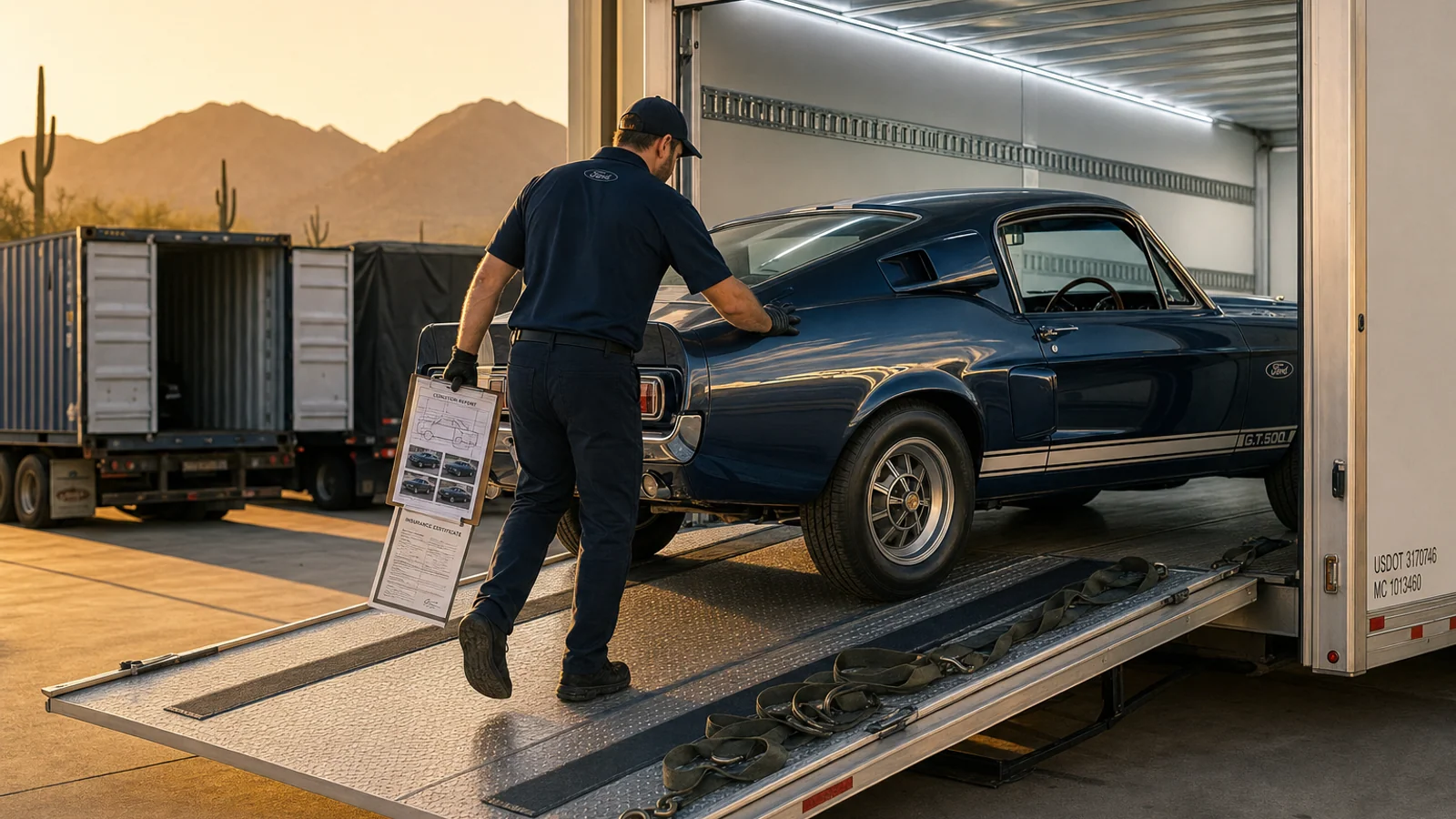
Quick answer An enclosed car shipping calculator prices door-to-door transport inside a covered trailer, which hauls two to seven cars instead of the seven to ten an open carrier stacks. Enter pickup and delivery ZIP codes, vehicle class, running condition and your first available date, and Walio returns real carrier rates in seconds — no signup, no calls.
- Enclosed trailers carry 2–7 vehicles versus 7–10 on an open carrier; that lower capacity is the single biggest reason the rate is higher.
- Hard-side trailers shield against road debris and hide the car; soft-side (canvas) trailers protect from weather for less, and the calculator prices both.
- Lift-gate loading is standard for cars under roughly 4 inches of ground clearance — ramps risk splitters, bumpers and exhaust tips.
- Shipping a collector car overseas? One vehicle in its own 20 ft container is quoted from $1,920 to Colombia and $2,970 to Jamaica, port to port.
Enclosed transport is a different market from open transport, with its own trucks, its own drivers and its own pricing logic. This guide explains what moves the number, then hands you the calculator so you can see your own.
See your price in seconds
Real carrier rates, no signup, no follow-up calls.
What Is an Enclosed Car Shipping Calculator?
Quick answer An enclosed car shipping calculator is a tool that prices covered, door-to-door auto transport from real carrier rates. You enter pickup and delivery ZIP codes, the vehicle's year, make and model, running condition, loading method and your first available date. The price returns in seconds, enclosed only — not an open-transport number with a toggle.
The tool exists because enclosed capacity prices differently from open capacity. A generic quote engine looks up an open rate and adds a guessed percentage on top. Walio's enclosed car shipping calculator returns enclosed-only pricing drawn from carriers that actually run covered equipment.
What the calculator asks you
- Pickup and delivery ZIP codes, not just city names — rural ZIPs change the rate
- Vehicle year, make and model, which sets length, width, weight and clearance
- Running condition: does the car start, roll, brake and steer
- Loading method: ramp or hydraulic lift gate
- First available date and how wide your pickup window can be
- Trailer preference: hard-side, soft-side or single-car
What the quote includes and excludes
A standard enclosed quote covers door-to-door pickup and delivery, fuel, tolls, driver labor and the carrier's cargo insurance on the vehicle. It does not automatically include lift-gate loading, expedited pickup windows, storage between pickup and delivery, winch service for a non-runner, or a terminal hold.
Each of those becomes a priced option the moment you select it. Nothing appears on the invoice that you did not see on screen first.
If the vehicle is oversized, a project car with no drivetrain, or a wide-body build, the calculator still takes the request. A Walio specialist reviews it and follows up with equipment that fits. You never wait on a phone call to find out whether your car can ship.
How Much Does It Cost to Ship a Car in an Enclosed Trailer?
Quick answer Enclosed auto transport cost is set by eight variables: distance, lane density, trailer type, vehicle size and clearance, running condition, loading method, season and how fast you need pickup. There is no flat national rate. Enclosed rates move weekly with truck availability, so the calculator prices your exact route instead of a published average.
Cost per mile falls as distance rises. A 2,400-mile coast-to-coast haul spreads the truck's fixed cost over far more miles than a 350-mile regional move. That is why short enclosed moves carry the highest per-mile rate even though the total is smaller.
Lane density matters more for enclosed than for open transport. Thousands of open carriers run I-95 and I-10 every week. Enclosed trucks are a small fraction of that fleet, so a thin lane into Montana or northern Maine carries a real scarcity premium.
| Cost driver | Effect on the quote | Calculator input that captures it |
|---|---|---|
| Distance | Total rises, cost per mile falls | Pickup and delivery ZIP codes |
| Lane density | Thin lanes add a scarcity premium | ZIP-to-ZIP routing |
| Trailer type | Single-car highest, soft-side lowest | Trailer preference |
| Vehicle size and weight | More deck space, higher share of the load | Year, make, model |
| Ground clearance | Under 4 in forces lift-gate equipment | Loading method |
| Running condition | Winch or dollies add labor and time | Operable or inoperable |
| Season | Peak weeks tighten enclosed capacity | First available date |
| Speed | 48–72 hour pickup is a premium service | Expedited option |
Seasonal pressure is sharper in enclosed than most owners expect. Snowbird season into Florida and Arizona runs October through December southbound, then reverses in April and May. Auction weeks in Scottsdale, Kissimmee and Monterey pull enclosed trucks off normal lanes for days at a time.
Walio does not publish enclosed price ranges, because those numbers change weekly with truck supply. The calculator shows your real number for your real route in seconds.
See your price in seconds
Real carrier rates, no signup, no follow-up calls.
How Much More Expensive Is Enclosed Car Shipping Than Open Transport?
Quick answer Enclosed costs more than open for three structural reasons: the trailer carries fewer cars, the equipment costs more to buy and insure, and far fewer enclosed trucks run each lane. The enclosed vs open carrier price gap widens on thin routes and narrows on dense corridors. The calculator shows your actual enclosed number, not an industry average.
Start with the capacity math. An open stinger-steer carrier stacks seven to ten cars and splits its fuel, tolls, insurance and driver pay across all of them. An enclosed trailer carries two to seven, so each car absorbs a much larger share of the same fixed cost.
Versus 7–10 on an open carrier. That capacity gap, not the trailer walls, is the main reason enclosed rates sit above open rates on every lane.
| Factor | Open transport | Enclosed transport |
|---|---|---|
| Cost per mile | Lower baseline | Materially higher on every lane |
| Cross-country total | Lower | Higher; gap widens on thin lanes |
| Cars per trailer | 7–10 | 2–7 |
| Cargo insurance limit | Standard per-vehicle limit | Higher per-vehicle limit; verify on the COI |
| Carrier availability | Very high nationwide | Limited, concentrated on dense corridors |
| Coast-to-coast transit | 7–12 days | 7–10 days, fewer stops |
| Weather and debris protection | None | Full roof and walls |
| Best for | Daily drivers, lease returns, dealer trades | Classics, exotics, show cars, fresh paint |
Cargo insurance is the second structural difference. Enclosed carriers typically file higher per-vehicle cargo limits than open carriers, because the cars they haul are worth more. Read the limit on the certificate of insurance rather than trusting a sales claim.
When should you choose each one?
Choose enclosed
Your car is irreplaceable, numbers-matching, freshly painted, or sits low enough that road debris reaches the bodywork. Concours entrants, auction purchases and six-figure exotics belong inside a trailer. Added rock chips on original paint cost more to correct than the freight premium ever did.
Choose open
Your car is a daily driver, a lease return, a dealer trade or a student's commuter. Open carriers run every lane in the country, book faster, and cost less. For a standard open-transport comparison on a busy corridor, see our Car Shipping Calculator New York to Florida 2026.
See your price in seconds
Real carrier rates, no signup, no follow-up calls.
Hard-Side vs. Soft-Side Enclosed Trailers: Which Costs More?
Quick answer A hard-side enclosed trailer has rigid aluminum or steel walls; a soft-side uses a canvas curtain over a steel frame. Both block rain, salt and sun. Only the hard-side stops road debris and hides the car from view. Single-car hotshot rigs cost the most per vehicle and offer the most control.
Hard-side trailers are the default for high-value cars. The rigid wall stops a stone kicked up by a passing truck, and nobody at a fuel stop can see what is inside. Soft-side trailers cost less and still block weather, which suits a clean driver-quality classic on a short lane.
A single-car hotshot is a small enclosed trailer behind a heavy-duty pickup carrying one vehicle. It costs the most per car and delivers the most control: direct routing, no deck mates, and fewer stops.
Lift-gate loading versus ramps
A lift gate is a hydraulic platform that raises the car level into the trailer. The approach angle is zero, so nothing touches the splitter, the front bumper or the exhaust. Cars under roughly 4 inches of ground clearance need a lift gate, not ramps.
Low-angle ramp extensions handle most classics, luxury SUVs and lowered sedans without trouble. Exotics with aggressive front aero almost always require the gate. Measure the lowest point in inches and tell the dispatcher that number in writing.
| Trailer type | Price premium | Protection level | Loading method | Ideal vehicle |
|---|---|---|---|---|
| Hard-side multi-car | Standard enclosed rate | Debris, weather, privacy | Ramps or lift gate | Classic, luxury, exotic |
| Soft-side multi-car | Lowest enclosed rate | Weather only | Ramps | Driver-quality classic |
| Single-car hotshot | Highest per vehicle | Debris, weather, privacy | Ramps or lift gate | Concours, auction buy |
| Lift-gate equipped | Add-on above base | Same as trailer type | Hydraulic platform | Under 4 in clearance |
Multi-car enclosed trailers use two-level decks with soft wheel straps over the tires. Ask whether your car rides the top deck or the bottom. Top-deck position keeps the car clear of any fluid drip from a vehicle above it.
What Does Enclosed Transport Cost by Distance and Vehicle Class?
Quick answer Enclosed quotes scale by distance band and by how much trailer space and handling the car demands. A 1,200 lb motorcycle and a dually pickup never price the same, even on the same lane. Running condition, width, clearance and weight all feed the rate. The calculator applies them to your exact vehicle.
| Distance band | Typical transit days | Booking lead time | Enclosed availability | What pushes the quote up |
|---|---|---|---|---|
| 0–500 miles | 1–3 | 1–2 weeks | Moderate | Highest cost per mile, rural pickup |
| 500–1,000 miles | 2–4 | 2 weeks | Good on interstates | Off-corridor delivery ZIP |
| 1,000–1,500 miles | 3–5 | 2–3 weeks | Good | Lift gate, inoperable status |
| 1,500–2,500+ miles | 7–10 | 3–4 weeks in season | Best on I-10, I-40, I-95 | Auction weeks, expedited pickup |
How vehicle class changes the rate
- Sedan: the baseline. One standard deck position, ramp loading, no special handling.
- Luxury SUV: taller and heavier, often needs a bottom-deck slot with more headroom.
- Classic: wide chrome bumpers, delicate paint and soft wheel straps instead of frame chains.
- Exotic or supercar: low clearance, lift gate, frequently a single-car or top-deck position.
- Inoperable: winch, roll-on dollies or a gate, plus extra loading time for the driver.
- Motorcycle in enclosed: small footprint but needs a chock, straps and a dedicated tie-down point.
Inoperable vehicles are the most common surprise. The calculator asks whether the car rolls, brakes and steers, because a truck without a winch simply cannot load it. A seized engine or locked brakes needs a specialist review before dispatch.
Oversize cases — lifted trucks, long-wheelbase limousines, wide-body builds — are flagged after the calculator takes the request. Classic car transport rates also move with practical details: a known fluid leak, a battery kill switch, or a car that needs a tender in transit.
See your price in seconds
Real carrier rates, no signup, no follow-up calls.
Which Enclosed Routes Run Fastest Across the USA?
Quick answer Transit time depends on lane density, not just mileage. Los Angeles to New York runs about 7–10 days door to door. Miami to Chicago takes 3–5 days, Dallas to Los Angeles 3–4 days, and Seattle to Phoenix 2–4 days. Enclosed trucks make fewer stops, which often shortens delivery versus open.
| Route | Distance | Transit days | Enclosed availability | Best booking window |
|---|---|---|---|---|
| Los Angeles – New York | 2,790 mi | 7–10 | High | 3 weeks ahead |
| Miami – Chicago | 1,380 mi | 3–5 | High | 2 weeks ahead |
| Dallas – Los Angeles | 1,435 mi | 3–4 | High | 2 weeks ahead |
| Seattle – Phoenix | 1,420 mi | 2–4 | Moderate | 2–3 weeks ahead |
The I-95, I-10 and I-40 corridors hold the most enclosed capacity in the country. Montana, the Dakotas and northern Maine often wait for a truck already heading that direction. That wait shows up as a longer pickup window, a higher rate, or both.
Keep pickup window and transit time separate. The transit clock starts the day the carrier physically loads the car, not the day you book. A three-day pickup window plus a four-day run is a seven-day door-to-door reality.
Snowbird lanes flip twice a year. Southbound into Florida and Arizona tightens in the fall; northbound tightens in April and May. For the open-transport comparison on the same corridor, read our Car Shipping Calculator New York to Florida 2026 guide.
How Do You Verify an Enclosed Carrier's Insurance and Credentials?
Quick answer Ask for the carrier's USDOT and MC numbers, then check them on the FMCSA SAFER system before the truck loads. Request the certificate of insurance and read the cargo limit, the deductible and the exclusions. Confirm whether the policy pays agreed value or actual cash value — the difference decides a classic car claim.
The FMCSA SAFER lookup takes two minutes. It shows active operating authority, insurance on file, out-of-service history and crash records. A carrier without active authority should never load your car, whatever the price looks like.
Reading the certificate of insurance
- Cargo coverage limit: confirm it is stated per vehicle, not per load
- Deductible: ask in writing who pays it on a claim
- Exclusions: look for personal items, acts of God and mechanical failure
- Valuation basis: agreed value or actual cash value
- Expiry date: the policy must be current on your pickup date
Valuation basis is where classic owners get hurt. Actual cash value settles on a depreciated book figure, which can sit far below what a restored car is worth. An agreed-value endorsement fixes the number before the trip, not after a claim.
Personal items are not covered
Carrier cargo insurance covers the vehicle, not luggage, tools or household goods inside it. Most policies exclude personal belongings outright, and the extra weight can push a trailer over legal axle limits. Empty the trunk and cabin, and leave only the spare tire, jack and factory tool kit.
The Bill of Lading is both the condition report and the contract. Photograph every panel, every wheel, the roof and the odometer at pickup and again at delivery. Do that before you sign anything, in daylight, with the car clean.
Carry your own collector policy with an agreed-value endorsement as secondary protection. Speak with your own insurer about coverage gaps during transit, not with the carrier's dispatcher.
How Do You Prepare and Book Enclosed Transport?
Quick answer Book enclosed transport two to three weeks out, or three to four weeks during auction and show season. Prepare the car with a quarter tank of fuel, a charged battery, clean bodywork for photos, and nothing loose inside. Tell the dispatcher the exact ground clearance in inches before the truck is assigned.
- Price the move. Run your ZIPs, vehicle and date through the enclosed car shipping calculator and book online.
- Wash the car. Clean paint makes the pickup condition photos usable if you ever file a claim.
- Drop to a quarter tank. Less fuel means less weight and lower fire risk inside a closed trailer.
- Disable the alarm and remove the toll transponder. A looping alarm drains the battery mid-route.
- Fold the mirrors and empty the cabin. Nothing loose, no luggage, no spare parts.
- Hand over written notes. Clearance, width, kill switch location, starting procedure and any known leak.
Insist on soft wheel straps over the tires for classics and exotics. Frame chains belong on tow trucks, not on a restored chassis or a carbon undertray. Any reputable enclosed carrier already works this way.
Late winter and the weeks right after Labor Day are usually the cheapest windows for enclosed transport. They sit between the snowbird migration and the summer collector-event season, when enclosed trucks are easiest to book. Expedited 48–72 hour pickup is always available, but it prices as a premium service.
Before loading day, confirm three things in writing: the trailer type assigned, your deck position, and the driver's direct contact. A confirmed deck position prevents the top-deck surprise on the morning of pickup.
Shipping a Classic Overseas? A 20 ft Container Is Enclosed Transport
Quick answer Overseas, the enclosed equivalent is a sealed 20 ft container — one car, its own box, doors locked for the whole ocean leg. Walio quotes one vehicle in its own 20 ft container from $1,920 to Colombia, $1,970 to Guatemala, $2,420 to Mexico and $2,970 to Jamaica, port to port.
Container shipping is the ocean version of an enclosed trailer. The car is strapped down, the doors are sealed, and nothing touches it until the consignee breaks the seal. RoRo is the open-deck equivalent — the car is driven onto a vessel deck and is quoted on request through the calculator.
| Destination | One car, own 20 ft container (port to port) |
|---|---|
| Colombia | $1,920 |
| Guatemala | $1,970 |
| Panama | $1,980 |
| Chile | $2,220 |
| Mexico | $2,420 |
| Dominican Republic | $2,545 |
| Brazil | $2,670 |
| Jamaica | $2,970 |
| Venezuela | $4,059 |
 Miami(USMIA)
 Cartagena(COCTG)
Your gateway sets the price and the transit. Florida ships through PortMiami, Texas through Port Houston, California through LA/Long Beach, the Northeast through NY/NJ, and the Southeast through Savannah. The Midwest moves by rail to Chicago, the Pacific Northwest through Seattle, Ontario through Toronto, Quebec through Montreal and Western Canada through Vancouver.
Export paperwork for a collector car
- Original title presented to CBP at least 72 hours before loading
- AES filing with the Internal Transaction Number
- Commercial Invoice or Bill of Sale stating the declared value
- Bill of Lading (B/L), the ocean contract and title document
- Certificate of Origin where the destination country requires one
Destination charges, duties and taxes sit outside the port-to-port price. A licensed customs broker in the destination country handles clearance and files against local rates. If you are buying abroad instead of exporting, our JDM Car Import Calculator: Japan to USA Rates (2026) walks through the import side.
For damaged or rebuild projects, see the Salvage Car Shipping Calculator: Canada to Jamaica 2026. When ocean transit is too slow, multimodal options cut the clock — compare the Sea-Air China to Peru Calculator and the Sea-Air Hong Kong to Jamaica Calculator.
See your price in seconds
Real carrier rates, no signup, no follow-up calls.
Price Your Enclosed Move Now
Enclosed transport rewards planning. Measure your clearance, set a realistic first available date, and book while dispatchers still have trucks heading your direction. The rest is arithmetic the calculator already does.
Enter your route in the calculator above and see your price in seconds — no signup, no follow-up calls.
Yes — for a restored or numbers-matching classic, enclosed transport is the standard choice because it removes road debris, salt, rain and public exposure from the trip. A single rock chip in freshly sprayed paint can cost more to correct than the difference between open and enclosed. Run both options in the calculator above and compare the real numbers for your lane.
Coast-to-coast enclosed transport typically takes 7 to 10 days door to door, with Los Angeles to New York at the long end. Enclosed trucks carry fewer cars and make fewer delivery stops, so they often arrive sooner than an open carrier on the same route. Your pickup window is separate from transit time and starts the day the driver loads.
Late winter and the weeks right after Labor Day are usually the cheapest windows, because they sit between the snowbird migration and the summer collector-event season. Auction weeks in Scottsdale, Kissimmee and Monterey pull enclosed trucks off normal lanes and tighten capacity nationwide. Booking two to three weeks ahead gives dispatchers room to match you with a truck already heading your direction.
No — carrier cargo insurance covers the vehicle, not household goods, tools or luggage inside it. Most policies exclude personal belongings entirely, and extra weight can push the trailer over legal limits. Empty the trunk and cabin, and leave only the spare tire, jack and factory tool kit.
Yes — enclosed carriers move non-running vehicles using a winch, roll-on dollies or a hydraulic lift gate, provided the car rolls, brakes and steers. Tell the calculator the car is inoperable before you book, since a truck without a winch cannot load it and the pickup gets rescheduled. A seized engine, locked brakes or missing wheels require a specialist review.