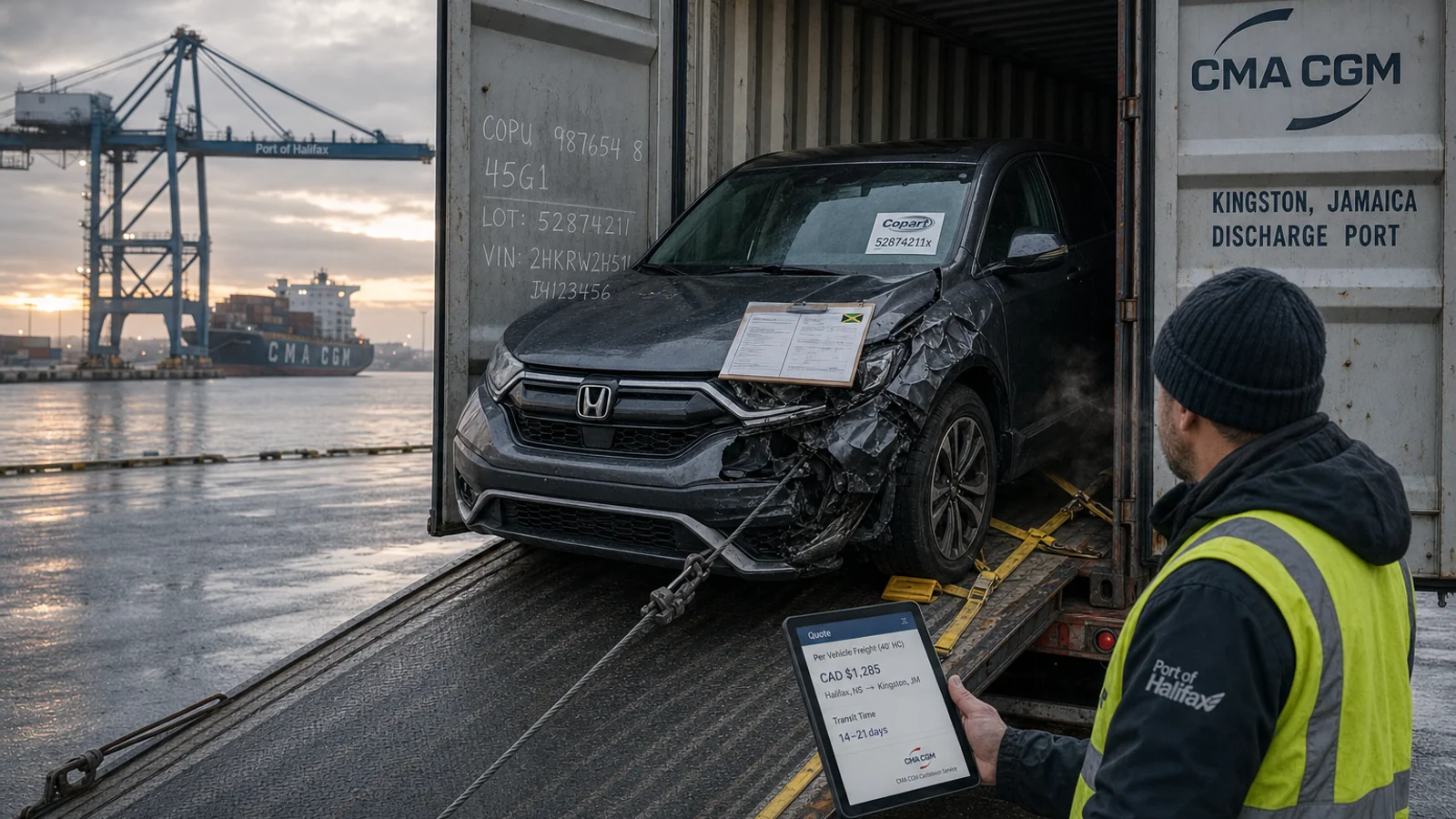
Quick answer Shipping a salvage car from Canada to Jamaica takes roughly 14 to 21 days at sea from Halifax or Saint John to Kingston, plus clearance. Non-running units ship inside containers, not RoRo. Jamaica caps motor car imports at five years old and requires a Trade Board import licence. Submit your auction details in the calculator for a confirmed price.
- Jamaica allows salvage and written-off vehicles, but motor cars must be no more than 5 years old and need a Trade Board import licence.
- Most salvage cars cannot use RoRo — roll-on/roll-off needs the vehicle to drive aboard, so non-runners load into containers by winch or forklift.
- Jamaica Customs charges Import Duty, SCT by engine size, GCT at 15%, Environmental Levy, Standard Compliance Fee and the Customs Administration Fee on CIF value.
- Canada requires an electronic CERS export declaration (the replacement for the paper B13A) filed before the container loads.
This guide walks through the full landed cost of a Canadian auction car arriving at Kingston, from the yard gate to the broker's entry. Use the calculator on this page to submit your lot, and a Walio specialist confirms carrier space and your exact price within one business day.
Get your salvage car quote
Real carrier rates. A Walio specialist confirms space and sends your exact price within 1 business day.
How much does it cost to ship a salvage car from Canada to Jamaica?
Quick answer A salvage car shipment from Canada to Jamaica has no fixed price. Cost moves with auction yard location, inland tow to port, loading method, whether you share a container, ocean freight and Jamaican port charges. Submit the shipment in the calculator on this page and a Walio specialist confirms space and the exact price within one business day.
Your total landed cost breaks into eight separate parts. Treat them as eight line items, not one number, and the budget stops surprising you.
- Auction purchase price — your winning bid at Copart Canada or IAAI Canada.
- Auction fees — buyer fee, gate fee, internet bid fee, and storage if you pay late.
- Inland transport — tow or flatbed from the yard to the loading warehouse near the port.
- Loading — winching or forklift handling into the container, plus lashing and blocking.
- Ocean freight — the container move from Halifax, Saint John, Montreal or Vancouver to Kingston.
- Marine insurance — usually total-loss-only cover on a pre-damaged unit.
- Jamaican port charges — wharfage, Port Authority handling, delivery order and deconsolidation.
- Duties and brokerage — duty is paid in Jamaica, not in the freight quote.
Eight separate charges stand between the auction hammer and your gate in Jamaica. Only the middle four sit inside a freight quote. The first two belong to the auction, the last two belong to Jamaica Customs.
Why no honest provider posts one flat rate
A Copart Moncton unit sits about two hours from Saint John. A Copart Calgary unit sits 970 km from Vancouver, or a continent away from Halifax. Same car, same model year, wildly different inland legs.
Inland tow is often the biggest single variable on this lane. Ocean freight from an Atlantic Canadian gateway to Kingston stays relatively stable across the year. The trucking leg does not, because it tracks distance, fuel, winch equipment and yard access hours.
What a Walio quote covers — and what it does not
Your quote covers the inland move, loading, documentation, terminal handling at origin and ocean freight to Kingston. It does not cover Jamaica Customs duty, SCT, GCT or your Jamaican broker's clearance fee. Those you pay on arrival through a licensed broker.
If you want a sense of how a comparable Caribbean auction lane prices out, the Copart to Dominican Republic Calculator: From $2,545 breakdown shows the same cost structure on a US-origin route. The components match; the inland legs and duty regime do not.
Salvage car shipping calculator Canada to Jamaica: what inputs do you need?
Quick answer A salvage car shipping calculator is a tool that turns auction details into a priced shipment request. You enter the Copart or IAAI yard, the Canadian port, the vehicle year, make, model, dimensions, running condition and declared value. Walio prices that exact movement against real carrier rates and returns your quote within one business day.
Generic car-shipping calculators get salvage units wrong for one reason. They assume the car drives. A total-loss unit may not roll, may not steer, and may be missing wheels or a drivetrain. That changes the equipment, the loading method and the carrier's acceptance.
The inputs that actually move the price
- Auction branch and lot number — the yard address sets the inland leg.
- VIN — confirms year, make, model, engine size and title branding.
- Overall length, width and height — a lifted pickup may not clear a standard 40 ft door.
- Keys: yes or no — no keys usually means no steering lock release.
- Runs and drives / rolls and steers / neither — this single field decides winch versus forklift.
- Declared auction value — feeds both the insurance policy and the CIF figure at Kingston.
A unit that rolls and steers winches onto the container floor on its own wheels. A unit that does neither needs forklift handling, skates or a pallet, and more labour at the loading warehouse. That is a real cost difference, and it is why a salvage car shipping calculator canada to jamaica must ask about condition before it quotes.
Declare the true purchase value. Jamaica Customs builds CIF from your invoice, and your marine policy pays out against the same figure. Understate it and you risk a valuation query at Kingston plus an underinsured claim if the box is damaged at sea.
Oversized units, flood-damaged cars and battery-electric salvage vehicles get a specialist review before the price is confirmed. Damaged lithium batteries fall under dangerous goods rules, and most carriers restrict or refuse them.
Submit your lot for pricing
Enter the yard, the VIN and the condition. A Walio specialist confirms carrier space and your exact price within 1 business day.
Can you import a salvage or written-off vehicle into Jamaica?
Quick answer Yes. Jamaica permits salvage and previously written-off vehicles, but under the same rules as any import: a Trade Board import licence, an age limit of five years for motor cars, and pre-shipment inspection where required. Write-off status on the Canadian branding record does not block entry on its own; age, licence and duty compliance do.
A Trade Board import licence is the permit issued by Trade Board Limited that authorizes one specific vehicle import. You apply before the vehicle ships, not after it lands. The licence names the vehicle, so buying first and applying later is how importers get stuck.
Jamaica used car import age limits
As of 2026, Jamaica's motor vehicle import policy applies these ceilings. Confirm the current figures with Trade Board Limited before you bid, because policy moves with the budget cycle.
| Vehicle category | Maximum age at import | Licence required |
|---|---|---|
| Motor car (private) | 5 years | Yes — Trade Board |
| Light commercial / pickup | 6 years | Yes — Trade Board |
| Heavy-duty truck / bus | 10 years | Yes — Trade Board |
| Motorcycle | 5 years | Yes — Trade Board |
Age counts from the model year, not the registration date. That matters more than buyers expect. A 2021 salvage unit bought in late 2026 can age out mid-process while you wait on title release and a sailing.
Disclose the title brand honestly
Salvage, rebuilt and irreparable brandings sit on the Canadian provincial record and the auction listing. Declare them on the invoice and to your broker. A branding that contradicts the condition report invites inspection, revaluation and delay at Kingston. For licence filing and any policy question, use a licensed Jamaican customs broker — Walio ships the car, the broker clears it.
How do I calculate Jamaica customs duty on a car shipped from Canada?
Quick answer Jamaica Customs assesses duty on CIF value — cost, insurance and freight — or on its own depreciated book value where that is higher. Layered on top sit Import Duty, Special Consumption Tax banded by engine size, GCT at 15%, the Environmental Levy, the Standard Compliance Fee and the Customs Administration Fee.
CIF value means the purchase cost, plus marine insurance, plus freight to Kingston. That is the starting base. Here is the part that catches salvage buyers: Jamaica Customs does not have to accept your hammer price. Where the declared value looks low against the market, the valuation falls back to a depreciated book value for that year, make and model.
Duty components by engine displacement
The table below shows the indicative structure for used motor cars as of 2026. Rates and bands change by budget cycle, so have a licensed Jamaican customs broker confirm the exact figures for your VIN.
| Engine size | Import Duty | SCT | GCT | Indicative effective rate |
|---|---|---|---|---|
| Up to 1,000 cc | 20% | 10% | 15% | ~57% |
| 1,001 – 1,500 cc | 20% | 20% | 15% | ~67% |
| 1,501 – 1,800 cc | 20% | 30% | 15% | ~80% |
| 1,801 – 2,000 cc | 20% | 40% | 15% | ~93% |
| 2,001 – 3,000 cc | 20% | 60% | 15% | ~120% |
| Over 3,000 cc | 20% | 80% | 15% | ~145% |
How the taxes stack, in order
The taxes are not simply added together. Each applies to a growing base, which is why the effective rate exceeds the sum of the percentages.
- Build CIF: purchase value + insurance + ocean freight to Kingston.
- Compare CIF against the Customs depreciated book value; the higher figure becomes the base.
- Apply Import Duty to that base.
- Add the Environmental Levy and the Standard Compliance Fee as percentage charges on the base.
- Apply Special Consumption Tax using your engine displacement band.
- Apply GCT at 15% on the accumulated value, duty and SCT.
- Add the Customs Administration Fee — a banded flat charge, not a percentage.
A 1,600 cc salvage sedan with a modest CIF therefore lands in the 80% band, while a 3.5 L SUV can face a charge larger than the car's value. Engine size, not damage level, drives the tax bill. Readers working through similar multi-layer Caribbean duty math will find the China to Guyana Import Tax Calculator: 2026 Rates breakdown a useful companion.
Price the freight side first
Duty is a broker calculation. Freight is ours. Submit the vehicle and a Walio specialist sends your exact price within 1 business day.
What documents do I need to export a salvage car from Canada?
Quick answer Canada requires an electronic export declaration filed in CERS, the system that replaced the paper B13A, for most vehicles leaving the country. You also need the provincial ownership or title, the auction bill of sale, a clear lien and VIN check, and 72 hours' notice to CBSA before the container loads.
CERS is the Canadian Export Reporting System, operated by the Canada Border Services Agency. Per CBSA, exporters file the declaration electronically and keep the proof-of-report number. A paper B13A no longer satisfies the requirement.
| Document | Issued by | Side | When it is needed |
|---|---|---|---|
| CERS declaration + proof of report | CBSA | Canada | Before container loading |
| Provincial ownership / title | Province or Copart Canada | Canada | At booking |
| Auction bill of sale and paid invoice | Copart / IAAI | Canada | At booking |
| Lien and VIN search result | Provincial registry | Canada | Before export filing |
| Bill of Lading (B/L) | Carrier or NVOCC | Both | After loading |
| Trade Board import licence | Trade Board Limited | Jamaica | Before shipment |
| Commercial invoice | Seller / exporter | Jamaica | At clearance |
| TRN (Taxpayer Registration Number) | Tax Administration Jamaica | Jamaica | At clearance |
The Copart Canada export workflow
Buying is the fast part. Getting the car out of the yard is where the clock runs.
- Register a member account, or bid through a licensed broker where a licence is required.
- Win the lot and pay within the auction's payment window — storage fees start quickly.
- Wait for title release; Copart Canada issues the ownership document after funds clear.
- Book the tow and get a gate pass for the yard.
- Deliver to the loading warehouse near Halifax, Saint John, Montreal or Vancouver.
- File CERS, then load and seal the container before the port cut-off.
The VIN on the title must match the auction description exactly. A mismatch between a branded title, the bill of sale and the physical plate stops the export at the filing stage. If your routing moves through a US gateway instead, note that US CBP requires the title and export filing 72 hours before lading at the US port.
RoRo vs shared container vs full container for a salvage car?
Quick answer Most salvage cars cannot sail RoRo, because roll-on/roll-off vessels need the vehicle to drive aboard under its own power. Non-running units move inside containers, loaded by winch or forklift. A shared 40 ft container holding two or three cars usually costs less per vehicle than a dedicated 20 ft box.
RoRo means roll-on/roll-off — a vessel with a ramp and decks, where drivers board each unit. Stevedores will not push a dead car up a ramp. That rules out RoRo for the majority of total-loss and heavily damaged units.
| Option | Accepts non-running | Typical cars per unit | Relative cost per car | Damage risk | Personal items |
|---|---|---|---|---|---|
| RoRo | No | 1 | Low | Higher — open deck, handling | No |
| Shared 40 ft container | Yes | 2–3 | Lowest for non-runners | Low | Limited |
| Full 20 ft container | Yes | 1 | Highest per car | Lowest | Yes, if declared |
| Full 40 ft container | Yes | 2–3 (your own) | Low if you fill it | Lowest | Yes, if declared |
The surcharges nobody advertises
- Winching — pulling a rolling-but-dead car onto the container floor.
- Forklift handling — for units that neither roll nor steer.
- Immobile vehicle fee — charged at the loading warehouse for extra labour and time.
- Lashing and blocking — straps, chocks and timber so the car cannot shift at sea.
- Container cleaning — leaking fluids from a crash-damaged unit trigger a cleaning charge.
The capacity math
One sedan fills a 20 ft container with little room to spare. A 40 ft box takes two cars easily, and three when the units are compact and the loaders stack carefully. A damaged car still sitting on its wheels packs far better than one resting on a pallet or skates.
A shared 40 ft container splits the ocean freight across two or three buyers, which is why it wins on cost. The trade-off is timing. You wait until the box fills. If your Trade Board licence is near expiry, or your auction storage clock is running, a dedicated 20 ft that sails on the next vessel can be the cheaper decision overall.
Compare container options for your car
Shared or dedicated, 20 ft or 40 ft. Submit the vehicle and a specialist confirms space and the exact price within 1 business day.
Which Canadian port should your salvage car sail from?
Quick answer Halifax, Saint John and Montreal are the usual Atlantic gateways to Kingston, and Toronto or Hamilton auction yards drayage east to reach them. Vancouver and Prairie units often rail across Canada or route through a US Gulf gateway instead. Your yard's distance to the port drives cost more than ocean freight does.
| Gateway | Feeds which auction yards | Typical inland distance | Sailing frequency to Kingston | Ocean transit |
|---|---|---|---|---|
| Halifax (CAHAL) | Nova Scotia, Moncton NB | 50–300 km | Weekly | 10–18 days |
| Saint John (CASJB) | Moncton, Fredericton NB | 150–200 km | Weekly to fortnightly | 12–18 days |
| Montreal (CAMTR) | Quebec, eastern Ontario | 50–400 km | Weekly | 14–21 days |
| Toronto / Hamilton (drayage) | GTA, southwestern Ontario | 550 km to Montreal, 1,800 km to Halifax | Follows the port used | 14–21 days |
| Vancouver (CAVAN) | BC, Alberta via rail | 970 km from Calgary | Fortnightly, transship | 25–35 days |
 Halifax(CAHAL)
 Kingston(JMKIN)Montreal(CAMTR)Kingston(JMKIN)
Matching your region to a gateway
Maritimes yards route through Halifax or Saint John. Quebec and eastern Ontario load at Montreal. GTA and southwestern Ontario drayage east, usually to Montreal, sometimes to Halifax when the sailing fits better. Prairie units rail east. British Columbia ships from Vancouver or routes south through a US Gulf gateway.
Montreal is a river port, and winter ice management affects schedules and surcharges. Halifax is deep-water and open year-round, with a steadier Caribbean rotation. For a January shipment, Halifax usually beats Montreal on reliability.
Kingston is the Caribbean's largest transshipment hub, served by Maersk, MSC, CMA CGM and Hapag-Lloyd among the carriers Walio compares. Most Canadian boxes discharge there. Buyers in St. James or Trelawny sometimes prefer Montego Bay discharge, which saves the drive but runs on thinner schedules. The calculator prices your exact yard-to-port leg, so you do not have to guess the gateway.
Let the calculator pick the gateway
Enter your auction yard. A Walio specialist confirms the best routing, carrier space and your exact price within 1 business day.
How long does it take to ship a car from Halifax to Jamaica?
Quick answer Ocean transit from Halifax or Saint John to Kingston usually runs 10 to 18 days on a direct service, and 18 to 30 days when the container transships through Caucedo, Freeport or a US hub. Add one to three weeks before sailing for auction payment, title release and container loading.
The full door-to-door timeline looks like this:
- Winning bid and payment — 1 to 3 business days.
- Title release from Copart Canada or IAAI — 3 to 10 business days.
- Yard pickup and tow to the loading warehouse — 2 to 7 days.
- Container loading, lashing and CERS filing — 1 to 3 days.
- Port cut-off, then vessel ETD — cut-off falls days before the ship actually leaves.
- Ocean transit to Kingston — 10 to 30 days by routing.
- Discharge, deconsolidation and clearance — 3 to 10 days.
Cut-off versus ETD, and why it matters
Port cut-off is the deadline for your container to be gated in. Vessel ETD is when the ship sails. Miss the cut-off by two hours and you wait for the next sailing — often a full week, sometimes two on a fortnightly service.
Pay the auction the same day you win. Title release is the step that most often pushes a car onto the following vessel. Everything downstream — tow, loading, cut-off — waits on that document.
Transshipment is normal on this lane and is not a problem on its own. A relay through Caucedo in the Dominican Republic or Freeport in the Bahamas adds days, not much freight cost. Readers comparing other inbound Jamaica routings can look at Sea-Air Hong Kong to Jamaica Calculator: 2026 Rates, and the Sea-Air China to Peru Calculator: 2026 Rates shows how relay routing reshapes transit time.
What hidden costs catch Jamaican importers of salvage cars?
Quick answer Auction yard storage, winching, container cleaning, wharfage, Port Authority handling, brokerage and demurrage at Kingston are the charges that wreck a budget. Jamaica gives limited free time after discharge. Clear the entry early, pay duty quickly, and collect the vehicle before free days expire and the daily clock starts.
Three terms decide how much you pay for being slow. Free time is the grace period after discharge. Demurrage is what the carrier charges when the container sits at the terminal past free time. Detention is what the carrier charges when you hold the empty box too long after unstuffing.
The add-ons that appear late
- Auction late-payment and daily storage fees at the Canadian yard.
- Lot relocation fees when the yard moves your unit.
- Container sweep and cleaning after a fluid leak.
- Fumigation where wood packing or soil contamination is present.
- Wharfage and Port Authority handling at Kingston.
- Delivery order fee and deconsolidation at the CFS.
- Brokerage and entry preparation — budget for the broker before the vessel sails.
Insuring a car that is already damaged
All-risk marine cover is usually unavailable on a pre-damaged unit. Underwriters offer total-loss-only cover instead, which pays if the vessel or container is lost, not if a dent gets worse. Photograph every panel at the yard and attach the images to the file.
Keep one value across every document
The declared value on your marine policy, your commercial invoice and your broker's entry at Kingston must match. A discrepancy triggers a valuation review, and a review costs you free days you cannot get back. Importers juggling layered duty math on other lanes can see the same discipline applied in Vietnam to Brazil Import Calculator: Rates & Rules 2026.
Your avoidance checklist
- Apply for the Trade Board import licence before you bid, not after.
- Appoint your Jamaican customs broker while the car is still in Canada.
- Email the invoice, B/L and licence to the broker while the box is at sea.
- Have duty funds ready on the day the entry is lodged.
- Book collection transport in Kingston before free time expires.
Ready to price your shipment?
Submit the auction lot, the VIN and the condition. A Walio specialist confirms carrier space and sends your exact price within 1 business day.
Frequently asked questions
The cost depends on the auction yard, the Canadian port, the loading method and whether you share a container. There is no flat rate on this lane, because a Copart Moncton unit and a Copart Calgary unit carry very different inland legs. Submit the vehicle in the calculator on this page and a Walio specialist confirms carrier space and your exact price within one business day.
Yes, Jamaica allows salvage and previously written-off vehicles, provided the unit meets the age limit and you hold a Trade Board import licence. Motor cars must generally be no more than five years old, with longer allowances for commercial vehicles. Confirm the current policy with the Trade Board and a licensed Jamaican customs broker before you bid.
A shared 40 ft container is usually the cheapest option, because two or three buyers split the ocean freight and the drayage from Ontario to the port. RoRo is normally not available, since roll-on/roll-off vessels require the vehicle to drive aboard. The trade-off is time — a shared box waits until it fills.
Jamaica Customs starts from the CIF value — purchase cost plus insurance plus freight — or its own depreciated book value where that is higher. It then applies Import Duty, Special Consumption Tax banded by engine size, GCT at 15%, the Environmental Levy, the Standard Compliance Fee and the Customs Administration Fee. A licensed Jamaican customs broker should confirm the final figure.
Direct sailings from Halifax to Kingston usually take 10 to 18 days at sea, while transshipped routings through Caucedo or Freeport run 18 to 30 days. Add one to three weeks before departure for auction payment, title release, towing and container loading, plus a few days for clearance at Kingston.
You now have the full picture: the eight cost components, the Trade Board licence, the five-year age limit, the duty bands by engine size and the gateway that fits your auction yard. The one number left is your freight price, and that depends on details only your lot can supply. Enter your auction yard, VIN and vehicle condition in the calculator above — no signup, no follow-up calls, and a Walio specialist confirms carrier space and your exact price within one business day.