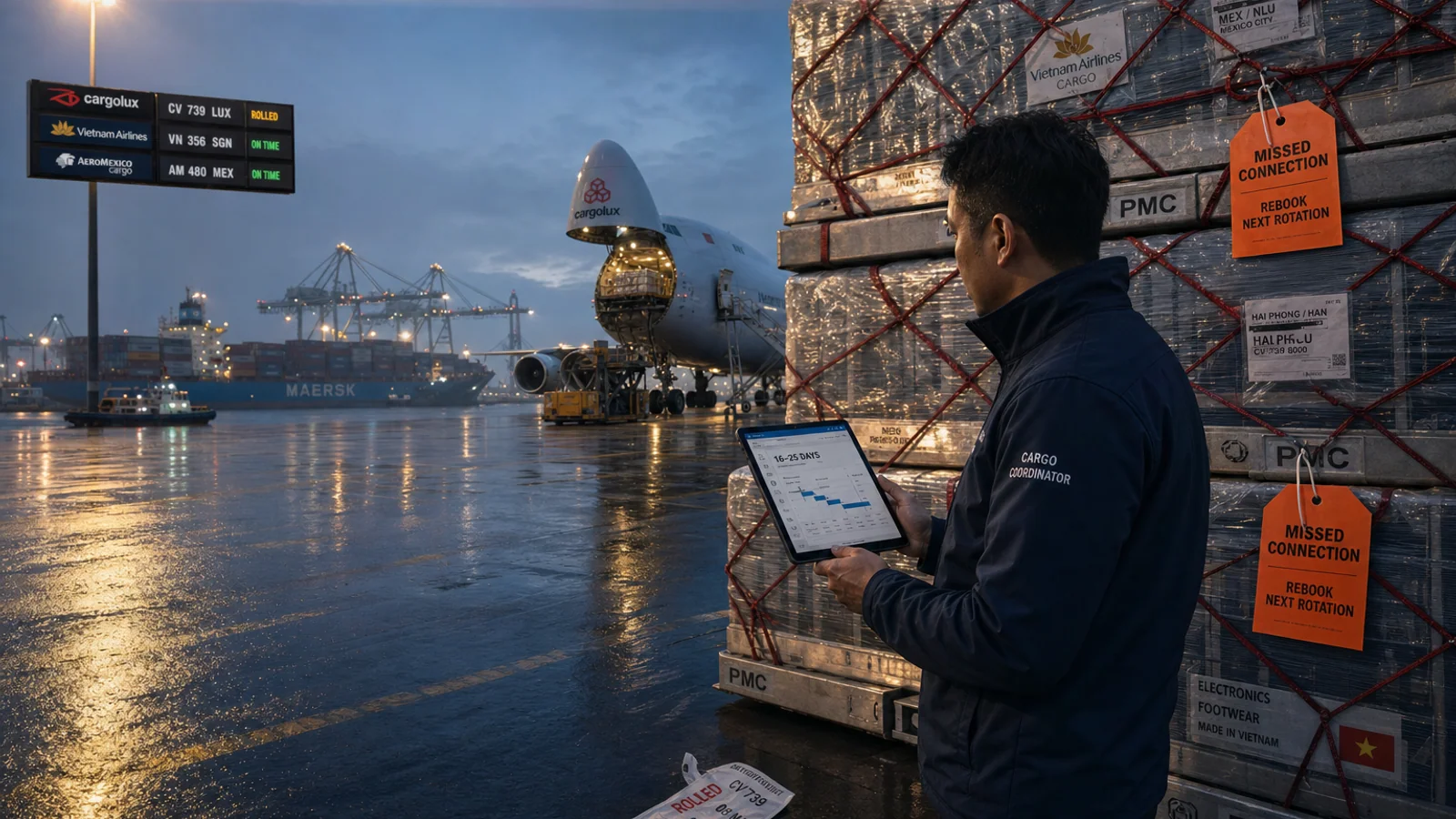
Quick answer A sea-air cargo delay happens when the ocean leg lands late and the box misses the air cut-off at the transshipment hub, costing 2–7 extra days per missed connection. On comparable China–Mexico sea-air routings, total transit runs 16–25 days port to airport. Price your exact shipment in the calculator in seconds.
- Sea-air moves ocean to a hub, then flies the last leg: comparable China–Mexico routings run 16–25 days port to airport via Los Angeles, Miami and MEX, GDL, MTY, CUN, MID or NLU.
- A missed air cut-off at the hub is the single most common cause of delay and typically costs 2–7 days, because consolidators rebook on the next available ULD space.
- The air leg falls under the Montreal Convention, the ocean leg under Hague-Visby, and most cargo insurance policies exclude pure delay losses unless a named peril caused them.
- Sea-air is billed on chargeable weight with a 300 kg minimum: volume × 167 kg per m³ versus actual weight, whichever is greater.
Mexican importers lose more days at the hub handover than they lose at sea. This guide shows you where the days go, who owes you what, and how to price the lane without waiting for a quote.
See your price in seconds
Real carrier rates, no signup, no follow-up calls.
What is sea-air cargo and where does the transshipment happen?
Quick answer Sea-air cargo is a multimodal service that moves freight by ocean to a transshipment hub, then flies it to the final airport. On Asia–Mexico routings the ocean leg lands at Los Angeles, trucks to Miami in 3–5 days, then flies to Mexico City, Guadalajara, Monterrey, Cancún, Mérida or Santa Lucía in 1–2 days.
Sea-air combines an ocean trunk leg with an air feeder leg under one booking. It costs far less than full air freight and arrives far sooner than an all-water service. That is the whole proposition.
The transshipment hub is the handover point. There, the container is stripped at a CFS (container freight station), the cargo is deconsolidated, re-weighed, built onto ULDs (unit load devices) and tendered to the airline. Every hour lost inside that warehouse is an hour against the air cut-off, not against the vessel.
Vietnamese origins sail from Hai Phong, Cat Lai and Cai Mep. The Pacific crossing discharges at Los Angeles/Long Beach. From there the cargo runs by domestic truck to Miami, the Latin America air gateway, and flies south into Mexico.
 Los Angeles(USLAX)Miami(USMIA)Miami(MIA)
 Mexico City(MEX)
The air cut-off is the airline's tender deadline before departure, usually several hours before ETD. Miss it by thirty minutes and you wait for the next flight with space.
Keep the paperwork trail in one folder from day one:
- Ocean Bill of Lading or Sea Waybill for the water leg
- Master Air Waybill (MAWB) and House Air Waybill (HAWB) for the flight
- FIATA multimodal through bill of lading, which covers both legs under one contract
- Commercial invoice and packing list matching the declared values
- HS classification used for the Mexican pedimento
Sea-air is a single multimodal contract with two legal regimes inside it. Ask your forwarder in writing which document governs: a FIATA through bill applies the regime of the leg where the loss happened, and that decides your claim limit.
See your price in seconds
Real carrier rates, no signup, no follow-up calls.
Sea-air cargo delay: what counts as one and how long does it last?
Quick answer A sea-air cargo delay is any slip against the booked air departure at the hub, not against the vessel ETA. Typical resolution is 2–7 days for a missed connection, 3–10 days in peak season, and 10–20 days when a customs hold or documentation mismatch stops the handover.
Most importers watch the wrong milestone. The vessel ETA tells you when steel touches the dock. The controlling date is the hub air cut-off, which sits days later and moves independently.
Realistic duration bands on this lane:
- Single missed flight: 2–4 days
- ULD shortage during peak season: 4–7 days
- CBP hold or CFS deconsolidation backlog: 5–10 days
- Documentation mismatch: 7–20 days, the most expensive failure of all
That is the standard rebooking window while the consolidator finds ULD space on the next flight with capacity to Mexico.
Consolidators often split a shipment. This partial airlift puts half your cargo on tonight's flight and half three days later. Plan your receiving and your production line for two arrivals, not one.
A delay is not a diversion. In a diversion the forwarder reroutes through a different hub or a different Mexican airport, and your broker's paperwork has to follow. Your booking and chargeable weight survive a rebooking, but CFS storage charges start accruing while the cargo waits.
Why does my sea-air cargo get delayed and how many days does it cost?
Quick answer The ten common causes are a missed air cut-off, vessel schedule slip, port congestion, CFS deconsolidation backlog, ULD and capacity shortage, customs hold, documentation mismatch, incorrect weight or dimensions, dangerous goods screening, and peak-season embargoes. Each typically costs 1–10 days and has a different responsible party.
| Cause | Days lost | Responsible party | Corrective action |
|---|---|---|---|
| Missed air cut-off at hub | 2–4 | Forwarder / trucker | Rebook plus protective booking on next flight |
| Vessel schedule slip | 1–5 | Ocean carrier | Reconfirm hub cut-off, move the air booking |
| Port congestion at LA/Long Beach | 2–6 | Terminal / carrier | Pre-book drayage and chassis before discharge |
| CFS deconsolidation backlog | 3–7 | Hub warehouse | Request priority strip and written ULD plan |
| ULD / air capacity shortage | 4–7 | Airline | Partial airlift of critical SKUs |
| CBP hold on the US transit leg | 5–10 | Customs | Supply invoice, HS code and ISF data same day |
| Documentation mismatch | 7–20 | Shipper | Correct invoice, AWB and consignee name before tender |
| Wrong weight or dimensions | 1–3 | Shipper | Re-weigh at CFS, reissue the AWB |
| Dangerous goods screening | 2–8 | Shipper / airline | IATA DGD and correct UN packing before booking |
| Peak-season embargo | 3–10 | Airline | Book blocked space weeks ahead |
The missed air connection dominates the list. Late drayage out of Los Angeles or a slow Los Angeles–Miami truck run eats the buffer, and the cargo arrives at the warehouse after the tender deadline closes.
Deconsolidation backlogs peak in Q4 and after a blank sailing. When carriers omit a port, two weeks of arrivals land in three days and the CFS cannot strip containers fast enough.
Documentation mismatches stop the tender cold. An invoice value, an HS code or a consignee name that does not match the Air Waybill will hold the shipment until it is corrected. On arrival in Mexico, SAT and ANAM may order a previo or a reconocimiento aduanero, adding days at the airport warehouse.
Upstream, Red Sea reroutes and Suez disruption push Asia–Europe water services around the Cape of Good Hope. That reshuffles vessel schedules globally and bunches cargo at every transshipment hub, including the Pacific ones.
What do I do if my shipment missed the air connection at the hub?
Quick answer Confirm the milestone, not the story. Pull the Master Air Waybill number, verify the flight it was tendered to, demand a written rebooking with a new flight number and date, ask for a partial airlift of the critical SKUs, and send a written notice to your supplier under your Incoterm.
- Hour 0–4: get the MAWB and HAWB numbers, the CFS reference, the actual gross and chargeable weight, and a screenshot of the airline status.
- Hour 4–24: request a written rebooking confirmation with flight number, date and ULD build plan. Refuse a verbal ETA — it is not a milestone.
- Hour 24–48: ask for a partial airlift of high-value or production-critical SKUs, plus the rebooking fee and the storage clock in writing.
- Same week: escalate with a formal written notice of delay so your claim window under the air and ocean regimes stays open.
- Immediately: tell your Mexican customs broker, so the pedimento, HS classification and COVE documents are ready the day the cargo lands.
Check your Incoterm before you argue about money. Under FOB the carriage risk sits with you as the buyer. Under CIF or DAP the seller still holds the carriage contract and should be chasing the forwarder.
Do not wait for the next status email
Claim deadlines run from delivery, not from the day you noticed. Under the Montreal Convention you have 21 days from delivery to give written notice of a delay on the air leg. A verbal complaint to your forwarder does not preserve that right.
Need a second pair of eyes on the milestones? Open the Walio chat, or enter the shipment details in the calculator and a Walio specialist follows up.
How long should Vietnam to Mexico sea-air really take?
Quick answer Benchmark against the comparable Asia–Mexico routing: 12–18 days ocean to Los Angeles, 3–5 days truck to Miami, 1–2 days air to the Mexican airport, for 16–25 days total port to airport. Add 2–7 days in peak season and 3–10 days when the hub backs up.
| Corridor | Standard transit | Typical delay | Hub bottleneck |
|---|---|---|---|
| Asia → Los Angeles → Miami → Mexico | 16–25 days | 2–7 days | Drayage and chassis at LA/Long Beach |
| Asia → Dubai → Europe | 18–23 days | 4–10 days | Jebel Ali customs transit |
| Asia → Colombo → LATAM | 20–28 days | 3–9 days | ULD build capacity, limited flights |
| Asia → Singapore → USA | 17–24 days | 2–6 days | Airline capacity sold first-come |
Hub choice drives the variance more than carrier choice. Los Angeles and Long Beach lose days to drayage and chassis shortages, while Colombo and Singapore lose them to ULD build capacity. Busan feeder timing adds its own day or two when the routing uses a Korean relay.
Your US gateway is set by the water leg. Pacific sailings discharge at Los Angeles; Miami then acts as the air gateway to Latin America, which is why the domestic truck leg exists at all.
From Vietnam, sailing frequency out of Hai Phong, Cat Lai and Cai Mep creates the first days of variance. A weekly string and a twice-weekly string produce very different cut-off math before the box ever moves.
For neighboring-corridor benchmarks, compare transit behavior on the Sea-Air Vietnam to Colombia Calculator: Rates 2026 and the Central America comparison in the Sea-Air Vietnam to Panama Calculator: 2026 Rates. For South America, the Vietnam to Argentina Sea-Air Calculator: 2026 Rates and the Sea-Air Cargo Vietnam to Paraguay Calculator: Rates 2026 show how an extra inland leg stretches the tail.
See your price in seconds
Real carrier rates, no signup, no follow-up calls.
Who pays the costs when sea-air cargo arrives late?
Quick answer Liability splits by leg. The air leg falls under the Montreal Convention, which caps delay compensation per kilogram and requires written notice within 21 days of delivery. The ocean leg falls under Hague-Visby. A FIATA multimodal bill of lading applies the regime of the leg where the loss occurred.
| Framework | Leg covered | Delay covered? | Notice deadline |
|---|---|---|---|
| Montreal Convention 1999 | Air | Yes, capped per kg | 21 days from delivery |
| Hague-Visby Rules | Ocean | Limited, loss/damage focused | 1 year to sue |
| Rotterdam Rules | Door to door (limited adoption) | Yes, with conditions | 2 years to sue |
| FIATA multimodal through B/L | Both legs | Network: regime of the failing leg | Per the applicable regime |
Insurance rarely saves you here. Standard cargo policies exclude loss of market and pure delay unless a named insured peril caused it. Read the exclusions before you assume you are covered for a missed production window.
The direct costs land in four buckets:
- Demurrage: the charge for leaving a container inside the terminal past free time
- Detention: the charge for keeping the carrier's equipment outside the terminal too long
- CFS storage at the hub while the cargo waits for ULD space
- Airline rebooking fees and almacenaje at the Mexican airport warehouse
Those clocks run independently of your air delay. Free time on the ocean leg expires on its own schedule, whether or not the flight ever boarded.
Under Incoterms 2020, EXW and FOB put carriage risk on the Mexican buyer. CIF and DAP keep it with the seller. DDP moves import liability onto the seller entirely. On duty and tax, use published rates only: Mexico applies 16% IVA plus the tariff rate tied to your HS fraction, the DTA and broker fees. Those are questions for a licensed Mexican customs broker, not for a freight platform.
Is sea-air more reliable than ocean when the Red Sea is disrupted?
Quick answer Yes, in most disrupted scenarios. Sea-air trades 20–40 days of ocean transit for 16–25 days with only one handover point, so a single blank sailing hurts less than it does on a direct all-water service. Full air is faster and more reliable, and costs several times more per kilogram.
| Mode | Transit days | Relative cost per kg | Schedule reliability | Delay risk profile |
|---|---|---|---|---|
| Sea-air | 16–25 | Medium | Medium-high | Concentrated at one hub |
| Full air | 3–7 | Highest | High | Capacity-driven, peak season |
| Full ocean | 30–45 | Lowest | Low | Blank sailings, port omissions |
| Rail | N/A for Vietnam–Mexico | Low | Medium | Border and gauge transfers |
Ocean carriers routinely run well under 70% on-time across the industry. Airlines hold tighter schedules, but they sell capacity first-come, so a confirmed booking matters more than a published flight schedule.
Sea-air
One handover, one hub, one chance to miss a cut-off. Transit lands at 16–25 days port to airport on comparable Asia–Mexico routings. Hub choice is the real risk decision, not the ocean carrier's name. Walio compares Maersk, MSC, CMA CGM and Hapag-Lloyd on the water leg.
All-water via Manzanillo or Veracruz
No air cut-off to miss, but 30–45 days and full exposure to blank sailings and port omissions. One skipped call can cost two weeks. It wins on cost per kilogram and loses badly on predictability during any disruption cycle.
Rail is not an option for Vietnam–Mexico. The real choice is sea-air, full air, or all-water into Manzanillo or Veracruz.
See your price in seconds
Real carrier rates, no signup, no follow-up calls.
How much does sea-air cost and how do I get the price now?
Quick answer Sea-air is billed per chargeable kilogram with a 300 kg minimum. On the comparable China–Mexico lane, port to airport, rates start from $6.03/kg for 300–499 kg, from $5.13/kg for 500–999 kg, from $4.44/kg for 1,000–4,999 kg and from $3.98/kg for 5,000+ kg. The calculator prices your exact shipment.
| Chargeable weight | Rate per kg (China → Mexico, port to airport) |
|---|---|
| 300–499 kg | from $6.03 |
| 500–999 kg | from $5.13 |
| 1,000–4,999 kg | from $4.44 |
| 5,000+ kg | from $3.98 |
These are the cheapest port and airport on that lane, from Walio's live multimodal rate table dated October 18, 2026. Your exact rate depends on the origin port and the destination airport you pick — Dalian, Fuzhou, Guangzhou, Ningbo, Qingdao, Shanghai, Shenzhen, Xiamen or Xingang, into CUN, GDL, MEX, MTY, MID or NLU.
Chargeable weight is the greater of the actual weight and volume × 167 kg per m³. A shipment under 300 kg is billed as 300 kg.
The scope is port to airport. You deliver the cargo to the origin port; the consignee collects it at the destination airport. Origin and destination handling charges are added per shipment in the calculator, never folded into the per-kg figure.
Not Walio prices, and never quoted as such:
- Mexican duty by HS fraction, set in the tariff schedule
- 16% IVA on the customs value, plus DTA
- Customs broker fees and pedimento charges
Door pickup in Vietnam or China and door delivery in Mexico are quoted on request through the calculator. No phone call, no sales follow-up.
See your price in seconds
Real carrier rates, no signup, no follow-up calls.
How do I prevent the next sea-air delay on this lane?
Quick answer Build buffer days into the purchase order, book a dual-hub alternative before peak season, lock capacity in writing, and watch milestone events instead of the vessel ETA. Three to five buffer days absorb most missed air connections on Asia–Mexico sea-air routings without touching your production plan.
Four early-warning signals tell you a sea-air cargo delay is coming before the ETA moves:
- Vessel ETA slipping more than 48 hours
- A port omission or blank sailing anywhere on the string
- No CFS receipt scan 24 hours after discharge
- No MAWB number issued 48 hours before the cut-off
Set up milestone alerts through EDI or API tracking. Let the handover events drive your decisions, not the carrier narrative in a weekly email.
Plan the calendar. Tet in Vietnam, Golden Week in China, Q4 air embargoes and the run-up to Buen Fin and Christmas in Mexico all compress capacity at the same hubs.
Negotiate written SLA language before peak season: guaranteed capacity blocks, rebooking priority, and a named escalation path. Then pre-match your HS classification, invoice values and consignee RFC across the ocean Bill of Lading, the Air Waybill and the pedimento. Mismatches cause the longest delays and the cheapest fixes.
Split production-critical SKUs across two bookings or two hubs. One missed flight should never stop a line in Monterrey or Guadalajara.
Stop guessing at transit and cost for this lane. Enter your origin port, destination airport and weight in the calculator above and see your price in seconds — no signup, no follow-up calls.
The most common cause is a missed air cut-off at the transshipment hub, which typically costs 2 to 4 days while the consolidator rebooks ULD space. Peak season capacity shortages and CFS deconsolidation backlogs push that to 4 to 7 days, and a customs hold or documentation mismatch can add 10 days or more. Watch the air cut-off milestone, not the vessel ETA.
Get the Master Air Waybill number and a written rebooking confirmation with a new flight number and date within 24 hours. Then ask the forwarder for a partial airlift of your production-critical SKUs and send your supplier a written notice of delay so your claim window stays open. Alert your Mexican customs broker the same day so the pedimento is ready on arrival.
It depends on the leg and the Incoterm. The air leg falls under the Montreal Convention, which caps delay compensation per kilogram and requires written notice within 21 days of delivery, while the ocean leg falls under Hague-Visby. Under FOB the Mexican buyer carries the carriage risk, and most cargo insurance policies exclude pure delay losses unless a named peril caused them.
On the comparable China–Mexico routing the total is 16 to 25 days port to airport: 12 to 18 days ocean to Los Angeles, 3 to 5 days by truck to Miami, and 1 to 2 days by air to Mexico City, Guadalajara, Monterrey, Cancún, Mérida or Santa Lucía. Add 2 to 7 days in peak season. The calculator shows the transit for your exact port and airport.
Yes, in most disrupted scenarios. Sea-air cuts the water portion short and finishes by air, so a blank sailing or a Suez reroute costs fewer days than it does on an all-water service. The tradeoff is a single point of failure at the transshipment hub, which is why buffer days and a backup hub matter.