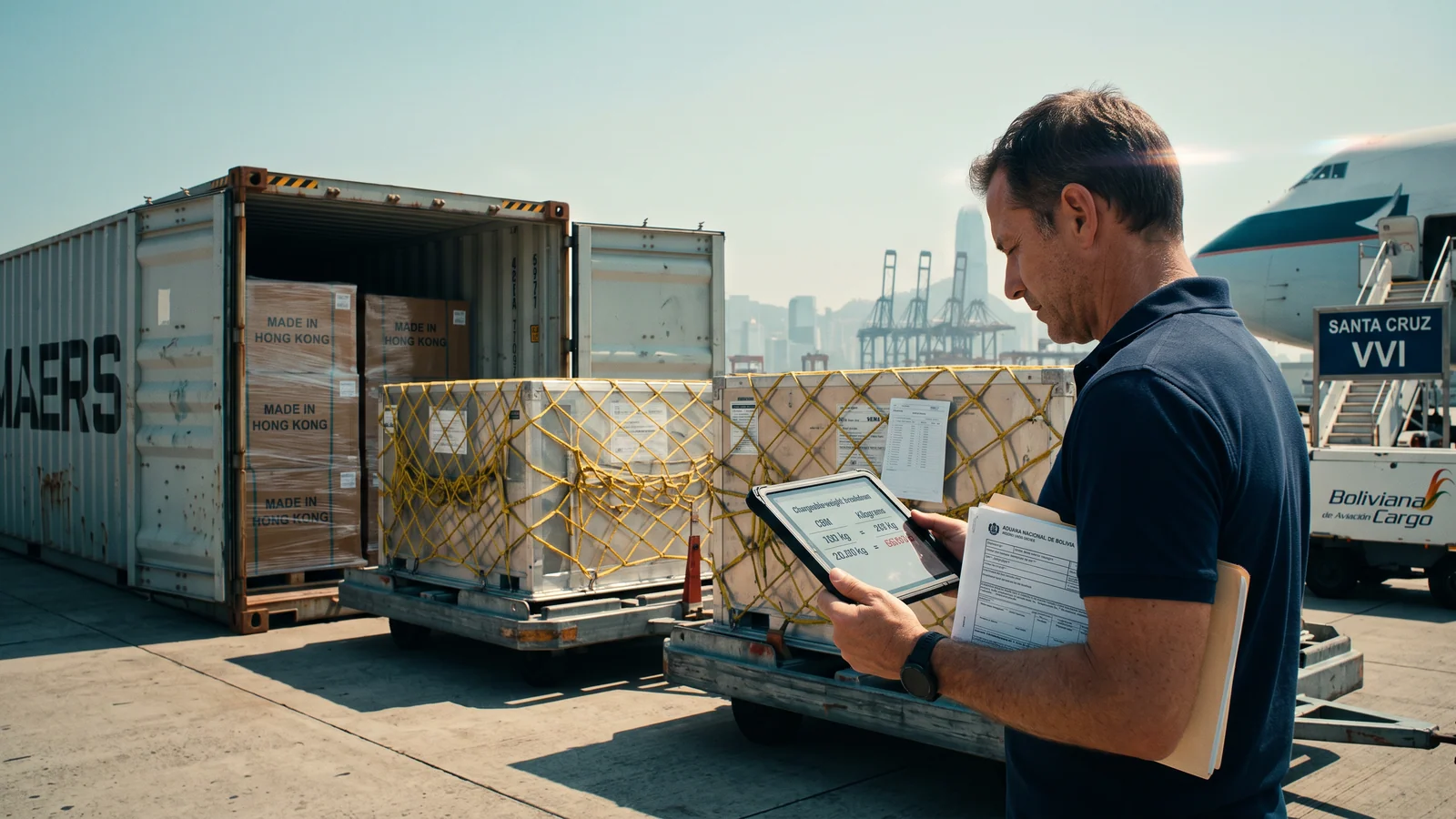
Quick Answer: Sea-air cargo from Asia to Bolivia runs 17-26 days door-to-airport and starts from $6.62/kg at 5,000+ kg, from $7.08/kg at 1,000-4,999 kg, with a 300 kg minimum billed weight. Ocean moves to Los Angeles, trucks to Miami, then flies to Santa Cruz (VVI), La Paz (LPB) or Cochabamba (CBB).
- Sea-air to Bolivia takes 17-26 days total: 12-18 days ocean to Los Angeles, 3-5 days trucking to Miami, 2-3 days air to VVI, LPB or CBB.
- Walio sea-air rates start from $8.67/kg (300-499 kg), $7.77/kg (500-999 kg), $7.08/kg (1,000-4,999 kg) and $6.62/kg (5,000+ kg).
- Chargeable weight is the greater of actual weight and volume x 167 kg per m3; anything under 300 kg is billed as 300 kg.
- Bolivian import tax is calculated on CIF value: GA (arancel) 0-40% plus IVA at an effective 14.94%, declared through a DUI filed by a licensed despachante de aduana.
Bolivian importers of electronics and spare parts search for a calculadora marítimo aéreo hong kong bolivia because they need the number before they place the supplier order. The calculator on this page prices your exact weight, volume and destination airport in seconds.
What is a sea-air Hong Kong to Bolivia calculator?
Quick Answer: A sea-air Hong Kong to Bolivia calculator prices a multimodal shipment that travels by ocean, then by truck, then by air. You enter weight, dimensions and destination city. The tool converts volume to chargeable weight, applies the per-kg band and adds handling, returning a real bookable price in seconds.
Sea-air is one service with three legs and one price. The container sails from an Asian port to Los Angeles. A truck carries the cargo across the United States to Miami. A freighter or passenger belly then flies it into Bolivia.
That is what multimodal means in practice: separate carriers, separate equipment, one bill of lading chain and one quote. You do not manage the handoffs. The rate you see covers the full port-to-airport move.
Which inputs change the price?
Five fields drive the number inside any calculadora marítimo aéreo hong kong bolivia:
- Gross weight in kilograms, all cartons combined
- Dimensions in centimeters per carton type, which produce your CBM
- Number of pieces, since pallet build and carton count change the volumetric total
- Origin port, because each gateway carries its own ocean rate and sailing frequency
- Destination airport: Viru Viru (VVI), El Alto (LPB) or Jorge Wilstermann (CBB)
What does port to airport include?
Walio prices this lane port to airport. The shipper delivers the cargo to the origin port. The consignee collects it at the Bolivian airport after clearance. Door pickup in Asia and door delivery in Bolivia are quoted on request inside the calculator.
Electronics and spare-parts importers use the tool because there is no email form and no waiting. Rates come from Walio's live multimodal rate table, and Walio compares carriers such as Maersk, MSC, CMA CGM and Hapag-Lloyd on the ocean leg. If you also buy for Central America, the same logic appears in our Sea-Air Hong Kong to Costa Rica Calculator: 2026 Rates guide.
Pro tip
Ask your Hong Kong supplier for the final carton list with real outer dimensions, not the catalog box size. Suppliers routinely add 3-5 cm of shrink wrap and corner protection per carton, which quietly raises your chargeable weight.
How does sea-air routing from Asia reach landlocked Bolivia?
Quick Answer: Bolivia has no coastline, so every import crosses a neighbor. Walio's sea-air route sails to Los Angeles, trucks 3-5 days to Miami, then flies 2-3 days into Santa Cruz (VVI), La Paz (LPB) or Cochabamba (CBB). The air leg skips the Arica and Iquique truck corridor entirely.
Nine ocean gateways are priced on this lane: Dalian, Fuzhou, Guangzhou, Ningbo, Qingdao, Shanghai, Shenzhen, Xiamen and Xingang. Hong Kong cargo normally trucks or feeders to the nearest of these. For most Kwai Tsing suppliers that means Shenzhen or Guangzhou, a short drayage away.
| Leg | Mode | From | To | Days |
|---|---|---|---|---|
| 1 | Ocean | Shenzhen / Shanghai / Ningbo (+6 ports) | Los Angeles | 12-18 |
| 2 | Truck | Los Angeles | Miami | 3-5 |
| 3 | Air | Miami | VVI / LPB / CBB | 2-3 |
| Total | Sea-air | Asian port | Bolivian airport | 17-26 |
 Shenzhen(CNSZX)
 Santa Cruz(VVI)
How does pure ocean to Bolivia work instead?
Pure ocean sails from Hong Kong to a transit port on the Pacific coast: Arica, Iquique or Antofagasta in Chile, or Matarani and Ilo in Peru. From there the cargo trucks roughly 1,900-2,100 km over the altiplano to La Paz, El Alto, Oruro, Cochabamba or Santa Cruz.
That inland leg is not a footnote. It can represent 25% to 45% of the total landed ocean cost, and it adds its own risks: port storage at Arica, border queues at Tambo Quemado and Pisiga, and demurrage and detention clocks that keep running while trucks wait for a slot.
Sea-air removes that corridor. The cargo lands already inside Bolivia. Viru Viru in Santa Cruz is the country's main cargo airport and handles the widest range of freighter equipment. El Alto sits at 4,061 m, where thin air limits payload on some aircraft, so capacity into LPB is tighter than into VVI.
How do I calculate chargeable weight and CBM step by step?
Quick Answer: Chargeable weight is the greater of actual weight and volumetric weight. For sea-air, volume in cubic meters is multiplied by 167 kg per m3. Pure air cargo uses length x width x height in cm divided by 6,000. Ocean LCL uses the W/M rule, where 1 CBM equals 1,000 kg.
Start with CBM. The formula is simple and it is the same everywhere:
- Multiply length x width x height in centimeters for one carton.
- Divide by 1,000,000 to get cubic meters per carton.
- Multiply by the number of cartons to get total CBM.
- Multiply total CBM by 167 to get sea-air volumetric weight in kilograms.
- Compare that figure with your actual gross weight and bill the higher one.
A worked sea-air example
Take 12 cartons of circuit boards at 60 x 40 x 50 cm each. One carton is 120,000 cm3, or 0.12 CBM. Twelve cartons give 1.44 CBM. Multiply 1.44 by 167 and you get 240 kg volumetric.
If the actual weight is 180 kg, the volumetric 240 kg wins. Both sit below the floor, so the shipment bills as 300 kg, the minimum billed weight on this lane.
The sea-air volumetric factor. One cubic meter of light electronics is billed as 167 kg, which is why carton size often matters more than scale weight.
Why do air and ocean use different divisors?
Pure air cargo uses the IATA standard divisor of 6,000: length x width x height in cm, divided by 6,000, gives kilograms. Some express and courier tariffs use /5000, which inflates your chargeable weight by 20%. Check which divisor your quote applies before comparing two offers.
Ocean LCL uses W/M, short for weight or measurement. The carrier bills the greater of metric tons and cubic meters, where 1 CBM counts as 1,000 kg. Light electronics almost always pay on volume, never on weight.
Pro tip
For spare-parts buyers, repacking beats renegotiating. Asking a Hong Kong consolidator to rebox loose alternators and brake kits into tighter master cartons can cut chargeable weight by 10-20%. That saves more than most rate discussions ever will.
Sea-air calculator Hong Kong to Bolivia: what does it cost?
Quick Answer: Walio sea-air freight runs from $8.67/kg for 300-499 kg, from $7.77/kg for 500-999 kg, from $7.08/kg for 1,000-4,999 kg and from $6.62/kg for 5,000+ kg of chargeable weight. Rates are port to airport, in USD, from Walio's live rate table dated October 2, 2026.
| Chargeable weight band | Sea-air rate (USD/kg) | Scope |
|---|---|---|
| 300-499 kg | from $8.67 | Port to airport |
| 500-999 kg | from $7.77 | Port to airport |
| 1,000-4,999 kg | from $7.08 | Port to airport |
| 5,000+ kg | from $6.62 | Port to airport |
| Under 300 kg | billed as 300 kg | Minimum billed weight |
Every figure is a "from" rate. The exact number depends on your origin port and your destination airport, which is precisely what the calculator resolves. A Shenzhen-to-VVI booking and a Xingang-to-LPB booking are not the same price.
The 300 kg floor matters more than importers expect. A 90 kg box of circuit boards still bills as 300 kg, so your effective cost per kilo triples. Consolidating three supplier orders into one booking is the single easiest saving on this lane.
What is not included in the freight rate?
- Origin and destination handling, added per shipment inside the calculator and never folded into the per-kg rate
- Bolivian GA (arancel) and IVA, plus ICE where it applies
- Despachante de aduana fees and the DUI filing
- Cargo insurance, which is optional but strongly advised
- Door pickup in Asia and door delivery in Bolivia, both quoted on request
Rates move with Chinese New Year, Golden Week, peak season and ocean disruption. A quote is therefore valid for a defined window. Price and book while the number is live on screen rather than three weeks later.
Sea-air vs ocean LCL vs air cargo vs courier: which wins?
Quick Answer: Sea-air sits between ocean and air: roughly half the transit of pure LCL to Bolivia and well below straight airfreight cost. Pure LCL via Arica suits bulky, low-value cargo over 15 m3. Full airfreight suits urgent shipments under 300 kg. Courier only makes sense under about 70 kg.
| Mode | Cost level | Transit days | Ideal volume | Arrival point | When it wins |
|---|---|---|---|---|---|
| Ocean FCL 40'HQ | Lowest per CBM | 35-50 + inland | 28+ CBM | Arica / Iquique, then truck | Full container of stock |
| Ocean LCL | Low per CBM | 35-50 + inland | 2-15 CBM | Arica / Iquique, then truck | Bulky, low-value goods |
| Sea-air | Mid | 17-26 | 300 kg to 10+ t | VVI / LPB / CBB | Electronics, parts, restocks |
| Pure air cargo | High | 5-9 | Under 300 kg | VVI / LPB / CBB | Urgent production stops |
| Courier express | Highest per kg | 4-7 | Under 70 kg | Door delivery | Samples, warranty parts |
Where is the break-even?
The crossover moves as weight climbs. At 300-499 kg you pay from $8.67/kg, close to airfreight territory. At 1,000 kg the band drops to from $7.08/kg, and at 5,000 kg to from $6.62/kg. Once you price the Arica truck leg, border time and port storage, sea-air closes much of the gap with ocean.
Choose sea-air
Your cargo is dense, valuable and sensitive to shelf time: phone parts, ECUs, sensors, LED modules, bearings. You want it in Santa Cruz this month, not next quarter, and you want to skip Tambo Quemado. Anything from 300 kg upward prices cleanly in the bands above.
Choose ocean LCL or FCL
Your cargo is bulky and low value per cubic meter: plastic housings, furniture, tires, bodywork panels. Above roughly 28 CBM a 40'HQ usually beats LCL per cubic meter. You accept 35-45 days of sailing plus the altiplano truck run.
Three worked scenarios
| Shipment | Sea-air chargeable weight | Sea-air freight (from) | Recommended mode |
|---|---|---|---|
| 80 kg / 0.5 CBM | 300 kg (minimum applies) | from $2,601 at $8.67/kg | Courier or pure air |
| 500 kg / 3 CBM | 501 kg (3 x 167) | from $3,893 at $7.77/kg | Sea-air |
| 6,000 kg / 28 CBM | 6,000 kg (actual wins) | from $39,720 at $6.62/kg | Sea-air if urgent, FCL if not |
Those freight figures exclude handling, duties and taxes. For the 80 kg case, the 300 kg floor makes sea-air uneconomic, so courier usually wins. The same math on a Caribbean lane is broken down in our Sea-Air Hong Kong to Jamaica Calculator: 2026 Rates analysis.
How long does cargo take to Santa Cruz, La Paz and Cochabamba?
Quick Answer: Sea-air totals 17-26 days to VVI, LPB or CBB, depending on the origin port. Add 2-5 working days for Aduana Nacional clearance and the DUI, plus local delivery. Pure ocean through Arica or Iquique typically runs 35-50 days before inland trucking to the altiplano or the lowlands.
| Destination | Airport | Sea-air freight days | Customs days | Total to release |
|---|---|---|---|---|
| Santa Cruz de la Sierra | VVI | 17-26 | 2-5 | 19-31 |
| La Paz / El Alto | LPB | 17-26 | 2-5 | 19-31 |
| Cochabamba | CBB | 17-26 | 2-5 | 19-31 |
| Oruro | via LPB + truck | 17-26 + 1 | 2-5 | 20-32 |
| Tarija | via VVI + truck | 17-26 + 1-2 | 2-5 | 20-33 |
Oruro and Tarija have no direct international cargo flights, so plan an inland truck leg from LPB or VVI. The calculator handles that request when you enter the final city.
Why do shipments miss their planned sailing?
Port cut-off is not vessel ETD. Cargo must be at the terminal several days before the ship sails, and documentation cut-off lands earlier still. Missing cut-off pushes you a full week, because most Asia-to-Los Angeles strings sail weekly.
Chinese New Year and the pre-Christmas peak compress space on both the ocean and air legs. Book three to four weeks ahead during those windows. On arrival the customs clock starts: parte de recepción, then the DUI, then payment, then release. Delays there cost storage, not freight.
What import taxes does Bolivia charge on Asian cargo?
Quick Answer: Bolivia charges GA (gravamen arancelario) of 0-40% depending on HS classification, plus IVA at an effective 14.94% on the CIF value plus GA. Some goods also pay ICE. Everything is declared through a DUI filed with the Aduana Nacional de Bolivia by a licensed despachante de aduana.
The DUI, or Declaración Única de Importación, is the single import declaration lodged with the Aduana Nacional de Bolivia. Only a licensed despachante de aduana files it. Your commercial documents feed straight into that filing, so errors in the invoice become errors in the declaration.
The tax base is CIF value: merchandise plus freight plus insurance. That is a detail importers miss. A higher freight bill directly raises your GA and IVA, which is another reason to compare modes before you book.
What rates apply to electronics and spare parts?
Per the Aduana Nacional de Bolivia tariff schedule, GA sits in bands from 0% to 40% by HS code. Capital goods and many industrial inputs fall at the low end. Finished consumer electronics and some vehicle spare parts sit higher. ICE applies to selected goods, with vehicles, alcohol and tobacco carrying their own rules.
Walio quotes freight, not duties
The rates above are Bolivia's published figures, not Walio prices. HS classification decides your actual GA, and a single digit changes the outcome. Confirm your codes with a licensed despachante de aduana or tax adviser before you commit to a purchase order.
Which documents does the DUI need?
- Factura Comercial from the Hong Kong supplier, with full product descriptions
- Packing list with carton count, weights and dimensions
- Air Waybill (AWB) for the final air leg into Bolivia
- Certificado de Origen where a preference or control applies
- NIT of the importing company
- Authorizations from SENASAG or IBMETRO for regulated goods
Which Incoterm should you buy on from Asia?
Quick Answer: FOB at the origin port is the cleanest base for sea-air: the supplier delivers to the terminal and you control the rest. EXW makes you pay origin pickup and export clearance. CIF ends at a seaport you are not using. DAP Santa Cruz hands everything to the seller but hides the margin.
| Incoterm 2020 | Seller covers | Who pays the onward legs | What you enter in the calculator |
|---|---|---|---|
| EXW Hong Kong | Goods at factory only | Buyer: pickup, export clearance, all legs | Request door pickup plus port to airport |
| FOB origin port | Delivery and loading at port | Buyer: ocean, truck, air, import | Port to airport — the standard fit |
| CIF Arica | Ocean to a Chilean port | Buyer: inland truck and import | Not applicable to a sea-air booking |
| DAP Santa Cruz | Everything to the named place | Seller, with margin built in | Nothing — seller books |
| DDP Santa Cruz | Everything plus Bolivian duties | Seller, including GA and IVA | Nothing — rarely workable |
FOB matches Walio's port-to-airport service exactly. Your supplier delivers to the terminal, Walio takes over from there, and you see one price for all three legs. No overlap, no gap.
CIF Arica is a trap on a sea-air booking. It buys ocean freight to a Chilean port you are not routing through, so you pay twice or scrap the plan. DDP shifts Bolivian import liability to a foreign seller who usually has no NIT and no despachante, which stalls the DUI.
Insurance is not automatic under FOB. Risk passes to you when the goods are loaded at the origin port. Arrange cargo cover before the first leg sails, especially on high-value electronics.
What cannot ship by sea-air from Asia to Bolivia?
Quick Answer: The air leg controls the restrictions. Loose lithium batteries, aerosols, flammable liquids, magnets and many cosmetics are restricted or prohibited as general cargo. Batteries installed in equipment can usually fly with UN 3481 packing and a declaration. Food and supplements need SENASAG registration before they land.
Lithium batteries split into two classes. UN 3480 covers standalone cells and packs, which airlines restrict heavily and often refuse as general cargo. UN 3481 covers batteries packed with or contained in equipment, which normally fly with correct packing, state-of-charge limits near 30% and a shipper's declaration.
- Cosmetics, perfumes and aerosols often fail the air leg even when ocean carriers accept them
- Drones, radios and telecom equipment may need an ATT authorization in Bolivia
- Used machinery and second-hand goods draw extra scrutiny and valuation disputes at Aduana Nacional
- Food, supplements and veterinary products need SENASAG registration before arrival
Declare restricted items before you book
A battery or aerosol discovered at the Miami air leg is offloaded, stored and re-declared at your cost. Dangerous goods and oversized pieces are handled by request: submit the shipment in the calculator and a Walio specialist follows up with the right routing.
A good calculadora marítimo aéreo hong kong bolivia does one job: it turns weight, CBM and a destination airport into a bookable number. Enter your route in the calculator above and see your price in seconds — no signup, no follow-up calls.
Walio sea-air freight starts from $8.67/kg for 300-499 kg and drops to from $6.62/kg at 5,000+ kg of chargeable weight, port to airport. Origin and destination handling is added per shipment. Enter your weight, dimensions and destination airport in the calculator to see the exact number in seconds.
Total transit is 17-26 days depending on the origin port: 12-18 days ocean to Los Angeles, 3-5 days trucking to Miami and 2-3 days flying into El Alto (LPB). Add 2-5 working days for the DUI and Aduana Nacional clearance before you take delivery.
Pure ocean LCL is cheapest per cubic meter but slowest, running 35-50 days plus a long truck leg from Arica or Iquique. Sea-air costs more per kilo yet lands in 17-26 days without the Chilean border corridor. Compare both in the calculator with your real weight and volume.
Bolivia applies GA (arancel) of 0-40% by HS classification plus IVA at an effective 14.94%, both calculated on the CIF value. Selected goods also pay ICE. A licensed despachante de aduana files the DUI and should confirm your classification before you buy.
The minimum billed weight is 300 kg, so a 120 kg shipment is still charged as 300 kg. Chargeable weight is the greater of actual weight and volume multiplied by 167 kg per cubic meter. Consolidating several supplier orders into one booking lowers your cost per kilo.