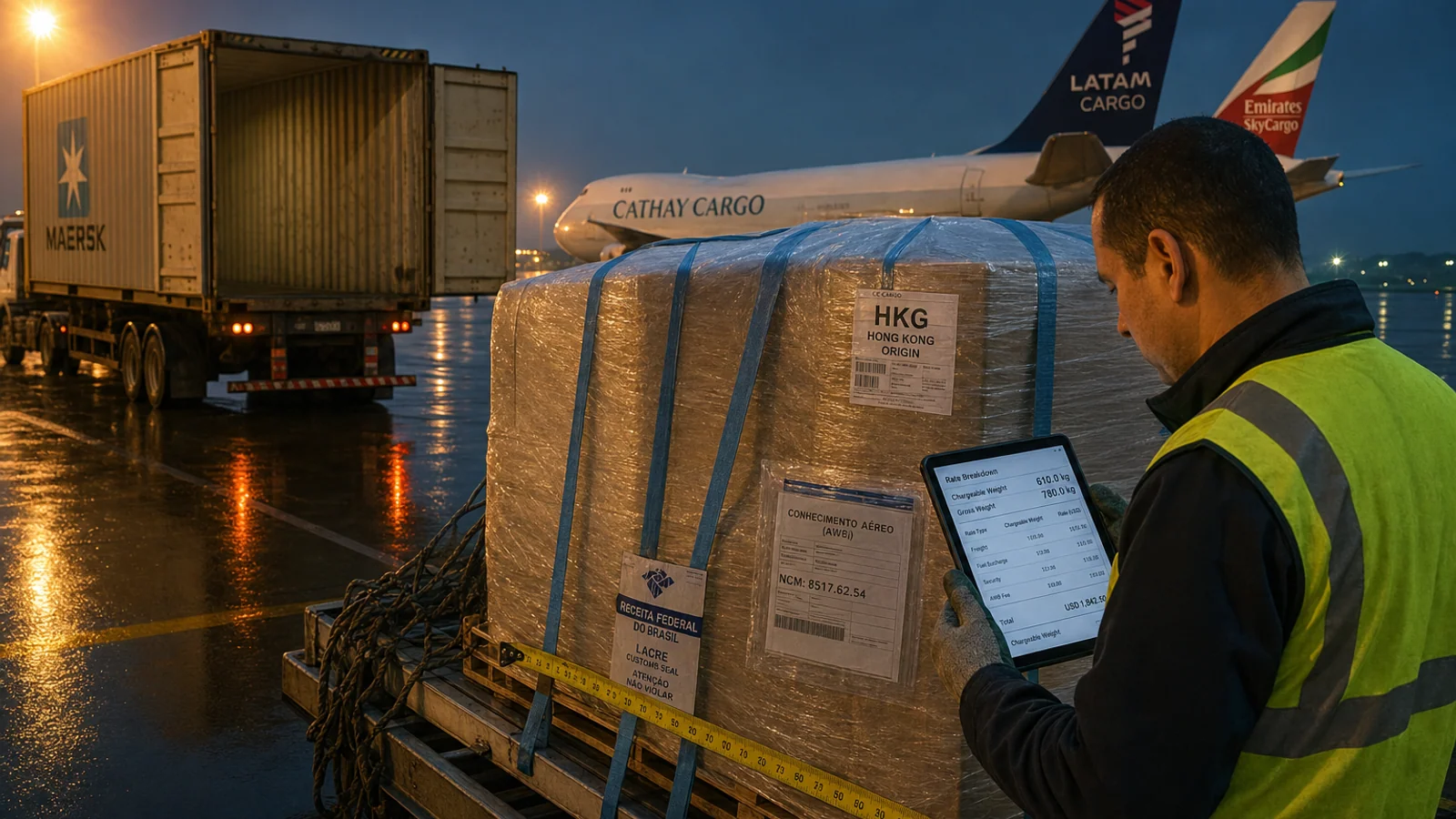
Quick answer Sea-air cargo from Hong Kong to Brazil takes 16–25 days and starts from $6.64/kg for 300–499 kg, falling to $4.60/kg from 5,000 kg, port to airport. Boxes sail from Shenzhen, Guangzhou or Xiamen to Los Angeles, truck to Miami, then fly to GRU, VCP and nine other Brazilian airports.
- Walio's sea-air rate from South China ports to Brazil starts from $6.64/kg (300–499 kg) and drops to $4.60/kg at 5,000 kg or more, port to airport.
- Total transit is 16–25 days: 12–18 days ocean to Los Angeles, 3–5 days truck to Miami, 1–2 days air to Brazil.
- Minimum billed weight is 300 kg, and chargeable weight is the greater of actual weight or volume × 167 kg per m³.
- Cargo arriving by air into GRU or VCP clears as an air import, so the 8% AFRMM charged on ocean freight does not apply — confirm treatment with your despachante aduaneiro.
This guide gives you the rate bands, the chargeable weight math, the Brazilian tax lines and the transit times for every arrival airport on the lane. The calculator on this page prices your exact port, airport and weight instantly.
See your price in seconds
Real carrier rates, no signup, no follow-up calls.
How much does it cost to ship cargo from Hong Kong to Brazil?
Quick answer Walio's sea-air rates from Hong Kong's neighboring South China ports to Brazil start from $6.64/kg for 300–499 kg, $5.74/kg for 500–999 kg, $5.06/kg for 1,000–4,999 kg and $4.60/kg from 5,000 kg, port to airport. Origin and destination handling are added per shipment in the calculator.
The rate falls as chargeable weight rises. Four published bands cover the lane, and every figure is a "from" rate tied to the cheapest port and airport pair.
| Chargeable weight band | Sea-air rate (from, USD/kg) | Scope |
|---|---|---|
| 300–499 kg | $6.64 | Port to airport |
| 500–999 kg | $5.74 | Port to airport |
| 1,000–4,999 kg | $5.06 | Port to airport |
| 5,000 kg and above | $4.60 | Port to airport |
Port to airport means the shipper delivers cargo to the origin port and the consignee collects it at the Brazilian airport. Door pickup in Guangdong and door delivery in São Paulo, Curitiba or Porto Alegre are quoted on request through the calculator.
Your exact per-kg rate depends on two choices: which port the cargo loads at, and which Brazilian airport it lands at. A box loading at Shenzhen and flying into Guarulhos prices differently from the same box loading at Qingdao and flying into Manaus.
What the rate covers:
- The ocean leg from the South China port to Los Angeles
- The US trucking leg from Los Angeles to Miami
- The air leg from Miami into your Brazilian arrival airport
What sits outside the per-kg rate:
- Origin and destination handling, shown as separate line items per shipment
- Brazilian customs clearance and the DUIMP filing
- II, IPI, PIS/COFINS-Importação and state ICMS
- Despachante aduaneiro fees and inland trucking from the airport
Large replenishment shipments earn the lowest published band on the lane. Run your exact port, airport and weight through the sea air cargo calculator Hong Kong Brazil importers use on this page.
See your price in seconds
Real carrier rates, no signup, no follow-up calls.
What is sea-air freight and how does the Hong Kong–Brazil route run?
Quick answer Sea-air combined freight is one multimodal service that moves cargo by ocean, then by road, then by air on a single booking. From South China the cargo sails to Los Angeles in 12–18 days, trucks to Miami in 3–5 days, and flies into Brazil in 1–2 days.
You book it once. You do not arrange three separate contracts, and you do not chase three carriers for milestones.
The ocean leg loads at Dalian, Fuzhou, Guangzhou, Ningbo, Qingdao, Shanghai, Shenzhen, Xiamen or Xingang. Vessels run to the Port of Los Angeles/Long Beach, where the cargo transfers to a line-haul truck for Miami. From Miami International the freight flies south on commercial and freighter capacity.
 Shenzhen(CNSZX)
 Los Angeles(USLAX)Los Angeles(USLAX)Miami(USMIA)Miami(MIA)
 São Paulo(GRU)
Hong Kong shippers rarely load in Hong Kong itself on this service. A short cross-border truck from Kwai Tsing or the New Territories feeds Shenzhen, Guangzhou or Xiamen, where sailing frequency and container availability are stronger.
Eleven Brazilian airports receive the air leg: Belo Horizonte (CNF), Campinas (VCP), Curitiba (CWB), Florianópolis (FLN), Manaus (MAO), Navegantes (NVT), Porto Alegre (POA), Rio de Janeiro (GIG), São José dos Campos (SJK), São Paulo (GRU) and Vitória (VIX). "Sea air Guarulhos" is the most searched pair on the lane, but Campinas often clears faster for pure cargo.
If you also import into other South American markets, compare lane structures before you commit volume. The Sea-Air Hong Kong to Peru Calculator: Rates 2026 shows how the same ocean-plus-air model prices into Callao and Lima.
Sea air cargo calculator Hong Kong Brazil: how does it price my shipment?
Quick answer The sea air cargo calculator for Hong Kong to Brazil asks for your loading port, your Brazilian arrival airport, actual weight and carton dimensions. It converts volume to chargeable weight, picks the right weight band, adds handling per shipment and returns a bookable price in seconds — no signup, no follow-up calls.
Six inputs drive the number:
- Origin port — Shenzhen, Guangzhou, Xiamen, Ningbo, Shanghai, Qingdao, Fuzhou, Dalian or Xingang.
- Destination airport — GRU, VCP, GIG, CWB, POA, FLN, NVT, CNF, SJK, VIX or MAO.
- Gross weight — the scale weight of all cartons together.
- Piece dimensions — length, width and height per carton or pallet, plus piece count.
- Cargo description — so the system flags restricted or controlled goods.
- Incoterm — FOB, FCA, EXW or CIF, which sets where your responsibility starts.
The calculator applies the 300 kg minimum billed weight automatically. A 180 kg shipment prices as 300 kg, so small orders rarely pay their way on this service.
Switching the arrival airport changes two things at once: the rate and the clearance queue. Viracopos in Campinas handles dedicated cargo volume, while Guarulhos mixes cargo with heavy passenger operations. A southern importer landing at Navegantes or Curitiba saves days of inland trucking.
Handling charges appear as separate line items per shipment. They are never folded into the per-kg figure, so you can see exactly what you pay at origin and at destination before you book.
Oversized, stackable-only, lithium battery or dangerous goods shipments need a human review. Submit the request through the calculator and a Walio specialist follows up with a compliant routing. The same tool runs other lanes — see the Sea-Air Hong Kong to Uruguay Calculator: Rates 2026.
See your price in seconds
Real carrier rates, no signup, no follow-up calls.
How do I calculate chargeable weight for air freight from Hong Kong to Brazil?
Quick answer Chargeable weight is the greater of actual gross weight and volumetric weight. For sea-air into Brazil, multiply total cubic meters by 167 kg per m³ and compare. Standard air freight uses the 1:6000 divisor (length × width × height in cm ÷ 6000); LCL uses 1 m³ = 1,000 kg.
Start with cubic meters. The formula is (L cm × W cm × H cm) ÷ 1,000,000 × number of cartons. Measure the outside of the carton, not the product.
| Mode | Conversion rule | 1 m³ equals | When it applies |
|---|---|---|---|
| Air freight | cm³ ÷ 6,000 | 167 kg | Direct HKG–GRU airport pairs |
| Sea-air | m³ × 167 kg | 167 kg | This Hong Kong–Brazil service |
| LCL ocean | m³ × 1,000 kg | 1,000 kg | Consolidated ocean freight (W/M) |
| Express courier | cm³ ÷ 5,000 | 200 kg | Parcels under 70 kg |
Worked example: 20 cartons of consumer goods
Twenty cartons at 60 × 40 × 40 cm give 0.096 m³ each, so 1.92 m³ in total. Multiply 1.92 by 167 and you get 321 kg volumetric. Actual weight is 230 kg. Chargeable weight is 321 kg, billed in the 300–499 kg band from $6.64/kg.
Worked example: a light 120 kg shipment
Six cartons at 50 × 40 × 40 cm give 0.48 m³, or 80 kg volumetric. Actual weight is 120 kg, so chargeable weight would be 120 kg. The 300 kg minimum takes over, and the shipment bills as 300 kg.
Re-measure before you quote
Supplier packing lists often understate carton height by 2–5 cm and ignore the pallet. A 1.2 × 1.0 m pallet at 1.5 m tall is 1.8 m³, which is 300 kg volumetric on its own. Measure the loaded pallet, pallet included, or your invoice will not match your quote.
Is air freight or sea freight cheaper from Hong Kong to Brazil?
Quick answer Sea freight wins on cargo under roughly 167 kg per cubic meter in density and over 10–15 m³ in volume. Direct air wins when the goods are high value and urgent. Sea-air sits between them: air-style transit of 16–25 days at a rate that sits well below a straight HKG–GRU airport pair.
| Mode | Transit (port/door) | Ideal weight | Cost driver | Best use case |
|---|---|---|---|---|
| Express courier | 4-7 days | Under 70 kg | cm³ ÷ 5,000 | Samples, spare parts |
| Direct air freight | 5-9 days | 100-2,000 kg | cm³ ÷ 6,000 | High-value, urgent SKUs |
| Sea-air | 16-25 days | 300 kg and up | m³ × 167 kg | E-commerce restocks |
| LCL ocean | 35-50 days | 1-15 m³ | m³ or 1,000 kg | Low-value bulk |
| FCL ocean | 35-50 days | 15 m³ and up | Per container | Full container programs |
The break-even is density. Below 167 kg per cubic meter, your shipment pays on volume rather than scale weight, and ocean economics take over. Above that density, air and sea-air pricing closes the gap fast.
On the ocean side, LCL beats FCL on cost per cubic meter until roughly 10–15 m³. Past that point a 20 ft container is usually the better buy, and you also escape CFS deconsolidation queues at destination.
Choose sea-air
Your SKU sells through in 30 days, your supplier ships monthly, and a 45-day ocean transit strands cash in stock you cannot sell. Sea-air lands in 16–25 days at a per-kg rate well under a direct booking.
Choose ocean FCL
You buy furniture, ceramics, packaging or any low-density, low-value cargo in 15 m³ blocks or more. Transit does not drive your margin. The container rate per cubic meter beats every airborne option.
Sea-air earns its place on restock cycles, e-commerce replenishment and seasonal SKUs. The same structure works on smaller Caribbean lanes too — compare it with the Sea-Air Hong Kong to Jamaica Calculator: 2026 Rates.
See your price in seconds
Real carrier rates, no signup, no follow-up calls.
How long does sea freight take from Hong Kong to Brazil?
Quick answer Port-to-port ocean from South China to Santos runs roughly 35–45 days with a transshipment, and Itajaí, Paranaguá and Navegantes add or subtract a few days. Sea-air is far faster: 12–18 days ocean, 3–5 days truck, 1–2 days air — 16–25 days in total, before Brazilian clearance.
Total sea-air transit depends on the loading port. Shenzhen and Ningbo sit at the fast end of the 12–18 day ocean window; Dalian and Xingang sit at the slow end because of coastal feeder time.
| Arrival point | Routing | Sea-air total transit | Air leg frequency |
|---|---|---|---|
| São Paulo (GRU) | South China → LAX → MIA → GRU | 16-25 days | Daily |
| Campinas (VCP) | South China → LAX → MIA → VCP | 16-25 days | Daily |
| Rio de Janeiro (GIG) | South China → LAX → MIA → GIG | 17-25 days | Several weekly |
| Curitiba (CWB) | South China → LAX → MIA → CWB | 17-25 days | Several weekly |
| Navegantes (NVT) | South China → LAX → MIA → NVT | 17-25 days | Several weekly |
| Porto Alegre (POA) | South China → LAX → MIA → POA | 17-25 days | Several weekly |
| Manaus (MAO) | South China → LAX → MIA → MAO | 17-25 days | Several weekly |
| Santos (ocean FCL/LCL) | South China → Santos, transshipped | 35-45 days | Weekly sailings |
| Itajaí / Paranaguá (ocean) | South China → Itajaí or Paranaguá | 38-50 days | Weekly sailings |
Port cut-off is not the same as vessel ETD. Documentation cut-off usually falls 2–3 days before the ship sails, and container cut-off 1–2 days before. Miss either and your cargo rolls to the next sailing, which costs a full week on the ocean leg alone.
Brazilian clearance time stacks on top of transit. A DUIMP routed to canal verde releases within hours. Canal amarelo triggers a document review, and canal vermelho adds a physical inspection — both commonly add 3–10 days.
Importers weighing regional hubs and transshipment options can see a parallel setup in the Sea Air Cargo Hong Kong to Guyana Calculator (2026).
What taxes do I pay when importing goods from Hong Kong into Brazil?
Quick answer Brazilian imports carry Imposto de Importação (II), IPI, PIS/COFINS-Importação, state ICMS, the SISCOMEX fee and, on ocean freight, the 8% AFRMM. Rates follow the NCM code of the goods and the state of clearance. A licensed despachante aduaneiro should confirm the exact figures for your NCM.
What is AFRMM and how does it affect Brazil import freight costs?
AFRMM is the Adicional ao Frete para a Renovação da Marinha Mercante, a merchant marine renewal charge of 8% applied to waterway freight arriving at Brazilian ports. It is calculated on the ocean freight value, not the goods value, and it is collected through the Mercante system.
Cargo that lands by air at GRU or VCP clears as an air import, so AFRMM on ocean freight does not apply. That is a real structural advantage of sea-air over a straight ocean booking into Santos. Confirm the treatment of your specific DUIMP with your despachante aduaneiro, because classification and documentation drive the final assessment.
The table below shows published Brazilian rates applied to a sample USD 10,000 customs value. II and IPI percentages vary by NCM code; the figures here are illustrative only.
| Cost line | Published rate | Example on USD 10,000 |
|---|---|---|
| Freight (sea-air, 1,000 kg) | From $5.06/kg | Priced in the calculator |
| AFRMM (ocean freight only) | 8% of waterway freight | Not applied to air arrivals |
| Imposto de Importação (II) | 0-35% by NCM (example 16%) | 1,600 |
| IPI | 0-15% by NCM (example 10%) | 1,160 |
| PIS-Importação | 2.1% | 210 |
| COFINS-Importação | 9.65% | 965 |
| ICMS São Paulo | 18%, grossed up | 3,065 |
| ICMS Santa Catarina / Espírito Santo | 17%, grossed up | 2,859 |
| SISCOMEX / Portal Único fee | Fixed BRL amount per declaration | Under 50 |
| Despachante aduaneiro | Quoted per declaration | Varies by broker |
ICMS is the planning lever most importers underuse. The state of clearance sets the ICMS rate and any incentive regime, which is why Santa Catarina and Espírito Santo attract import volume. Your tax adviser, not your freight forwarder, should model this.
Before any of it happens, your company needs an active Radar habilitação with Receita Federal, and the import declaration is filed as a DUIMP in the Portal Único Siscomex. Walio is a shipping platform, not a tax adviser — use a licensed customs broker for duty and tax positions.
Which documents and surcharges appear on a Hong Kong–Brazil quote?
Quick answer Every sea-air booking needs a Commercial Invoice, packing list, the ocean Bill of Lading for the first leg and the Air Waybill for the final leg, plus the NCM classification and an active Radar licence. Surcharges include THC, ISPS, BAF, CAF, fuel and security fees and peak season charges.
- Commercial Invoice — values, Incoterm, NCM codes, exporter and importer details
- Packing list — carton count, dimensions, gross and net weight per piece
- House Bill of Lading or Sea Waybill — covers the ocean leg to Los Angeles
- Master Air Waybill and House AWB — cover the Miami to Brazil flight
- Certificate of Origin — only where a trade preference applies
- Authorization documents for used goods, which Brazil restricts tightly
Surcharge glossary in plain words
- THC / DTHC — terminal handling at origin and destination
- ISPS — port security fee under the international ship and port facility code
- BAF / CAF — bunker fuel adjustment and currency adjustment on ocean freight
- GRI and peak season surcharge — rate increases applied in tight capacity windows
- Fuel and security surcharges — standard add-ons on the air leg
- War risk — applied on specific routings, not usually on this lane
Incoterms 2020 decide who pays what. Under FOB Shenzhen the seller delivers to the port and you pay the freight. Under EXW you pay from the factory door. Under CIF the seller buys the main carriage, which often hides a markup. DDP into Brazil is rare because the importer of record must hold Radar, and a Hong Kong seller normally cannot.
Check restricted cargo before you book
Lithium batteries, aerosols, magnets and liquids follow IATA dangerous goods rules on the air leg. ANVISA controls cosmetics, food contact items and medical devices; INMETRO controls toys, electricals and safety equipment. Used machinery needs prior authorization. Declare the cargo correctly in the calculator so the booking reflects it. For a landlocked documentation comparison, see the Sea-Air Hong Kong to Bolivia Calculator: Rates (2026).
How can Brazilian importers cut Hong Kong freight costs?
Quick answer Consolidate purchase orders to cross a weight break, since 1,000 kg prices from $5.06/kg and 5,000 kg from $4.60/kg. Repack to raise density above 167 kg per cubic meter, choose the arrival airport closest to your clearance state, and classify NCM codes correctly the first time.
The weight-break math is the fastest win. Two separate 600 kg shipments both price in the 500–999 kg band from $5.74/kg. Combine them into one 1,200 kg booking and the whole volume moves into the 1,000–4,999 kg band from $5.06/kg.
- Repack at source — ask the Hong Kong supplier to cut carton void, flat-pack where possible and avoid oversized master cartons that inflate CBM
- Pick the right airport — VCP often clears faster than GRU for pure cargo, while NVT, CWB and POA cut inland trucking for southern importers
- Get NCM right — a wrong code triggers reclassification, fines and canal vermelho inspections
- Book before Chinese New Year and before the Q4 peak, when space on the air leg tightens and rates firm
Model your tax line before your freight line. On most consumer goods, II plus IPI plus PIS/COFINS plus ICMS exceeds the freight cost several times over. Freight optimization matters, but NCM accuracy and the state of clearance move far more money.
Run both scenarios side by side in the sea air cargo calculator Hong Kong Brazil importers use on this page — one shipment versus two, GRU versus VCP — and the arithmetic answers itself.
See your price in seconds
Real carrier rates, no signup, no follow-up calls.
Walio compares real carrier capacity on this lane, including the ocean services operated by names such as Maersk, MSC, CMA CGM and Hapag-Lloyd, and returns a bookable price without a sales call. Enter your loading port, your Brazilian airport and your carton dimensions in the calculator above and see your price in seconds — no signup, no follow-up calls.
Walio's sea-air rate starts from $6.64/kg for 300–499 kg, from $5.74/kg for 500–999 kg, from $5.06/kg for 1,000–4,999 kg and from $4.60/kg at 5,000 kg or more, port to airport. The exact figure depends on the loading port and the Brazilian arrival airport. Origin and destination handling are added per shipment in the calculator.
Sea-air takes 16–25 days in total, depending on the origin port: 12–18 days by ocean to Los Angeles, 3–5 days by truck to Miami, and 1–2 days by air into Brazil. Brazilian customs clearance time at GRU or VCP is additional and depends on the inspection channel your DUIMP is assigned.
Chargeable weight is the greater of the actual gross weight and the volumetric weight. For sea-air, multiply total cubic meters by 167 kg per m³ and compare with the scale weight; standard air freight uses length × width × height in cm divided by 6,000. Shipments under 300 kg are billed at the 300 kg minimum.
Sea freight is cheaper for low-density cargo above roughly 10–15 m³, while air freight is cheaper only when speed or high value justifies it. Sea-air sits in the middle: 16–25 days transit at a per-kg rate well below a direct airport-to-airport booking. Enter your weights and dimensions in the calculator to see which mode wins on your exact shipment.
No. AFRMM is an 8% charge applied to waterway freight arriving at Brazilian ports, and cargo landing by air at GRU or VCP clears as an air import. Confirm the treatment of your specific DUIMP with a licensed despachante aduaneiro, since classification and documentation drive the final assessment.