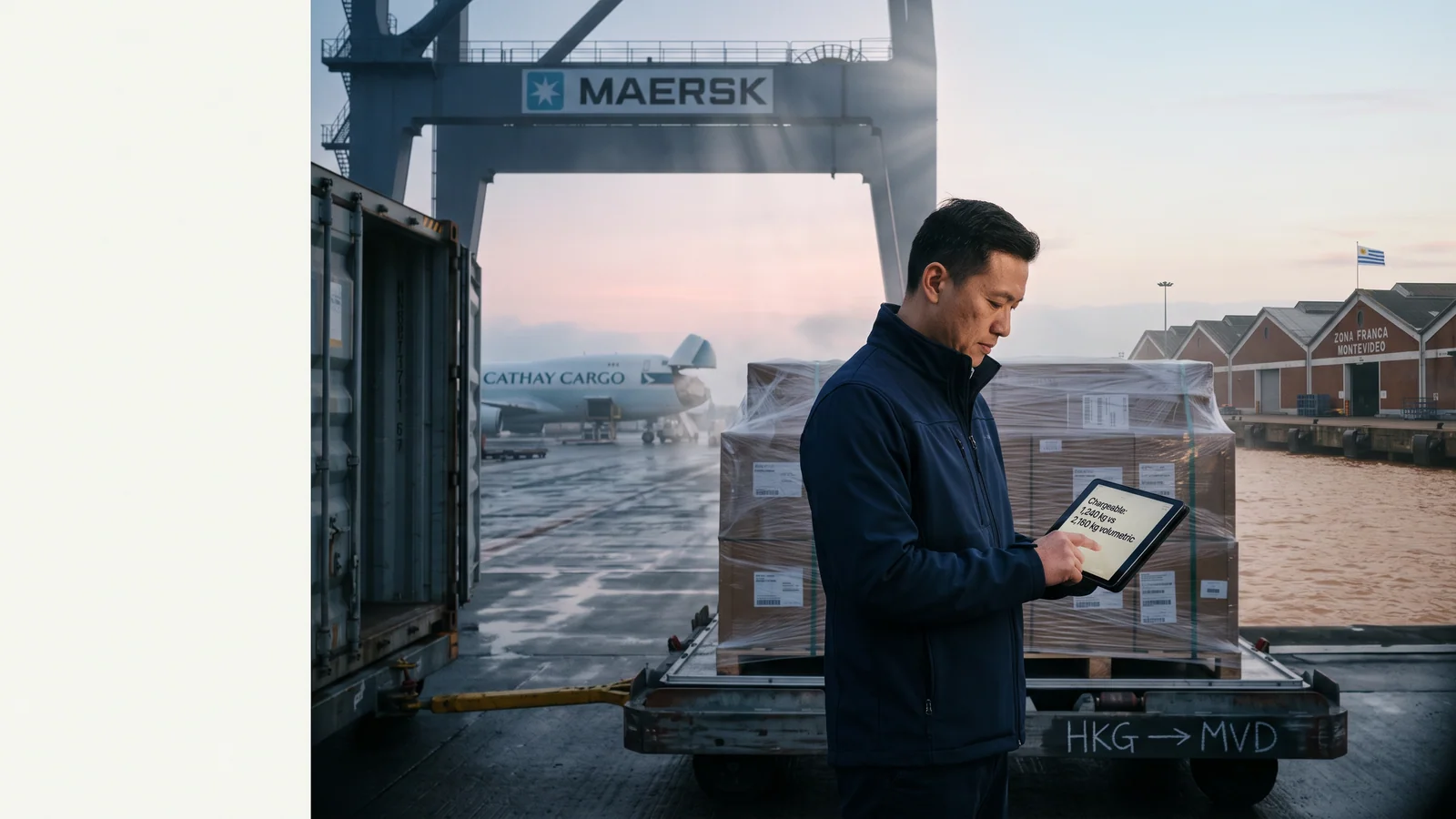
Quick Answer: Sea-air from Hong Kong to Uruguay moves cargo by ocean to Los Angeles, by truck to Miami, then by air to Montevideo (MVD) in 17-26 days total. Walio's sea-air rates start from $8.28/kg for 1,000-4,999 chargeable kg, with a 300 kg minimum billed weight. The calculator on this page prices your exact shipment in seconds.
- Sea-air Hong Kong to Montevideo takes 17-26 days port to airport, roughly half the time of all-ocean and a fraction of pure air cost.
- Walio sea-air rates start from $9.87/kg (300-499 kg), $8.97/kg (500-999 kg), $8.28/kg (1,000-4,999 kg) and $7.83/kg (5,000+ kg), cheapest port and airport on the lane.
- Minimum billed weight is 300 kg, and chargeable weight is the greater of actual kilos or volume x 167 kg per m3.
- Uruguay charges 22% IVA plus the Mercosur Common External Tariff on the CIF value, paid at clearance by the importer, not by Walio.
Uruguayan importers of phones, components, LED displays and lab equipment face the same squeeze: ocean is too slow, air is too expensive. Sea-air closes that gap, and the sea air cargo calculator hong kong uruguay importers need sits right on this page — compare it with a similar lane in our Sea-Air Hong Kong to Costa Rica Calculator: 2026 Rates.
What is a sea air cargo calculator for Hong Kong to Uruguay?
Quick Answer: A sea air cargo calculator for Hong Kong to Uruguay is an online tool that prices a multimodal shipment — ocean leg, truck leg and air leg — in one quote. You enter weight, dimensions and ports. It returns a per-kilo rate, transit days and handling charges instantly, with no sales call.
One quote covers three carriers and three legs. The tool converts your cartons into chargeable kilograms, applies the rate bracket your shipment falls into, then adds handling at origin and destination as separate line items. You see the number on screen.
Sea-air is a multimodal service: one booking, one file, one point of contact, but two different carriers and a transfer point in between. The ocean carrier issues a Bill of Lading for the water leg. The air carrier issues an Air Waybill for the flight. Walio manages the handoff so you do not book two shipments and hope they meet.
Walio's calculator prices this lane port to airport. The shipper delivers the cargo to the origin port, and the consignee collects it at Carrasco International Airport (MVD) in Montevideo. That scope keeps the rate clean and comparable.
Five inputs move the number:
- Gross weight in kilograms, carton by carton, not estimated by eye.
- Dimensions of each carton in centimeters, which drive volumetric weight.
- Origin port and destination airport, since the rate varies by pair.
- Commodity description — batteries, aerosols and magnets change the air leg entirely.
- Incoterm, which decides where your cost responsibility starts.
Pro tip
Door pickup at a Shenzhen or Hong Kong factory and door delivery to your Montevideo warehouse are both available. Request them through the same calculator and a Walio specialist prices them on your file — no phone tag, no separate quote request.
How does sea-air routing work from Hong Kong to Montevideo?
Quick Answer: Sea-air splits the trip: an ocean vessel carries the container to Los Angeles in 12-18 days, a truck moves the cargo to Miami in 3-5 days, then a flight covers Miami to Montevideo in 2-3 days. Total transit is 17-26 days depending on the origin port and sailing.
The logic is simple. The transpacific ocean leg is the cheap part of the journey, so sea-air uses the water for the long haul. The expensive air leg is kept short — Miami to Montevideo, not Hong Kong to Montevideo.
 Miami(MIA)
 Montevideo(MVD)
What happens at the transfer point?
Cargo is deconsolidated at a container freight station (CFS) near the airport. Handlers strip the container, re-weigh every piece, and re-manifest the consignment under a new Air Waybill. Dimensions get measured again at this stage — a carton that bulged in transit can gain volumetric weight.
From Hong Kong, your cargo loads at the Kwai Tsing Container Terminals, which feed the same transpacific strings as Shenzhen and Guangzhou. Hong Kong remains a free port with no export duty and no general tariff on outbound goods, which keeps origin paperwork light for electronics shippers.
Other published sea-air programs transfer in Dubai or Singapore and fly onward to South America. Walio's priced lane to Uruguay transfers in the United States, which shortens the air leg and keeps the cargo under a single North American handling network.
Port cut-off is not vessel ETD
Documentation cut-off and container cut-off usually fall 2-4 days before the ship sails. Book 3-5 days before cut-off, not before ETD. Miss the string and you miss the connecting flight slot in Miami, which pushes your arrival by a full week.
For a comparable Latin American routing with the same structure, see our Sea-Air Hong Kong to Ecuador Calculator: Rates 2026.
How much does it cost to ship cargo from Hong Kong to Uruguay?
Quick Answer: Walio sea-air rates start from $9.87/kg for 300-499 chargeable kg, $8.97/kg for 500-999 kg, $8.28/kg for 1,000-4,999 kg and $7.83/kg for 5,000+ kg, cheapest port and airport on the lane. Origin and destination handling are added per shipment. The calculator prices your exact port and weight in seconds.
| Chargeable weight bracket | Walio sea-air rate | Typical cargo | Total transit |
|---|---|---|---|
| 300-499 kg | from $9.87/kg | Sample orders, phone accessories | 17-26 days |
| 500-999 kg | from $8.97/kg | Tablets, networking gear | 17-26 days |
| 1,000-4,999 kg | from $8.28/kg | Retail replenishment, LED panels | 17-26 days |
| 5,000+ kg | from $7.83/kg | Full project orders, display stock | 17-26 days |
Every figure is a "from" rate. The exact number depends on which origin port your supplier loads at and which destination airport you nominate. Walio's calculator resolves that pair and returns the real rate.
A 180 kg shipment of smartphones is still billed as 300 kg. Below that threshold, consolidate with a second purchase order or compare express courier in the calculator.
What is and is not in the rate?
The per-kilo rate covers the ocean leg, the US trucking leg, the air leg and carrier documentation. Origin and destination handling charges are itemized per shipment in the calculator, never folded into the per-kilo figure — that is how you compare apples to apples against a forwarder's all-in quote.
Not included: Uruguayan import duty, the 22% IVA, customs brokerage by your despachante, and final delivery from Carrasco to your warehouse. Those are your costs at destination.
Rates also move with the calendar. Chinese New Year, the October Golden Week and the transpacific peak season all tighten ocean space and lift air rates out of Miami. Book earlier in those windows and lock your sailing. The same seasonality logic applies on the lane described in our Sea-Air China to Mexico Calculator: 2026 Rates.
How do I calculate chargeable weight for air cargo from Hong Kong?
Quick Answer: Chargeable weight is the greater of actual gross weight and volumetric weight. For Walio's sea-air lane, volumetric weight equals cubic meters multiplied by 167 kg per m3. Pure air freight uses the 1:6000 divisor, express uses 1:5000, and ocean LCL bills per m3 with a 1 m3 to 1,000 kg ratio.
Gross weight is what the scale says. Volumetric weight is what the space costs. Carriers bill the higher of the two, because a pallet of foam fills the aircraft long before it hits the weight limit.
The formulas, side by side
| Mode | Formula | Equivalent per m3 | Minimum |
|---|---|---|---|
| Walio sea-air | CBM x 167 kg | 167 kg | 300 kg |
| Pure air freight | L x W x H (cm) ÷ 6,000 | 167 kg | Carrier minimum |
| Express courier | L x W x H (cm) ÷ 5,000 | 200 kg | 0.5 kg |
| Ocean LCL | Greater of CBM or tonnes | 1,000 kg | 1 m3 or 1 ton |
| Ocean FCL | Flat per container | n/a | Per box |
Worked example one: a small phone order
Twelve cartons measure 60 x 40 x 40 cm each. That is 0.096 m3 per carton, so 12 cartons equal 1.15 m3. Multiply by 167 and the volumetric weight is 192 kg. Actual weight is 260 kg. The higher figure is 260 kg — but the 300 kg minimum applies, so you are billed for 300 kg at the 300-499 bracket rate.
Worked example two: LED panels
Forty cartons total 3.8 m3 and weigh 420 kg actual. Volumetric weight is 3.8 x 167 = 635 kg. Volume wins, and 635 kg sets the bill at the 500-999 kg bracket, from $8.97/kg.
The CBM formula itself is straightforward: length x width x height in meters per carton, multiplied by the carton count. Measure the outer carton, including any pallet overhang.
Pro tip for electronics importers
Shaving 3 cm of void fill from each carton on a 40-carton order can cut half a cubic meter. That is roughly 83 volumetric kilos — often enough to drop into a cheaper weight bracket. Ask your supplier for right-sized cartons before the purchase order ships.
Is sea freight or air freight cheaper from Hong Kong to Uruguay?
Quick Answer: Ocean LCL is cheapest per kilo but slowest at 40-55 days to Montevideo with transshipment. Pure air is fastest at 4-7 days and the most expensive. Sea-air sits between: 17-26 days at rates from $7.83/kg. For high-value electronics, sea-air usually wins on total landed cost once inventory financing is counted.
| Mode | Transit (port/airport) | Minimum charge basis | Best shipment size | Cost profile |
|---|---|---|---|---|
| Sea FCL | 40-55 days | Per container | Over 15 m3 | Lowest per kg |
| Sea LCL | 40-55 days | 1 m3 or 1 ton | 2-15 m3 | Low per kg |
| Sea-Air | 17-26 days | 300 kg | 300-5,000+ kg | From $7.83/kg |
| Air freight | 4-7 days | 45-100 kg | 50-1,000 kg urgent | Highest per kg |
| Express courier | 5-8 days | 0.5 kg | Under 70 kg | High per kg, door to door |
Where the break-even sits
Two rules decide the mode. First, LCL beats FCL under roughly 10-15 m3; above that, a 20 ft container is cheaper per cubic meter. Second, air beats ocean when the daily carrying cost of the goods exceeds the freight gap.
Run the math on a $90,000 pallet of smartphones. Sea-air saves about 25 days against all-water service. Twenty-five days of freed working capital, plus faster shelf availability in a market where handset models turn over quarterly, frequently exceeds the freight premium per kilo.
When ocean still wins
Choose FCL or LCL for bulky, low-value, non-seasonal stock: cables, enclosures, packaging, furniture-grade goods. The cost per cubic meter is unbeatable and a 45-day lead time is manageable if you forecast well. Accept the transshipment risk and build buffer stock in Montevideo.
When sea-air wins
Choose sea-air for dense, high-value, fast-turning cargo: handsets, GPUs, medical devices, laptop stock, replacement parts. You pay more per kilo than ocean but far less than pure air, and you cut three to four weeks off the lead time. Most electronics importers in Uruguay sit squarely here.
One ocean reality matters: there is no direct service from Hong Kong to Montevideo. Cargo relays at Santos, Cartagena or a Caribbean hub, which adds days and adds a rollover risk at the transshipment port. Express courier only competes under about 70 kg and carries the punishing 1:5000 divisor.
Importers weighing the same trade-off on another South American lane can read our Sea-Air Vietnam to Colombia Calculator: Rates 2026.
How long does shipping take from Hong Kong to Montevideo?
Quick Answer: Sea-air takes 17-26 days port to airport. All-water ocean service runs 40-55 days with at least one transshipment. Direct air freight from HKIA to Montevideo takes 4-7 days with a connection in Europe or North America. Express courier delivers in 5-8 days on small parcels.
| Origin gateway | Destination | Mode | Transshipment hub | Transit |
|---|---|---|---|---|
| Kwai Tsing Terminals | Carrasco (MVD) | Sea-air | Los Angeles + Miami | 17-26 days |
| Kwai Tsing Terminals | Puerto de Montevideo | FCL / LCL | Santos or Cartagena | 40-55 days |
| Kwai Tsing Terminals | Nueva Palmira | FCL + river feeder | Montevideo | 45-60 days |
| HKIA (HKG) | Carrasco (MVD) | Air freight | Europe or North America | 4-7 days |
| HKIA (HKG) | Carrasco (MVD) | Express courier | Carrier network | 5-8 days |
Why no direct vessel? Volumes between South China and the River Plate are too thin to justify a dedicated string. Carriers such as Maersk, MSC, CMA CGM and Hapag-Lloyd relay this cargo through Santos, Cartagena or Balboa, and Walio compares their schedules when it prices your booking.
Add the clearance clock
Transit ends when the flight lands, not when the cargo reaches your warehouse. Count 2-5 working days for customs clearance in Uruguay after arrival at Carrasco, assuming your despachante has documents in hand before the aircraft touches down.
Factory timing matters too. Chinese New Year and the October Golden Week shut plants for one to two weeks, and the backlog stretches door-to-port timing before the ocean leg even starts. Pull your purchase orders forward by three weeks around both holidays.
What taxes do I pay when importing goods into Uruguay from Hong Kong?
Quick Answer: Uruguay applies 22% IVA on the CIF value plus duties, the Mercosur Common External Tariff on the goods' HS code, and port and agency fees. Many consumer electronics carry reduced or zero tariff lines. The Dirección Nacional de Aduanas clears the entry; a despachante de aduana must file it on your behalf.
Three charges make up most of your landed cost beyond freight. The published country rates are: IVA at 22%, the Mercosur Common External Tariff applied by HS classification, and ANP port or airport handling plus agency fees.
Uruguay's duty line is known as IMADUNI, the import tariff applied at the border. The taxable base is the CIF value — cost, insurance and freight. That matters more than importers expect: every dollar of freight and insurance raises both the duty base and the IVA base.
Documents your broker will ask for
- Factura Comercial from the Hong Kong supplier, in the currency of sale.
- Packing list with carton count, gross weight and dimensions.
- Air Waybill for the final leg into Carrasco.
- Certificado de Origen where a tariff preference applies.
- RUT of the importing company, registered with DGI.
Uruguay requires a licensed despachante de aduana for commercial entries. Walio moves the cargo and hands over clean transport documents. Your broker files the entry with the Dirección Nacional de Aduanas and pays the duty and IVA on your account.
Classification is not a guess
Tariff treatment swings widely between HS lines — a finished handset, a bare PCB and a battery pack are taxed differently. Walio is a shipping platform, not a tax adviser. Confirm your classification and duty exposure with a licensed customs broker or tax adviser before you commit to a purchase order.
Importers running a parallel Caribbean lane can compare documentation requirements in our Sea-Air Hong Kong to Jamaica Calculator: 2026 Rates.
Should you use Zona Franca Montevideo or a bonded warehouse?
Quick Answer: Zona Franca Montevideo lets you store, relabel and re-export goods without paying Uruguayan duty or IVA until the cargo enters the national territory. A depósito aduanero works the same way for shorter holds. Both suit importers who sell into Paraguay, Bolivia or Brazil from a Montevideo stock position.
Zona Franca Montevideo
A legally defined free zone where goods sit outside Uruguayan customs territory. You can warehouse, relabel, repack, kit and re-export without triggering duty or IVA. Best for importers holding regional inventory for months and distributing across Mercosur. Requires a free zone user agreement and an operator.
Depósito aduanero
A bonded warehouse inside customs territory with suspended duties for a limited period. Lighter to set up, shorter maximum hold, fewer value-added operations permitted. Best for one-off shipments, split consignments, or stock awaiting a classification ruling or a missing certificate.
The cash-flow case
Deferral is the real benefit. On a $200,000 electronics stock position, holding back the 22% IVA for 90 days keeps roughly $44,000 of working capital in your business instead of with the treasury. You pay when the goods leave for the national market, not when they land.
Nueva Palmira matters for regional distributors. The river port feeds barge traffic up the Paraná and Uruguay rivers toward Paraguay and Bolivia, which makes a Montevideo free zone position a practical hub for landlocked customers.
The destination leg changes accordingly. Clearance into a free zone is a different entry from clearance for consumption, and your despachante files each one separately. Sea-air cargo landing at Carrasco can be moved to the free zone by bonded truck under customs control, with no duty event at the airport.
How do Incoterms change your Hong Kong to Uruguay quote?
Quick Answer: Incoterms 2020 decide where the seller's cost stops and yours begins. On FOB Hong Kong you pay from the port onward, which matches Walio's port-to-airport sea-air service. EXW adds Chinese inland trucking and export clearance. DDP moves Uruguayan duty and IVA liability onto your supplier.
| Incoterm | Seller pays to | You add | Fit with Walio sea-air |
|---|---|---|---|
| EXW | Factory door | Inland trucking, export clearance, all freight | Possible, quoted on request |
| FCA | Named terminal or CFS | Main carriage onward | Good |
| FOB Hong Kong | On board at origin port | Freight, insurance, import costs | Best fit |
| CIF | Destination port, insured | Import clearance, delivery | Workable |
| DAP | Your named address | Duty and IVA only | Quoted on request |
| DDP | Your door, duties paid | Nothing nominally | Use with caution |
FOB Hong Kong is the cleanest fit. Your supplier delivers to Kwai Tsing and clears the goods for export. Walio takes over from the port, which is exactly where the calculator's port-to-airport scope begins.
Be careful with DDP offers from Asian suppliers. Under DDP, the seller becomes responsible for import clearance in Uruguay, and you lose visibility of the duty and IVA actually declared. If the declared value is understated, the exposure lands on your company's name in the entry record.
CIF carries a tax consequence. Because Uruguay's taxable base is the CIF value, a padded freight figure on the supplier's invoice inflates your IVA bill. Ask for freight shown separately and verified against a real rate — the one on this page, for example.
Pro tip on cargo insurance
Incoterms assign risk, but only CIF and CIP oblige the seller to insure — and at minimum cover. Buy all-risk cargo insurance separately on high-value electronics, declared at commercial invoice value plus freight. Request it alongside your booking in the calculator.
Ready to price your Hong Kong to Uruguay shipment?
You now have the routing, the weight math, the brackets and the tax base. The last step takes seconds. Enter your cartons, your origin port and Montevideo, and the sea air cargo calculator hong kong uruguay importers use will return your chargeable weight, your rate bracket and your transit window on screen.
- Measure and weigh every carton before you quote — volumetric weight decides most bills.
- Check whether your shipment clears the 300 kg minimum or should be consolidated.
- Confirm your HS code with your despachante before the purchase order ships.
- Book 3-5 days ahead of port cut-off, earlier around Chinese New Year.
Container pricing depends on size, port pair and sailing week, so Walio prices your exact 20 ft, 40 ft or 40HC booking in the calculator on this page. For faster, smaller high-value cargo, Walio's sea-air service to Montevideo starts from $8.28/kg in the 1,000-4,999 chargeable kg bracket. Enter your cargo details and see both options in seconds.
Direct air freight from HKIA to Carrasco (MVD) takes 4-7 days, always with at least one connection because no carrier flies the route nonstop. Walio's sea-air service takes 17-26 days port to airport and costs far less per kilo. Add 2-5 working days for customs clearance by your despachante de aduana.
Chargeable weight is the greater of actual gross weight and volumetric weight. On Walio's sea-air lane to Uruguay, volumetric weight equals your cubic meters multiplied by 167 kg per m3, and the minimum billed weight is 300 kg. Pure air freight instead uses the 1:6000 divisor and express courier uses 1:5000.
Sea freight is cheaper per kilogram, but it takes 40-55 days with transshipment and ties up your working capital. Sea-air costs more per kilo than ocean yet far less than pure air, and lands in 17-26 days at rates from $7.83/kg for 5,000+ kg. For electronics and small high-value goods, sea-air usually wins on total landed cost.
Uruguay charges 22% IVA plus the Mercosur Common External Tariff on the CIF value of your shipment, along with ANP port and agency fees. The exact tariff depends on your HS classification, and many consumer electronics lines carry reduced rates. Confirm your classification with a licensed customs broker before you book.