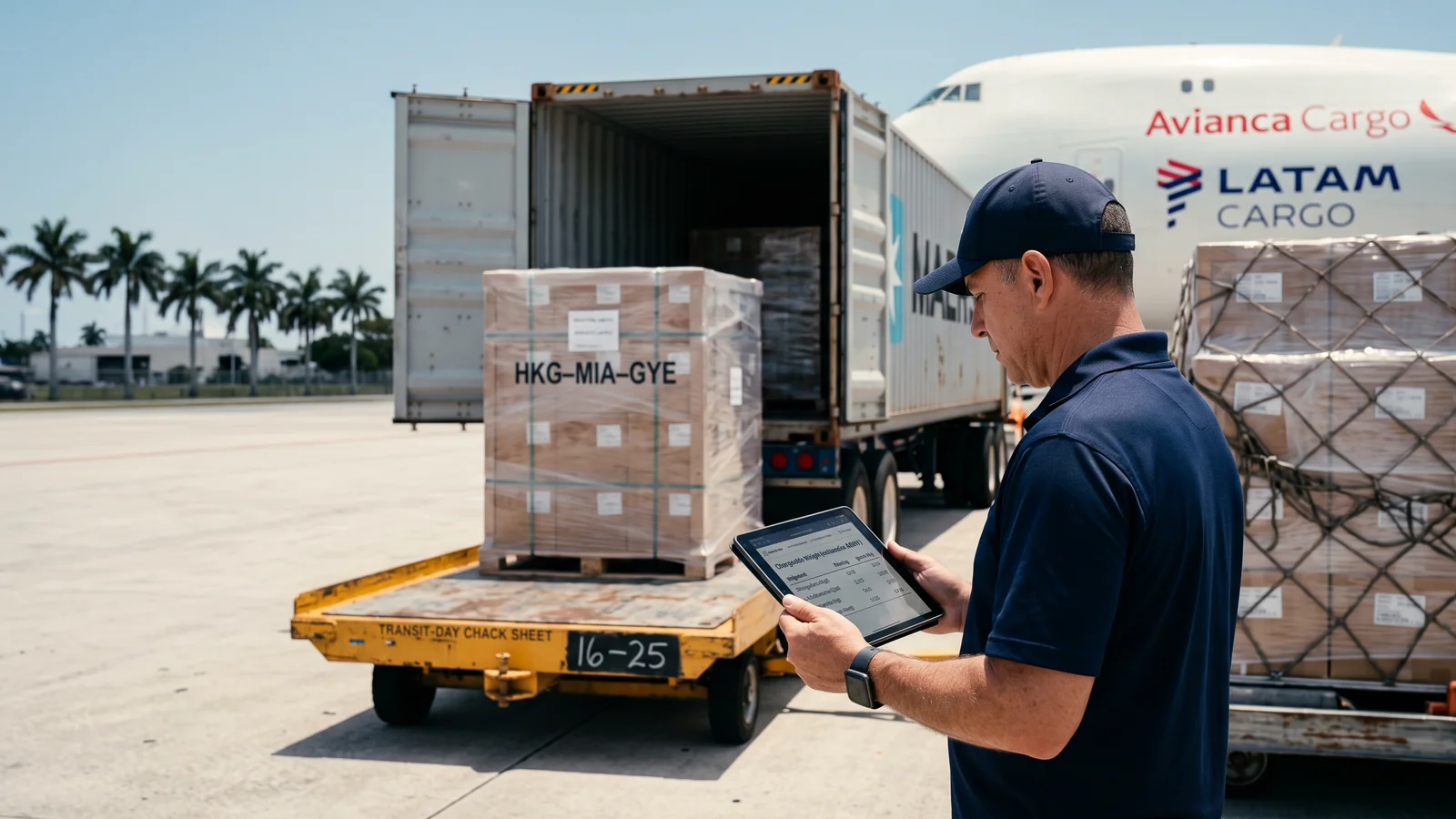
Quick Answer: Sea-air from South China to Ecuador runs 16-25 days door-of-port to airport, with rates from $3.10/kg for shipments over 5,000 chargeable kg and from $5.15/kg at 300-499 kg. Hong Kong cargo joins the ocean leg at Shenzhen or Guangzhou, sails to Los Angeles, trucks to Miami, then flies to Guayaquil or Quito.
- Sea-air from Hong Kong to Ecuador takes 16-25 days total: 12-18 days ocean to Los Angeles, 3-5 days trucking to Miami, 1-2 days flying to Guayaquil (GYE) or Quito (UIO).
- Rates start from $5.15/kg at 300-499 kg, from $4.25/kg at 500-999 kg, from $3.56/kg at 1,000-4,999 kg and from $3.10/kg above 5,000 kg, port to airport.
- Minimum billed weight is 300 kg, and chargeable weight is the greater of actual weight or volume times 167 kg per cubic meter.
- Ecuador charges duty on the CIF value through SENAE's ECUAPASS system, plus FODINFA at 0.5% and IVA on top; you need an active RUC to import commercially.
This guide explains how the sea air calculator hong kong ecuador importers use actually prices a shipment, leg by leg. You will see the rate tiers, the transit windows, the chargeable-weight math and the SENAE charges that land on top.
What is a sea-air calculator for Hong Kong to Ecuador?
Quick Answer: A sea-air calculator prices a multimodal shipment that sails part of the way and flies the rest. For Hong Kong to Ecuador it combines an ocean leg to Los Angeles, a truck leg to Miami and a flight to Guayaquil or Quito, then returns one chargeable-kg rate in seconds.
Sea-air is one contract, one price and two transport modes. It is a multimodal service: the cargo crosses the Pacific in a container, then transfers to an aircraft at a hub inside the United States. You get a single rate per chargeable kilo instead of three separate bills.
The physical routing is fixed and repeatable. The ocean leg loads at a South China port and discharges at Los Angeles in 12-18 days. Drayage moves the container to a deconsolidation warehouse, and a truck runs the freight to Miami in 3-5 days. The air leg lifts from Miami to GYE or UIO in 1-2 days.
Hong Kong cargo normally joins the ocean leg at Shenzhen (Yantian) or Guangzhou (Nansha). Barge feeders and cross-border trucks move boxes from Kwai Tsing or from a Hong Kong warehouse into those terminals. That feeder hop adds a day or two before the CFS cut-off, so build it into your supplier's schedule.
The service suits Ecuadorian importers of electronics, phone accessories, LED lighting, small appliances and consumer goods. These buyers need cargo faster than a 35-day FCL sailing but cannot absorb pure air freight on every purchase order. Importers running a Caribbean lane as well can compare the Sea-Air Hong Kong to Jamaica Calculator: 2026 Rates, which uses the same hub logic.
Pro tip
Ask your Hong Kong supplier to quote FCA Yantian or FCA Nansha instead of FOB Hong Kong. You skip a feeder leg, you hit the ocean cut-off cleanly, and the sea air calculator hong kong ecuador quote matches the port your cargo actually loads at.
How much does it cost to ship from Hong Kong to Ecuador?
Quick Answer: Sea-air freight runs from $5.15/kg at 300-499 chargeable kg, from $4.25/kg at 500-999 kg, from $3.56/kg at 1,000-4,999 kg and from $3.10/kg at 5,000 kg and above, port to airport. Origin and destination handling is added per shipment. The calculator prices your exact pairing instantly.
Walio's live multimodal rate table for China to Ecuador, dated October 1, 2026, publishes four weight bands. Each figure is a "from" rate on the cheapest port and airport pairing. Your exact rate depends on which South China port the ocean leg sails from and whether the cargo lands at GYE or UIO.
| Chargeable weight band | Sea-air rate, port to airport | Total transit | Typical cargo |
|---|---|---|---|
| 300-499 kg | from $5.15/kg | 16-25 days | Sample runs, accessories, 1-2 pallets |
| 500-999 kg | from $4.25/kg | 16-25 days | Phone cases, cables, small appliances |
| 1,000-4,999 kg | from $3.56/kg | 16-25 days | LED lighting, replenishment orders |
| 5,000 kg and above | from $3.10/kg | 16-25 days | Full seasonal buys, multi-SKU consolidations |
The minimum billed weight is 300 kg. A 140 kg pallet is still billed as 300 kg, so a single small order carries dead weight. Consolidate two or three suppliers into one booking and the cost per unit drops sharply.
The quoted rate covers the ocean leg, the US trucking leg and the air leg. Quoted separately per shipment: origin handling, destination handling, door pickup in Hong Kong or South China and door delivery in Ecuador. Walio itemizes those lines in the quote rather than folding them into a per-kg figure.
Five factors move your number: the weight tier, the origin port, the destination airport, cargo density and lithium-battery handling. Peak season capacity out of Los Angeles and Miami also tightens space in Q3 and Q4. Importers weighing other Latin American destinations can compare the Sea-Air China to Mexico Calculator: 2026 Rates on the same screen logic.
How long does sea freight take from Hong Kong to Guayaquil?
Quick Answer: Full-container ocean from Hong Kong to Guayaquil usually runs 28-40 days port to port with a Panama or Manzanillo transshipment. Sea-air cuts that to 16-25 days total: 12-18 days to Los Angeles, 3-5 days trucking to Miami and 1-2 days flying into GYE or UIO.
Transit splits into three measurable legs. The Pacific crossing to Los Angeles takes 12-18 days depending on the loading port and the string. Trucking Los Angeles to Miami takes 3-5 days. The Miami uplift to Guayaquil or Quito takes 1-2 days once the cargo is tendered.
Port cut-off is not the vessel's ETD. Cargo must sit in the CFS several days before the ship sails, and documentation cut-off falls earlier still. Missing the cut-off costs a full week on a weekly string, which erases the entire advantage of paying for sea-air.
Clearance in Ecuador runs on top of transit. SENAE assigns an inspection channel through ECUAPASS after the declaration is filed. A green channel can release within a day; a red channel with physical inspection adds several working days.
| Mode | Port/airport to port/airport | Realistic door to door | Minimum viable size | Best use case |
|---|---|---|---|---|
| Air freight | 2-4 days via a hub | 5-9 days | 45 kg | Urgent spares, launch samples, high-value SKUs |
| Sea-air | 16-25 days | 20-30 days | 300 chargeable kg | Electronics replenishment that cannot wait 40 days |
| LCL ocean | 32-45 days | 38-55 days | 1 CBM | Non-urgent cargo between 1 and 15 CBM |
| FCL ocean | 28-40 days | 34-48 days | ~15 CBM to be efficient | Full container buys, bulky low-value goods |
 Shenzhen(CNSZX)
 Guayaquil(GYE)Guangzhou(CNCAN)Quito(UIO)
Is air freight or sea freight cheaper from Hong Kong to Ecuador?
Quick Answer: Sea freight is cheaper per kilo, air is cheaper per day saved, and sea-air sits between them. For dense electronics above roughly 300 kg and under about 8 cubic meters, sea-air usually wins on landed cost once inventory financing and demurrage risk are counted.
Work the break-even with real numbers. Take a 2,000 kg consignment of electronics measuring 9 m³. On sea-air, volumetric weight is 9 × 167 = 1,503 kg, so the actual 2,000 kg bills, at the 1,000-4,999 kg band from $3.56/kg. On pure air with the 1:6000 divisor, volumetric is also 1,500 kg, so 2,000 kg bills again at a far higher per-kilo rate.
On LCL ocean the same box is billed on the W/M rule: 9 m³ against 2 metric tons, so you pay for 9 revenue tons. LCL stays cheapest in absolute freight, but adds 15-25 days. The calculator prices all three on one screen so you compare landed cost, not just freight.
LCL beats FCL below roughly 10-15 m³ because you only pay for the space you fill. Above that threshold a 20ft container usually wins on cost per cubic meter, and you avoid CFS deconsolidation at destination.
When to fly or use sea-air
Fly when the SKU is small, high value and out of stock on your shelves in Guayaquil. Choose sea-air when the order sits between 300 kg and a few thousand kilos and the cash tied up in 40 days of transit costs more than the freight premium. Electronics with short product cycles rarely survive a 40-day sailing without markdown risk.
When to sail
Sail FCL when volume passes 15 m³, when the goods are bulky and low value, or when you buy to a forecast rather than to a stockout. Ocean also makes sense for furniture, packaging and anything where freight per unit matters more than shelf date. Just budget for free time at Guayaquil and clear fast.
The hidden cost of slow is real. Capital sits in inventory for an extra 25-30 days, stockouts push customers to a competitor, and demurrage and detention at Guayaquil start the moment free time expires. Importers running a second lane into Central America can check the Sea-Air Hong Kong to Costa Rica Calculator: 2026 Rates, which routes through the same Miami hub.
How do you calculate chargeable weight and CBM?
Quick Answer: Chargeable weight is the greater of actual weight and volumetric weight. On this sea-air lane volume converts at 167 kg per cubic meter; pure air freight uses the 1:6000 divisor. Calculate CBM as length × width × height in meters, per carton, then multiply by carton count.
Three formulas cover every quote on this lane:
- CBM = length (m) × width (m) × height (m), per carton, times the carton count.
- Volumetric kg, sea-air = CBM × 167.
- Volumetric kg, pure air = (L × W × H in cm) ÷ 6,000, which is the IATA standard divisor.
Work a real carton. A box of LED drivers measures 60 × 40 × 40 cm and weighs 12 kg. Volume is 0.096 m³, so volumetric weight is 0.096 × 167 = 16.03 kg. The chargeable weight is 16 kg, not 12 kg, because volume exceeds actual weight.
LCL ocean uses different logic. The W/M rule bills whichever is greater: one cubic meter or 1,000 kg. Air and sea-air compare kilos against a density conversion, while LCL compares cubic meters against metric tons.
Measure pallets, not cartons, once the goods are palletized. The pallet footprint, any carton overhang and the shrink wrap all count toward billed volume. A 1.2 × 1.0 m pallet stacked to 1.6 m bills 1.92 m³ even if the cartons inside total 1.7 m³.
Estimated dimensions get corrected
The deconsolidation hub re-measures and reweighs every piece in Los Angeles and again before the Miami uplift. If your declared dimensions understate the cargo, the invoice is adjusted upward. Use the supplier's real carton list, not a rounded guess.
Which ports and airports serve the Hong Kong-Ecuador lane?
Quick Answer: The ocean leg loads at Shenzhen, Guangzhou or another South China port, transships through Los Angeles and Miami, and lands at Guayaquil (GYE) or Quito (UIO). Guayaquil serves the coast and Posorja handles deepwater ocean volume; Quito suits Sierra-bound cargo and high-value electronics.
Hong Kong's Kwai Tsing terminals still handle plenty of transpacific volume. For sea-air, though, most cargo feeds into Shenzhen Yantian or Guangzhou Nansha, where the ocean strings to Los Angeles are denser. Barge feeders from Hong Kong to Yantian take roughly a day, plus terminal handling.
On the ocean side in Ecuador, Guayaquil's Puerto Marítimo remains the main container gateway, with Posorja taking deepwater calls on larger vessels. Neither matters for a sea-air booking: your cargo arrives by air at GYE or UIO, not by ship.
Quito's Mariscal Sucre airport at Tababela suits Sierra deliveries. If your warehouse sits in Quito, Ambato or Riobamba, flying into UIO often beats flying into GYE and trucking 420 km uphill. Manta works as an alternative ocean gateway for certain projects, but rarely changes a sea-air decision.
| Destination gateway | Mode served | Typical frequency | Onward trucking to Quito | Best for |
|---|---|---|---|---|
| Guayaquil GYE (airport) | Sea-air, air | Daily from Miami | 8-10 hours, 420 km | Coastal distribution, Guayas and Manabí |
| Quito UIO (airport) | Sea-air, air | Daily from Miami | None required | Sierra buyers, high-value electronics |
| Guayaquil Puerto Marítimo | FCL, LCL | Weekly strings | 8-10 hours | Containerized ocean volume |
| Posorja | FCL | Weekly, deepwater | 9-11 hours | Large vessels, high-volume importers |
| Manta | FCL, project cargo | Limited | 7-9 hours | Manabí-based industry |
Container capacity drives the ocean alternative, so keep these figures at hand when you compare modes.
| Unit | Internal dimensions | Usable volume | Max payload | Typical HK-Ecuador transit |
|---|---|---|---|---|
| 20ft standard | 5.90 × 2.35 × 2.39 m | ~33 m³ | ~28,200 kg | 28-40 days |
| 40ft standard | 12.03 × 2.35 × 2.39 m | ~67 m³ | ~26,700 kg | 28-40 days |
| 40ft high cube | 12.03 × 2.35 × 2.69 m | ~76 m³ | ~26,500 kg | 28-40 days |
| LCL (per CBM) | Priced per m³ or ton, W/M | 1 m³ minimum | n/a | 32-45 days |
| Air ULD (AKE) | 1.56 × 1.53 × 1.63 m | ~4.3 m³ | ~1,500 kg | 2-4 days |
Importers comparing South American gateways side by side can also review the Vietnam to Chile Sea-Air Calculator: Rates 2026.
What taxes do I pay when importing goods into Ecuador from Hong Kong?
Quick Answer: Ecuador assesses import charges on the CIF value: Ad Valorem duty by HS code, FODINFA at 0.5% of CIF, and IVA on the duty-inclusive base. SENAE administers clearance through ECUAPASS, and commercial importers need an active RUC. Confirm your exact rates with a licensed customs broker.
CIF value is the base for everything. It equals the goods value plus international freight plus insurance. Per SENAE, every import charge is calculated from that figure, which is why a cheaper freight rate also lowers your duty bill.
Ad Valorem duty varies by HS code. Phone accessories, LED luminaires and finished appliances sit in different brackets, so HS classification drives the bill more than any other single decision. A licensed agente de aduana should confirm the code before you order.
- Ad Valorem — percentage of CIF, set by HS code in Ecuador's tariff schedule.
- FODINFA — 0.5% of CIF, collected for the childhood development fund.
- IVA — applied on the duty-inclusive base; the general rate moved from 12% to 15% in 2024, so verify the current published rate before budgeting.
- ICE — a special consumption tax that applies only to specific product categories.
ECUAPASS mechanics are straightforward once you are registered. You need an active RUC, a digital signature (token), and normally a customs broker to file the declaración aduanera. SENAE then assigns an aforo channel, and release follows inspection or document review.
Duties are never part of the freight rate
Walio quotes freight and handling. Ad Valorem, FODINFA, IVA and broker fees are paid to SENAE and your broker, not to Walio. Budget them separately, and ask a licensed customs broker for your specific HS codes. For a regional comparison of customs mechanics, see the Sea-Air China to Colombia Calculator: Rates in Seconds.
Which documents and Incoterm should you use?
Quick Answer: You need a commercial invoice, packing list, the house air waybill or bill of lading, a certificate of origin when claiming preference, and a correct HS code. FOB Shenzhen or Guangzhou gives you control of the freight leg; CIF and DDP shift cost and liability to the seller.
- Factura Comercial — commercial invoice with Incoterm, unit prices and HS codes.
- Lista de Empaque — packing list with carton count, weights and dimensions.
- House Air Waybill or Bill of Lading — the transport document for the controlling leg.
- Certificado de Origen — required when you claim preferential treatment.
- INEN certificate — technical conformity for many electrical and electronic products.
| Incoterm 2020 | Seller delivers at | Who pays main freight | Who clears SENAE | Fits sea-air? |
|---|---|---|---|---|
| EXW | Supplier's factory | Buyer | Buyer | Yes, with origin pickup quoted |
| FCA Yantian/Nansha | Named terminal | Buyer | Buyer | Best fit |
| FOB Shenzhen | On board / terminal | Buyer | Buyer | Common and workable |
| CIF Guayaquil | Destination port | Seller | Buyer | Ocean only, not sea-air |
| DAP Quito | Buyer's address | Seller | Buyer | Yes, with door delivery |
| DDP Quito | Buyer's address | Seller | Seller | Rarely practical |
DDP moves import liability onto the seller. That seller must then file through ECUAPASS, which requires registration a Hong Kong trading company usually does not hold. FCA or FOB keeps the Ecuadorian importer in control of the freight leg and the declaration.
Battery cargo needs declaring up front. Lithium cells in phones, power banks and LED drivers fall under the IATA Dangerous Goods Regulations on the air leg and IMDG on the ocean leg. Submit those shipments through the calculator and a Walio specialist follows up on packing and documentation.
How do I calculate shipping cost from Hong Kong to Ecuador in seconds?
Quick Answer: Enter the origin port, destination airport, gross weight and carton dimensions in the calculator on this page. It returns the sea-air rate, the chargeable weight it billed and the transit window from real carrier rates — no signup, no forms that wait for an email, no sales call.
- Pick the origin port — Shenzhen, Guangzhou or another listed South China port.
- Pick the destination airport: Guayaquil (GYE) or Quito (UIO).
- Enter cartons or pallets with real weights and dimensions.
- Read the price, the chargeable weight and the transit window on screen.
Anything lighter still bills at 300 chargeable kg on this lane. Consolidating two suppliers into one booking is the fastest way to cut your cost per unit.
The quote itemizes everything. You see chargeable weight, freight per kilo, handling lines listed separately, and estimated transit days. Walio compares real carrier rates — the same ocean carriers you know, such as Maersk, MSC, CMA CGM and Hapag-Lloyd, feed the ocean leg.
Door pickup in Hong Kong or South China and door delivery in Ecuador are quoted on request through the same calculator. Oversized pieces, dangerous goods and battery-heavy consignments go through the same path, and a specialist follows up with the detail.
- Use the supplier's real carton dimensions, never a rounded estimate.
- Add pallet height and shrink wrap to your volume figure.
- Quote before the supplier books the barge to Yantian, so the cut-off still fits.
- Compare GYE and UIO against your inland trucking cost before choosing.
Container rates depend on size, season and the exact port pairing, so the calculator on this page prices your 20ft, 40ft or 40HC move in seconds. If your cargo is under about 10-15 cubic meters, LCL or sea-air usually costs less per unit shipped than a full container. Enter your volume and weight and compare all modes on one screen.
Standard ocean freight takes roughly 28-40 days port to port with a transshipment in Panama or Manzanillo. Sea-air cuts the same journey to 16-25 days: 12-18 days of ocean to Los Angeles, 3-5 days of trucking to Miami and 1-2 days of flying into Guayaquil. Customs clearance in Ecuador is additional.
Sea freight is cheaper per kilo, but sea-air often wins on total landed cost for shipments between 300 kg and a few thousand kilos. Sea-air starts from $3.10/kg above 5,000 chargeable kg and from $5.15/kg in the 300-499 kg band, while arriving in 16-25 days instead of 28-40.
Chargeable weight is the greater of the actual gross weight and the volumetric weight. On this sea-air lane, volume converts at 167 kg per cubic meter; pure air freight divides length x width x height in centimeters by 6,000. The minimum billed weight on sea-air is 300 kg.
Ecuador applies Ad Valorem duty by HS code, FODINFA at 0.5% and IVA, all calculated on the CIF value through SENAE's ECUAPASS platform. Commercial importers need an active RUC and normally work with a licensed customs broker. Confirm your HS classification and current IVA rate with that broker before you budget.
You now have the transit windows, the rate bands and the chargeable-weight math for this lane. Enter your route in the calculator above and see your price in seconds — no signup, no follow-up calls.