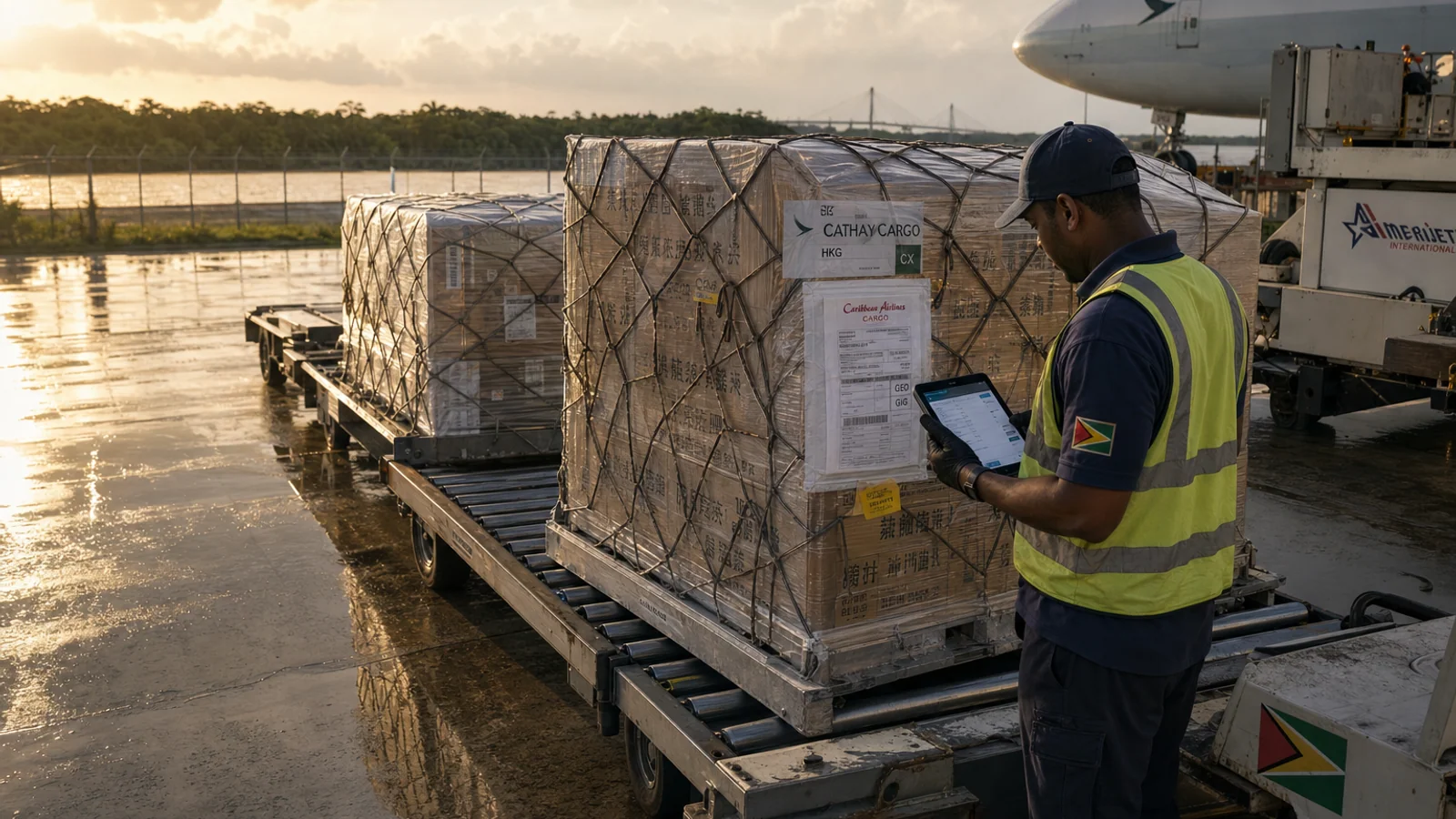
Quick answer Sea-air from Hong Kong to Georgetown runs 17-26 days door-relevant transit: ocean to Los Angeles (12-18 days), truck to Miami (3-5 days), then air to Cheddi Jagan International (2-3 days). Walio prices this lane from $5.48/kg at 5,000+ kg, port to airport, with a 300 kg minimum billed weight.
- Sea-air Hong Kong to Guyana totals 17-26 days versus 5-9 days for pure air and 40-55 days for LCL via transshipment.
- Walio sea-air rates start from $7.52/kg at 300-499 kg and fall to from $5.48/kg at 5,000+ kg, port of origin to Georgetown airport.
- Guyana has no direct ocean or air service from Asia — every shipment transships through Los Angeles, Miami, Caucedo, Kingston or Port of Spain.
- Chargeable weight is the greater of actual weight or volume x 167 kg per m3, with a 300 kg minimum billed weight on this lane.
Guyana's retail and oil-service importers are stuck between two bad options: pay full air freight, or wait six weeks for a feeder vessel. Sea-air sits in the middle, and this page prices it in seconds.
See your price in seconds
Real carrier rates, no signup, no follow-up calls.
What is the fastest sea air cargo route from Hong Kong to Guyana?
Quick answer The fastest practical sea-air route moves cargo by ocean from South China to Los Angeles in 12-18 days, by truck to Miami in 3-5 days, then by air to Georgetown in 2-3 days. Total transit is 17-26 days, roughly half the time of full ocean at a fraction of pure air freight cost.
Sea-air freight is a multimodal service: one shipment travels by ocean vessel for the long haul, then by aircraft for the final leg, under a single booking and a single rate. You do not manage two carriers. You manage one chain.
On Walio's live lane, the ocean leg sails from Dalian, Fuzhou, Guangzhou, Ningbo, Qingdao, Shanghai, Shenzhen, Xiamen or Xingang to the Port of Los Angeles. Cargo is devanned there, trucked cross-country to Miami, and flown into Cheddi Jagan International Airport (GEO). The fastest sea air cargo Hong Kong to Guyana is a routing decision, not a carrier brand.
Why sea-air beats full ocean into Georgetown
Pure ocean to Guyana always involves a second maritime transshipment. Your box lands at Caucedo, Kingston, Colón or Port of Spain, waits for a weekly feeder, then crawls up the Demerara River. That feeder wait is where 10 to 20 days disappear, and no ocean schedule published at booking fully protects you from it.
Sea-air removes that wait entirely. Once the container is devanned in Los Angeles, your cargo moves on trucks and aircraft, both of which run daily and both of which have far more capacity than the Georgetown feeder trade.
Ocean to Los Angeles (12-18 days), truck to Miami (3-5 days), air to Georgetown (2-3 days). Compare that with 40-55 days for LCL via a Caribbean feeder hub.
Who should use this routing
- Retail importers restocking Georgetown and Berbice stores on a four-week reorder cycle.
- Electronics, phone and appliance distributors where 40+ days of ocean ties up working capital in stock you cannot sell.
- Oil and gas service suppliers moving tools, fittings, PPE and spare parts against a rig schedule.
- Hardware and building-supply buyers who need part of a purchase order early and can send the rest by FCL.
See your price in seconds
Real carrier rates, no signup, no follow-up calls.
How long does shipping take from Hong Kong to Guyana by each mode?
Quick answer Pure air freight reaches Georgetown in 5-9 days, sea-air in 17-26 days, LCL in 40-55 days and FCL in 35-50 days. Ocean times swing widely because every Guyana-bound box transships at least once, and feeder sailings into Demerara Harbour are weekly rather than daily.
| Mode | Transit (days) | Cost basis | Practical minimum | Best cargo | Schedule reliability |
|---|---|---|---|---|---|
| Air freight | 5-9 | Per chargeable kg, highest | No minimum | Urgent spares, samples, high value | High |
| Sea-air | 17-26 | Per chargeable kg, mid | 300 kg billed | Electronics, tools, fast-turn retail | Medium-high |
| LCL ocean | 40-55 | Per m3 | 1 m3 | Non-urgent mixed goods | Low-medium |
| FCL ocean | 35-50 | Per container | 15 m3 upward | Full-container volume, heavy goods | Medium |
Port cut-off versus vessel ETD
The published sailing date is not your deadline. The port cut-off at Yantian, Shekou or Shanghai usually falls two to four days before the vessel's ETD, and the documentation cut-off falls earlier still. Miss the cut-off by three hours and you lose a full week, because the next string sails weekly.
Why LCL transit tables understate the real wait
LCL quotes usually show port-to-port days. They leave out CFS deconsolidation at the transshipment hub, which adds three to seven days while the consolidator breaks down the container and re-manifests each house bill. Add the feeder wait and the honest LCL number into Georgetown is 40-55 days.
Port of Spain is a common alternative feeder hub for Guyana-bound cargo, and the same multimodal structure applies there. Our Sea-Air Hong Kong to Trinidad Calculator: Rates 2026 breaks down that lane if you consolidate through Trinidad.
See your price in seconds
Real carrier rates, no signup, no follow-up calls.
Is there a direct shipping route from Hong Kong to Guyana?
Quick answer No. No carrier runs a direct ocean or air service from Hong Kong to Guyana. Every shipment transships — through Los Angeles and Miami on the sea-air routing, or through Caucedo, Kingston, Panama or Port of Spain on pure ocean. Transshipment is why Guyana transit times vary so much.
Transshipment means your cargo is discharged from one vessel or aircraft at an intermediate hub and loaded onto another before it reaches its final port or airport. Each transfer adds handling, a schedule connection and a potential roll.
Hub profiles on the Guyana lane
- Los Angeles / Long Beach: deep-sea capacity from every South China port plus the densest trucking market in the Americas. This is the sea leg on Walio's routing.
- Miami (MIA): the Caribbean's air cargo gateway, with the highest frequency of any airport serving Georgetown.
- Caucedo (Dominican Republic) and Kingston (Jamaica): ocean feeder hubs where Asia-origin boxes wait for a Guyana-bound feeder.
- Colón / Manzanillo, Panama: the main Asia-to-Caribbean ocean relay, strong on frequency, weak on onward Guyana connections.
- Port of Spain (Trinidad): regional feeder hub with short sea legs into Demerara Harbour but limited sailings per week.
Why no carrier calls Guyana directly from Asia
Two reasons. Volume per sailing does not justify a dedicated Asia-Caribbean string ending at Georgetown. And the Demerara River has draft and tidal limits that cap vessel size well below the ships Maersk, MSC and CMA CGM deploy on Asia trades.
| Routing | Total transit | Frequency | Hub reliability | Typical carriers |
|---|---|---|---|---|
| Sea-air via Los Angeles + Miami | 17-26 days | Multiple sailings weekly | High | Ocean carrier + trucker + Amerijet |
| Sea-air via Dubai | 20-30 days | Weekly | Medium | Gulf ocean + long-haul air, 2 air legs |
| Ocean via Panama / Colón | 38-50 days | Weekly feeder | Medium | Maersk, MSC, CMA CGM + feeder |
| Ocean via Caucedo or Kingston | 40-55 days | Weekly feeder | Medium-low | Seaboard Marine, Tropical Shipping, CFS |
Kingston deserves a note of its own as a feeder hub, because Jamaica-bound sea-air uses a near-identical structure. See our Sea-Air Hong Kong to Jamaica Calculator: 2026 Rates for that comparison.
 Miami(MIA)
 Georgetown(GEO)
How much does sea-air cargo from Hong Kong to Guyana cost?
Quick answer Walio prices sea-air on this lane from $7.52 per chargeable kg at 300-499 kg, from $6.62 at 500-999 kg, from $5.94 at 1,000-4,999 kg and from $5.48 at 5,000 kg and above. Rates are port to airport, cheapest port and airport on the lane, with a 300 kg minimum billed weight.
| Chargeable weight band | Walio sea-air rate (USD/kg) | Service | Transit |
|---|---|---|---|
| 300-499 kg | from $7.52 | Port to airport | 17-26 days |
| 500-999 kg | from $6.62 | Port to airport | 17-26 days |
| 1,000-4,999 kg | from $5.94 | Port to airport | 17-26 days |
| 5,000 kg and above | from $5.48 | Port to airport | 17-26 days |
Every figure is a from rate on the cheapest port and airport combination on the lane. Your exact rate depends on the origin port you select — Shenzhen and Shanghai price differently from Dalian or Xingang. The calculator shows your number.
How chargeable weight works
Chargeable weight is the greater of actual gross weight and volumetric weight. On this lane volumetric weight is volume in cubic metres multiplied by 167 kg. So bulky light cargo pays on volume, not on the scale.
Example: 1.8 m3 of plastic housewares weighing 220 kg. Volumetric weight is 1.8 x 167 = 300.6 kg. You are billed on 300.6 kg, not 220 kg — and that lands you in the 300-499 kg band.
The 300 kg minimum billed weight
A 180 kg shipment is still billed as 300 kg on this lane. That is why consolidating two purchase orders into one booking cuts your effective cost per kg sharply. Two 180 kg shipments cost two minimums; one 360 kg shipment does not.
Ask your Hong Kong or Shenzhen supplier to hold a small order for seven days and ship it with the next one. Crossing 500 kg or 1,000 kg moves you into a cheaper band, and the saving usually exceeds the cost of the delay.
What port to airport actually includes
You deliver the cargo to the origin port. Your consignee collects it at Cheddi Jagan International Airport. Origin handling and destination handling are added per shipment inside the calculator, shown as their own lines — never folded into the per-kg rate.
Door pickup from a factory in China and door delivery in Georgetown are both available and quoted on request through the calculator. Submit the request there and a Walio specialist follows up, or open the chat.
Freight is not landed cost
Sea air cargo Guyana rates cover transport only. Import duty under the CARICOM Common External Tariff and 14% VAT are assessed separately by the Guyana Revenue Authority and paid by the importer. Budget them before you price your retail margin.
See your price in seconds
Real carrier rates, no signup, no follow-up calls.
How do I get sea air cargo Guyana rates in seconds?
Quick answer Enter your origin port, chargeable weight and volume in the calculator on this page and the price appears in seconds from real carrier rates. No signup, no quote form that waits for an email, no follow-up calls. The calculator prices your exact port, airport and weight band instantly.
Four inputs move the number:
- Origin port. Dalian, Fuzhou, Guangzhou, Ningbo, Qingdao, Shanghai, Shenzhen, Xiamen or Xingang — each carries its own ocean leg and transit.
- Total gross weight in kilograms, as it will appear on the packing list.
- Total volume in cubic metres, measured on the outside of the cartons or pallets.
- Door pickup or door delivery — tick these if you want factory collection in China or delivery to a Georgetown warehouse.
Work out chargeable weight before you quote
Run the 167 kg per m3 rule yourself first. If volume x 167 beats your gross weight, you are a volume shipper, and repacking matters more than reweighing. Flattening cartons and tightening pallet height can drop a whole weight band.
Itemized, not all-in-and-hope
Walio shows freight per chargeable kg, origin handling and destination handling as separate lines. You see what each piece costs before you book, so nothing surfaces as a surprise invoice after the aircraft lands at GEO.
Price the same shipment three ways in the calculator — sea-air, LCL and air — before you commit. On 400-900 kg of dense cargo, sea-air often beats LCL once you value the 20-plus days you save against the cost of holding stock.
Oversized pieces, project cargo for the oil and gas sector and dangerous goods go through the same calculator as a specialist request. A Walio specialist follows up on those, or you can open the chat on this page.
See your price in seconds
Real carrier rates, no signup, no follow-up calls.
What happens at Georgetown airport and the Demerara Harbour?
Quick answer Cheddi Jagan International Airport (GEO) handles Guyana's air cargo through a compact bonded warehouse with limited cold chain and palletized storage. Port of Georgetown sits on the Demerara River with draft and tide restrictions that cap vessel size, which is exactly why feeder schedules into Guyana are weekly rather than daily.
At GEO, the aircraft landing is not the finish line. Unit load devices must be broken down, cargo moved into the bonded warehouse, and the manifest matched against the declaration. Expect one to three days between touchdown and release, longer if your entry has not been lodged yet.
After-hours release is limited. A Friday evening arrival often means a Monday collection, so build the weekend into your delivery promise to customers.
Demerara River constraints
The river's draft limits and tidal berthing windows restrict the size of vessels that can reach Georgetown. Large Asia-trade ships physically cannot call. That is the structural reason every ocean shipment transships, and the reason sea-air exists as a commercial product on this lane.
Peak congestion windows
- October to December: retail restock before Christmas, the heaviest period of the year at both GEO and the harbour.
- Oil and gas project cycles: equipment surges tied to drilling and FPSO schedules compress warehouse space without warning.
- Chinese New Year run-up: a January rush at origin that lands in Guyana during February, then a three-week capacity hole after the factories close.
Pack for four handling events, not one
Sea-air cargo is handled far more than ocean cargo: container stuffing in China, devanning in Los Angeles, truck transfer to Miami, air palletization, then GEO breakdown. Use double-wall cartons, strap and shrink-wrap pallets, and mark fragile items clearly. Weak packaging is the leading cause of damage claims on multimodal moves.
What documents do I need to clear customs in Guyana for goods from Hong Kong?
Quick answer Guyana customs requires a commercial invoice, packing list, Bill of Lading or Air Waybill, certificate of origin where a tariff preference applies, your TIN, and an entry lodged in ASYCUDA World by a licensed broker. HS classification drives the CARICOM Common External Tariff rate and the 14% VAT.
ASYCUDA World is the electronic customs system the Guyana Revenue Authority (GRA) uses to receive, risk-assess and release import declarations. Your broker lodges the entry there; the system assigns a channel, and the channel decides whether you are examined.
| Document | Who issues it | What it is used for |
|---|---|---|
| Commercial Invoice | Hong Kong / China supplier | Customs value, duty and VAT calculation |
| Packing List | Supplier | Piece count, weights, dimensions, examination |
| Air Waybill (Miami-GEO leg) | Air carrier / forwarder | Title and arrival notice for air cargo |
| Bill of Lading (ocean leg) | Ocean carrier / NVOCC | Proof of the ocean movement to Los Angeles |
| Certificate of Origin | Chamber of commerce at origin | Tariff preference claims, origin verification |
| TIN registration | Guyana Revenue Authority | Identifies the importer in ASYCUDA World |
| Import licence / permit | Relevant Guyanese ministry or agency | Required for restricted and controlled goods |
HS classification drives everything
The first six digits of an HS code are global. Guyana applies the CARICOM Common External Tariff on top of that classification. Misclassification is the most common cause of a GRA query, and a query means storage days you pay for at GEO.
Per the GRA, VAT is charged at 14% on the duty-paid value, with duty rates set by the CARICOM CET band for your classification. Confirm current rates with the GRA or your broker before you commit to a retail price.
Cargo that needs more than the standard set
- Dangerous goods: IATA DGD for the air leg, declaration and approved packaging — flag these before booking, never after.
- Pharmaceuticals and medical devices: regulatory approval from the relevant Guyanese authority.
- Foodstuffs: health and sanitary documentation on arrival.
- Used goods and machinery: additional declarations and possible inspection.
For duty, tax or classification rulings, work with a licensed Guyanese customs broker. Walio is a shipping platform, not a tax adviser.
Which Incoterm should you use on the Hong Kong to Georgetown lane?
Quick answer FOB Hong Kong gives Guyanese importers the most control on sea-air, because you choose the routing, the forwarder and the air leg carrier. CIF hands routing to the supplier and usually hides a margin in the freight. DDP Georgetown shifts import liability and GRA filings onto a seller who rarely understands CARICOM rules.
Under Incoterms 2020, risk on FOB transfers when the goods are loaded on board at the origin port. On FCA, risk transfers earlier, at the named place. On a sea-air booking the ocean leg is the long haul, so FOB and FCA both work cleanly.
FOB Hong Kong — recommended
You control the routing, so you can choose sea-air over ocean after you see both prices. You appoint the forwarder, you hold the relationship with the Miami air carrier, and you see the real freight cost line by line instead of a bundled supplier number.
CIF Georgetown — avoid on sea-air
Your supplier quotes CIF using an ocean rate, because that is what Chinese suppliers buy. The sea-air option disappears before you ever see it. You also inherit the supplier's chosen feeder hub and their margin on the freight.
Why DDP Georgetown is risky
Under DDP, the seller becomes responsible for import clearance and duties. A Chinese supplier has no TIN, no relationship with a Guyanese broker and no standing in ASYCUDA World. VAT recovery gets messy when the importer of record is not your company.
Match the Incoterm to the paperwork
Decide early who is named as shipper and consignee on the ocean Bill of Lading, who appears on the Miami-to-GEO Air Waybill, and who holds the cargo insurance certificate. On FOB with Walio handling the chain, you are consignee throughout and the documents line up without reassignment.
The same FOB logic applies on other South American sea-air lanes — see our Sea-Air Hong Kong to Ecuador Calculator: Rates 2026 for a close comparison.
Who carries the final leg into Guyana, and how do you book it?
Quick answer Amerijet, Laparkan, Tropical Shipping, Seaboard Marine and Caribbean Feeder Services dominate the Miami and Caribbean legs into Georgetown. Amerijet runs the air service, the rest run ocean. Walio books the full sea-air chain as one shipment, so you hold one booking instead of three separate contracts.
| Carrier | Service type | Frequency into Georgetown | Best cargo fit |
|---|---|---|---|
| Amerijet | Air freighter, Miami hub | Multiple times weekly | Sea-air final leg, urgent and high-value |
| Laparkan | Ocean + air, Caribbean specialist | Weekly | Consolidated retail and personal cargo |
| Tropical Shipping | Ocean LCL and FCL | Weekly | Non-urgent containerized goods |
| Seaboard Marine | Ocean FCL, Caribbean network | Weekly | Full containers, heavy and bulk |
| Caribbean Feeder Services | Ocean feeder from hub ports | Weekly | Relay boxes from Caucedo, Kingston, Colón |
Timeline from purchase order to Georgetown delivery
- Supplier confirms the ready date and sends the packing list with real dimensions.
- Cargo is delivered to the origin port before the documentation and port cut-off.
- Ocean sailing to Los Angeles: 12-18 days depending on the origin port.
- Devanning in Los Angeles, then truck to Miami: 3-5 days.
- Air booking and departure from Miami to GEO: 2-3 days.
- Broker lodges the entry in ASYCUDA World — ideally while the cargo is still in transit.
- GRA release and collection at Cheddi Jagan International Airport.
Peak season planning
Build two extra weeks into your reorder cycle around Chinese New Year and Q4. Pre-CNY demand spikes ocean rates and fills sailings; the post-holiday shutdown stops production for roughly three weeks. Q4 peak season surcharges hit ocean legs hardest.
Insure the whole chain, not pieces of it
Cargo insurance on a multimodal move should cover the full door-to-airport chain under one certificate. Claims get disputed at the Los Angeles devanning and Miami transfer points, precisely where two separate policies leave a gap.
The structure is identical on other long multimodal lanes — compare our Sea-Air Hong Kong to Bolivia Calculator: Rates (2026) and Sea-Air Hong Kong to Uruguay Calculator: Rates 2026 if you buy for more than one market.
A simple decision framework
- Under 300 kg and genuinely urgent: use pure air freight.
- 300 kg to 5 tonnes on a three-to-four week clock: sea-air is the best value, and the fastest sea air cargo Hong Kong to Guyana routing runs through Los Angeles and Miami.
- Over 15 m3 with a flexible delivery date: use FCL and accept 35-50 days.
See your price in seconds
Real carrier rates, no signup, no follow-up calls.
Stop guessing at freight and stop waiting on quote emails. Enter your origin port, weight and volume in the calculator above and see your sea-air price in seconds — no signup, no follow-up calls, and the option to compare sea-air, LCL and air side by side before you book.
Pure air freight is the fastest at 5-9 days, but sea-air is the fastest option that does not carry a full air freight price, landing in Georgetown in 17-26 days. The route runs ocean to Los Angeles, truck to Miami, then air into Cheddi Jagan International Airport. The calculator on this page prices both modes side by side in seconds.
Sea-air takes 17-26 days in total: 12-18 days ocean to Los Angeles, 3-5 days by truck to Miami, then 2-3 days by air to Georgetown. The exact figure depends on which origin port you ship from and the sailing schedule you catch. Add 1-3 days for ASYCUDA World clearance and airport release in Guyana.
Walio prices this lane from $7.52 per chargeable kg at 300-499 kg, from $6.62 at 500-999 kg, from $5.94 at 1,000-4,999 kg and from $5.48 at 5,000 kg and above, port to airport. The minimum billed weight is 300 kg, so lighter shipments are still charged as 300 kg. Origin and destination handling are added per shipment in the calculator.
No, no carrier runs a direct ocean or air service between Hong Kong and Guyana. Every shipment transships at least once, through Los Angeles and Miami on sea-air routings, or through Caucedo, Kingston, Panama or Port of Spain on pure ocean services. Transshipment is the single biggest reason Guyana import transit times vary so widely.
You need a commercial invoice, packing list, the Bill of Lading or Air Waybill, a certificate of origin where a tariff preference applies, and your TIN registered with the Guyana Revenue Authority. A licensed broker lodges the declaration in ASYCUDA World, and the HS code determines the CARICOM Common External Tariff duty plus 14% VAT. Confirm current rates with the GRA or your broker.