Quick Answer: Sea-air from Hong Kong and South China to Trinidad and Tobago takes 16-25 days door-to-airport, against 35-45 days by pure ocean. Walio's live rate table prices it from $5.68/kg at 5,000+ kg and from $7.71/kg at 300-499 kg, port to airport, with a 300 kg minimum billed weight.
- Sea-air moves ocean from South China to Los Angeles (12-18 days), truck to Miami (3-5 days), then air to Port of Spain (1-2 days) — 16-25 days total.
- Walio's October 2026 rate table starts from $7.71/kg for 300-499 kg and from $5.68/kg for 5,000+ kg, port to airport, cheapest port and airport on the lane.
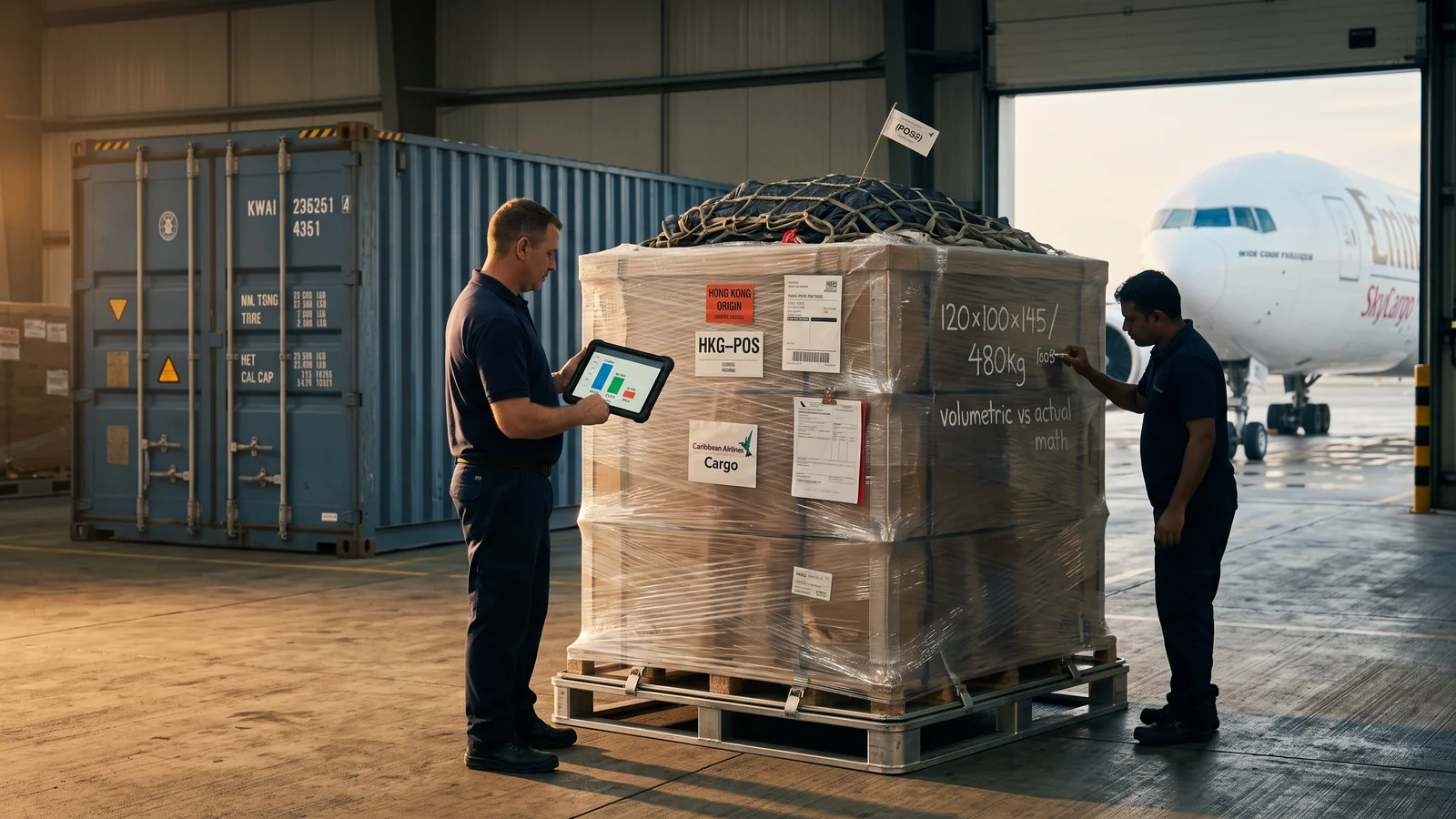
- Chargeable weight is the greater of actual kilos and volume × 167 kg per m³; anything under 300 kg is billed as 300 kg.
- Trinidad and Tobago applies import duty by HS code plus 12.5% VAT on the duty-paid value, declared through ASYCUDA World via TTBizLink.
This guide explains how the lane works, what sets your rate, and how to price it yourself. Every figure below comes from Walio's live multimodal rate table dated October 3, 2026.
What is sea-air freight and is it cheaper than air freight?
Quick Answer: Sea-air freight is a multimodal service that carries cargo by ocean for the long leg, then flies it on the final leg. From Hong Kong to Trinidad, cargo sails to Los Angeles, trucks to Miami, then flies to Port of Spain. It costs far less than pure air and arrives weeks before pure ocean.
One booking, one price, two or three modes under a single set of transport documents. That is sea-air. The forwarder issues a House Bill of Lading for the ocean leg and an Air Waybill for the flight, and the shipment moves as one consignment.
On Walio's Hong Kong and South China lane the routing is fixed and repeatable. Cargo sails from Dalian, Fuzhou, Guangzhou, Ningbo, Qingdao, Shanghai, Shenzhen, Xiamen or Xingang to Los Angeles in 12-18 days. It then trucks across the United States to Miami in 3-5 days. The final leg flies Miami to Piarco International Airport (POS) in 1-2 days.
That is the whole service. Sea-air sits between the two classic modes on both price and speed, which is exactly why Trinidad importers use it. Hardware stock, electrical fittings, plumbing supplies and retail restock cannot wait 40 days on the water. They also cannot carry a full air freight rate per kilo and still sell at a margin.
 Shenzhen(CNSZX)
 Port of Spain(POS)
The same logic serves other island markets. Our Sea-Air Hong Kong to Jamaica Calculator: 2026 Rates covers the sister Caribbean lane, where the Miami gateway does the same job for Kingston.
How does sea-air differ from pure sea and pure air?
Pure ocean FCL or LCL from Hong Kong to Port of Spain runs roughly 35-45 days. Nothing sails direct. Boxes transship at a hub such as Kingston, Caucedo or Cartagena, and that relay adds a week or more to the schedule.
Pure air from HKG to POS routes through a United States or European hub and lands in 4-8 days. The rate per kilo sits far above sea-air, because every kilo flies the entire 16,000 kilometers.
Sea-air keeps ocean economics on the Pacific crossing and buys speed only on the short Caribbean leg. You pay for air on the last 3,500 km, not the first 12,000.
Which cargo suits sea-air from Hong Kong?
- Strong fit: mid-value-density goods — hand tools, electrical fittings, plumbing fixtures, LED lighting, small appliances, apparel restock, auto parts.
- Poor fit: very low-value bulky goods such as floor tiles, raw boards or bagged materials — ocean FCL wins every time on dense, cheap cargo.
- Poor fit: tiny urgent spares under 100 kg — international courier beats the 300 kg minimum billed weight.
Pro tip
Split your purchase order. Send the fast-selling SKUs by sea-air and the heavy, slow-moving lines by FCL. Trinidad hardware distributors do this every quarter: the shelf gets restocked in three weeks while the bulk cargo follows on the water.
How long does sea-air shipping take from Hong Kong to Trinidad and Tobago?
Quick Answer: Sea-air takes 16-25 days from the origin port to Piarco International Airport, depending on which Chinese port the cargo sails from. The ocean leg to Los Angeles runs 12-18 days, the truck to Miami 3-5 days, and the Miami to Port of Spain flight 1-2 days. Customs clearance is additional.
The spread between 16 and 25 days comes almost entirely from the ocean leg. Shenzhen and Yantian sail fastest to Los Angeles. Northern ports such as Dalian, Qingdao and Xingang add days, and some strings call at a second Chinese port before crossing.
Transit is measured port to airport, not door to door. Your factory's trucking to the origin port sits outside that window, and so does clearance at Piarco.
| Mode | Routing | Transit days | Billing unit |
|---|---|---|---|
| Sea-air | South China → Los Angeles → Miami → POS | 16-25 | Chargeable kg |
| Pure air | HKG → US or EU hub → POS | 4-8 | Chargeable kg |
| LCL ocean | HK → transship Caribbean hub → Port of Spain | 38-45 | Per m³ or 1,000 kg (W/M) |
| FCL ocean | HK → transship Caribbean hub → Port of Spain | 35-42 | Per container |
Why does the port cut-off matter more than the sailing date?
Importers watch the vessel ETD. Experienced shippers watch the cut-off. The container yard cut-off at Shenzhen or Yantian usually falls two to three days before the vessel sails, and the documentation cut-off falls earlier still.
Miss it by an hour and your cargo rolls to the next sailing. On a weekly string, a missed cut-off costs a full week, not a day. Build 48 hours of buffer into your supplier's delivery date to the port.
How long does clearance at Piarco take?
Plan clearance separately from transit. Declarations go to the Customs and Excise Division through ASYCUDA World, and a prepared broker with a complete document set often releases within one to three working days. An incomplete invoice or a disputed HS classification extends that quickly.
Sea air calculator Hong Kong to Trinidad: how do I get an instant rate?
Quick Answer: Enter the origin port, Piarco as the destination airport, your weight and your cubic meters in the calculator on this page. It returns a sea-air price in seconds from Walio's live multimodal rate table — from $7.71/kg at 300-499 kg and from $5.68/kg at 5,000+ kg, port to airport.
The sea air calculator Hong Kong to Trinidad pricing engine reads Walio's live multimodal rate table. These are the bands as of October 3, 2026, on the cheapest port and airport pairing on the lane.
| Chargeable weight band | Sea-air rate (port to airport) |
|---|---|
| 300-499 kg | from $7.71/kg |
| 500-999 kg | from $6.81/kg |
| 1,000-4,999 kg | from $6.13/kg |
| 5,000 kg and above | from $5.68/kg |
Every figure is a "from" rate. The exact number depends on which Chinese port you sail from and which airport pairing applies, and the calculator resolves both instantly.
A 180 kg shipment is billed as 300 kg on this lane. Below that threshold, international courier usually prices better — the calculator will show you both.
The scope is port to airport. The shipper delivers the cargo to the origin port and the consignee collects it at Piarco. Origin and destination handling charges are added per shipment inside the calculator, never folded into the per-kg figure. That is deliberate: an all-in per-kilo number that hides handling is how importers get surprised at destination.
Door pickup at a Chinese factory and door delivery in Trinidad are both quoted on request through the same calculator. No signup, no form that waits for an email, no follow-up call. The number appears on screen.
What drives shipping Hong Kong Trinidad cost per kg?
- Chargeable weight band. Crossing 500 kg, 1,000 kg or 5,000 kg moves you into a cheaper tier. A 980 kg shipment can cost more than a 1,020 kg shipment — consolidate two POs if you are close to a break.
- Origin port and destination airport. The published bands reflect the cheapest pairing on the lane. Northern ports and alternative airports price differently.
- Density. Light, bulky cargo bills on volume, so the effective cost per actual kilo rises sharply.
- Season. Chinese New Year, the pre-Christmas peak and peak season surcharges all move the ocean leg. Air capacity out of Miami tightens around the same calendar.
- Handling at origin and destination, priced per shipment rather than per kilo.
How do you calculate chargeable weight for sea-air shipments?
Quick Answer: Chargeable weight is the greater of the actual gross weight and the volumetric weight, calculated as cubic meters multiplied by 167 kg per m³. A 4 m³ shipment weighing 500 kg bills as 668 kg. Walio's minimum billed weight on this lane is 300 kg, whichever figure is lower.
The formula is short. Take your total volume in cubic meters, multiply by 167, and compare the result against your actual gross weight in kilos. The carrier bills whichever number is higher.
Here is a worked example for a Trinidad hardware distributor. Twelve cartons of LED fittings and electrical boxes measure 3.2 m³ and weigh 410 kg on the scale. Volumetric weight is 3.2 × 167 = 534 kg. The shipment bills at 534 kg, not 410 kg, which places it in the 500-999 kg band.
Sea-air uses the air divisor even though most of the journey floats. The air leg sets the billing rule for the whole movement, because the aircraft is the constrained asset. That is the single biggest difference from pure LCL ocean freight, which bills on weight or measure — per cubic meter or per 1,000 kg, whichever is greater.
Measure the carton, not the product
Carriers measure the outer carton footprint at its widest point, including pallet overhang, and round up. A 42 cm carton measures as 42 cm, not the 38 cm box inside it. Give your forwarder carton dimensions, never product dimensions — this is the most common reason a quoted rate and an invoiced rate diverge.
Repack to cut volume and you cut the bill. Ask your supplier to remove retail display voids, flat-pack where possible and standardize carton sizes so cartons stack without air gaps. On a 3 m³ consignment, trimming 15% of the volume can drop you below a pricing break.
Sea vs sea-air vs air from Hong Kong to Port of Spain: which wins?
Quick Answer: Ocean wins on low-value bulky freight, air wins on urgent high-value spares, and sea-air wins in the middle. For Trinidad importers restocking hardware, electrical and retail lines, sea-air cuts roughly three weeks off ocean transit while staying well below a pure air rate per kilo.
| Mode | Transit days | Walio sea-air rate | Minimum charge basis | Relative CO₂ per tonne | Best cargo type |
|---|---|---|---|---|---|
| Ocean FCL | 35-42 | — | Per container | Lowest | Tiles, boards, bulk hardware, 25 m³+ |
| Ocean LCL | 38-45 | — | 1 m³ or 1,000 kg (W/M) | Low | Mixed pallets under 15 m³ |
| Sea-air | 16-25 | from $5.68-$7.71/kg | 300 kg | Mid — ocean for 12,000 km, air for 3,500 km | Tools, lighting, fittings, retail restock |
| Pure air | 4-8 | — | Carrier minimum, often 45-100 kg | Highest | Urgent spares, high-value electronics |
The break-even is a business decision, not a freight decision. Sea-air wins when the cost of holding stock, losing a sale or idling an installation crew exceeds the premium over ocean. A distributor whose shelf empties in week five of a 42-day ocean transit is paying for the delay somewhere.
Use value density as the shortcut. The higher the value per kilo, the easier sea-air pays for itself. Goods worth $40 per kilo absorb a few dollars of freight premium without touching the retail price. Goods worth $2 per kilo do not.
When FCL still wins
Above roughly 25-28 m³ you are filling a 40 ft container, and per-container pricing almost always beats per-kilo pricing. If your order is dense and your reorder cycle is long, book the box and plan around the 35-42 day transit. Watch demurrage and detention free time at Port of Spain so the saving survives the last mile.
When LCL beats FCL
Under about 10-15 m³, consolidated ocean is cheaper per cubic meter than paying for empty container space. LCL moves through a CFS for deconsolidation at destination, which adds a few days and a handling charge. Above that range, run the numbers both ways — a 20 ft container often overtakes LCL sooner than importers expect.
For a Central American reference point on the same service model, see our Sea-Air Hong Kong to Costa Rica Calculator: 2026 Rates, where the Miami gateway serves San José on a comparable structure.
Which sea-air routings serve Hong Kong to Trinidad?
Quick Answer: Walio's lane routes ocean to Los Angeles, trucks to Miami, then flies to Port of Spain. Other forwarders use Dubai/Jebel Ali, Singapore or Colombo as transshipment hubs, but those routings add days and rely on thinner air capacity into the Caribbean. The Miami gateway carries the most frequent POS flights.
| Routing | Total days | Air leg frequency to POS | Schedule reliability | Typical cost position |
|---|---|---|---|---|
| Los Angeles → Miami → POS | 16-25 | Daily lift | High | Baseline (Walio lane) |
| Dubai / Jebel Ali → POS | 24-32 | Thin, often via a second hub | Medium | Premium |
| Singapore → POS | 25-34 | Thin, multi-leg | Medium | Premium |
| Colombo → POS | 26-35 | Very thin | Lower | Premium |
Dubai, Singapore and Colombo are genuine sea-air hubs — they work well for Asia to Europe and Asia to Africa. For the Caribbean they fight geography. Cargo crosses the Indian Ocean away from Trinidad, then needs a long-haul flight that frequently connects twice.
Miami is the Caribbean's air hub for a simple reason: volume. Daily lift into Piarco, deep consolidation capacity, and a mature customs and handling ecosystem. The gateway you transit decides both your transit time and your rate.
How does the document switch work at the hub?
The ocean carrier — Maersk, MSC, CMA CGM or Hapag-Lloyd are examples of the lines Walio compares — issues a Master Bill of Lading to the NVOCC. The NVOCC issues the House Bill of Lading to you for the ocean leg into Los Angeles.
At Miami the cargo is handed to the air carrier and an Air Waybill is raised for the Miami to POS flight. The AWB consignee must match your Trinidad importer of record, including the BIR number on file. A mismatch stalls the release at Piarco.
Blank sailings are the real schedule risk
The ocean leg carries the variability. A blank sailing out of South China or a missed berth window at Los Angeles/Long Beach pushes the whole chain, because the Miami truck and the POS flight are both scheduled against the vessel's arrival. Book with buffer around Chinese New Year and the Q4 peak.
For the equivalent Miami-gateway structure into South America, see our Sea-Air China to Colombia Calculator: Rates in Seconds.
Do I have to pay customs duty on goods shipped from Hong Kong to Trinidad?
Quick Answer: Yes. Trinidad and Tobago charges import duty by HS code plus 12.5% VAT on the duty-paid value, and an Online Purchase Tax applies to certain online consumer purchases. Declarations go to the Customs and Excise Division through ASYCUDA World, accessed via the TTBizLink single electronic window.
The Customs and Excise Division administers imports. Per the Division, declarations are filed electronically in ASYCUDA World, reached through the TTBizLink single electronic window. Your licensed customs broker files on your behalf against your BIR number.
Duty rates follow HS classification under the CARICOM Common External Tariff. VAT of 12.5% applies to the duty-paid value — that is CIF value plus duty, not the invoice value alone. An Online Purchase Tax applies to specified online consumer purchases; a licensed broker confirms whether your HS code falls within scope.
- Commercial Invoice showing value, currency, Incoterm and full goods description
- Packing List with carton count, gross weight and carton dimensions
- Certificate of Origin where preferential treatment is claimed
- House Bill of Lading covering the ocean leg
- Air Waybill covering the Miami to Port of Spain leg
- BIR number for the importer of record
Walio prices freight. Duties and taxes are the country's published rates, paid to Customs and never to Walio. Classification, valuation and exemption questions belong with a licensed customs broker or a tax adviser — a shipping platform cannot give that advice.
Port of Spain, Point Lisas or Piarco: where does your cargo land?
Quick Answer: Sea-air cargo lands at Piarco International Airport (POS), roughly 25 km from Port of Spain. Port of Spain handles containerized ocean freight and LCL deconsolidation at the CFS, while Point Lisas serves industrial, bulk and project cargo. Free time, handling and clearance speed differ at each gateway.
| Gateway | Services handled | Free time | Typical clearance | Door-delivery radius |
|---|---|---|---|---|
| Piarco (POS) | Air cargo, sea-air final leg | Short — days | 1-3 working days | Port of Spain, Chaguanas, Arima, San Fernando |
| Port of Spain | FCL, LCL, CFS deconsolidation, RoRo | Carrier free time on containers | 2-5 working days | Nationwide |
| Point Lisas | Industrial, bulk, flat rack, project cargo | Terminal-set | 3-6 working days | Couva-Point Lisas estate and south Trinidad |
Piarco free time is short and storage charges start quickly. File the declaration before the flight lands, not after. Your broker can lodge in ASYCUDA World against the Air Waybill as soon as the cargo departs Miami.
Sea-air sidesteps container demurrage and detention entirely, because no container is released to you. Ocean FCL at Port of Spain does carry both: demurrage accrues on the box inside the terminal, detention accrues once it leaves. Those two charges are where ocean savings quietly disappear.
Point Lisas is the right answer for heavy industrial equipment, flat rack cargo and project shipments serving the Couva-Point Lisas industrial estate. It is the wrong answer for pallets of retail stock.
What paperwork does a sea-air booking to Trinidad need?
Quick Answer: A sea-air booking needs a Commercial Invoice, a Packing List with cartons, weights and dimensions, the House Bill of Lading for the ocean leg, and the Air Waybill issued at the switch point. Trinidad importers also need a BIR number and, where preference is claimed, a Certificate of Origin.
- Price the shipment in the calculator using your origin port, Piarco as destination, gross weight and total cubic meters.
- Confirm chargeable weight with your supplier's final carton list before booking.
- Book online and receive the booking reference and origin port delivery instructions.
- Have the supplier deliver cargo to the origin port before the documentation cut-off.
- Track the ocean leg to Los Angeles, the road leg to Miami and the flight into Piarco.
- Have your broker lodge the declaration in ASYCUDA World while the cargo is in the air.
To price accurately, a forwarder needs five things: the exact origin port, gross weight, total cubic meters, carton count and HS codes, plus your Incoterm. Guessed cubic meters produce guessed rates.
Which Incoterms 2020 rule fits this lane?
FOB at the origin port matches Walio's port-to-airport scope exactly. The seller delivers to the port and clears for export; you control the main carriage from there. EXW puts factory pickup on you, which Walio quotes on request through the calculator.
DDP shifts import liability onto the Chinese seller, including Trinidad duty and VAT. Few Chinese suppliers price that honestly, and you lose visibility of what was declared. DAP at Piarco is a cleaner middle ground for buyers who want the seller to carry freight but not customs.
Pro tip
The most common pricing error on this lane is dimensions given per product instead of per carton. A supplier who sends you 25 × 18 × 10 cm for a single light fitting has told you nothing about the shipping carton. Always request the master carton dimensions and the quantity per carton — that pair is what sets your chargeable weight.
For a documentation parallel on another South American sea-air lane, see our Sea-Air Hong Kong to Ecuador Calculator: Rates 2026.
How much CO₂ does sea-air save against pure air freight?
Quick Answer: Sea-air emits far less CO₂ per tonne than pure air because the Pacific crossing moves by vessel, the lowest-emission mode per tonne-kilometer. Only the Miami to Port of Spain leg flies. Importers reporting Scope 3 emissions can cite the ocean leg as the main reduction against a full Hong Kong to Piarco air routing.
The emissions ranking by mode is settled. Ocean container shipping produces the lowest CO₂ per tonne-kilometer, road freight sits in the middle, and air freight sits far above both. Sea-air borrows the first and uses the third sparingly.
On this routing roughly 12,000 km move by sea, 4,400 km by road and only the final 3,500 km by air. A pure air routing flies every one of those kilometers. That structural difference is why the comparison table above places sea-air in the middle of the CO₂ column rather than near pure air.
This matters commercially for Trinidad distributors supplying regional retail chains or overseas buyers with supplier emissions targets. Documenting a modal shift from pure air to sea-air is a straightforward, auditable Scope 3 story: same lane, same cargo, one leg replaced.
Pro tip
Ask your forwarder for the leg-by-leg distance and mode breakdown on your booking confirmation. That single document supports an emissions calculation without you building a model. For another long-haul sea-air comparison with the same reporting logic, see our Sea-Air Hong Kong to Bolivia Calculator: Rates (2026).
Price your Hong Kong to Trinidad sea-air shipment now
The sea air calculator Hong Kong to Trinidad tool on this page reads Walio's live multimodal rate table and returns your number on screen. Enter your origin port, Piarco as the destination airport, your gross weight and your cubic meters.
- Confirm your carton dimensions with the supplier before you price.
- Check whether consolidating two orders crosses a 500 kg, 1,000 kg or 5,000 kg break.
- Compare the sea-air result against LCL and FCL in the same calculator.
- Request door pickup in China or door delivery in Trinidad if you need full door-to-door scope.
Enter your route in the calculator above and see your price in seconds — no signup, no follow-up calls.
Sea-air takes 16 to 25 days from the origin port to Piarco International Airport, depending on which Chinese port the cargo sails from. That breaks down as 12-18 days of ocean to Los Angeles, 3-5 days of trucking to Miami, and a 1-2 day flight to Port of Spain. Customs clearance in Trinidad is additional to that transit.
Sea-air freight is a multimodal service that carries cargo by ocean for the long haul and by air for the final leg, under one booking. It is substantially cheaper per kilo than pure air freight because the Pacific crossing moves on a vessel. It costs more than pure ocean but arrives roughly three weeks earlier.
Walio's live multimodal rate table from October 3, 2026 prices sea-air from $7.71 per chargeable kg at 300-499 kg, from $6.81/kg at 500-999 kg, from $6.13/kg at 1,000-4,999 kg and from $5.68/kg at 5,000 kg and above, port to airport on the cheapest port and airport pairing. Origin and destination handling is added per shipment. The calculator on this page prices your exact port, airport and weight in seconds.
Yes. Trinidad and Tobago charges import duty set by HS code under the CARICOM Common External Tariff, plus 12.5% VAT on the duty-paid value, and an Online Purchase Tax on specified online consumer purchases. Declarations are filed with the Customs and Excise Division through ASYCUDA World via TTBizLink, and a licensed customs broker should confirm your classification.
Sea-air is faster. Pure ocean from Hong Kong to Port of Spain typically runs 35-45 days with transshipment, while sea-air lands at Piarco in 16-25 days. The saving comes from replacing the slow Caribbean ocean transshipment with a short flight out of Miami.
The minimum billed weight on this lane is 300 kg. A shipment weighing less is still billed as 300 kg, so very small consignments usually move more cheaply by international courier. Chargeable weight is the greater of actual kilos and volume in cubic meters multiplied by 167.